Foam plastic testing is the set of laboratory methods that measure the density, compression behavior, indentation hardness, tensile and tear strength, thermal conductivity, and fire performance of cellular polymers — flexible foams (polyurethane seating, packaging), rigid foams (EPS/XPS insulation, structural cores), and specialty crushable foams. It is governed by ASTM D3574 (flexible cellular), ASTM D1621 / ISO 844 / GB/T 8813 (rigid cellular compression), ASTM C518 / ISO 8301 (thermal conductivity), FMVSS 302 / GB 8410 / UL 94 (fire), and a matrix of application-specific standards that decide whether a given foam can be specified for a given end-use.
What Makes Foam a Distinct Test Subject?
A foam is a two-phase material — a polymer matrix perforated by gas-filled cells. Its mechanical behavior is governed not by the polymer chemistry alone but by the morphology: open-cell vs closed-cell, cell size and orientation, cell-wall thickness, and whether the part has a dense skin over a low-density core. The consequences for testing are direct: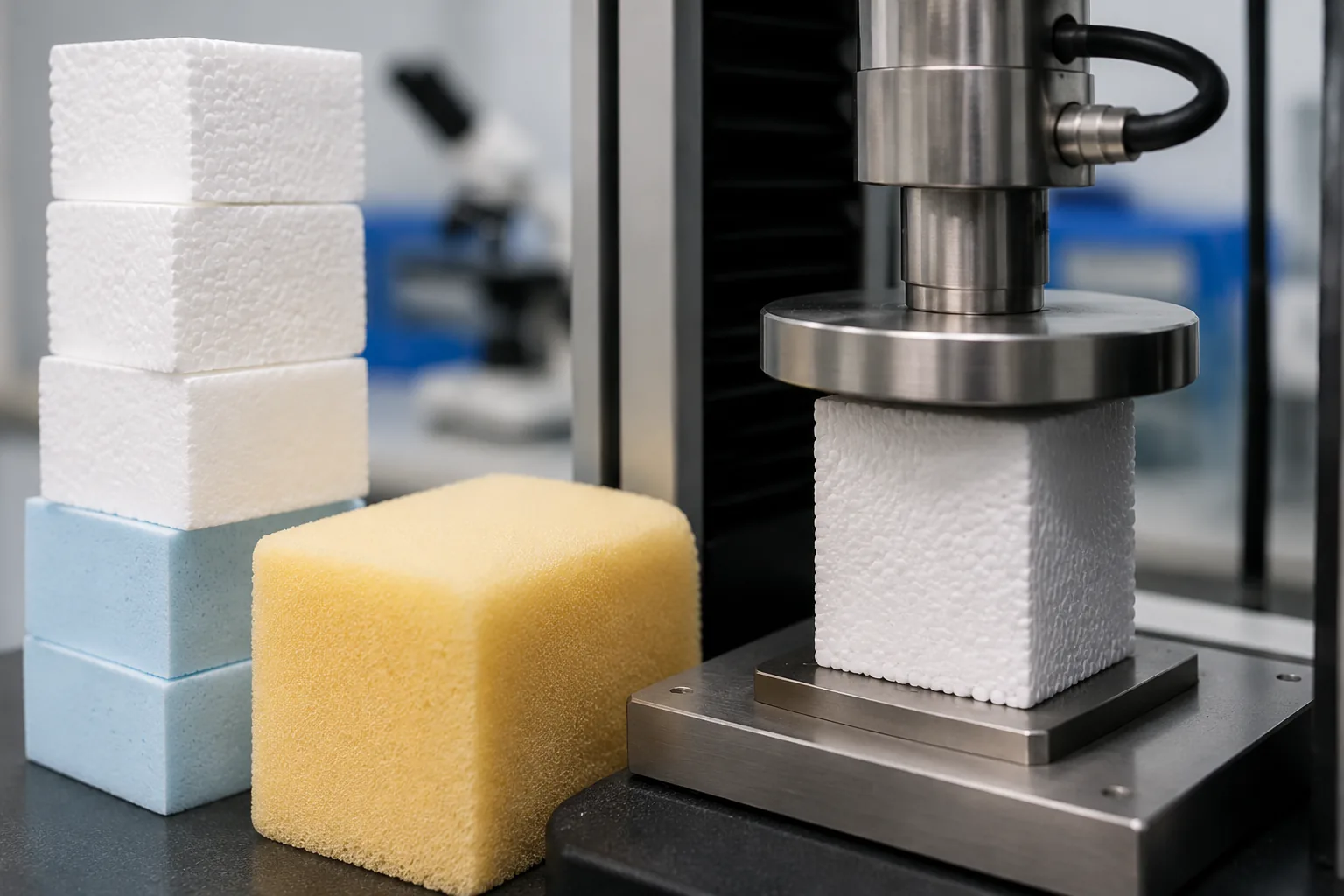
- Density is not uniform through a molded foam part. The skin is denser and stiffer than the core, so a specimen cut from the surface does not represent the bulk. Sampling must be specified relative to the skin.
- Compression is the dominant loading in nearly every foam application (seating, packaging, insulation under load), so the compression curve — not the tensile curve — is the engineering-critical measurement.
- The stress–strain curve has three regimes: a linear-elastic region at small strain (cell walls bending), a long plateau (cell walls buckling and collapsing at near-constant stress — the energy-absorbing region), and a densification region (collapsed cells compressing as a solid). For energy-absorption applications (packaging, helmet padding, crash pads), the plateau stress and the strain at densification are the design values, not a single "compressive strength."
- Foam is rate- and temperature-dependent, and it creeps under sustained load. A cushion that passes a 24 h comfort test may fail a multi-year creep test, and a packaging foam qualified at 23 °C may behave differently at −20 °C or 60 °C.
These four properties — non-uniform density, compression-dominated loading, the three-regime stress-strain curve, and rate/temperature sensitivity — are why foam cannot be characterized by a single number, and why the test matrix below exists.
What Standards Govern Flexible Foam Testing?
Flexible cellular materials — polyurethane seating, mattress, packaging, and cushion foams — are governed by ASTM D3574 (Standard Test Methods for Flexible Cellular Materials Made from Olefin Polymers or Vulcanized Rubber) in North America and by ISO 1798, ISO 2439, ISO 3386, and ISO 1856 internationally. The Chinese counterpart is GB/T 10807 (indentation), GB/T 10808 (tensile), and GB/T 6669 (compression set), aligned with the ISO methods.
ASTM D3574 is actually a family of tests, each identified by a letter. The SERP sources list the letter codes without explaining what they measure or how the result is used:
| Test | Property | What it tells you |
|---|---|---|
| Test A1 | Density (kg/m³) | The primary classification parameter — a flexible PU foam's grade is defined by its density and IFD. |
| Test B1 / B2 | Indentation Force Deflection (IFD) at 25 % / 65 % | The "firmness" of a cushion. A 25 % IFD of ~100 N is plush; ~300 N is firm. The 65 %/25 % ratio (support factor) should exceed ~1.8 for good progressive support. |
| Test C | Compression Force Deflection (CFD) | Force to compress the entire specimen (not indent it) to 50 %. Less sensitive to thickness than IFD; used for specification writing. |
| Test D | Compression Set | Permanent deformation after the foam is compressed 50 % (or 75 %) for 22 h at 70 °C and allowed to recover. A compression set > 10 % means the cushion will thin out in service. |
| Test E | Tensile Strength and Elongation | Failure stress and strain of a dumbbell specimen; detects regrind or contamination in the polymer. |
| Test F | Tear Resistance | Resistance to propagation of a cut — critical for molded foams with sharp contours. |
| Test H | Resilience (Ball Rebound) | A steel ball is dropped onto the foam; the % rebound is the resilience. > 60 % is "high resilience" (HR) grade. |
The two tests the SERP sources gloss over — IFD (Test B) and compression set (Test D) — are the ones that decide whether a seating foam delivers comfort and durability. IFD measures firmness; the support factor (65/25 ratio) measures whether the foam stiffens progressively under load. Compression set measures whether the foam will recover after long-term compression — a cushion with a high compression set will be permanently dented after a season of use.
What Standards Govern Rigid Foam Compression Testing?
Rigid cellular plastics — EPS (expanded polystyrene), XPS (extruded polystyrene), PUR/PIR insulation boards, and structural foam cores — are governed by ASTM D1621 (Standard Test Method for Compressive Properties of Rigid Cellular Plastics) in North America, ISO 844:2021 (Rigid cellular plastics — Determination of compression properties) internationally, and GB/T 8813-2020 (《硬质泡沫塑料 压缩性能的测定》, a modified adoption of ISO 844) in China.
The three are technically aligned. The procedure:
- Specimen — a cube or cylinder with a minimum face area (typically ≥ 25 cm²) and thickness ≥ the linear dimension, cut so the loading faces are parallel and perpendicular to the foam rise direction (anisotropy matters).
- Conditioning — at 23 ± 2 °C and 50 ± 5 % RH for ≥ 24 h, because foam properties drift with temperature and moisture.
- Loading — compress at a constant crosshead speed (typically 2.5 mm/min per ISO 844 / GB/T 8813, or 2.5 mm/min per 25 mm of thickness per ASTM D1621) until the specimen yields or reaches 10 % strain, whichever comes first.
- Result — the compressive strength is reported as the stress at the yield point, or the stress at 10 % deformation if there is no yield, whichever occurs first. This "whichever occurs first" rule is the engineering-critical point: for ductile rigid foams (XPS) there is often no clear yield, so the 10 % deformation stress is the reported value; for brittle foams (some low-density EPS) the yield comes first and governs.
GB/T 8813-2020 offers two methods: Method A (crosshead displacement) and Method B (an extensometer attached directly to the specimen), the latter eliminating machine-compliance error and used for stiffness-critical work.
Typical compressive stress at 10 % deformation values give context:
- EPS (packaging and wall insulation): ~30–250 kPa, depending on grade.
- XPS (roof, floor, cold-store): ~150–500 kPa.
- PUR/PIR (insulation board): ~100–400 kPa.
A test report citing only "compressive strength X kPa" without the standard, the direction (parallel/perpendicular to rise), and whether the value is yield or 10 %-deformation is unverifiable.
How Is Foam Thermal Conductivity Measured?
For insulation foams (XPS, EPS, PUR/PIR, phenolic), thermal conductivity is the defining property. The methods are ASTM C518 (Steady-State Thermal Transmission Properties by Means of the Heat Flow Meter Apparatus) and its ISO equivalent ISO 8301; the absolute reference method is the guarded hot plate (ISO 8302 / GB/T 10294).
The heat-flow meter (HFM) places the foam specimen between two plates at different temperatures, measures the heat flux through a calibrated transducer, and computes the thermal conductivity λ (W/m·K) at a mean temperature (commonly 10 °C or 24 °C for building insulation). The result is sensitive to:
- Specimen thickness and flatness — air gaps add contact resistance.
- Mean temperature — λ rises with temperature; the report must state the mean.
- Moisture content — water has λ ≈ 0.6 W/m·K, twenty times that of still air, so even a few % of moisture inflates λ sharply. This is why insulation standards require conditioning befOre testing.
- Ageing — closed-cell foams (XPS, PUR) are blown with low-λ gases (HFCs, HCFCs, CO₂) that diffuse out over time and are replaced by air; the aged λ is higher than the fresh λ, so long-term λ is tested after controlled ageing (ISO 11561 for closed-cell foams).
Typical λ values: EPS 0.030–0.040 W/m·K; XPS 0.024–0.034 W/m·K; PUR/PIR 0.022–0.028 W/m·K. A building-insulation foam is sold on its aged λ at a declared mean temperature, and the test report must state both.
How Is Foam Fire Performance Tested?
Fire performance is where foam testing is most regulated, because polyurethane and polystyrene foams are inherently combustible. The standards differ sharply by application:
- Automotive interior — FMVSS 302 (U.S. Federal Motor Vehicle Safety Standard) and GB 8410-2006 (中国汽车内饰材料燃烧特性) are horizontal burn tests: a specimen is held horizontally, a flame is applied to one end for 15 s, and the horizontal burning rate (mm/min) is measured. The pass criterion for FMVSS 302 / GB 8410 is ≤ 102 mm/min (4 in/min), and the test applies to every interior material within 13 mm of the occupant compartment, including seat foam and headliner foam.
- Plastic parts and appliances — UL 94 (Tests for Flammability of Plastic Materials for Parts in Devices and Appliances) is the dominant rating standard. The vertical burn ratings V-0 / V-1 / V-2 are far stricter than the horizontal HB rating and the automotive horizontal test. UL 94 V-0 means each of five specimens self-extinguishes within 10 s after two 10 s flame applications, with no flaming drips that ignite cotton. A foam passing FMVSS 302 will not necessarily pass UL 94 V-0 — the horizontal test is easier than the vertical test because the flame sits below the specimen and preheats it less.
- Building insulation — UL 723 (ASTM E84) Steiner tunnel and EN 13501-1 (Single Burning Item, SBI) rate the flame-spread index (FSI) and smoke-developed index (SDI) of foam insulation boards, typically required to meet Class A (FSI ≤ 25) for commercial-roof and wall assemblies. Because bare foam cannot meet this, the test is run on the foam-plus-facer or foam-plus-thermal-barrier composite.
- Furniture and mattress — CAL 117 / TB117 (California), EN 1021 (smoldering cigarette and match ignition), and GB 17927 (China) assess upholstery and mattress ignition resistance, often on the foam-plus-fabric composite rather than the foam alone.
The fact the SERP sources miss: a foam's fire performance depends on whether the test runs on the bare foam or the foam in its end-use composite (with facer, fabric, adhesive, or thermal barrier). Two foams that test identically bare can behave completely differently behind a gypsum thermal barrier. The test specimen construction must match the application.
What Other Tests Complete the Foam Qualification Matrix?
Beyond the mechanical, thermal, and fire tests above, a full foam qualification typically includes:
- Density to ASTM D1622 (rigid) or ASTM D3574 Test A (flexible) / ISO 845 / GB/T 6343 — the primary classification parameter and the basis for almost every other specification.
- Dimensional stability to ISO 2796 / GB/T 8811 — measures permanent swelling or shrinkage after the foam is held at elevated temperature and specific humidity (e.g., 70 °C / 97 % RH for 7 days), critical for insulation board service life.
- Water absorption to ISO 2896 / GB/T 8810 — long-term immersion absorption (% by volume), decisive for flotation and below-grade insulation where water uptake destroys the insulation value.
- Accelerated ageing to ASTM G155 (xenon arc) or ISO 2440 (heat and humidity ageing) — simulates years of service in weeks, used to predict compression-set growth and embrittlement.
- Compression creep to ISO 7850 / GB/T 20672 — measures time-dependent strain under constant load, the design basis for long-term static loads (warehouse floors, cold-store walls).
- VOC and odor to VDA 270 (automotive odor) and VDA 277 / VOC — for automotive interior foams, where cabin-air quality is regulated.
Frequently Asked Questions
What standard governs flexible polyurethane foam testing?
ASTM D3574 in North America, ISO 1798 / ISO 2439 / ISO 3386 / ISO 1856 internationally, and GB/T 10807 / GB/T 10808 / GB/T 6669 in China. ASTM D3574 is a family of lettered tests: Test A (density), Test B (IFD), Test C (CFD), Test D (compression set), Test E (tensile), Test F (tear), Test H (resilience).
What is the difference between IFD and CFD?
Both measure foam firmness but in different geometries. IFD (Indentation Force Deflection, ASTM D3574 Test B) pushes a circular indenter into a foam specimen larger than the indenter — it simulates a finger or body pressing into a cushion and is sensitive to foam thickness. CFD (Compression Force Deflection, Test C) compresses the entire specimen between two plates and is less thickness-dependent, which is why it is preferred for specification writing.
What is compression set and why does it matter?
Compression set (ASTM D3574 Test D / ISO 1856) measures the permanent deformation that remains after the foam is compressed 50 % or 75 % for 22 h at 70 °C and allowed to recover for 30 min. A high compression set (> 10 %) means the foam will not spring back after long-term compression — the cushion flattens, the seal leaks, the packaging loses its cushioning. It is the single best predictor of long-term comfort retention in flexible foam.
What compressive strength is reported for rigid foam?
Per ASTM D1621 / ISO 844 / GB/T 8813, the compressive strength is the stress at the yield point, or the stress at 10 % deformation, whichever occurs first. For ductile foams (XPS) without a clear yield, the 10 %-deformation stress is the reported value; for brittle low-density EPS, the yield governs. A report must state the standard, the loading direction relative to foam rise, and whether the value is yield or 10 %-deformation.
Does a foam that passes FMVSS 302 also pass UL 94 V-0?
Not necessarily. FMVSS 302 and GB 8410 are horizontal burn tests on automotive interior materials with a ≤ 102 mm/min pass limit. UL 94 V-0 is a stricter vertical burn test on plastic parts — each specimen must self-extinguish within 10 s with no flaming drips. The vertical test preheats the specimen by the flame rising along it, so a foam passing the horizontal automotive test can fail the vertical UL 94 test. They answer different questions for different applications.
Why is foam thermal conductivity reported at a stated mean temperature?
Thermal conductivity (ASTM C518 / ISO 8301) rises with temperature, so a single λ number is meaningless without the mean temperature at which it was measured. Building insulation is typically declared at a 10 °C or 24 °C mean. The report must also state whether the λ is fresh or aged — closed-cell foams lose their blowing agent over time, raising λ, so the aged value is the design value.
Our Testing Capabilities
Beijing ZKGX Research (ISO/IEC 17025 testing laboratory) provides foam plastic testing across the flexible, rigid, and specialty categories:
- Density to ASTM D1622 / D3574 Test A / ISO 845 / GB/T 6343.
- Compression — flexible: IFD and CFD to ASTM D3574 Test B/C, ISO 2439, GB/T 10807; rigid: compressive strength at yield or 10 % deformation to ASTM D1621, ISO 844, GB/T 8813, with Method A and Method B (extensometer) options.
- Compression set to ASTM D3574 Test D, ISO 1856, GB/T 6669 — the durability predictor for seating, gasketing, and packaging foams.
- Tensile, elongation, and tear to ASTM D3574 Test E/F, ISO 1798, GB/T 10808.
- Resilience (ball rebound) to ASTM D3574 Test H / GB/T 6670.
- Thermal conductivity to ASTM C518 / ISO 8301 / GB/T 10295 (heat-flow meter), with controlled mean temperature and conditioning.
- Dimensional stability to ISO 2796 / GB/T 8811, and water absorption to ISO 2896 / GB/T 8810 — for insulation-board and below-grade qualification.
- Fire performance — horizontal burn to FMVSS 302 / GB 8410 (automotive interior), UL 94 (HB / V-0 / V-1 / V-2) for plastic parts, building flame-spread to ASTM E84 / GB/T 8626 / GB 8624, and upholstery smolder ignition to GB 17927.
- Compression creep and accelerated ageing to ISO 7850 / GB/T 20672 and ISO 2440 / ASTM G155 — long-term load and service-life prediction.
If you have a foam batch to qualify, a packaging or insulation foam to specify, or a foam failure to diagnose, contact our testing team to scope the applicable standards, the specimen preparation requirements, and the acceptance criteria.