What Is Graphite and Why Does Testing Matter?
Graphite is a crystalline form of carbon characterized by a layered structure of hexagonally arranged carbon atoms. Its unique combination of properties — high thermal conductivity, electrical conductivity, chemical inertness, lubricity, and extreme temperature resistance — makes it indispensable across industries ranging from steelmaking to lithium-ion batteries.
However, graphite products are far from uniform. Natural graphite varies in crystallinity, flake size, and impurity content depending on the deposit. Synthetic graphite differs from natural graphite in structure, purity, and performance characteristics. Even within a single production batch, variability in density, strength, and thermal properties can directly affect end-use performance.
This is why graphite testing is not optional — it is essential. Whether you are a producer verifying output quality, an engineer selecting material for a nuclear reactor component, or a battery manufacturer sourcing anode-grade spherical graphite, precise characterization is the foundation of reliable product performance and regulatory compliance.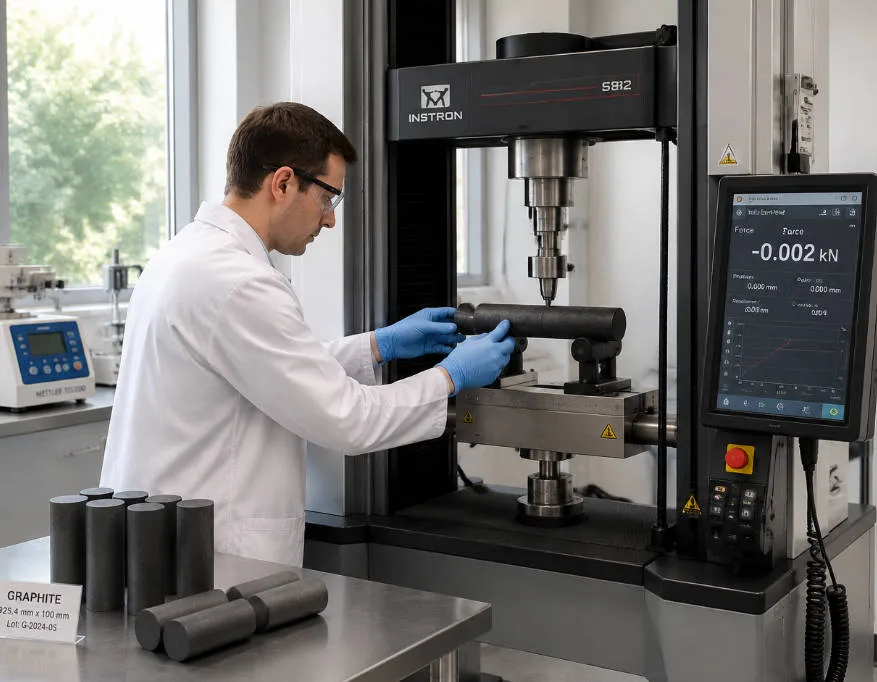
The main categories of graphite testing include:
| Category | What It Measures | Why It Matters |
|---|---|---|
| Mechanical | Tensile, flexural, compressive, shear strength | Determines structural reliability under load |
| Chemical/Purity | Trace elements, carbon content, ash, LOI | Ensures compatibility with sensitive applications (nuclear, electronics) |
| Physical | Density, porosity, particle size distribution | Affects thermal/electrical performance and downstream processing |
| Thermal | Conductivity, expansion, behavior at elevated temperature | Critical for refractory and high-temperature applications |
Key Graphite Testing Standards You Need to Know
Multiple international standards govern graphite testing. The following table summarizes the most widely referenced standards:
| Standard | Scope | Key Parameters |
|---|---|---|
| ASTM C565 | Tension testing of carbon and graphite mechanical materials | Tensile strength, modulus, strain (grain size < 0.79 mm) |
| ASTM C651 | Flexural strength of carbon and graphite by four-point loading | Flexural strength, modulus of rupture |
| ASTM C611 | Electrical resistivity of graphite materials | Electrical resistivity, conductivity |
| ASTM C838 | Density and porosity of carbon and graphite | Bulk density, apparent porosity |
| ASTM C830 | Tensile creep of carbon and graphite | Creep strain, creep rate at elevated temperature |
| ASTM C1039 | Apparent density and porosity of carbon/graphite electrodes | Density, porosity, dimensions |
| ISO 945 | Classification of graphite in cast irons | Graphite type, distribution, size |
| AS 5049 | Graphite classification in cast irons (Australian) | Microstructure classification |
| ASTM C561–C569 | Chemical analysis of graphite (withdrawn 2025) | Trace elements (Si, Fe, Ca, Al, Ti, V, B) |
Note: ASTM C561 through C569 (chemical analysis of graphite by colorimetric methods) were withdrawn in 2025. Modern laboratories now use instrumental techniques such as ICP-OES, ICP-MS, and GDMS for trace element analysis with parts-per-million sensitivity.
Mechanical Testing of Graphite
Graphite is a brittle material that behaves differently from metals and ceramics under mechanical load. Its mechanical properties are anisotropic — strength values differ significantly depending on whether force is applied parallel or perpendicular to the grain direction. This makes standardized mechanical testing critical.
Tensile Testing (ASTM C565)
ASTM C565 is the primary standard for measuring the tensile properties of carbon and graphite materials with a grain size smaller than 0.79 mm (1/32 inch). The test method determines:
- Tensile strength — maximum stress the material can withstand before fracture
- Elastic modulus — stiffness of the material in the elastic region
- Strain to failure — ductility indicator (typically very low for graphite)
This standard is used for quality control of established grades, development of new graphite grades, and comparative strength evaluations between materials. Specimen geometry and alignment are critical — misalignment introduces bending stresses that skew tensile results in brittle materials.
Flexural Strength Testing (ASTM C651)
ASTM C651 measures flexural (bending) strength using four-point loading. The four-point configuration produces a uniform bending moment between the inner loading points, eliminating the stress concentration inherent in three-point bending setups.
Flexural testing is often preferred over tensile testing for graphite because:
- Specimen preparation is simpler and less expensive
- Grip alignment issues that plague tensile testing of brittle materials are avoided
- Flexural strength values are consistently higher than tensile strength for the same material (typical ratio: 1.5:1 to 2:1)
Compressive and shear testing
While no ASTM standard is exclusively dedicated to compressive testing of graphite, general ceramic and carbon testing standards (such as ASTM C1358 for advanced ceramics) are adapted. Compressive strength of graphite typically ranges from 20 to 100 MPa depending on grade and grain orientation.
Shear strength testing follows ASTM C273 (sandwich core shear) or adapted methods. Interlaminar shear is particularly important for graphite composite structures where delamination is a primary failure mode.
Fatigue and Creep Testing
Graphite components operating at high temperatures (nuclear reactors, furnace fixtures) experience time-dependent deformation. ASTM C830 covers tensile creep testing of carbon and graphite, measuring strain accumulation under constant load at elevated temperature. Fatigue testing follows ASTM C1360 for ceramic materials adapted to graphite, with tests performed at temperatures up to 2500 F (1371 C).
Chemical and Purity Testing
Purity is often the single most critical specification for graphite, particularly in nuclear, semiconductor, and battery applications. Even trace amounts of certain elements can render graphite unsuitable for its intended use.
Modern Instrumental Techniques
With the withdrawal of the colorimetric ASTM C561–C569 methods in 2025, modern graphite impurity analysis relies on:
| Technique | Capability | Detection Limit |
|---|---|---|
| ICP-OES (inductively coupled plasma Optical Emission Spectroscopy) | Accurate determination of specified elements | Parts-per-million (ppm) |
| ICP-MS (inductively coupled plasma mass spectrometry) | Simultaneous semi-quantitative determination of 48 elements | Parts-per-billion (ppb) for many elements |
| GDMS (Glow Discharge mass spectrometry) | Simultaneous quantitative analysis of 76 stable elements | Sub-ppm for bulk solids |
| TGA (Thermogravimetric Analysis) | Total carbon content, oxidative degradation behavior | 0.1% mass change |
| XRD (X-ray Diffraction) | Phase identification, crystallinity assessment | Qualitative + semi-quantitative |
| CIC (Combustion Ion Chromatography) | Halogens and sulfur content | ppm range |
Common Contaminants of Concern
- Boron — problematic in nuclear applications due to neutron absorption cross-section
- Iron, Silicon, Calcium — affect oxidative degradation rate
- Sulfur, Nitrogen — impact battery anode performance
- Vanadium, Titanium — indicators of mineral impurity from natural deposits
- Ash content — general indicator of mineral contamination level
Assay Methods
Graphite assaying requires removal of carbon associated with other minerals and all volatile compounds before measurement. This prevents bias from non-graphite carbon sources. The graphite is then measured by thermal decomposition and gravimetric determination. Obtaining a representative sample is challenging due to graphite's unusual density, shape, and electrical conductivity — laboratories use large aliquots (5–10 g), which are 10–20 times larger than standard exploration assay procedures.
Physical Property Testing
Density and Porosity
Density and porosity are fundamental physical properties that correlate strongly with mechanical strength, thermal conductivity, and oxidation resistance of graphite. ASTM C838 covers bulk density and apparent porosity measurement using water immersion (Archimedes' principle). For graphite electrodes, ASTM C1039 provides specific density and porosity requirements.
Key relationships:
- Higher density correlates with higher strength, higher thermal conductivity, and lower porosity
- Higher porosity increases oxidation susceptibility and permeability
- Typical bulk density for manufactured graphite: 1.5–1.9 g/cm3
- Typical apparent porosity: 10–25% depending on grade
Particle Size Distribution (PSD)
Particle size distribution directly affects flowability, packing density, reactivity, and downstream processing behavior. For battery anode-grade graphite, controlling PSD is critical for achieving consistent electrode performance. Analysis methods include laser diffraction, sieve analysis, and dynamic image analysis.
Electrical Resistivity (ASTM C611)
ASTM C611 measures the electrical resistivity of graphite materials. This property is inversely related to purity and crystallinity. High-purity, well-crystallized natural graphite exhibits lower resistivity than amorphous or impure grades. Electrical resistivity data is essential for electrode design, EMI shielding applications, and battery current collector performance.
Thermal and High-Temperature Testing
Graphite's thermal properties are among its most valuable characteristics, but they must be carefully characterized because graphite behavior changes significantly at elevated temperatures.
Thermal Conductivity
Thermal conductivity of graphite is highly anisotropic — typically 2–5 times higher parallel to the basal plane than perpendicular to it. Measurements are performed using laser flash analysis (LFA) or guarded hot-plate methods. For nuclear-grade graphite, thermal conductivity data at operating temperatures is essential for reactor safety analysis.
Thermal Expansion
The coefficient of thermal expansion (CTE) of graphite is unusual — it can be slightly negative at low temperatures parallel to the basal plane before becoming positive. ASTM E228 (push-rod dilatometer method) is adapted for graphite CTE measurement. Mismatched CTE between graphite components and surrounding materials is a common cause of thermal stress failure in high-temperature assemblies.
High-Temperature Behavior
Thermal treatment profoundly affects graphite properties. Testing at elevated temperatures is essential to understand:
- Reaction temperatures and kinetics — when oxidation begins and how fast it proceeds
- Structural changes — crystal growth, pore evolution, densification
- Off-gassing and emissions — volatile release during heating
- Strength retention — graphite often gains strength at elevated temperature before weakening near oxidation onset
Pilot-scale rotary kilns are used to simulate commercial thermal treatment conditions, providing data for residence time optimization, heating profile design, and equipment sizing.
Oxidation Resistance Testing
Graphite begins to oxidize in air at approximately 400 C, though the rate depends heavily on purity, crystallinity, and porosity. Oxidation resistance testing measures mass loss rate as a function of temperature and atmosphere. This data is critical for refractory applications where graphite components are exposed to oxidizing environments at high temperature.
Graphite Flake Size Characterization
For natural graphite, flake size is arguably the most economically important characteristic. Larger, coarser flakes command premium prices and enable applications that finer material cannot serve.
Why Flake Size Matters
- Refractories — larger flakes provide better thermal shock resistance and lower impurity content per unit surface area
- Expandable graphite — expansion behavior depends on flake size and crystallinity
- Lubricants — flake size affects lubricity and film-forming behavior
- Battery anodes — spherical graphite produced from coarse flakes yields better cycling performance
Standard Characterization Method
The typical flake size characterization procedure:
- Sample preparation — approximately 10 kg of ore is crushed and ground to a coarse size (0.8–1.0 mm)
- Separation — a MAT super-panner (gravity separation) or froth flotation concentrates the graphite
- Sieving — the concentrate is sieved for accurate flake size distribution
The goal is to quickly identify the flake size of the easily recoverable graphite while understanding the challenges of upgrading the remaining material. Microscopic analysis complements sieve data by revealing flake morphology, surface quality, and mineral inclusions.
Industry Applications Driving Graphite Testing
Lithium-Ion Batteries
Battery manufacturing has become the largest growth driver for graphite demand. Anode-grade graphite must meet strict specifications for:
- Purity (> 99.95% C for high-Ni cathode systems)
- Particle size distribution (tight control for electrode slurry consistency)
- Tap density (affects energy density)
- First-cycle efficiency and cycling stability
Spherical graphite production from natural flake graphite involves rounding, purification, and classification steps — each requiring testing to verify product quality.
Nuclear Industry
Nuclear-grade graphite serves as moderator, reflector, and structural material in gas-cooled reactors. Boron content is strictly limited (typically < 0.1 ppm) due to its high neutron absorption cross-section. Mechanical properties must be characterized at operating temperatures, and dimensional stability under neutron irradiation must be verified through long-term testing programs.
Steel and Metallurgy
Graphite electrodes for electric arc furnaces (EAF) are the largest single application of synthetic graphite by volume. Testing requirements include density, porosity, electrical resistivity, flexural strength, and oxidation resistance. Electrode performance directly affects steelmaking productivity and energy consumption.
Cast Iron Metallurgy
In cast iron, graphite morphology determines mechanical properties. ASTM ISO 945 and AS 5049 classify graphite in cast irons by type (flake, vermicular, nodular), distribution, and size. This classification predicts ductility, tensile strength, and thermal conductivity of the casting. Gray iron (flake graphite) has high thermal conductivity but low strength; ductile iron (nodular graphite) offers high strength and ductility with reduced thermal conductivity.
Refractories and High-Temperature Furnaces
Graphite-containing refractories are used in steel ladles, continuous casting systems, and high-temperature furnace linings. Testing focuses on oxidation resistance, thermal shock resistance, slag corrosion resistance, and hot strength retention at service temperatures.
Electronics and Semiconductor
High-purity graphite is used as crucibles for silicon crystal growth, heating elements, and EDM electrodes. Semiconductor-grade graphite requires impurity levels below 10 ppm total, demanding the most sensitive analytical techniques (GDMS, high-resolution ICP-MS).
How to Choose a Graphite Testing Laboratory
Selecting the right testing partner depends on your application and the specific data you need. Key considerations:
| Factor | What to Look For |
|---|---|
| Accreditation | ISO/IEC 17025, NATA, or equivalent; ensures traceability and data integrity |
| Capabilities | Full range of mechanical, chemical, physical, and thermal tests under one roof |
| Experience | Proven track record with your specific graphite type (natural, synthetic, expanded, electrode) |
| Equipment | Pilot-scale equipment for process simulation (kilns, dryers, pelletizers) if scale-up data is needed |
| Turnaround | Production environments require fast turnaround for QC testing |
| Sample requirements | Labs should specify minimum sample mass and geometry for each test |
Summary
Graphite testing spans mechanical strength, chemical purity, physical properties, and thermal behavior — each category essential for different end-use applications. The shift from legacy colorimetric methods to modern instrumental techniques (ICP-OES, ICP-MS, GDMS) has dramatically improved detection limits and throughput. With graphite demand surging from electrification and energy storage, rigorous testing is no longer just a quality checkbox — it is the competitive advantage that separates reliable producers from the rest.