Table of Contents
- What standards govern hydroxyapatite powder testing?
- How is the Ca/P molar ratio measured?
- How is the crystallinity ratio determined?
- What are the foreign phases and how are they quantified?
- How are trace elements and heavy metals analyzed?
- How are powder morphology and granulometry characterized?
- How does the Chinese GB 23101 framework align?
- FAQ
- Our hydroxyapatite powder testing service
What standards govern hydroxyapatite powder testing?
Hydroxyapatite (HAp, Ca₅(OH)(PO₄)₃) powder testing is governed by the ISO 13779 series, Implants for surgery — Hydroxyapatite, a multi-part international standard that defines every property a hydroxyapatite material must demonstrate for the surgical-implant use. The series is organised by the physical form of the material — the ceramic, the coating, the powder — and the test methods apply across the forms. A complete powder-conformity project draws primarily from Part 6 (the powder product specification) and Part 3 (the chemical-analysis and crystallinity test methods), with the supporting characterisation that the application requires.
The ISO 13779 series structure is:
- Part 1, Ceramic hydroxyapatite (ISO 13779-1:2008) — the requirements for the ceramic hydroxyapatite (the sintered block, the dense or the porous monolith) intended for use as a surgical implant. Part 1 does not apply to the coatings, the powders used as raw materials, the non-ceramic hydroxyapatite, or the glass-ceramics — those are covered by the other parts.
- Part 2, Hydroxyapatite coatings (ISO 13779-2:2018) — the requirements for the single-layer thermally-sprayed hydroxyapatite coatings applied to the metallic surgical implants. Part 2 references Part 3 for the chemical analysis (the Ca/P content determination) and sets the acceptance criteria for the coating thickness, the crystallinity, the phase purity and the adhesion strength.
- Part 3, Chemical analysis and characterization of crystallinity ratio and phase purity (ISO 13779-3:2018) — the test methods for the chemical analysis, the crystallinity-ratio assessment and the phase-composition determination of the hydroxyapatite-based materials. Part 3 is the methods standard, used by Parts 1, 2 and 6 to characterise the material.
- Part 4, Determination of coating adhesion strength (ISO 13779-4:2018) — the test method for the measurement of the adhesion (the bonding) strength of the hydroxyapatite coatings, by the tensile test per ASTM F1147.
- Part 6, Powders (ISO 13779-6:2015) — the requirements for the hydroxyapatite powders used as the raw material for the manufacturing or the coating of the surgical implants. Part 6 is the product specification for the powder, and it is the standard that the HAp-powder conformity project reports against.
A point worth noting: Part 5 does not exist in the ISO 13779 series. The numbering skips from Part 4 to Part 6, because the Part 5 content (originally considered for the alternatives to the animal testing for the biocompatibility) was never formally published under the ISO 13779 designation. Specifications that cite "ISO 13779-5" are citing a non-existent document, and a project scoped against that citation will not produce a valid report.
The supporting standards that a complete HAp-powder project draws from include:
- ASTM F1185, Standard Specification for Composition of Medical-Grade Hydroxyapatite for Surgical Implants — the U.S. material-composition specification, defining the chemical-composition requirements for the medical-grade hydroxyapatite. ASTM F1185 and ISO 13779 are complementary, not interchangeable — ASTM F1185 specifies what the composition must be, ISO 13779-3 specifies how the composition is measured.
- ASTM F1147, Standard Test Methods for Tension Testing of Calcium Phosphate and Metallic Coatings — the tensile-test method for the coating-adhesion measurement under ISO 13779-4.
- ISO 10993, Biological evaluation of medical devices — the biocompatibility framework, applied to the finished hydroxyapatite device.
- ASTM F1854, Standard Test Method for Stereological Evaluation of Porous Coatings on Medical Implants — the stereological method for the porosity characterisation of the HAp coatings.
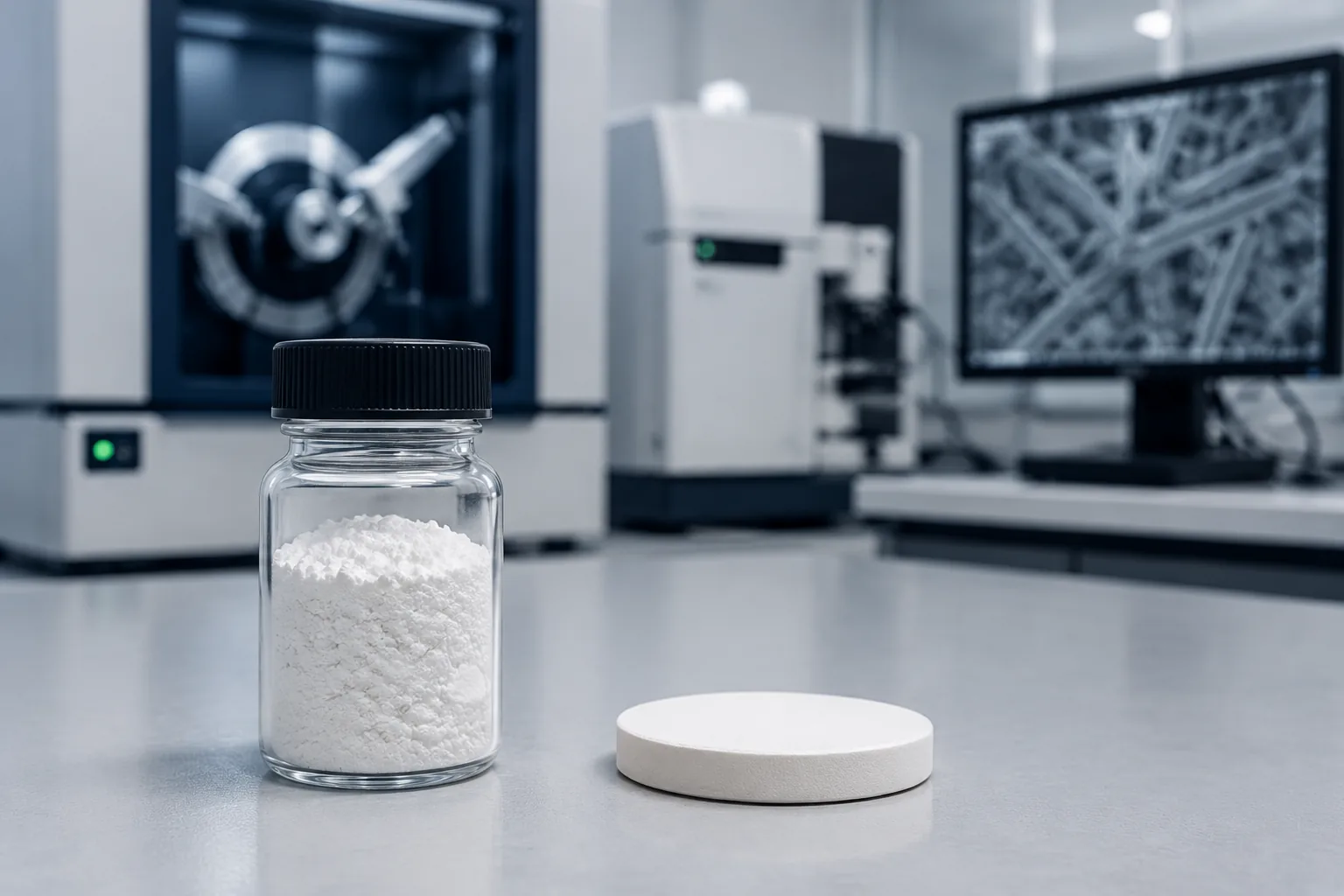
A common misconception worth stating: the ISO 13779 product standards and the regional medical-device regulations (the EU MDR, the FDA 510(k) / PMA, the NMPA registration) work together, not in substitution. Under the EU MDR (Annex II, Section 6.1), the physical and chemical characterisations of the device — and the proof of conformity with the product specifications — are mandatory, and the ISO 13779-6 powder characterisation is the evidence the MDR submission requires for the raw material. We confirm the target market and the regulatory pathway before quoting, because the test scope and the reporting format are driven by the pathway.
How is the Ca/P molar ratio measured?
The calcium-to-phosphorus molar ratio (Ca/P) is the defining compositional property of the hydroxyapatite. The stoichiometric hydroxyapatite has the Ca/P molar ratio of 1.67 (5 calcium atoms to 3 phosphorus atoms in the Ca₅(OH)(PO₄)₃ formula unit). A non-stoichiometric hydroxyapatite — the calcium-deficient HAp with the Ca/P below 1.67, or the calcium-rich HAp with the Ca/P above 1.67 — has different solubility, different biological behaviour and different impurity-phase content, and the Ca/P measurement is what distinguishes them.
The Ca/P molar ratio is measured under ISO 13779-3:2018, by the combination of the elemental analysis and the crystallographic analysis:
ICP-OES (inductively coupled plasma – optical emission spectroscopy) is the reference method for the elemental calcium and phosphorus determination. The hydroxyapatite powder is dissolved in the defined acid (the hydrochloric or the nitric acid digestion), the solution is nebulised into the ICP plasma, and the calcium and the phosphorus emission lines are measured. The Ca/P molar ratio is calculated from the measured calcium and phosphorus concentrations and the atomic weights. The ICP-OES is the high-accuracy method, and it is the one the ISO 13779-3 standard references for the elemental Ca/P measurement.
XRF (X-ray fluorescence spectroscopy) is the alternative elemental method, non-destructive and faster, that measures the calcium and the phosphorus from the characteristic X-ray emissions. The XRF is calibrated against the certified reference materials, and it is the production-line method where the speed matters.
XRD (X-ray diffraction) with the Rietveld refinement provides the crystallographic Ca/P determination, by the quantitative phase analysis (QPA) that resolves the hydroxyapatite phase from the foreign phases (the α-TCP, the β-TCP, the CaO, the TTCP — see the foreign-phases section below). The Rietveld refinement fits the calculated diffraction pattern to the measured pattern by varying the phase fractions, and the resulting phase composition is the basis for the crystallographic Ca/P. The XRD-based Ca/P and the ICP-OES-based Ca/P should agree for a pure hydroxyapatite; a disagreement indicates the presence of the amorphous phase (which the XRD does not see) or the elemental-analysis artefact.
The pass criterion for the stoichiometric hydroxyapatite powder is the Ca/P within the defined tolerance of 1.67, typically reported as the range 1.60 to 1.70 or the narrower range depending on the application. A Ca/P below 1.60 indicates the calcium-deficient hydroxyapatite (which contains the calcium vacancies and the proton substitutions, and which converts to the β-TCP on the calcination); a Ca/P above 1.70 indicates the presence of the CaO (the free lime, the foreign phase that causes the alkaline pH on dissolution and the adverse biological response).
How is the crystallinity ratio determined?
The crystallinity ratio — the fraction of the hydroxyapatite that is in the crystalline state, as opposed to the amorphous calcium phosphate — is the property that determines the powder's dissolution behaviour, its sintering behaviour and its biological response. The crystalline hydroxyapatite dissolves slowly (the bone mineral is itself a poorly-crystalline hydroxyapatite, and the crystallinity governs the resorption rate); the amorphous calcium phosphate dissolves rapidly and can produce the local pH spike. The crystallinity is therefore the property the medical-device manufacturer specifies for the controlled-resorption applications.
The crystallinity ratio is determined under ISO 13779-3:2018, by XRD. The XRD pattern of the hydroxyapatite powder is collected on the diffractometer, and the crystallinity is derived from the diffraction-peak characteristics. Two approaches apply:
The peak-intensity method uses the intensity of the (300) diffraction peak and the intensity of the hollow (the valley) between the (112) and the (300) peaks to calculate the crystallinity fraction, by the formula that relates the peak-to-valley intensity ratio to the crystalline fraction. This is the classical method, simpler and faster, but it is sensitive to the preferred orientation and the instrument-parameter variation.
The Rietveld refinement fits the full diffraction pattern (not just the selected peaks) to the calculated pattern, by varying the lattice parameters, the crystallite size and the phase fractions, and it provides the crystallinity as part of the quantitative phase analysis. The Rietveld method is the more robust and the more accurate, and it is the method the 2018 edition of ISO 13779-3 introduces as the alternative for the crystallinity-ratio measurement.
A practical point from the published HAp-powder research: the crystallinity depends on the calcination temperature (the heat treatment that converts the amorphous or the poorly-crystalline precursor to the well-crystallised hydroxyapatite). The crystallinity increases with the calcination temperature, and the temperature must be controlled to achieve the target crystallinity without the phase decomposition (the conversion of the HAp to the α-TCP or the β-TCP at the excessive temperature). The published work on the HAp from the fish-bone source found that the highly crystalline structure was obtained at the 900 °C and the 1200 °C calcination, with the crystallinity measurable by the XRD diffractogram and the texture coefficient. A crystallinity-ratio measurement that does not state the calcination condition is reporting a property that depends on an unreported variable.
What are the foreign phases and how are they quantified?
The foreign phases — the crystalline phases other than the hydroxyapatite that are present in the powder — are the impurities that affect the biological behaviour and the regulatory acceptance. The hydroxyapatite powder, depending on the synthesis route and the heat treatment, may contain:
- α-TCP (alpha-tricalcium phosphate) — the high-temperature TCP phase, more soluble than the HAp, present in the powder calcined above the α-β transition.
- β-TCP (beta-tricalcium phosphate) — the lower-temperature TCP phase, the principal component of the biphasic calcium phosphate (BCP) materials that combine the HAp and the β-TCP for the controlled resorption. The β-TCP is not a "foreign phase" in the BCP material — it is an intentional component — but it is a foreign phase in the pure-HAp powder, where its presence indicates the calcium deficiency or the phase decomposition.
- CaO (calcium oxide, the free lime) — the alkaline oxide that forms from the calcium excess, and that produces the adverse biological response (the pH spike on dissolution). The CaO is the most critical foreign phase to detect, because it is directly toxic.
- TTCP (tetracalcium phosphate, Ca₄O(PO₄)₂) — the high-temperature phase that forms at the very high calcination temperatures.
The foreign phases are quantified under ISO 13779-3:2018, by the XRD with the Rietveld refinement. The Rietveld method resolves the foreign phases from the hydroxyapatite in the diffraction pattern, by fitting the calculated pattern (the weighted sum of the HAp, the α-TCP, the β-TCP, the CaO and the TTCP reference patterns) to the measured pattern, and the phase fractions are the quantitative result. The detection limit of the Rietveld QPA is on the order of 0.5 to 1 % for the crystalline foreign phases, and the reporting typically covers the phases above the detection limit.
The pass criterion for the pure hydroxyapatite powder is the foreign-phase content below the defined limits — the total foreign phases below a defined percentage (commonly a few percent), and the specific phases (the CaO in particular) below the stricter limits. A powder that exceeds the foreign-phase limits is not a pure hydroxyapatite, and the report must identify and quantify the foreign phases present, because the regulatory submission and the clinical-behaviour prediction depend on the phase composition.
How are trace elements and heavy metals analyzed?
The trace elements and the heavy metals in the hydroxyapatite powder are the contaminants that affect the biological safety, and they are the elements the ISO 13779-6 standard requires to be reported. The trace elements enter the hydroxyapatite from the raw materials (the natural-source HAp from the bone or the mineral carries the trace elements of the biological or the geological origin — the strontium, the magnesium, the sodium, the silicon; the synthetic HAp from the wet-chemical or the hydrothermal synthesis carries the trace elements of the reagent grade), and the heavy metals (the lead, the arsenic, the cadmium, the mercury) are the toxic contaminants that the regulatory framework limits.
The trace-element and heavy-metal analysis is performed under ISO 13779-3 and ISO 13779-6, by:
ICP-MS (Inductively Coupled Plasma Mass Spectrometry) — the high-sensitivity multi-element method that detects and quantifies the trace elements and the heavy metals from the sub-ppb to the ppm levels. The ICP-MS is the reference method for the trace-element analysis, with the detection limits that meet the regulatory requirements for the toxic elements.
ICP-OES — the alternative ICP method, with the higher dynamic range and the lower sensitivity than the ICP-MS, suitable for the major and the minor elements (the calcium, the phosphorus, the strontium, the magnesium) at the higher concentrations.
The ISO 13779-6 standard requires the trace-element report to include all the trace elements present in excess of 500 mg/kg (500 ppm), with their mass fractions. This is the threshold above which the trace element must be reported by identity and by quantity, and it is the basis on which the HAp-powder purity is documented. The heavy metals (the lead, the arsenic, the cadmium, the mercury) are subject to the additional, stricter limits per the regulatory framework (the ISO 19227 for the residuals, the USP <232> / <233> for the pharmaceutical-grade materials, the EU MDR requirements for the implantable devices), and the report must demonstrate the heavy-metal content below these limits.
A point worth noting for the natural-source HAp: the hydroxyapatite extracted from the biological sources (the bovine bone, the fish bone, the marine coral) carries the trace elements of the biological origin, and these trace elements are, in part, the reason the natural HAp has the biological properties that differ from the synthetic HAp. The strontium, the magnesium, the sodium and the silicon that substitute for the calcium in the apatite lattice are not contaminants in the pejorative sense — they are the biological mimics that make the natural HAp closer to the bone mineral. The trace-element report for the natural-source HAp documents these elements alongside the toxic heavy metals, and the regulatory submission interprets them in the context of the source. The laboratory's role is to measure and report all the trace elements above the 500 mg/kg threshold, with the source context provided by the manufacturer.
How are powder morphology and granulometry characterized?
The powder morphology and the granulometry — the particle shape, the particle-size distribution and the specific surface area — are the properties that determine the powder's behaviour in the downstream processing (the sintering, the coating, the compaction) and in the biological application (the cell response to the particle size and the surface area). These properties are characterised under ISO 13779-6 and the supporting test methods.
Powder morphology (the particle shape and the surface texture) is characterised by the Scanning Electron Microscopy (SEM). The SEM image reveals the particle shape (the equiaxed, the needle-like, the plate-like, the spherical), the surface texture (the smooth, the rough, the porous), and the agglomeration state (the individual particles vs. the agglomerates). The morphology depends on the synthesis route — the wet-chemical precipitation produces the nano-crystalline needle-like particles, the hydrothermal synthesis produces the larger more-crystalline particles, the calcination of the natural bone produces the particles that retain the bone-mineral morphology. The SEM is the method that documents the morphology and confirms the powder matches the synthesis-route expectation.
Granulometry (the particle-size distribution) is characterised by the laser diffraction (the wet or the dry dispersion) or the sieving method. The laser diffraction is the method for the fine powders (the sub-micron to the tens-of-micron range), and the sieving is the method for the coarser powders (the tens-of-micron and above). The particle-size distribution is reported as the D10, the D50 and the D90 (the diameters at the 10 %, the 50 % and the 90 % cumulative volume), or as the full distribution curve. The distribution affects the sintering (the finer powder sinters at the lower temperature), the coating (the plasma-spray feedstock requires the defined size range for the flow and the deposition), and the cell response (the sub-micron particles have the higher specific surface area and the different cellular uptake).
Specific surface area (SSA) is characterised by the BET (Brunauer-Emmett-Teller) method, by the nitrogen-gas adsorption at 77 K. The BET measures the surface area per unit mass (in m²/g), and it is the property that connects the particle size to the dissolution behaviour and the cell response. The SSA of the hydroxyapatite powder ranges from the single-digit m²/g for the coarse sintered powder to the 50–100 m²/g for the nano-crystalline precipitated powder, and the SSA is the property the medical-device manufacturer specifies for the controlled-resorption application.
Calcination loss at 1000 °C is the thermogravimetric measurement that quantifies the mass loss on heating to 1000 °C — the loss of the adsorbed water, the residual organics, the carbonate, and the volatile components. The calcination loss is the indicator of the powder's cleanliness and thermal stability, and it is the ISO 13779-6 requirement. A powder with the high calcination loss is the powder that contains the residual volatiles or the unburnt organics, and the report identifies the calcination-loss value alongside the other powder properties.
A practical point from the published HAp-powder research: the powder morphology and the particle size depend on the milling and the sieving protocol — the ball-milling at the defined rpm and duration, the sieving to the defined mesh size (e.g. the <90 µm by the mesh 270, per the ASTM C136 recommendation). The powder-processing protocol must be documented alongside the morphological and the granulometric results, because the same precursor material processed by the different protocols produces the different powder characteristics, and the report that does not state the processing protocol is reporting the properties of an undefined material.
How does the Chinese GB 23101 framework align?
The Chinese framework for the hydroxyapatite testing is the GB 23101 series, 外科植入物 羟基磷灰石 (Implants for surgery — Hydroxyapatite), administered by the NMPA through the National Technical Committee for Surgical Implants and Orthopaedic Devices (TC110), and it is the Chinese national adoption of the ISO 13779 series. The GB 23101 series mirrors the ISO 13779 structure part-for-part, with each GB 23101 part adopting the corresponding ISO 13779 part.
The GB 23101 series structure:
- GB 23101.1-2008, Part 1: Hydroxyapatite ceramic (std.samr.gov.cn) — the requirements for the ceramic hydroxyapatite, adopting ISO 13779-1.
- GB 23101.2-2008, Part 2: Hydroxyapatite coatings — the requirements for the hydroxyapatite coatings, adopting ISO 13779-2.
- GB/T 23101.3-2023, Part 3: Chemical analysis and characterization of crystallinity ratio and phase purity — the test methods for the chemical analysis, the crystallinity ratio and the phase purity, adopting ISO 13779-3. (The 2023 edition replaces the GB 23101.3-2010; note the prefix change from the mandatory GB to the recommended GB/T, reflecting the evolution of the standard from a mandatory product standard to a recommended test-method standard.)
- GB/T 23101.4-2023, Part 4: Determination of coating adhesion strength — the coating-adhesion test method, adopting ISO 13779-4.
A point worth noting: the GB 23101 series covers Parts 1 through 4, and it does not include a Part 6 (the powder product specification) in the same way the ISO 13779 series does. The HAp-powder requirements for the Chinese market are addressed through the combination of the GB 23101.1 (the ceramic, which is the form the powder is processed into for the implant use) and the GB/T 23101.3 (the chemical-analysis and crystallinity methods, which apply to the powder as the precursor), with the powder-specific requirements drawn from the applicable YY-series medical-device-industry standards and the NMPA registration technical guidelines for the specific implant category. A Chinese-market HAp-powder project confirms the applicable standard set at the scoping step, because the powder-product specification is distributed across the GB and the YY standards rather than concentrated in a single Part-6 document.
A related Chinese regulatory point: the hydroxyapatite materials used in the surgical implants are Class III implantable medical devices in the Chinese classification, and the NMPA registration requires the full physical-and-chemical characterisation, the biocompatibility evaluation under ISO 10993, and the clinical-investigation data for most implant categories. The hydroxyapatite-powder characterisation (the Ca/P, the crystallinity, the phase purity, the trace elements, the morphology and the granulometry) is the evidence that supports the NMPA submission, and the report must be in Chinese against the GB 23101 / GB/T 23101 references.
FAQ
Which standard should my hydroxyapatite powder be tested to?
ISO 13779-6 (the powder product specification) is the primary standard, with the test methods drawn from ISO 13779-3 (the chemical analysis, the crystallinity, the phase purity). For the U.S. market, ASTM F1185 (the composition specification) applies. For the Chinese market, the GB 23101 series applies (with the powder-specific requirements distributed across the GB and the YY standards). We confirm the target market and the application before quoting. Note that ISO 13779-5 does not exist — a specification citing it is in error.
What is the stoichiometric Ca/P molar ratio of the hydroxyapatite?
1.67 (5 calcium atoms to 3 phosphorus atoms in the Ca₅(OH)(PO₄)₃ formula unit). The stoichiometric HAp has the Ca/P 1.67; the calcium-deficient HAp has the Ca/P below 1.67 (and converts to the β-TCP on the calcination); the calcium-rich HAp has the Ca/P above 1.67 (and contains the CaO, the free lime). The Ca/P is measured by the ICP-OES for the elemental ratio and by the XRD Rietveld for the crystallographic ratio.
Why does the crystallinity ratio matter?
Because it governs the dissolution and the resorption rate. The crystalline HAp dissolves slowly; the amorphous calcium phosphate dissolves rapidly and can produce the local pH spike. The medical-device manufacturer specifies the crystallinity for the controlled-resorption application, and the crystallinity depends on the calcination temperature (the higher temperature produces the higher crystallinity, up to the point of the phase decomposition). The crystallinity-ratio measurement under ISO 13779-3 is the test that confirms the powder matches the target crystallinity.
What are the critical foreign phases in the hydroxyapatite powder?
The α-TCP, the β-TCP, the CaO and the TTCP. The CaO (the free lime) is the most critical to detect, because it is directly alkaline and toxic on dissolution. The β-TCP is not a foreign phase in the biphasic calcium phosphate (where it is intentional), but it is a foreign phase in the pure-HAp powder. The foreign phases are quantified by the XRD with the Rietveld refinement, and the report identifies and quantifies each phase above the detection limit.
Can you test the natural-source hydroxyapatite (the bone-derived, the marine-derived)?
Yes. The natural-source HAp carries the trace elements of the biological origin (the strontium, the magnesium, the sodium, the silicon), and these are documented alongside the toxic heavy metals. The trace-element report includes all the elements above the 500 mg/kg threshold (per ISO 13779-6), with the source context provided by the manufacturer. The natural-source HAp is characterised by the same ISO 13779-3 / -6 test methods as the synthetic HAp, and the source difference shows up in the trace-element profile and the morphology (the bone-derived HAp retains the bone-mineral morphology).
Our hydroxyapatite powder testing service
Our laboratory provides hydroxyapatite powder testing across the full ISO 13779 series — Part 6 (the powder product specification), Part 3 (the chemical analysis, the crystallinity, the phase purity), with the supporting ASTM F1185 (the composition), the GB 23101 series (the Chinese market), and the ISO 10993 biocompatibility framework for the finished device. Each project begins with a scoping step that confirms the HAp source (the synthetic, the bone-derived, the marine-derived), the application (the implant, the coating, the scaffold, the filler), the target market and the regulatory pathway, so the report you receive answers the question your regulator, your manufacturer or your quality system will actually ask.
We measure the Ca/P molar ratio by the ICP-OES and the XRD Rietveld refinement; the crystallinity ratio by the XRD peak-intensity and the Rietveld methods; the foreign phases (the α-TCP, the β-TCP, the CaO, the TTCP) by the XRD Rietveld QPA; the trace elements and the heavy metals by the ICP-MS / ICP-OES with the 500 mg/kg reporting threshold; the powder morphology by the SEM; the granulometry by the laser diffraction and the sieving; the specific surface area by the BET; and the calcination loss by the thermogravimetry at 1000 °C. The sampling plans follow the Gold / Economic / Minimum paradigm (3 batches × 3 / 2 / 1 samples = 9 / 6 / 3 total) for the statistical robustness, and the report includes the statistical evaluation and the critical assessment. Reports are issued with the standard, the method, the measured value, the limit and the conformity conclusion explicitly stated, with the XRD patterns, the ICP spectra, the SEM images and the particle-size distributions included where the result depends on them, in a format suitable for the FDA submission, the EU MDR technical documentation, the NMPA registration dossier or the internal quality audit.
To start a project, send us the HAp source (the synthetic, the bone-derived, the marine-derived), the application (the implant, the coating, the scaffold, the filler), the target market, the regulatory pathway (FDA, EU MDR, NMPA), and the sampling plan you require (the Gold, the Economic or the Minimum). We will return a project scope, sample requirement, schedule and quotation, and begin testing on your confirmation.