What Makes Reusable Container Testing Different from Single-Use?
A reusable food-contact container — a PP lunch box, a Tritan water bottle, a stainless-steel thermos, a silicone baking mould — is designed to contact food dozens or hundreds of times over its service life, not once. This single design difference changes the enTire testing framework: instead of one migration test, the standard requires three consecutive migration tests on the same specimen to verify that migration does not increase with repeated use.
For single-use packaging, one migration test into the food simulant is sufficient — the product contacts the food once and is discarded. For reusable containers, the GB 31604.1 General Rules for Migration Testing requires three consecutive migration tests on the same specimen, each with fresh food simulant. The compliance criterion is that all three results must be below the migration limit — and, under the EU 10/2011 framework, each result should be lower than the previous (3rd < 2nd < 1st), demonstrating that migration is depleting, not accumulating. A container whose migration rises on the second or third extraction is releasing substances faster than they are depleting — it is not safe for repeated use.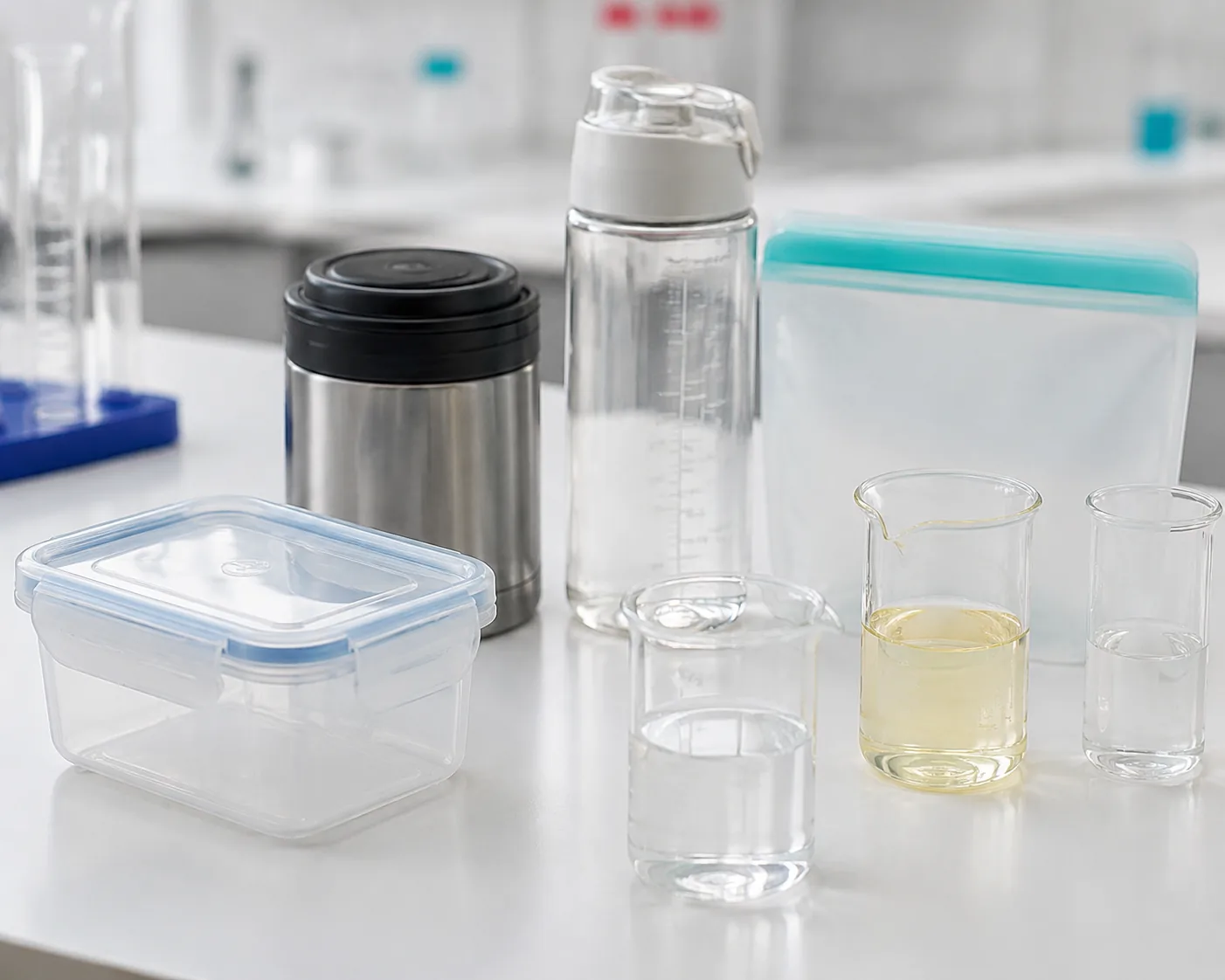
This three-test protocol is the defining difference of reusable container testing and the one that catches products that pass the first contact but become unsafe with repeated use. The international reference frameworks are EU 10/2011 (plastic food-contact regulation, with its three-consecutive-migration requirement for repeat-use articles) and FDA 21 CFR (US food-contact regulations, which apply the same principle).
What Are the Food-Contact Migration Requirements?
The migration test set for reusable containers is defined by the GB 4806 family — the mandatory food-safety national standards for food-contact materials — and the applicable part depends on the container material.
GB 4806.7-2023 Plastic Materials and Articles for Food Contact applies to PP, Tritan, PET, PE, PS, and other plastic containers. It sets the overall migration limit (≤ 10 mg/dm²) and the specific migration limits (SMLs) for the monomers and additives of the plastic's resin (per the GB 4806.6 resin positive list). For plastic reusable containers, the three-consecutive-migration test verifies that the plastic does not leach excessive substances over repeated use.
GB 4806.9-2023 Metallic Materials and Articles for Food Contact applies to stainless steel, aluminium, and other metal containers. For stainless steel, the three-consecutive-migration test shows the most stable attenuation pattern (migration depletes consistently across the three contacts) — stainless steel's chemical inertness is what makes it the most durable food-contact material. For other metals (aluminium, copper), migration may not deplete as predictably, and all three results must independently comply.
GB 4806.11-2023 Silicone Materials and Articles for Food Contact applies to silicone containers, baking moulds, and seals. Silicone is chemically stable and high-temperature resistant (~200–250 °C), but the migration test verifies that volatile siloxanes and other silicone-specific migrants do not exceed limits.
The test simulants and conditions for reusable containers reflect the repeated-use scenario: water, 4 % acetic acid, 10 % / 20 % / 50 % ethanol, and vegetable oil (selected by the food type the container is declared for), at the maximum service temperature and for the maximum contact time per use. A container declared "microwave safe" is tested at microwave-temperature conditions; one declared "dishwasher safe" is tested after dishwasher-cycle preconditioning.
What Are the Dishwasher and Microwave Durability Requirements?
A reusable container that is declared dishwasher-safe must survive repeated dishwasher cycles without degradation that increases migration or compromises structural integrity. The dishwasher durability test exposes the container to a defined number of dishwasher cycles (typically 50–100 cycles, or as declared by the manufacturer) using standard dishwasher detergent at the machine's hottest setting, and after the cycling, the container is re-tested for migration and inspected for warping, cracking, crazing, or surface degradation.
The logic: dishwasher detergent is alkaline and aggressive, and the hot-water cycle is a sustained chemical + thermal attack on the container material. A plastic that survives one food contact may degrade over 100 dishwasher cycles — its surface erodes, its additives leach out, and its migration rises. The dishwasher durability test catches this before the container reaches the consumer's kitchen.
Microwave safety is verified by testing the container's migration at microwave-temperature conditions — typically by filling the container with a food simulant (water or oil) and heating it in a microwave to the temperature the container would reach in real microwave use (often 100–120 °C for PP containers). The migration after microwave heating must still comply with the GB 4806 limits. A plastic that passes at room temperature but fails at microwave temperature is not microwave-safe, regardless of any manufacturer claim.
The material-specific guidance: PP (polypropylene) is the only plastic widely accepted as microwave-safe, with a service temperature around 120 °C. Tritan is durable and dishwasher-safe but has a lower temperature limit (~100 °C) and is generally not recommended for microwave heating. Silicone tolerates both microwave and oven temperatures (200–250 °C). Stainless steel is chemically inert and thermally stable but must not be put in a microwave (metal arcing hazard).
What Physical and Mechanical Tests Apply?
Beyond the food-contact migration tests, a reusable container must survive the physical stresses of repeated use — filling, stacking, transporting, washing, and the occasional drop. The physical test set:
Drop and impact resistance: the container is dropped from a defined height in multiple orientations (base, side, corner) onto a hard surface, and must not crack, shatter, or leak. For glass containers, this test is particularly critical — tempered or borosilicate glass has a higher impact resistance than annealed glass. The Fraunhofer Institute's 2025 study of reusable plastic containers (RPCs) documented that reusable plastic containers had a 0.01 % breakage rate at central warehouses versus 0.22 % for single-use crates — a 20× advantage that is driven by the structural design and wall thickness that repeated use demands.
Seal and leak resistance: for containers with lids (lunch boxes, water bottles, storage containers), the seal must prevent leakage under defined conditions — inverted, on the side, under vibration (simulating transport), and after repeated open-close cycling. The seal test fills the container with coloured water, places it on absorbent paper in the test orientation for a defined time, and checks for any staining on the paper. A seal that leaks in transport is a complete product failure for the consumer.
Stacking and compression resistance: for storage and logistics containers, the container must support the weight of stacked containers above it without deforming or collapsing. The compression test applies a defined load to the container (simulating the weight of stacked containers in storage) and measures the deformation. A container that buckles under stacking load fails its purpose.
Lid fit and open-close cycling: for containers with snap-on or screw-on lids, the lid must maintain its sealing force after repeated open-close cycles. The cycling test opens and closes the lid a defined number of times (typically 100–500) and re-tests the seal performance. A lid that loosens with cycling is a progressive seal failure — the container leaks more with each use.
How Does the Material Choice Affect the Test Panel?
The container material determines which GB 4806 part applies and which specific migrants are tested.
| Material | GB 4806 part | Key migrants | Microwave | Dishwasher | Typical service life |
|---|---|---|---|---|---|
| PP (polypropylene) | GB 4806.7 | Overall migration, no BPA | ✅ (120 °C) | ✅ | Years |
| Tritan (copolyester) | GB 4806.7 | Overall migration, no BPA | ⚠️ (≤100 °C) | ✅ | Years |
| Stainless steel | GB 4806.9 | Cr, Ni, Fe migration | ❌ (metal) | ✅ | Decades |
| Silicone | GB 4806.11 | Volatile siloxanes, overall | ✅ (250 °C) | ✅ | Years |
| Glass (borosilicate) | GB 4806.5 (if coated) | Overall migration (minimal) | ✅ | ✅ | Decades (breakable) |
| Ceramic | GB 4806.4 | Pb, Cd extract | ❌ (thermal shock) | ✅ | Decades (breakable) |
The three-consecutive-migration test applies to all materials, but the attenuation pattern differs. Stainless steel shows the most consistent depletion — migration decreases predictably across the three contacts because the surface passivation layer is stable. Plastics may show variable patterns — some additives deplete quickly (high first-migration, low third), while others are released steadily. Silicone may show volatile-siloxane migration that is significant on the first contact but depletes. The test report should include all three migration results and the trend, not just the third.
How Does Reusable Testing Differ Across Regulatory Frameworks?
| Scope | China (GB 4806) | EU (10/2011) | US (FDA 21 CFR) |
|---|---|---|---|
| Plastic food-contact | GB 4806.7-2023 | EU 10/2011 | 21 CFR 177 (resin-specific) |
| Metal food-contact | GB 4806.9-2023 | EU 1935/2004 + GMP | 21 CFR 175-177 |
| Silicone food-contact | GB 4806.11-2023 | EU 10/2011 (if plastic) / 1935/2004 | FDA silicone FCN |
| Three-consecutive-migration | GB 31604.1 (all three must comply) | EU 10/2011 (3rd < 2nd < 1st) | FDA (3× extraction, average or highest) |
| Overall migration limit | ≤ 10 mg/dm² | ≤ 10 mg/dm² | ≤ 0.5 mg/in² (≈ 0.008 mg/cm²) |
| Dishwasher durability | GB 4806.7 (after cycling) | EN 12875-1 (dishwasher test) | — |
| Microwave safety | GB 4806.7 (at MW temp) | — | — |
The three-consecutive-migration requirement is common across GB, EU, and FDA — all three frameworks recognise that a single migration test does not predict repeated-use safety. The EU framework's "3rd < 2nd < 1st" criterion is the strictest (it requires migration to decrease with each contact); the GB framework requires all three to comply with the limit (which is slightly more lenient on the trend but equally strict on the absolute value). For export, the report must cite the destination framework's specific criterion.
Our Testing Capabilities
Beijing ZKGX Research provides reusable container testing across the GB 4806 food-contact framework, the physical-durability test set, and the dishwasher/microwave durability protocols.
Food-contact migration (GB 4806):
- Overall migration — three consecutive tests (GB 31604.8), water / 4 % acetic acid / ethanol / vegetable oil simulants
- Specific migration — resin-specific monomers and additives (GB 31604 series)
- Material scope: plastic (GB 4806.7), metal/stainless steel (GB 4806.9), silicone (GB 4806.11), glass, ceramic
- Three-consecutive-migration compliance with trend analysis
Dishwasher and microwave durability:
- Dishwasher cycling (50–100 cycles, standard detergent, hot setting) — post-cycling migration re-test and visual inspection
- Microwave safety — migration at microwave-temperature conditions
Physical and mechanical:
- Drop and impact resistance (multi-orientation)
- Seal and leak resistance (inverted, side, vibration, after open-close cycling)
- Stacking and compression resistance
- Lid-fit cycling and seal-force retention
Material identification:
- FTIR / DSC material confirmation (PP, Tritan, PET, PE, PS, silicone)
- Declaration-of-conformity verification against the resin positive list (GB 4806.6)
If you need a GB 4806 three-consecutive-migration compliance report for a reusable food container, a dishwasher-durability qualification, a microwave-safety verification, a seal and leak test, or a material identification for a container of unknown composition — contact our laboratory with the container material, declared use conditions (microwave / dishwasher / freezer / oven), intended food type, and applicable standard, and we will scope the test plan.
FAQ
Why does a reusable container need three migration tests instead of one?
Because the container contacts food repeatedly over its service life, and migration may change with repeated use. The first food contact extracts the most available surface substances, but subsequent contacts may extract substances that were not available on the first — or, conversely, the first contact may deplete the surface so that subsequent contacts show lower migration. Three consecutive tests on the same specimen, each with fresh simulant, reveal whether migration is depleting (safe for reuse) or accumulating/constant (potentially unsafe). A container that passes the first test but fails the third is not safe for repeated use.
What does "microwave safe" actually mean in testing terms?
It means the container's migration has been tested at the temperature the container reaches in real microwave use (typically 100–120 °C for a PP container filled with food), not just at room temperature. A plastic that passes at 23 °C but releases excessive substances at 120 °C is not microwave safe. PP (polypropylene, ~120 °C) is the only plastic widely accepted as microwave-safe; Tritan (~100 °C) is borderline; metal and ceramic with metallic glaze are prohibited from microwave use. A "microwave safe" claim without a migration test at microwave temperature is not defensible.
How is dishwasher durability tested?
The container is cycled through a defined number of dishwasher cycles (typically 50–100) using standard dishwasher detergent at the machine's hottest setting. After cycling, the container is re-tested for migration (to verify that the aggressive alkaline detergent has not degraded the material and raised migration) and inspected for warping, cracking, crazing, or surface change. A container whose migration rises after dishwasher cycling is not dishwasher-safe — the detergent has degraded the surface, and the container will become progressively less safe with each wash.
Can a container that is safe for cold food be unsafe for hot food?
Yes — migration is strongly temperature-dependent. A plastic container that shows very low migration into cold water (refrigerator storage) may show dramatically higher migration into hot oil (microwave reheating of oily food). The GB 4806 test conditions are selected by the food type and the use temperature: a container declared for cold storage only is tested at cold conditions; one declared for hot food is tested at hot conditions. A container should not be used beyond its declared and tested conditions — a "cold use only" container put in a microwave may exceed the migration limits that were never tested at that temperature.
What is the difference between the GB 4806 and the EU 10/2011 three-migration requirement?
Both require three consecutive migration tests on reusable articles. The GB 4806 framework (GB 31604.1) requires all three results to comply with the migration limit. The EU 10/2011 framework additionally requires each result to be lower than the previous (3rd < 2nd < 1st), demonstrating that migration is depleting. The EU criterion is stricter on the trend; the GB criterion is equally strict on the absolute value. A container that passes GB may need additional trend verification for EU compliance — the report should state which framework's criterion is applied.