Table of Contents
- What standards govern safety net testing?
- How are safety nets classified under EN 1263-1?
- How is energy absorption capacity tested?
- How is mesh and rope strength measured?
- What is the UV deterioration test, and why is it annual?
- How does the Chinese GB 5725 standard differ from EN 1263?
- What does a drop test at the jobsite actually verify?
- FAQ
- Our safety net testing service
What standards govern safety net testing?
Safety net testing is governed by a family of standards that split along two lines: the product standard that defines what a safety net must be, and the installation standard that defines how it must be placed in service. A test report that quotes only the product standard, without confirming the installation criteria, answers only half the question a regulator or a contractor will ask.
The principal reference standards our laboratory works to are:
- BS EN 1263-1, Safety nets — Part 1: Safety requirements, test methods — the European product standard. It defines the net classes, the mesh-rope and border-rope strength requirements, and the test methods for energy absorption, mesh break force and UV deterioration.
- BS EN 1263-2, Safety nets — Part 2: Safety requirements for positioning limits — the companion installation standard. It defines the maximum fall height (6.0 metres), the net-size threshold above which its rules apply (35 m², shortest side ≥5.0 m), the catching-width rules at platform edges, and the clearance-distance envelopes that prevent a falling person striking an obstacle below the deflecting net.
- BS 8411, Code of practice for safety nets on construction sites and other works — the UK code of practice that adds conservative safety factors on top of EN 1263-2, including a recommended 0.5 m additional clearance and a 1.5 m extension to the EN 1263-2 catching widths.
- GB 5725, Safety nets (std.samr.gov.cn) — the Chinese national standard, covering flat nets (安全平网), vertical nets (安全立网) and fine-mesh vertical nets (密目式安全立网), with classification, technical requirements and test methods distinct from the European regime.
- ISO 1806, Fishing nets — Determination of mesh breaking force of netting (ISO catalog) — the mesh-break test method referenced for the strength of the netting mesh itself, run on either a single mesh in the dry or wet state until rupture occurs at a knot or joint.
- OSHA 29 CFR 1926.502(c) (osha.gov) — the U.S. installation and jobsite drop-test requirements, including the 400-pound (≈181 kg) sandbag drop test and the maximum mesh size of 6 inches by 6 inches (≈152 mm).
A common misconception in specifications we receive is that these standards are interchangeable. They are not. A safety net tested to EN 1263-1 is classified by energy absorption class (A or B) and mesh size class (1 or 2); a safety net tested to GB 5725 is classified by net type (flat, vertical, fine-mesh) and graded by impact test against a 120 kg test mass; a safety net qualified under OSHA is qualified by an on-site drop test of a 400-pound sandbag from the highest fall-exposed surface. The three regimes answer different questions, and a project's target market determines which set of answers the report must contain.
How are safety nets classified under EN 1263-1?
EN 1263-1 classifies a safety net along two independent axes — energy absorption capacity and mesh size — and combines them into a single class designation such as A2 or B1. The two axes are:
- Energy absorption class — the maximum energy the net can absorb, in kilojoules. Class A denotes 2.3 kJ; Class B denotes 4.4 kJ.
- Mesh size class — the centre-to-centre mesh dimension. Class 1 denotes 60 mm mesh; Class 2 denotes 100 mm mesh.
The two axes are independent for a reason. Energy absorption capacity is the property that determines whether the net can arrest a fall from a given height — the kinetic energy of a falling mass scales with fall height as E = m·g·h — so the class sets the maximum design fall height the net is qualified for. Mesh size is the property that determines whether the net will retain a falling person (a small mesh catches a body) versus primarily catch debris (a larger mesh is lighter, sags less, and is easier to rig). The combination lets a designer choose a net with sufficient energy capacity for the expected fall height and a mesh size matched to the falling-object hazard.
For System S safety nets — the horizontally-installed nets with a continuous border rope that cover the majority of construction applications — both Class A1 and A2 nets are suitable, but Class A2 (2.3 kJ energy absorption, 100 mm mesh) is the most commonly specified. The 100 mm mesh is lighter and produces less initial sag than the 60 mm alternative, which simplifies rigging without compromising the energy-absorption qualification.
A practical consequence of the two-axis classification is that a net's energy class cannot be inferred from its mesh size, and vice versa. A 100 mm mesh net can be Class A2 (2.3 kJ) or Class B2 (4.4 kJ); the difference is the mesh-cord and net construction, not the mesh dimension. The class is confirmed by the energy-absorption test on a representative sample, not by inspecting the mesh.
How is energy absorption capacity tested?
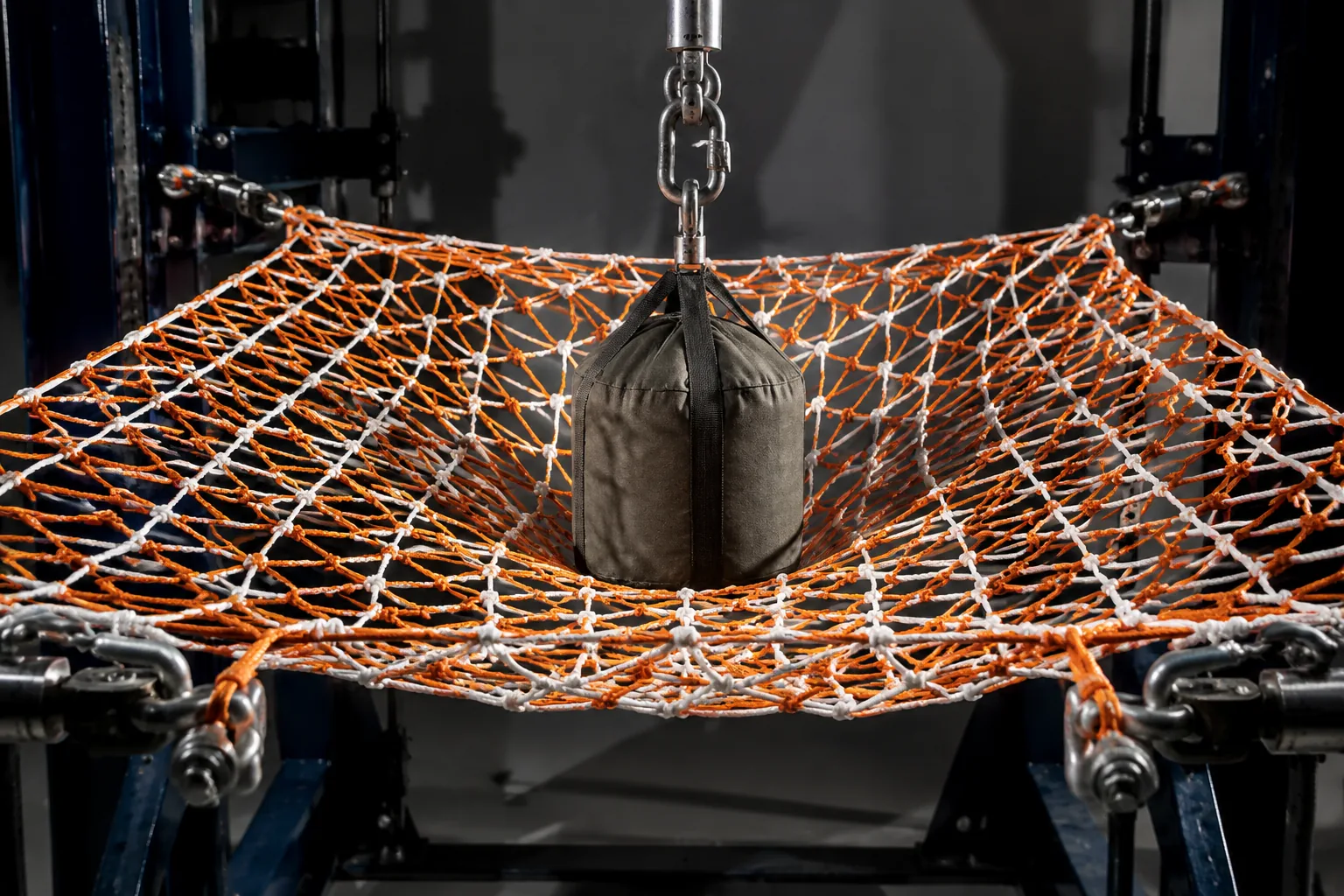
The energy-absorption test is the defining mechanical test in EN 1263-1. A representative net sample is rigged on a calibrated test frame, a defined impact mass is dropped into the net from a defined height, and the test verifies that the net arrests the mass without rupture and without exceeding the permissible deflection envelope.
The physics the test exercises is straightforward. The falling mass arrives at the net with kinetic energy E = m·g·h converted from its potential energy, where m is the mass, g is gravitational acceleration (9.81 m/s²) and h is the drop height. The net must absorb this energy by deflecting — the mesh and border ropes elongate, the knots or joints in knotless construction slip slightly, and the energy is dissipated as mechanical work in the deformation. A net that is too stiff transfers excessive force to the falling person; a net that is too soft deflects too far and risks ground strike. The EN 1263-1 class threshold (2.3 kJ for Class A, 4.4 kJ for Class B) is the energy the net must absorb within the permissible deflection.
A recurrent finding in this test is that knotted and knotless nets behave differently on repeated impacts. When a load lands on a knotted net, the knots near the impact point tighten permanently; the tightening is irreversible and reduces the energy the net can absorb on subsequent impacts. Knotless nets do not exhibit this progressive tightening, which is one of the reasons knotless construction is increasingly preferred for nets expected to see repeated loading. This is a testing observation with a direct bearing on in-service inspection: a knotted net that has arrested one fall has a reduced energy-absorption capacity that the test must re-verify before the net returns to service.
The test also exposes the interaction between the net and its border rope. The border rope is the continuous rope passing through each mesh around the net's perimeter, and EN 1263-1 requires it to have a minimum tensile strength of 30 kN (tested under clause 7.5). The same 30 kN minimum applies to the tie ropes that fasten the net to the structure; the coupling ropes that join adjacent nets carry a lower 7.5 kN minimum because they join rather than anchor. A net that passes the energy-absorption test but fails a border-rope or tie-rope tensile check is non-compliant, because the load path from the arrested fall runs through the ropes, not just the mesh.
How is mesh and rope strength measured?
The strength of the netting itself is measured at two scales: the whole-mesh breaking force, and the yarn or cord tensile strength. The two tests answer different questions and are not interchangeable.
Mesh breaking force is determined under ISO 1806, which specifies that a single mesh — a loop of netting formed at the knot or node — is clamped in a tensile testing apparatus and extended until rupture occurs at one of the knots or joints. The test may be carried out in the dry or the wet state, and the wet state is particularly relevant for nets used in environments where moisture affects cord performance. The result is the mesh-breaking force in newtons. This is the strength property the net actually relies on in service, because overloaded netting characteristically fails at the knots rather than in the strand between knots — the stress concentration at the knot is where the rupture initiates.
Cord or yarn tensile strength is determined under ISO 1805, which tests the breaking force of the netting yarn or thread itself rather than the finished mesh. ISO 1805 answers the materials question (is the cord strong enough); ISO 1806 answers the construction question (does the assembled mesh hold together under load). A specification that quotes only ISO 1805 is documenting a property the user never relies on in isolation, because the weakest point of an assembled net is the knot, not the strand.
For the rope components — border rope, tie rope, coupling rope — EN 1263-1 clause 7.5 specifies a direct tensile test to the breaking strength minimum (30 kN for border and tie rope, 7.5 kN for coupling rope). Mesh rope is required to be made from at least three separate strands, braided so they cannot unravel, and is tested under clause 7.3.
The equipment used for these tests is a computer-controlled universal testing machine fitted with bollard grips for rope specimens and appropriate clamps for mesh specimens. A manually operated test machine is not acceptable under the common standard — the test machine must be calibrated to BS EN ISO 7500-1 and re-calibrated before the end of the month in which the current calibration expires. This is not a footnote; the calibration traceability is what makes the test result admissible in a conformity report.
What is the UV deterioration test, and why is it annual?
Safety nets are manufactured predominantly from polypropylene or nylon, and both materials are degraded by ultraviolet light. UV exposure embrittles the polymer, reducing the energy-absorption capacity of the net below its as-manufactured class value. The reduction is invisible — UV degradation is generally not detectable by visual inspection — so the only way to confirm that an in-service net still meets its manufacturer's minimum energy-absorption capacity is to test it.
EN 1263-1 clause 7.7 specifies the UV deterioration test. The procedure is that each safety net carries one or more test meshes — small sections of the same mesh material as the net, attached to the net and exposed to the same service conditions. At intervals of no more than 12 months, a test mesh is removed and tested to breaking; the result is compared to the manufacturer's withdrawal-from-service level, which is the minimum strength at which the net must be retired. If the test mesh meets or exceeds the withdrawal level, the net is recertified for a further 12 months and a new test tag is attached; if it fails, the net is withdrawn from service.
The procedural requirements of the test, codified in industry practice and reinforced by FASET (Fall Arrest Safety Equipment Training), are:
- The test is run at a break speed of 300 mm per minute.
- For both knotted and knotless nets of A2 and B2 specification (100 mm mesh), the test is carried out on the square across one cell only.
- If a sample fails by less than 5% below the manufacturer's withdrawal level, the net may be retested once.
- The test machine must be calibrated to BS EN ISO 7500-1:2004 and re-calibrated before the end of the month in which calibration expires; manually operated machines are not permitted.
- Test results must be recorded by computer printout or in electronic format, listing date, serial number, test result and manufacturer; full records must be kept for traceability.
- A tag must be attached to each net following a successful test, showing the testing company's name, the date of test, the date of next test, and confirmation of pass.
The 12-month frequency is a maximum, not a target. A net subjected to high UV exposure — sustained outdoor service in a sunny climate, prolonged storage in direct sunlight, exposure to welding spatter or chemical contamination — may degrade faster than the annual cycle assumes, and an in-service inspection that identifies such exposure should trigger an interim test rather than waiting for the calendar interval.
How does the Chinese GB 5725 standard differ from EN 1263?
GB 5725, the Chinese national standard for safety nets, is structurally different from EN 1263 and is not a translation of it. The differences matter because a safety net qualified under one regime is not automatically qualified under the other, and a Chinese construction site expects a GB 5725 conformity report regardless of what EN 1263 testing the same net has passed.
The three principal differences are:
Classification by net type, not by energy class. GB 5725 classifies safety nets into three types — flat nets (安全平网, horizontally rigged to catch falling persons or objects), vertical nets (安全立网, vertically rigged for edge protection), and fine-mesh vertical nets (密目式安全立网, the dense mesh used for facade debris containment, graded A or B). EN 1263-1 classifies by energy absorption class (A or B) crossed with mesh size class (1 or 2). A GB 5725 fine-mesh vertical net and an EN 1263-1 Class A2 system net are different products answering different installation questions.
Impact test with a 120 kg test mass. GB 5725 specifies the impact test (耐冲击性能) using a defined test sphere or surrogate of 120 kg, dropped from a specified height onto the test net, with the pass criterion defined by the extent of damage observed — the test methodology is set out in Appendix A of GB 5725. EN 1263-1 uses the energy-class system (2.3 kJ / 4.4 kJ) expressed in joules, derived from a defined mass and height but reported as an energy figure rather than as a pass/fail observation on a specific drop.
Separate test requirements for fine-mesh vertical nets. GB 5725 contains specific requirements for the fine-mesh vertical net that have no direct EN 1263 equivalent: breaking strength of the mesh and of the seam, breaking strength of the tie cord (tested on a force gauge with range greater than 2 kN and class-1 accuracy), puncture resistance (耐贯穿性能), and the impact test. These are the properties that determine whether a fine-mesh net installed on a building facade will retain debris under impact, which is the dominant use case for this net type in Chinese construction.
A regulatory point that affects specifications we receive: GB 5725-2009 is in the process of being superseded by GB 5725-2025. The 2009 edition, which consolidated the earlier GB 5725-1997 and GB 16909-1997 (the fine-mesh vertical net standard) into a single document, remains in force but is scheduled for full replacement. A conformity project that will run into the transition window should confirm with the customer whether the report is to be issued against the 2009 edition or the incoming 2025 edition, because the test scope and the pass criteria may differ between the two.
What does a drop test at the jobsite actually verify?
The EN 1263-1 and GB 5725 laboratory tests qualify the net as a product. The jobsite drop test qualifies the installation — it verifies that the net, rigged as it actually is on this structure with these anchor points at this fall height, will arrest a representative fall. The two tests answer different questions and both are required for a defensible safety argument.
OSHA 29 CFR 1926.502(c) is the most prescriptive of the jobsite drop-test regimes. It requires that safety nets and their installations be drop-tested at the jobsite in four circumstances:
- After initial installation and before being used as fall protection.
- Whenever the net is relocated.
- After any major repair.
- At six-month intervals if the net is left in one place.
The OSHA drop test consists of a 400-pound (approximately 181 kg) bag of sand, 28 to 32 inches (approximately 711 to 813 mm) in diameter, dropped into the net from the highest surface at which employees are exposed to fall hazards, but from not less than 42 inches (approximately 1.07 m) above that level. The net and installation must absorb the impact without contact with the surface or structures below, and the net must not fail. Where an employer can demonstrate that the drop test is unreasonable to perform — for example, on a structure where dropping a 400-pound sandbag is itself hazardous — a competent person may certify the installation by preparing a certification record that identifies the net, the date of the determination, and the signature of the certifier.
The OSHA regime also sets installation criteria that the drop test implicitly exercises: nets must be installed as close as practicable under the working surface but in no case more than 30 feet (approximately 9.1 m) below; the horizontal extension of the net beyond the work edge must scale with the fall height (8 feet for falls up to 5 feet, 10 feet for falls of 5 to 10 feet, 13 feet for falls over 10 feet); maximum mesh size must not exceed 6 inches by 6 inches (approximately 152 mm); and each net must have a border rope with a minimum breaking strength of 5,000 pounds (approximately 22.2 kN).
A drop test that the net passes in the EN 1263-1 laboratory rig does not automatically satisfy the OSHA jobsite test, because the jobsite test exercises the rigging, the anchor points, the clearance and the actual fall geometry, not just the net. A complete project for a U.S.-market installation therefore includes both: the laboratory product qualification and the field drop-test documentation, with the two reports cross-referenced.
FAQ
Which standard should my safety net be tested to?
It depends on the target market and the net's application. European construction markets work to BS EN 1263-1 and 1263-2; Chinese construction works to GB 5725; U.S. construction works to OSHA 29 CFR 1926.502(c) for the installation and the jobsite drop test. We confirm the standard before quoting, because testing to the wrong standard produces a report that satisfies no one.
Can you test an in-service net, or only new nets?
Both. New nets are tested for product conformity to their declared class. In-service nets are tested annually for UV deterioration under EN 1263-1 clause 7.7, using the test meshes attached to the net, with the result compared to the manufacturer's withdrawal-from-service level. We also test nets that have arrested a fall, because the energy-absorption capacity of a fall-arrested net — particularly a knotted net — is reduced and must be re-qualified before the net returns to service.
What sample do you need for a mesh-breaking-force test under ISO 1806?
A representative section of the netting, sufficient to clamp a single mesh in the tensile apparatus. The test is run dry or wet per the standard and the application; for nets used in wet service conditions, the wet-state test is the more representative result. We confirm the test state with the client befOre testing.
How do you handle a net that fails the UV test by a small margin?
Under industry practice, a sample that fails by less than 5% below the manufacturer's withdrawal-from-service level may be retested once. A second failure, or a first failure by more than 5%, retires the net. We report the measured value, the withdrawal level, the margin and the retest outcome, and we tag the net according to the result.
Do you test to GB 5725-2009 or the incoming GB 5725-2025?
We confirm the edition with the client at scoping. For projects whose report will be submitted to Chinese construction inspection, we recommend confirming the edition the receiving authority expects, because the 2009 edition and the incoming 2025 edition may differ in test scope and pass criteria. We can issue against either edition once the scope is fixed.
Our safety net testing service
Our laboratory provides safety net testing across the full range of applicable standards — BS EN 1263-1 for product conformity, BS EN 1263-2 and BS 8411 for positioning-limit verification, GB 5725 for the Chinese market (flat nets, vertical nets and fine-mesh vertical nets), ISO 1806 for mesh breaking force, and the OSHA 29 CFR 1926.502(c) jobsite drop-test requirements for U.S. installations. Each project begins with a standard-selection step that maps your net's application and target market to the correct specification, so the report you receive answers the question your regulator, contractor or customer will actually ask.
We perform energy-absorption testing to the EN 1263-1 class thresholds, mesh-breaking-force testing under ISO 1806 in both dry and wet states, border-rope and tie-rope tensile testing to the 30 kN / 7.5 kN minima, annual UV deterioration testing under EN 1263-1 clause 7.7 with test-mesh sampling and withdrawal-level comparison, impact testing under GB 5725 Appendix A with the 120 kg test mass, and conformity evaluation of new nets and re-qualification of in-service nets. Reports are issued with the standard, the test method, the measured value, the limit and the conformity conclusion explicitly stated, with test-machine calibration traceability recorded, in a format suitable for regulatory submission, contractor handover or internal safety audit.
To start a project, send us the net type, the declared class or GB 5725 type, the target market, the service history (for in-service nets) and any fall-arrest record. We will return a project scope, sample requirement, schedule and quotation, and begin testing on your confirmation.