Table of Contents
- What standards govern safety rope testing?
- How is dynamic safety rope tested under EN 892?
- How is low-stretch kernmantle rope tested under EN 1891?
- What destructive break testing reveals about residual strength?
- What non-destructive inspection can and cannot detect?
- When must a safety rope be retired?
- How do Chinese standards classify safety rope?
- FAQ
- Our safety rope testing service
What standards govern safety rope testing?
Safety rope testing has no single universal standard. The applicable specification depends on the rope's intended function — dynamic climbing line, low-stretch access line, escape line, or single-person suspension line — and on the regulatory regime of the market where the rope is sold or used. A testing laboratory that only quotes one standard is usually testing the wrong rope.
The principal reference standards our laboratory works to are grouped by function:
- Dynamic mountaineering ropes — EN 892 (Europe) and the technically equivalent UIAA 101; in China, GB/T 23268.1, which is based on BS EN 892.
- Low-stretch kernmantle ropes for rope access, rescue and work at height — EN 1891 (Type A for full-specification, Type B for lighter applications).
- Escape and rescue descent lines — EN 341 (descender systems) and EN 341-compatible escape ropes, with a commonly referenced minimum breaking strength of 13.5 kN.
- North American life-safety rope for fire and rescue services — NFPA 1983, which classifies rope as General Use or Technical Use by minimum breaking strength.
- Single-person board-type suspension equipment used for building facade work in China — GB 23525, a mandatory national standard that specifies the safety rope component together with the seat board, suspension belt and connectors.
A recurring source of confusion in specifications we receive is the conflation of GB/T 23268 with GB 23525. GB/T 23268 is a recommended sporting-equipment standard covering dynamic climbing rope; GB 23525 is a mandatory safety standard for the suspension system used by facade workers. Submitting a facade-work safety rope for GB/T 23268 testing produces a report that does not satisfy Chinese regulatory inspection, and the reverse error is equally common. Identifying the correct standard befOre testing is the single highest-value decision in the project.
How is dynamic safety rope tested under EN 892?
EN 892 governs dynamic ropes — the energy-absorbing lines used in climbing and fall-arrest applications where the rope is expected to stretch under load to limit peak impact force. The defining test is the dynamic fall test, in which a defined mass is released into a free fall and arrested repeatedly by the rope until the rope fails.
The standard parameters of the EN 892 fall test are:
- Single ropes — tested with an 80 kg mass; the rope must withstand at least 5 falls.
- Half ropes — tested with a 55 kg mass; the rope must withstand at least 5 falls.
- Twin ropes — tested as a pair with an 80 kg mass; the pair must withstand at least 12 falls.
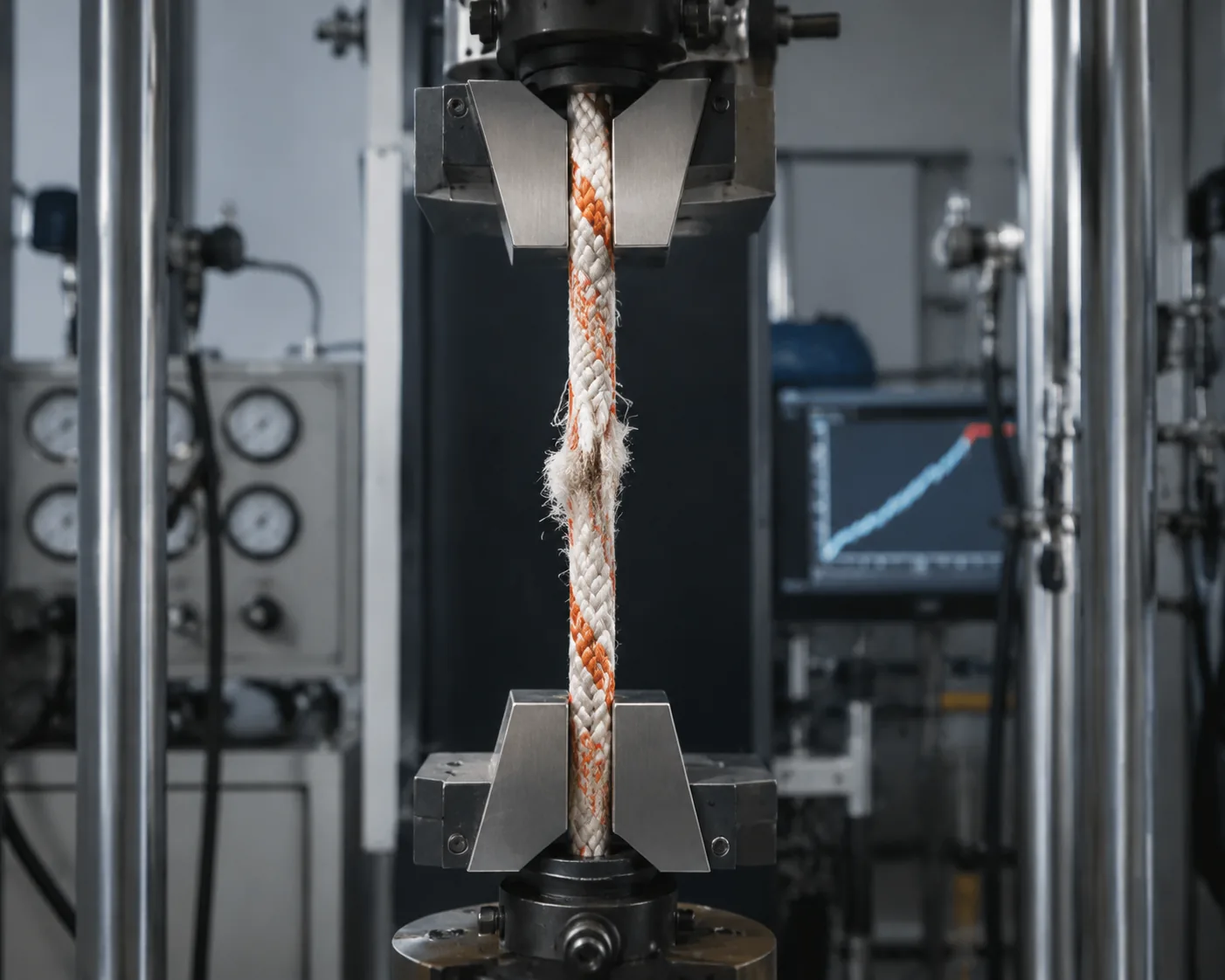
Two further pass criteria accompany the fall count. The impact force recorded on the first drop must remain below the standard ceiling: 12 kN for single and twin ropes, 8 kN for half ropes. This ceiling exists because impact force above roughly 12 kN exceeds the load the human body can tolerate in a harness, so a rope that arrests the fall but transmits excessive force still fails. The dynamic elongation on the first drop must not exceed 40%, because excessive stretch creates a striking hazard against ledges and the ground.
Beyond the dynamic test, EN 892 specifies a static elongation measurement under a fixed load and a sheath slippage test in which the rope is cycled through a defined apparatus and the sheath must not migrate more than 40 mm relative to the core over a 1930 mm test length. Sheath slippage is the defect behind the "sock slipping on the ankle" sensation in worn rope, and it is one of the parameters most often out of tolerance in ropes that have been in service.
The fall-test regime is the reason EN 892 cannot be performed on used rope with any meaningful pass/fail interpretation. Each drop consumes a portion of the rope's energy-absorption capacity; a rope that has arrested real-world falls has an unknown fraction of its original fall rating remaining. EN 892 testing is therefore a type-test and batch-test standard, applied to new rope, not a residual-life tool.
How is low-stretch kernmantle rope tested under EN 1891?
EN 1891 covers low-stretch — sometimes called "semi-static" — kernmantle rope used for rope access, industrial work at height, caving and rescue. Because these ropes are not intended to arrest dynamic falls, the test philosophy is different from EN 892: the rope is evaluated primarily for static strength, controlled elongation and termination performance.
The static strength thresholds in EN 1891 are:
- Type A ropes — minimum breaking strength not less than 22 kN without terminations.
- Type B ropes — minimum breaking strength not less than 18 kN without terminations.
- With terminations — a Type A rope must hold 15 kN and a Type B rope must hold 12 kN for three minutes without releasing the load.
The termination test is the more discriminating of the two for in-service rope, because almost every field failure of a low-stretch rope occurs at a termination — a knot, a sewn eye or a mechanical termination — rather than in the body of the rope. A laboratory that reports only the un-terminated breaking strength is documenting a property the user never actually relies on.
EN 1891 also specifies a fall test, but a less severe one than EN 892: the rope must withstand five falls with a defined mass without releasing it. This is a fall-arrest survival criterion, not an energy-absorption criterion, and it exists because low-stretch rope is sometimes subjected to a single accidental fall in service even though it is not designed for repeated dynamic loading.
Sheath slippage, static elongation (typically reported in the 3–5% range for new Type A rope under the standard load) and diameter tolerance round out the routine EN 1891 test set. Static elongation is the parameter rope-access technicians care about most, because it determines how far a worker descends when loading the rope at the top of a pitch — excessive elongation turns a controlled maneuver into an uncontrolled slide.
What destructive break testing reveals about residual strength?
Destructive break testing — pulling a sample to failure in a calibrated tensile machine — is the only measurement that produces an actual numerical breaking load for a specific piece of rope. For new rope it confirms conformity to the standard minimum. For in-service rope it answers a question that no non-destructive method can answer: what is the residual strength of this specific rope, right now?
The limitation is that break testing is, by definition, terminal for the sample. The standard laboratory approach is to take a representative sample — typically a one-to-three metre section cut from the end of a rope that has seen defined service — and break it as a proxy for the remainder of the rope. The result is a statistical inference, not a guarantee, and its usefulness depends on how representative the sample is of the worst-conditioned section of the rope. A clean sample cut from the bag end of a rope tells you nothing about a section that ran over a sharp edge mid-pitch.
Break-test results are normally reported as minimum breaking strength (MBS) derived from a sample population using the three-sigma statistical method, which is the basis for the working-load ratios cited in rigging literature — working load limits of 10% to 15% of MBS for general rigging, lower for human suspension. The reason working-load ratios are conservative is that laboratory break tests are run under ideal conditions: new termination, steady pull, room temperature, dry rope. Knots, moisture, contamination, edge contact and dynamic loading all reduce the in-service strength below the laboratory figure — a knotted rope commonly retains only 40–60% of its un-knotted breaking strength.
For these reasons destructive break testing is best deployed selectively: on rope populations with a defined and undocumented service history, on rope recovered from an incident, or as a periodic audit sample from a fleet of identical ropes. It is not, and should not be presented as, a substitute for inspection of every rope in service.
What non-destructive inspection can and cannot detect?
Non-destructive examination of fiber safety rope is dominated by visual and tactile inspection, formalized in standards such as ASTM F1740, which defines the procedure for inspecting life-safety rope. The inspector works the rope section by section through gloved hands while simultaneously examining the sheath for the catalog of retirement indicators: cuts, glazing, soft or hard spots, diameter variation, discoloration, chemical contamination and melted or fused areas.
What visual-tactile inspection reliably detects:
- Surface cuts and abrasion to the sheath
- Glazing or fusing from frictional heat
- Soft spots indicating core damage or contamination
- Hard spots indicating compressed or fused core
- Chemical discoloration and contamination
- Diameter variation from core migration or damage
What visual-tactile inspection cannot reliably detect:
- Core damage beneath an intact sheath — the single most important limitation
- Cumulative strength loss from fatigue that has not yet produced a visible symptom
- Chemical degradation that has not yet produced a visible symptom
- The numerical residual strength of the rope
This last limitation is decisive. No accepted non-destructive method exists that assigns a residual breaking strength to a used fiber rope. The honest position, echoed across competent inspection authorities, is that inspection can identify a rope that should be retired, but it cannot certify a rope as fit for continued service at a defined strength. The pass outcome of an inspection is "no disqualifying defect found today," not "this rope is good for another N kN."
For wire rope used in lifting and cable applications, the situation is different: magnetic rope testing (MRT) can detect internal broken wires, corrosion and cross-section loss through the lubricant and outer wires. MRT is a genuine quantitative non-destructive method, but it applies to steel wire rope, not to fiber kernmantle rope. Conflating the two — sometimes seen in marketing material — is a category error.
When must a safety rope be retired?
Retirement criteria combine condition-based and age-based rules. The condition-based rules are the inspection findings enumerated under ASTM F1740 and equivalent procedures: any visible or tactile defect that compromises the sheath or core — cut, glaze, soft spot, hard spot, contamination, diameter change, discoloration of unknown origin — retires the rope immediately and finally. There is no remediation for a damaged fiber rope.
The age-based rules address the hidden-strength-loss problem. Even a rope that passes inspection accumulates degradation that inspection cannot measure. The widely cited retirement ages in life-safety use are:
- Rope of unknown or undocumented history — retire immediately; a rope without a service log cannot be inspected because its history is part of the inspection.
- Rope in frequent service — typically retired at five years from first use.
- Rope in infrequent service with documented storage — typically retired at ten years from manufacture, sometimes expressed as ten years from first use for rope that has seen little or no service.
These ages are not the rope's physical service life — a well-stored rope may retain most of its strength well beyond ten years. They are administrative ages set so that the retirement decision is made on a conservative schedule rather than left to a judgment that inspection cannot fully support. A testing laboratory's role is to provide the destructive data that lets an organization calibrate its own retirement schedule to its actual usage, rather than relying on the generic defaults.
The retirement decision is also irreversible. A rope retired under an organization's procedure must be destroyed or permanently marked as unserviceable; returning a retired rope to service is the failure mode that retirement procedures exist to prevent.
How do Chinese standards classify safety rope?
The Chinese regulatory landscape for safety rope splits along two axes that are often confused in specifications we receive: the mandatory versus recommended axis, and the sporting versus occupational axis.
GB 23525, Safety technical specification for personal board-type sling equipment suspension work, is a mandatory national standard administered through the emergency-management regulatory framework. It governs the complete suspension system used by facade workers — the seat board, the suspension belt, the working rope and the safety rope, and the connectors between them. Key provisions relevant to the safety rope component include a limit on the effective length of the safety rope, material requirements excluding low-melting fibers such as polypropylene, and defined test methods for the strength and performance of each component. Compliance with GB 23525 is what Chinese occupational-safety inspection expects of facade-work equipment.
GB/T 23268, Requirements for sports protective equipment, is a recommended standard. Its Part 1 covers dynamic mountaineering rope and is based on BS EN 892. It applies to sporting equipment, not to occupational suspension equipment. A facade-work safety rope tested to GB/T 23268 holds a report that the occupational regulator does not recognize, because the wrong question was asked.
A third category — general fall-protection equipment including safety harnesses and lanyards — falls under the GB 6095 family, which is again distinct from both GB 23525 and GB/T 23268. Selecting the correct Chinese standard for a given safety rope requires first identifying the application, then mapping the application to the regulatory framework, and only then quoting the standard. Our laboratory provides this mapping as a defined pre-test step on every Chinese-standard project.
FAQ
Can you test a used rope and tell me if it is still safe to use?
We can perform destructive break testing on a representative sample and report its residual breaking strength. We cannot certify a used fiber rope as fit for continued service at a defined load, because no accepted non-destructive method can do that. The break-test result is a numerical datum for your retirement decision; it is not a green light.
Which standard should my rope be tested to?
It depends on the rope's intended function and its target market. Dynamic climbing rope is tested to EN 892 or GB/T 23268.1; low-stretch access rope to EN 1891; North American rescue rope to NFPA 1983; Chinese facade-work equipment to GB 23525. We confirm the standard before quoting, because testing to the wrong standard produces a report that satisfies no one.
What sample size do you need for break testing?
A representative section, typically one to three metres, cut from the end of the rope or from the location of greatest concern. The sample must be documented — where it came from in the rope, what service that section saw — because the result is only as representative as the sample.
Do you issue reports accepted by regulatory inspection?
Yes. We issue test reports against the cited standards in a format suitable for regulatory submission, with the standard, the test method, the measured values and the pass/fail conclusion clearly identified. For Chinese-market work we confirm whether the applicable standard is GB 23525, GB/T 23268 or GB 6095 before testing begins.
How long does a safety rope test project take?
A standard EN 892, EN 1891 or NFPA 1983 conformity project on new rope is typically completed within the standard laboratory turnaround for that standard. Destructive break testing of used-rope samples is faster. We provide a project-specific schedule after confirming the standard and sample count.
Our safety rope testing service
Our laboratory provides safety rope testing across the full range of applicable standards — EN 892 for dynamic rope, EN 1891 for low-stretch kernmantle, EN 341 for escape systems, NFPA 1983 for North American life-safety rope, and GB 23525 / GB/T 23268 / GB 6095 for the Chinese regulatory framework. Each project begins with a standard-selection step that maps your rope's application to the correct specification, so that the report you receive answers the question your regulator or customer will actually ask.
We perform dynamic fall testing, static and termination strength testing, elongation and sheath-slippage measurement, conformity evaluation of new rope, and destructive break testing of in-service samples for residual-strength assessment. Reports are issued with the standard, the test method, the measured values and the conformity conclusion explicitly stated, in a format suitable for regulatory submission, customer qualification or internal audit.
To start a project, send us the rope's intended application and target market, the standard you believe applies (or let us confirm it), and the number of samples available. We will return a project scope, schedule and quotation, and begin testing on your confirmation.