Table of Contents
- What standards govern seamless Steel pipe testing?
- How is chemical composition verified?
- What mechanical tests are required?
- How is non-destructive testing applied to seamless pipe?
- What are the process performance tests for pipe?
- How do the Chinese GB/T seamless pipe standards differ?
- What does metallographic examination reveal?
- FAQ
- Our seamless steel pipe testing service
What standards govern seamless steel pipe testing?
Seamless steel pipe testing is governed by two layers of standards that must be specified together: the product specification that defines what the pipe must be (its chemistry, its mechanical properties, its dimensional tolerances, its end-use category), and the test-method standards that define how each property is measured. A test report that quotes only the product specification, without naming the test methods, is unverifiable — it tells the reader what the result was compared against, but not how the result was obtained.
The product specifications for carbon-steel seamless pipe fall into two families.
The ASTM/API family, used for North American and international market pipe:
- ASTM A106, Standard Specification for Seamless Carbon Steel Pipe for High-Temperature Service — the workhorse carbon-steel seamless pipe for high-temperature service, with Grade B the most commonly specified.
- ASTM A53, Standard Specification for Pipe, Steel, Black and Hot-Dipped, Zinc-Coated, Welded and Seamless — the general-purpose carbon-steel pipe specification, covering both welded and seamless; Grade B again the common grade.
- ASTM A333, Standard Specification for Seamless and Welded Steel Pipe for Low-Temperature Service — the low-temperature carbon and alloy pipe specification, with grades selected for notch toughness at sub-zero service.
- API 5L, Specification for Line Pipe — the API specification for pipeline transportation, with the PSL1 / PSL2 product-specification-level distinction that tightens chemistry, toughness and inspection requirements for the higher PSL.
The Chinese GB/T family, used for the Chinese market and selected export markets, splits the same physical product into four application-specific standards:
- GB/T 8163, Seamless steel pipes for liquid service (std.samr.gov.cn) — general fluid-conveying pipe for water, oil and gas at conventional pressures. The standard explicitly excludes the special-application pipe that has its own dedicated standards.
- GB/T 5310, Seamless steel tubes and pipes for high pressure boiler — high-temperature, high-pressure boiler pipe for power-station service, with stricter chemistry, tighter dimensional tolerances and additional high-temperature testing.
- GB/T 3087, Seamless steel tubes for low and medium pressure boiler — the lower-pressure boiler counterpart to GB/T 5310.
- GB/T 9948-2025, Seamless steel tubes for petrochemical and chemical plants (std.samr.gov.cn) — the consolidated petrochemical standard, which in its 2025 edition absorbs the former GB/T 6479 (high-pressure fertilizer-equipment pipe) into a single petrochemical-and-chemical-equipment specification.
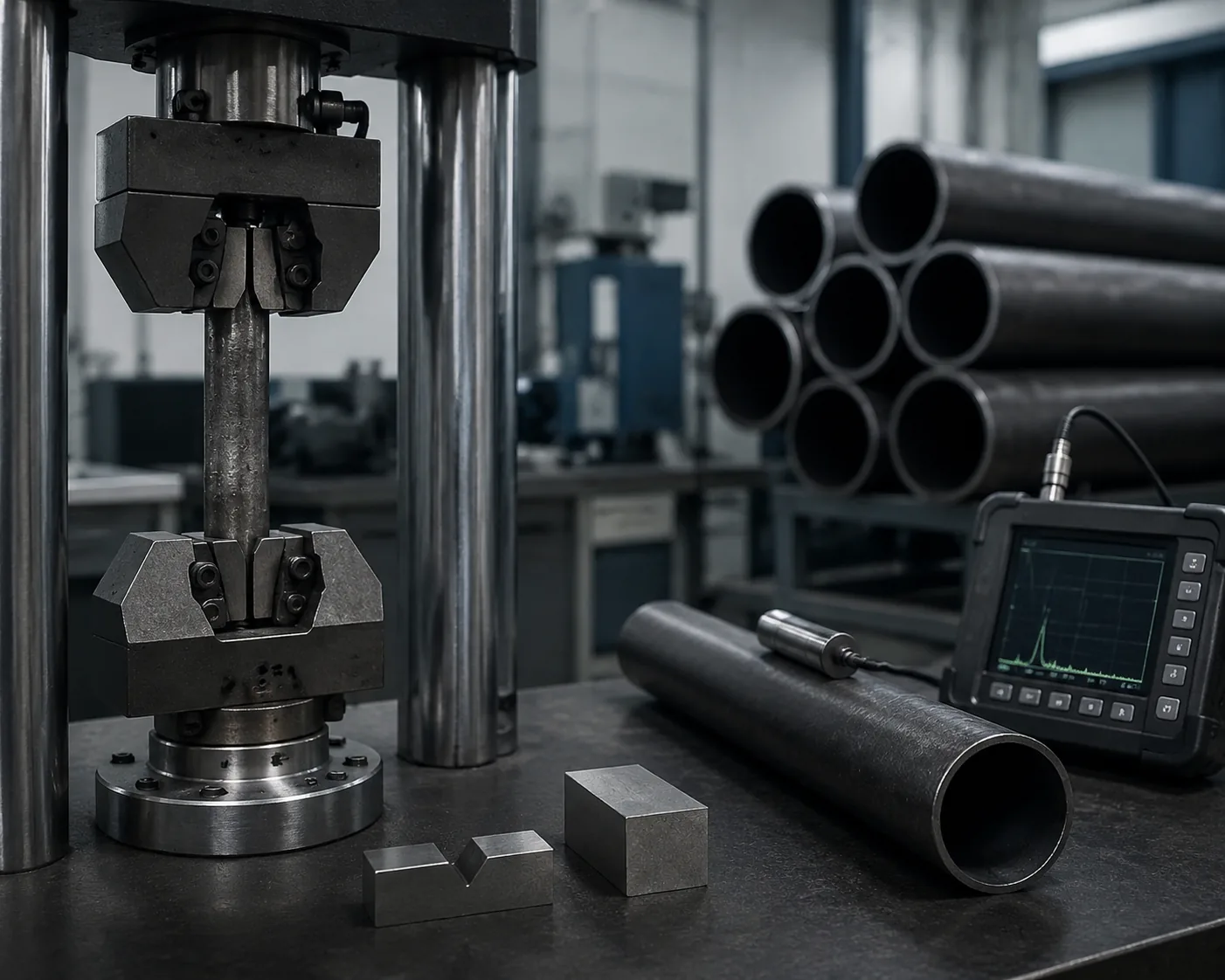
The test-method standards, used whichever product specification applies, include:
- ASTM A370, Standard Test Methods and Definitions for Mechanical Testing of Steel Products (astm.org) — the master mechanical-test-method standard covering tension, bend, impact and hardness testing of steel.
- ASTM E8 / E10 / E18 / E92 / E23 — the individual tensile, Brinell, Rockwell, Vickers and Charpy-impact test-method standards referenced by A370.
- GB/T 228, GB/T 230, GB/T 231, GB/T 229, GB/T 241, GB/T 242, GB/T 246 — the Chinese test-method standards for tensile, Rockwell hardness, Brinell hardness, impact, hydraulic, flattening and flaring tests respectively.
A common and consequential mistake in specifications we receive is to specify a pipe by its application without naming the product specification, or to specify the product specification without naming the application. A "high-pressure boiler pipe" tested to GB/T 8163 (the fluid-service standard) holds a report that satisfies no boiler inspector, because GB/T 8163 explicitly does not cover boiler service and the chemistry, tolerances and high-temperature testing the boiler application requires were never run. The product specification and the application must be confirmed together befOre testing begins.
How is chemical composition verified?
Chemical composition is the property that determines whether a pipe can be classified as the grade it is sold as. Carbon controls hardness and strength; manganese controls strength and toughness; silicon affects weldability; phosphorus and sulfur control brittleness and hot-shortness; chromium, nickel and molybdenum control corrosion and high-temperature performance. A pipe whose chemistry falls outside the grade limits is not the grade, regardless of how it performs mechanically.
The composition limits for the common carbon-steel grades differ across standards, and the differences matter. Representative maxima for the dominant carbon-steel seamless grades are:
- API 5L Grade B PSL1 — carbon 0.28 % max, manganese 1.20 % max, phosphorus 0.030 % max, sulfur 0.030 % max.
- API 5L Grade B PSL2 — carbon 0.24 % max, manganese 1.20 % max, phosphorus 0.025 % max, sulfur 0.015 % max. The PSL2 level tightens phosphorus and sulfur substantially — the cleaner steel is the principal reason PSL2 is specified for the more demanding pipeline services.
- ASTM A53 Grade B — carbon 0.30 % max, manganese 1.20 % max, phosphorus 0.050 % max, sulfur 0.045 % max.
- ASTM A106 Grade B — carbon 0.30 % max, manganese 1.06 % max, phosphorus 0.035 % max, sulfur 0.040 % max, silicon 0.10 % min.
The composition is verified by two complementary analytical routes.
Wet chemical analysis — the classical gravimetric and volumetric methods, used as the referee where a dispute over the instrumental result must be resolved.
Instrumental analysis — the production route. The infrared carbon-sulfur analyzer quantifies C and S from the combustion products of a weighed sample; the direct-reading optical-emission spectrometer (OES) quantifies the full element suite (C, Si, Mn, P, S, Cr, Mo, Ni, Cu, Al, V, Ti, Nb, W and the trace residuals) from the emission spectrum of a spark-excited sample; the nitrogen-oxygen analyzer quantifies the gas content. The OES is the workhorse instrument for a grade-verification project, because it returns the full chemistry from one sample preparation in one run.
The reason both routes matter is that the instrumental methods are calibrated against certified reference materials, and a disagreement between the instrumental result and the wet-chemical result on a borderline element is the kind of finding that can reclassify a pipe from "conforming" to "non-conforming" — a reclassification with direct commercial consequences. A laboratory that reports only the instrumental value without the calibration traceability leaves the result open to challenge; a laboratory that runs the wet-chemical referee on borderline elements closes that gap.
What mechanical tests are required?
The mechanical tests verify that the pipe, as manufactured, has the strength, the ductility and the toughness that the grade and the application require. Under ASTM A370, the master mechanical-test-method standard, these tests divide into six methods: tension, bend, Charpy impact, Brinell hardness, Rockwell hardness and portable hardness. For seamless pipe, the dominant three are tension, impact and hardness.
Tensile testing (ASTM A370 / E8, GB/T 228). A specimen machined from the pipe — a longitudinal or transverse specimen, depending on the product specification and the pipe diameter — is pulled to fracture on a calibrated tensile machine, and the test records the yield strength, the tensile strength, the elongation after fracture and the reduction of area. These are the properties that determine whether the pipe can carry the pressure and the structural load it is designed for. The pass thresholds for the common grades are explicit: ASTM A106 Grade B and ASTM A53 Grade B both specify tensile strength of 415 MPa minimum and yield strength of 240 MPa minimum; the elongation requirement differs, with A53 Grade B requiring 30 % minimum against A106 Grade B's 22 % minimum — a difference that reflects A106's high-temperature-service design intent, where higher strength is traded against lower ductility.
Charpy V-notch impact testing (ASTM A370 / E23, GB/T 229). A standard notched specimen — 10 × 10 × 55 mm for the standard sample, 5 × 10 × 55 mm for the sub-size sample used when the pipe wall will not yield a full-size specimen — is fractured by a pendulum on a calibrated impact machine, and the energy absorbed in joules is the impact toughness. For pipes intended for low-temperature service (ASTM A333 grades) or for the higher API 5L product specification level (PSL2), the impact test is mandatory and is run at the minimum service temperature. A pipe whose impact toughness falls below the standard minimum at the service temperature is a pipe that may fail in brittle fracture when the temperature drops — the failure mode the impact test exists to prevent.
Hardness testing (ASTM A370 / E10 / E18 / E92, GB/T 230 / 231). Hardness is measured by pressing a hard indenter into the prepared pipe surface under a defined load and measuring the indentation (Brinell measures the indentation diameter; Rockwell measures the indentation depth; Vickers measures the diagonal of a diamond-pyramid indentation). Hardness correlates approximately with tensile strength, so for pipe where a full tensile specimen cannot be machined, hardness is used as a proxy. A practical constraint in ASTM A370: Brinell hardness testing is not applicable to tubular products less than 2 in (51 mm) in outside diameter, or less than 0.200 in (5.1 mm) in wall thickness, because the indenter requires sufficient wall to support the load without the pipe deforming locally. For thin-wall or small-diameter pipe, Rockwell or Vickers — which use smaller indenters and lighter loads — replace Brinell. A test report that quotes a Brinell hardness on a pipe below the Brinell-applicability threshold is reporting a measurement the standard does not support.
The hardness-versus-tensile trade-off is the reason the three methods coexist rather than one displacing the others. Brinell produces a large indentation that averages over a heterogeneous structure and reads well on heavy wall, but it cannot read thin wall. Rockwell is fast and reads well across the soft-to-hard range, but its small indentation is more sensitive to local variation. Vickers resolves thin materials and surface layers that neither Brinell nor Rockwell can address, but it is slower and is used less frequently in pipe specifications. The method chosen for a given project is driven by the pipe geometry.
How is non-destructive testing applied to seamless pipe?
Non-destructive testing (NDT) verifies the integrity of the pipe wall without destroying the pipe. For seamless pipe, which has no weld seam whose defects must be inspected, the NDT programme is focused on the body of the pipe — the longitudinal and transverse flaws, the laminations and the wall-thickness variations that can be present in any seamless product. Three NDT methods dominate seamless-pipe inspection.
Ultrasonic testing (UT). A high-frequency sound wave is coupled into the pipe wall from an external transducer and reflects off the inner wall and off any internal discontinuity. The time-of-flight of the reflections measures the wall thickness, and the pattern of the reflections from within the wall reveals cracks, laminations and inclusions. UT is sensitive to both surface and internal defects in materials of uniform structure, which makes it the principal method for body-wall inspection of seamless pipe. It is also the method used to verify wall thickness to the dimensional tolerance, which matters for the pressure calculation.
Eddy-current testing (ET). An alternating-current coil induces eddy currents in the pipe wall, and the impedance change in the coil as it passes over a defect is the signal. ET is a non-contact electromagnetic method, fast enough for automated production-line inspection, and is particularly sensitive to surface and near-surface defects — especially the point-type defects (pinholes, pits) that UT is less sensitive to. ET is the method most commonly applied to the full-length, full-circumference body inspection of seamless pipe in production.
Magnetic-particle inspection (MT) and magnetic-flux-leakage (MFL). For ferromagnetic steels, magnetizing the pipe wall and applying iron particles (MT) or detecting the flux leakage from a defect with a coil (MFL) reveals surface and near-surface flaws. MT is the manual method, used on selected areas; MFL is the automated method, used for full-length inspection. MFL in particular is a standard method for pipe-mill production inspection because it is fast, it does not require a coupling medium, and it reads the kind of surface flaws that degrade the pipe in service.
Radiographic testing (RT) is available but is less commonly applied to seamless pipe body inspection than to weld inspection, because the wall geometry and the absence of a weld seam make UT and ET the more efficient methods for the seamless-pipe body.
The selection of NDT methods for a given pipe is driven by the product specification. GB/T 5310 (high-pressure boiler pipe) requires a more rigorous NDT programme than GB/T 8163 (fluid-service pipe), because the consequence of a defect in high-pressure boiler service is more severe. The same physical pipe tested to GB/T 8163's NDT requirements would not satisfy a GB/T 5310 inspector, because the inspection sensitivity and the coverage are different. This is one of the reasons the product specification cannot be selected independently of the application.
What are the process performance tests for pipe?
Process performance tests verify that the pipe can withstand the deformation it will experience in fabrication and service — the flattening, the bending, the expanding and the flaring that the pipe undergoes when it is formed into a fitting, bent around a corner, or expanded into a tubesheet. These are the tests that catch the brittle or the poorly-ductile pipe that would crack in fabrication rather than deform.
Flattening test (ASTM A999 / GB/T 246). A specimen cut from the pipe is flattened between two parallel plates to a defined separation, and the specimen is inspected for cracks. The pass criterion is that no crack or defect develops beyond the standard allowance. For thicker-wall pipe (where the wall-to-diameter ratio exceeds a defined threshold), a C-shaped specimen is used. The flattening test is the most widely specified process test for seamless pipe because it exercises both the ductility and the soundness of the wall in one operation.
Flaring and curling test (GB/T 242 / ASTM A450). The end of the pipe is expanded over a cone of defined angle (commonly 30°, 40° or 60°) to a defined increase in diameter, and the specimen is inspected for cracks. The flaring test simulates the deformation the pipe undergoes when it is expanded into a fitting or a tubesheet; the curling test does the same with the deformation in the opposite sense. Both tests are specified for heat-exchanger and boiler service, where the pipe-to-tubesheet expansion is a routine fabrication step.
Bending test (ASTM A370 / GB/T 232). A full-section specimen is bent around a defined radius to a defined angle, and the specimen is inspected for cracks. The bending test is the alternative to the flattening test for larger-diameter pipe where a flattening specimen would be impractical.
Ring-tensile test. A ring cut from the pipe is loaded in tension across a defined gauge length, and the specimen is inspected for cracks. The ring-tensile test is specified for applications where the circumferential ductility must be confirmed independently of the longitudinal ductility that the standard tensile test measures.
Hydraulic test (GB/T 241 / ASTM A999). The pipe is pressurized internally with water to a defined test pressure, held for a defined stabilization time, and inspected for leakage, rupture or excessive deformation. The test pressure is calculated from the wall thickness, the outside diameter and the specified minimum yield strength, and the test confirms that the pipe as manufactured can sustain the pressure it is rated for. The hydraulic test is the final pressure-integrity verification before the pipe ships, and it is the test that catches the through-wall defect that UT or ET missed — a defect that would weep or rupture under service pressure.
The combination of process tests matters because each one exercises a different deformation mode. A pipe that passes the flattening test can still fail the flaring test, because the flaring test concentrates the deformation at the pipe end where the manufacturing residual stresses may differ from the body. A complete process-test programme covers flattening (or bending for large pipe), flaring (for heat-exchanger and boiler service), and the hydraulic test as the pressure-integrity check.
How do the Chinese GB/T seamless pipe standards differ?
The four Chinese seamless-pipe product specifications cover the same physical product — a seamless steel pipe — but split it by application, with chemistry, dimensional tolerances, NDT requirements and supplementary testing tailored to each application. The differences are not cosmetic; selecting the wrong standard for a given application produces a report that the receiving authority will not accept, and a pipe that may not be safe in the service it is used for.
The four standards and their applications are:
- GB/T 8163, Seamless steel pipes for liquid service — general fluid-conveying pipe for water, oil and gas at conventional pressures. The chemistry control is relatively relaxed (phosphorus and sulfur limits do not meet the tighter pressure-vessel requirements), the dimensional tolerances are wider, and the NDT requirements are the basic set. This is the pipe for non-critical fluid service where the consequence of a failure is limited.
- GB/T 5310, Seamless steel tubes and pipes for high pressure boiler — high-temperature, high-pressure boiler pipe for power-station service. The chemistry is tighter, the dimensional tolerances are stricter, the NDT programme is more rigorous, and the standard adds the high-temperature mechanical testing that boiler service requires. The common grades include the alloy steels (15CrMoG, 12Cr1MoVG) alongside the carbon steel (20G), because carbon steel alone is not adequate at boiler service temperatures.
- GB/T 3087, Seamless steel tubes for low and medium pressure boiler — the lower-pressure boiler counterpart to GB/T 5310, for industrial boilers operating below the high-pressure threshold.
- GB/T 9948-2025, Seamless steel tubes for petrochemical and chemical plants — the consolidated petrochemical standard. The 2025 edition is a regulatory transition worth noting: it absorbs the former GB/T 6479, Seamless steel tubes for high-pressure chemical fertilizer equipment, into a single petrochemical-and-chemical specification. The 2013 edition of GB/T 9948 has been withdrawn, and GB/T 6479 is no longer a standalone standard. A project that specified GB/T 6479 in its original scope must now be quoted and reported against GB/T 9948-2025.
The "wrong standard, wrong application" trap is the single most common conformity problem in Chinese-market seamless-pipe projects. A pipe tested to GB/T 8163 cannot be reported as GB/T 5310, because the high-temperature testing, the tighter chemistry and the stricter NDT were never run. A pipe tested to the withdrawn GB/T 9948-2013 cannot be reported as the current GB/T 9948-2025, because the standard has changed. The product specification must be confirmed against the current edition and the application before testing begins, and a project that spans the GB/T 6479-to-GB/T 9948-2025 transition should confirm with the receiving authority which document the conformity argument must cite.
What does metallographic examination reveal?
Metallographic examination looks inside the pipe wall at the microstructure and the macrostructure that the chemistry and the mechanical tests cannot see directly. It is the test that explains why a pipe passed or failed the mechanical tests, by revealing the grain structure, the non-metallic inclusions and the macro-defects that determine the bulk behaviour.
Macrostructure examination (low-magnification). A cross-section of the pipe wall is prepared by acid etching and examined visually or at low magnification. The test reveals the macro-defects that a chemistry or mechanical test cannot detect directly: white spots (flakes), non-metallic inclusions, subcutaneous bubbles, skin folding and delamination. None of these defects is permitted on the etched cross-section of a conforming pipe. The macro-examination is also where the segregation — the non-uniform distribution of alloying elements from the casting — is evaluated.
Microstructure examination (high-magnification). A polished and etched specimen is examined under the metallurgical microscope, and the grain size, the phase distribution and the non-metallic inclusions are evaluated. The grain size matters because it correlates with strength and toughness — a fine, uniform grain structure is what a well-controlled rolling and heat-treatment schedule produces, and a coarse or mixed grain structure is the indicator of a process excursion. The non-metallic inclusions (oxides, sulfides, silicates) are rated against the standard inclusion-rating charts, because excessive inclusions degrade fatigue and toughness even when the bulk chemistry is in specification.
Tower (hairline) test. A tower-shaped specimen is machined from the pipe and examined for the number, the length and the distribution of hairline cracks — the fine longitudinal fissures that indicate a quality problem in the steel, particularly in the cleaner grades used for the more demanding services. The tower test is specified for the higher-grade pipe where hairline cracks would be unacceptable in service.
The value of the metallographic examination is diagnostic. A pipe that fails a Charpy impact test may have a chemistry and a tensile result that are both in specification, and only the metallographic examination will reveal that a coarse grain structure or a banded microstructure is the underlying cause. A pipe that fails a flattening test may have a chemistry that is in specification, and only the macro-examination will reveal the subcutaneous bubbles that initiated the crack. The metallographic result is what turns a "failed mechanical test" finding into an "identified root cause" finding — and that is what makes the result actionable for the manufacturer and for the failure investigator.
FAQ
Which standard should my seamless steel pipe be tested to?
It depends on the application and the target market. For North American and international markets, ASTM A106 (high-temperature service), ASTM A53 (general purpose), ASTM A333 (low-temperature service) and API 5L (line pipe) are the common product specifications, tested under ASTM A370 for the mechanical methods. For the Chinese market, GB/T 8163 (fluid service), GB/T 5310 (high-pressure boiler), GB/T 3087 (low-medium-pressure boiler) and GB/T 9948-2025 (petrochemical, now consolidating GB/T 6479) are the common product specifications, tested under the corresponding GB/T test methods. We confirm the application and the target market before quoting, because the wrong product specification produces a report that satisfies no one.
What is the difference between API 5L PSL1 and PSL2?
PSL2 tightens the chemistry — phosphorus drops from 0.030 % max to 0.025 % max, sulfur from 0.030 % max to 0.015 % max — and adds the impact-toughness and NDT requirements that PSL1 does not mandate. PSL2 is specified for the more demanding pipeline services; PSL1 is adequate for the less critical applications.
Can you test to both ASTM and GB standards on the same sample?
Often yes, where the test methods are equivalent and the standards are confirmed at scoping. The tensile, impact and hardness tests under ASTM A370 and under the GB/T test-method standards are run on the same instrumentation with the same specimen geometry, and the chemical analysis is run on the same instrument. The product specification, however, must be named explicitly in the report — a pipe tested to ASTM A106 cannot be reported as GB/T 5310 without confirming that the chemistry, tolerance and supplementary requirements of both standards are met.
Why is the Brinell hardness test sometimes not applicable to my pipe?
ASTM A370 excludes Brinell hardness testing for tubular products below 2 in (51 mm) outside diameter or below 0.200 in (5.1 mm) wall thickness, because the indenter requires sufficient wall to support the load without local deformation of the pipe. For thin-wall or small-diameter pipe, Rockwell or Vickers — with smaller indenters and lighter loads — are the applicable methods. We confirm the hardness method against the pipe geometry before testing.
My project specified GB/T 6479. Can you still test to it?
GB/T 6479 has been consolidated into GB/T 9948-2025 and is no longer a standalone standard. We test to GB/T 9948-2025, which absorbs the former GB/T 6479 scope into the consolidated petrochemical-and-chemical specification. For projects whose original specification cited GB/T 6479, we recommend confirming with the receiving authority that the report against GB/T 9948-2025 is acceptable, because the standard reference has changed.
Our seamless steel pipe testing service
Our laboratory provides seamless steel pipe testing across the full product-specification and test-method stack — ASTM A106 / A53 / A333 / API 5L and the corresponding GB/T 8163 / 5310 / 3087 / 9948-2025 product specifications, tested under ASTM A370 and the GB/T test-method standards. Each project begins with a standard-selection step that confirms the application (fluid service, boiler service, petrochemical service, line pipe) and maps it to the correct product specification, so the report you receive answers the question your customer, your regulator or your inspector will actually ask.
We verify chemical composition by optical-emission spectrometry with wet-chemical referee on borderline elements; run the tensile, Charpy-impact and hardness tests under ASTM A370 / GB/T test methods with the hardness method selected to the pipe geometry; perform the ultrasonic, eddy-current and magnetic NDT body inspection; run the flattening, flaring, bending and hydraulic process-performance tests; and conduct the macro-, micro- and tower-test metallographic examination. Reports are issued with the product specification, the test method, the measured value, the limit and the conformity conclusion explicitly stated, with calibration traceability on every instrument, in a format suitable for customer qualification, regulatory submission, mill inspection or failure investigation.
To start a project, send us the pipe grade, the outside diameter and wall thickness, the application and target market, the product specification if known (or let us confirm it), and any supplementary requirements (NDT level, impact-test temperature, metallographic examination). We will return a project scope, sample requirement, schedule and quotation, and begin testing on your confirmation.