Table of Contents
- What is titanium dioxide testing?
- The standard stack: FAO JECFA, USP, EP, GB 1886.341, EU 2022/63, SCCS
- The 2021–2022 regulatory upheaval: EU E171 ban and the global divergence
- Assay (≥ 99.0 % TiO₂) and the ICP-AES method
- Crystalline form: anatase vs rutile by X-ray diffraction
- Alumina and silica coatings: the ≤ 2 % specification
- Heavy metals: Pb, As, Cd, Sb, Hg and the acid-soluble extraction
- Nanoparticle fraction and the size-distribution analysis
- Whiteness, tint strength, and hiding power for the coatings grade
- Cosmetic grade: UV filter, photocatalysis, and the SCCS framework
- Occupational air: NIOSH 0500 / 0600 / 7300
- FAQ
- Our titanium dioxide testing capabilities
What is titanium dioxide testing?
Titanium dioxide (TiO₂, CAS 13463-67-7, INS 171 / E171, CI 77891 / Pigment White 6, MW 79.88) testing is the measurement and validation of the identity, assay, crystalline form, particle-size distribution, coating content, heavy-metal impurities, whiteness, and functional performance of the highest-volume inorganic white pigment and one of the most widely used food, pharmaceutical, cosmetic, and industrial colorants. The output of a TiO₂ test is a dossier covering the assay (TiO₂ content, ≥ 99.0 % on the dried, Al₂O₃/SiO₂-free basis per FAO JECFA / GB 1886.341-2021), the crystalline form (anatase vs rutile, by X-ray diffraction), the coating content (Al₂O₃ and/or SiO₂ ≤ 2 %, by ICP-AES), the heavy-metal impurities (Pb ≤ 10 mg/kg, As ≤ 1 mg/kg, Cd ≤ 1 mg/kg, Sb ≤ 2 mg/kg, Hg ≤ 1 mg/kg, all by AAS or ICP-AES), the loss on drying (≤ 0.5 %) and loss on ignition (≤ 1.0 %), the nanoparticle fraction (the fraction ≤ 100 nm, by TEM — central to the post-2021 regulatory debate), and the functional performance (whiteness Lab*, tint strength, hiding power — for the coatings, plastics, and ink grades).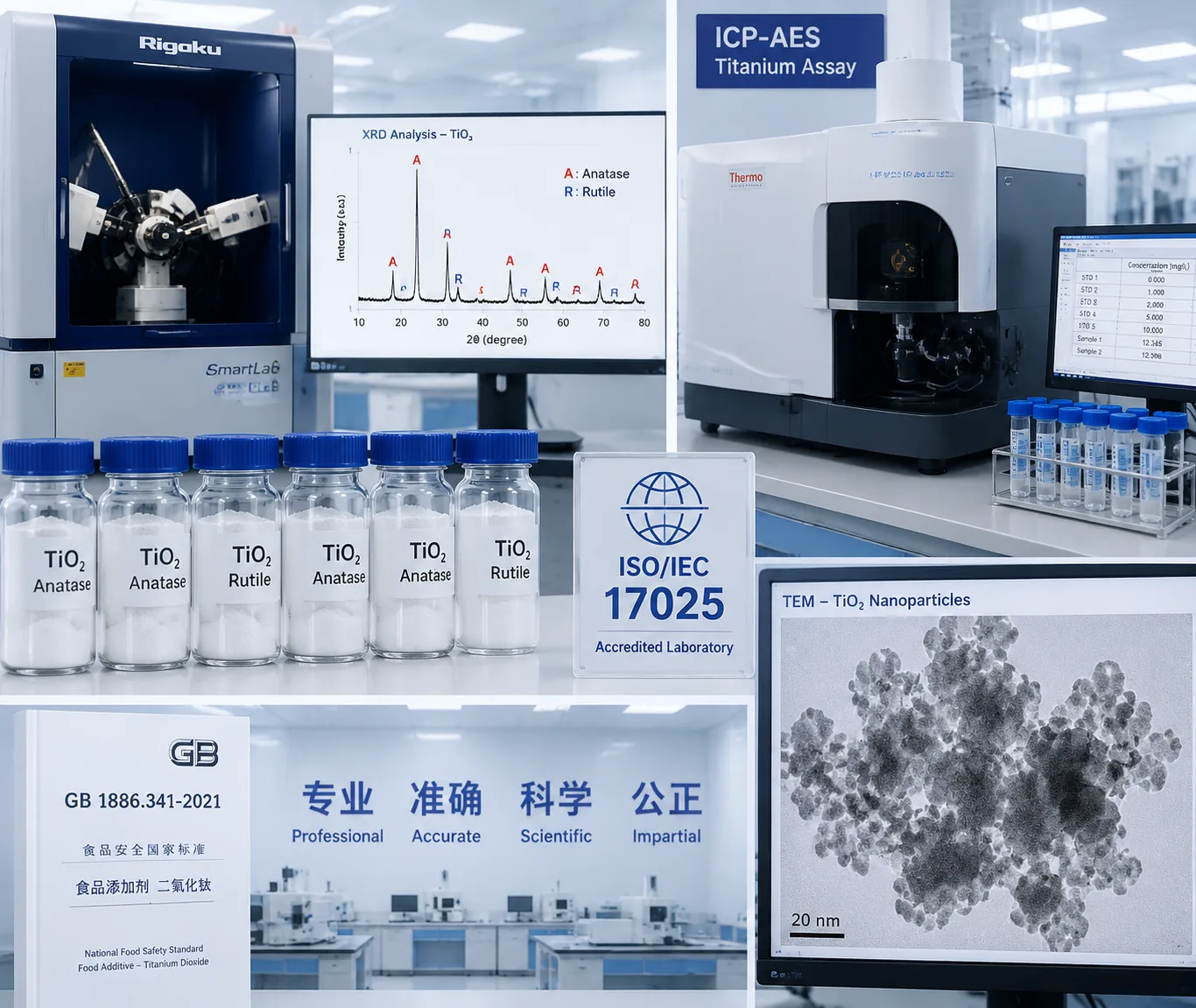
TiO₂ is produced commercially by either the sulfate process (digestion of ilmenite FeTiO₃ or titanium slag with sulfuric acid, followed by purification, hydrolysis, calcination, and micronisation) or the chloride process (reaction of a titanium mineral with chlorine under reducing conditions to TiCl₄, purified and re-oxidised to TiO₂). The processing conditions determine the crystalline form of the final product — anatase (metastable, lower refractive index 2.55, preferred for food, pharmaceutical, and certain photoactive applications) and rutile (stable, higher refractive index 2.7, preferred for coatings, plastics, and UV-shielding). Commercial TiO₂ pigments are typically coated with small amounts of alumina and/or silica to improve dispersibility, durability, and photo-stability.
The standards governing TiO₂ testing span the FAO JECFA INS 171 monograph (the international reference specification, ADI "not specified" reaffirmed at the 97th JECFA in 2024 on the basis of negligible oral absorption, no genotoxicity in the E171-representative test materials, and no carcinogenicity in 2-year rodent studies), the USP / EP / JP monographs for pharmaceutical-grade TiO₂, the Chinese GB 1886.341-2021 National food safety Standard for Food Additive — Titanium Dioxide (the current Chinese product standard), the EU Commission Regulation (EU) 2022/63 of 14 January 2022 (which removed E171 from the list of permitted food additives in the EU, with a six-month transition period that ended on 7 August 2022, after the EFSA 2021 opinion that could not rule out genotoxicity concerns), the SCCS/1661/23 opinion on cosmetic-grade TiO₂ (44 pigmentary + 40 nano grades; genotoxicity cannot be excluded for almost all grades), and the ASTM D476 / ISO 591 standards for coatings-grade TiO₂.
The standard stack: FAO JECFA, USP, EP, GB 1886.341, EU 2022/63, SCCS
A complete TiO₂ testing project draws on a stack of international, US, EU, Chinese, and product-sector standards, the choice of which depends on the application (food, pharmaceutical, cosmetic, coating) and the target market.
| Family | Standard | Scope |
|---|---|---|
| FAO JECFA | Titanium Dioxide monograph (prepared at the 76th JECFA 2012, published in FAO JECFA Monographs 13; ADI "not limited" since 13th JECFA 1969; reaffirmed 97th JECFA 2024) | International reference specification for INS 171 — assay ≥ 99.0 %, loss on drying ≤ 0.5 %, loss on ignition ≤ 1.0 %, Al₂O₃ + SiO₂ ≤ 2 %, acid-soluble substances ≤ 0.5 %, water-soluble matter ≤ 0.5 %, Sb ≤ 2 mg/kg, As ≤ 1 mg/kg, Cd ≤ 1 mg/kg, Pb ≤ 10 mg/kg, Hg ≤ 1 mg/kg |
| USP Titanium Dioxide | USP monograph | Pharmaceutical-grade TiO₂ for tablet coating and topical UV protection; assay, loss on ignition, heavy metals |
| EP 01/2016:0150 | Titanium Dioxide | European pharmacopeial monograph; harmonised with USP under the PDG |
| JP Titanium Dioxide | Japanese pharmacopeial monograph | Pharmaceutical-grade TiO₂ for the Japanese market |
| GB 1886.341-2021 | National Food Safety Standard — Food Additive — Titanium Dioxide (replacing the older GB 25584 and earlier versions) | Chinese national standard for food-additive TiO₂ — assay ≥ 99.0 %, loss on drying, loss on ignition, heavy metals (Pb, As, Cd, Hg) by GB 5009.12 / GB 5009.11 |
| GB 2760-2024 | National Food Safety Standard — Use of Food Additives | Chinese usage scope for TiO₂ as a colour; in force since 8 February 2025; the 2024 revision tightened the scope (some categories restricted; meat/fish products excluded) |
| EU Commission Regulation (EU) 2022/63 | Removal of E171 (titanium dioxide) from the list of permitted food additives | EU ban on E171 in food; adopted 14 January 2022; entered into force February 2022; six-month transition; effective ban date 7 August 2022 |
| EFSA ANS FAF Panel Opinion (6 May 2021) | Safety assessment of titanium dioxide (E171) as a food additive (EFSA Journal 19:e06585) | The scientific basis of the EU ban — genotoxicity concerns could not be ruled out |
| SCCS/1661/23 | Scientific Advice on Titanium Dioxide (TiO₂) in Cosmetic Products (13 May 2024) | EU cosmetic-grade TiO₂ opinion — 44 pigmentary + 40 nano grades; genotoxicity cannot be excluded for almost all grades |
| EU Regulation 1223/2009 Annex VI entry 27a | Cosmetics Regulation — TiO₂ as a UV filter | Permits TiO₂ (including the nano form) as a UV filter in cosmetic products, with restrictions on inhalation exposure |
| ASTM D476 | Standard Classification for Dry Pigmentary Titanium Dioxide Products | US coating-grade TiO₂ classification (anatase, rutile, treated rutile) |
| ISO 591-1:2000 / ISO 591-2:2006 | Titanium dioxides for paints | International coating-grade TiO₂ specification |
| NIOSH 0500 / 0600 / 7300 | Particulate not otherwise regulated (total / respirable) and ICP-AES elements | US occupational-air methods for TiO₂ exposure monitoring |
The single most consequential fact for a Chinese manufacturer is that GB 1886.341-2021 is the current Chinese national standard for food-additive TiO₂, and the 2024 revision of GB 2760 (in force since 8 February 2025) has tightened the usage scope of TiO₂ in Chinese food. The divergence between the EU (which banned E171 in food in 2022) and the rest of the world (which continues to permit TiO₂ in food) is the dominant regulatory fact of the current TiO₂ testing landscape.
The 2021–2022 regulatory upheaval: EU E171 ban and the global divergence
The single most consequential regulatory event in TiO₂ testing was the EFSA 6 May 2021 opinion that E171 (titanium dioxide as a food additive) "could no longer be considered safe as a food additive" because genotoxicity concerns could not be ruled out — a conclusion driven by uncertainties in the genotoxicity testing of the poorly-soluble particulate TiO₂ (the standard Ames / chromosome-aberration assays, designed for soluble chemicals, do not adequately capture the uptake and DNA damage that sub-micron TiO₂ particles may produce in mammalian cells). The EFSA opinion did not conclude that TiO₂ is a definite risk to health, but the inability to rule out genotoxicity was sufficient to trigger the EU ban under the precautionary principle.
The European Commission adopted Commission Regulation (EU) 2022/63 on 14 January 2022, removing E171 from Annex II to Regulation (EC) No 1333/2008 (the list of permitted food additives). The Regulation entered into force 20 days after publication in the OJEU (February 2022); a six-month transition period applied to food products placed on the market before the ban; from 7 August 2022, E171 is no longer permitted in food in the EU.
The global divergence after the EU ban is striking:
| Jurisdiction | Status of TiO₂ in food (as of 2024) |
|---|---|
| EU | Banned as E171 food additive (since 7 August 2022) |
| UK | Permitted (post-Brexit, the UK did not follow the EU ban) |
| US (FDA) | Permitted (21 CFR 73.575 — TiO₂ for food colouring; the FDA reaffirmed the safety in a 2023 review) |
| FAO JECFA | ADI "not specified" reaffirmed at the 97th JECFA (2024) — JECFA evaluated the E171-representative test materials and excluded the non-representative nanoparticle-only studies |
| Australia / New Zealand (FSANZ) | Permitted |
| Canada (Health Canada) | Permitted |
| Japan | Permitted |
| China | Permitted (GB 1886.341-2021; GB 2760-2024 tightened the usage scope but did not ban) |
The EU ban has reshaped the food-industry testing demand: food manufacturers selling to the EU must demonstrate the absence of E171 in their products (verification testing), while manufacturers selling to the rest of the world must continue to verify the specifications of the E171 they use. The two require different test packages, and a laboratory serving both markets must hold capability in both.
Assay (≥ 99.0 % TiO₂) and the ICP-AES method
The assay — the TiO₂ mass fraction — is the primary compositional specification. FAO JECFA / GB 1886.341-2021 / USP all set the assay at ≥ 99.0 % TiO₂, on the dried basis and on the Al₂O₃/SiO₂-free basis. The reference method is ICP-AES (inductively coupled plasma atomic emission spectroscopy), per the FAO JECFA method-of-assay:
- Sample dissolution — Fuse ~0.5 g of TiO₂ in a platinum or nickel crucible with 5 g potassium hydroxide and 2 g boric acid; dissolve the melt in 150 mL hot deionised water + 50 mL HCl; dilute to 250 mL (Solution A).
- Dilution — Prepare the test solution by 1000× dilution of Solution A with 2 % HCl, ensuring no single dilution step exceeds 20×.
- ICP-AES measurement — Measure titanium at the 334.941 nm analytical line against a 0.5–1.5 µg/mL Ti standard curve.
- Calculation —
%TiO₂ = (1.668 × C × 250 × 1000) / (W × 10⁶ × (100 − %LOD − %Al₂O₃ − %SiO₂) / 100) × 100
where C is the Ti concentration in µg/mL, W is the sample weight in g, and the Al₂O₃, SiO₂, and LOD corrections are applied to express the result on the dried, Al₂O₃/SiO₂-free basis.
The assay is corrected for the loss on drying (LOD, ≤ 0.5 % at 105 °C, 3 h), the loss on ignition (LOI, ≤ 1.0 % at 800 °C), and the Al₂O₃ + SiO₂ coating (≤ 2 %), so that the reported TiO₂ % is the true TiO₂ content of the pigment independent of the moisture, the coating, and the volatile components.
Crystalline form: anatase vs rutile by X-ray diffraction
The crystalline form of TiO₂ — anatase or rutile — determines the optical, photochemical, and photoactive properties of the pigment and is therefore a routine specification.
| Property | Anatase | Rutile |
|---|---|---|
| Crystal system | Tetragonal | Tetragonal |
| Refractive index | 2.55 | 2.7 (higher — better hiding power) |
| Density | 3.89 g/cm³ | 4.25 g/cm³ |
| Mohs hardness | 5.5 | 6.5 |
| Photocatalytic activity | Higher (more photoactive) | Lower (preferred for durability) |
| Typical application | Food, pharmaceutical, photo-active coatings | Coatings, plastics, sunscreen (UV shielding) |
The crystalline form is identified by X-ray diffraction (XRD) — the anatase and rutile phases give distinct diffraction peaks (anatase main peak at 2θ = 25.3°; rutile main peak at 2θ = 27.4° on Cu-Kα radiation), and the ratio of the two phases is quantified by the Rietveld refinement or the Spurr-Myers equation from the peak intensities. The FAO JECFA / GB 1886.341-2021 monographs do not specify a particular crystalline form (the form is "determined by the processing conditions") but the manufacturer must declare the form on the data sheet.
The photocatalytic activity difference is the basis of the application distinction: anatase is more photoactive and is preferred for self-cleaning coatings and photovoltaic cells; rutile is more photo-stable and is preferred for outdoor coatings, plastics, and cosmetic sunscreens where photo-degradation of the matrix is undesirable.
Alumina and silica coatings: the ≤ 2 % specification
Commercial TiO₂ pigments are typically coated with small amounts of alumina (Al₂O₃) and/or silica (SiO₂) to improve the dispersibility in the matrix, the durability (chalk-resistance in outdoor coatings), and the photo-stability. The coating is applied in the post-calcination step (the "surface treatment") and typically amounts to a few percent of the pigment mass.
The FAO JECFA / GB 1886.341-2021 specification caps the Al₂O₃ and/or SiO₂ at ≤ 2 %, either singly or combined. The determination is by ICP-AES of aluminium and silicon, on the same Solution A prepared for the assay:
- Al measured at 396.152 nm; Si measured at 251.611 nm
- Standard curves 0.2–5.0 µg/mL for each element
- Calculation:
%Al₂O₃ = (1.889 × C × 250 × 5) / (W × 10⁶) × 100
%SiO₂ = (2.139 × C × 250 × 5) / (W × 10⁶) × 100
The coating content feeds back into the assay calculation (the assay is reported on the Al₂O₃/SiO₂-free basis) and into the regulatory conformity (≤ 2 %). A coating above 2 % would change the classification of the pigment (it would become a "treated TiO₂" with a different specification) and may trigger the EU REACH classification of a nanoform if the coating itself is in the nano-size range.
Heavy metals: Pb, As, Cd, Sb, Hg and the acid-soluble extraction
The heavy-metal impurity specification caps the metals that arise from the ilmenite / titanium-slag raw material and from the sulfate / chloride process. The FAO JECFA / GB 1886.341-2021 specification sets the limits on the 0.5 N HCl-soluble fraction:
| Metal | FAO JECFA limit | Method |
|---|---|---|
| Lead (Pb) | ≤ 10 mg/kg | AAS (electrothermal atomisation) or ICP-MS |
| Arsenic (As) | ≤ 1 mg/kg | AAS (hydride generation) or ICP-MS |
| Cadmium (Cd) | ≤ 1 mg/kg | AAS (electrothermal atomisation) or ICP-MS |
| Antimony (Sb) | ≤ 2 mg/kg | ICP-AES |
| Mercury (Hg) | ≤ 1 mg/kg | AAS (cold-vapour generation) |
The 0.5 N HCl extraction (10.0 g of TiO₂ in 50 mL 0.5 N HCl, boiled gently 15 min, centrifuged, filtered, washed, and diluted to 100 mL) simulates the gastric-soluble fraction of the metal impurities — the fraction that the human consumer is actually exposed to. Total-digestion heavy-metal analysis (HF + HNO₃ + HClO₄ in a closed vessel) gives higher results but is not the regulatory basis; the acid-soluble extraction is.
Nanoparticle fraction and the size-distribution analysis
The nanoparticle fraction — the fraction of TiO₂ particles ≤ 100 nm in the constituent-particle size distribution — is the single most consequential analytical result of the post-2021 TiO₂ testing landscape. The EFSA 2021 opinion was driven by concerns about the uptake and potential DNA damage of the sub-micron / nano fraction of E171; the SCCS/1661/23 noted that some pigmentary TiO₂ grades contain over 50 % of particles in the nano-size range (by particle number, median constituent particle size). The European Commission's Recommendation 2011/696/EU defines a nanomaterial as having ≥ 50 % of particles in the size range 1–100 nm (by number).
The reference method for the constituent particle size distribution of TiO₂ is transmission electron microscopy (TEM) with image analysis:
- Sample preparation — Disperse the TiO₂ powder in a low-concentration surfactant solution; deposit a drop on a carbon-coated copper grid; dry under vacuum.
- Imaging — TEM at 80–200 kV; acquire 200–500 particle images per sample.
- Image analysis — Measure the minimum Feret diameter of each particle; build the number-based size distribution; report the D50, D90, and the percentage ≤ 100 nm.
Alternative methods include Scanning Electron Microscopy (SEM) with image analysis (similar to TEM, slightly lower resolution), centrifugal liquid sedimentation (LUM LUMiSizer), small-angle X-ray scattering (SAXS), and the Brunauer-Emmett-Teller (BET) specific surface area (a proxy for the mean particle size, calculated as 6 / (BET × ρ) where ρ is the TiO₂ density). A typical E171 has a BET surface area of 7–11 m²/g, corresponding to a mean spherical diameter of 140–220 nm; the constituent particle D50 by TEM is typically 100–200 nm, with 10–40 % of the particles ≤ 100 nm by number.
Whiteness, tint strength, and hiding power for the coatings grade
For the coatings-grade TiO₂ (paints, plastics, inks), the functional performance tests are the whiteness, the tint strength, and the hiding power. These are governed by ASTM D476 (the US classification of dry pigmentary TiO₂ products) and ISO 591-1 / ISO 591-2 (the international TiO₂ for paints specification).
| Test | Method | What it measures |
|---|---|---|
| Whiteness (Lab*) | Spectrophotometer (e.g. Konica Minolta CM-5); D65/10° geometry; report L, a, b* | The colour of the TiO₂ itself; the higher L* (typical 96–98) and the lower |
| Tint strength (reducing power) | Disperse TiO₂ in a black-tinted linseed-oil vehicle; compare to a standard; ASTM D332 | The ability of the TiO₂ to lighten a black vehicle — a measure of the scattering power per unit mass |
| Hiding power (contrast ratio) | Draw down the TiO₂ over a black-and-white chart; measure the contrast ratio Y_black / Y_white | The ability of the TiO₂ to hide the substrate; typically 0.98+ at 25 µm dry film |
| Oil absorption | Rub-out with linseed oil; ASTM D1483 | The amount of oil to wet the pigment; lower is preferred (typical 15–25 g oil / 100 g TiO₂) |
| Specific surface area (BET) | N₂ adsorption; ISO 9277 | The surface area per unit mass (typical 7–20 m²/g); proxy for particle size |
| Particle-size distribution | Laser diffraction (Malvern Mastersizer); ISO 13320 | The agglomerate size distribution (median 250–400 nm for a typical coatings grade) |
The whiteness, tint strength, and hiding power together define the commercial value of a coatings-grade TiO₂. The replacement of a high-reflectance rutile grade with a lower-reflectance anatase grade in a paint formulation would reduce the hiding power and require more pigment to achieve the same opacity — a direct cost penalty. The whiteness meters (RGB 0/45 optical-filter instruments) used in some quality-control labs are less informative than spectrophotometers because they cannot provide the reflectance curve from which the tint strength, hiding power, and metamerism calculations are derived.
Cosmetic grade: UV filter, photocatalysis, and the SCCS framework
In cosmetics, TiO₂ is used both as a white pigment (in make-up, toothpaste, sunscreen-visual blurring) and as a UV filter (in sunscreens, SPF boosters). The cosmetic use is regulated under EU Regulation 1223/2009, with the nanoform of TiO₂ listed in Annex VI entry 27a as a permitted UV filter (up to 25 % in sunscreens), with restrictions on inhalation exposure (the nanoform is not permitted in applications that may lead to exposure of the end-user's lungs by inhalation).
The SCCS/1661/23 opinion (13 May 2024) is the most recent scientific advice on the safety of cosmetic-grade TiO₂. The SCCS evaluated 44 pigmentary grades and 40 nano grades and concluded that:
- The available evidence is not sufficient to exclude the genotoxicity potential of almost all of the TiO₂ grades used in oral cosmetic products (toothpaste, lipstick).
- The only exceptions are two nano grades (RM09 and RM11) for which the provided genotoxicity data indicate no concern.
- For dermally-applied cosmetic products, the conclusions drawn in previous SCCS Opinions (SCCS/1516/13, SCCS/1580/16) remain unchanged for the TiO₂ grades and the coatings evaluated in those Opinions.
- Some pigmentary TiO₂ grades contain over 50 % of the particles in the nano-size range (by particle number) — a fact that drives the genotoxicity concern.
The cosmetic-grade TiO₂ testing battery therefore includes the photocatalysis test (the ability of the TiO₂ to generate reactive oxygen species under UV — must be below the regulatory threshold for sunscreen use), the dermal penetration test (the fraction of TiO₂ that penetrates the stratum corneum — must be negligible), and the genotoxicity test battery (Ames, in vitro micronucleus, in vivo micronucleus) per the OECD Test Guidelines.
Occupational air: NIOSH 0500 / 0600 / 7300
The occupational exposure to TiO₂ in the workplace (TiO₂ manufacturing, paint mixing, plastics compounding, sunscreen formulation) is regulated by the OSHA PEL (15 mg/m³ total particulate, 5 mg/m³ respirable) and the NIOSH REL (5 mg/m³ total particulate, 2.4 mg/m³ respirable, time-weighted average) — the NIOSH REL is more stringent than the OSHA PEL because the respirable TiO₂ fraction (the sub-micron / nano fraction) carries a greater pulmonary-toxicity concern.
| Method | Matrix | What it measures | Detection limit |
|---|---|---|---|
| NIOSH 0500 | Total particulate | Total TiO₂ dust on a PVC membrane filter, by gravimetric filter weight | 0.23 mg/m³ for a 133 L sample |
| NIOSH 0600 | Respirable particulate | Respirable TiO₂ dust (size-selected by a cyclone), by gravimetric filter weight | 0.075 mg/m³ for a 400 L sample |
| NIOSH 7300 | Air (elements) | TiO₂ by ICP-AES of a filter digest | 80 ppb for a 100 L sample, 96 % recovery |
The NIOSH 7300 method (Ti at 334.941 nm by ICP-AES) is the most sensitive and the most specific for TiO₂ (the gravimetric methods include all particulate, not just TiO₂). A laboratory serving TiO₂ manufacturers must hold capability in all three methods.
FAQ
Why did the EU ban titanium dioxide (E171) as a food additive?
The EU ban (Commission Regulation (EU) 2022/63, effective 7 August 2022) was triggered by the EFSA 6 May 2021 opinion that E171 could no longer be considered safe as a food additive because genotoxicity concerns could not be ruled out — driven by uncertainties in the genotoxicity testing of the poorly-soluble particulate TiO₂ and by the nanoparticle fraction of E171. The ban applies only to the food-additive use (E171); the pharmaceutical, cosmetic, and coating uses are unaffected.
Is TiO₂ still permitted as a food additive in China and the US?
Yes. China permits TiO₂ as a food additive under GB 1886.341-2021 (assay ≥ 99.0 %, Pb ≤ 10 mg/kg, As ≤ 1 mg/kg), with the usage scope tightened by the GB 2760-2024 revision (in force 8 February 2025). The US FDA permits TiO₂ under 21 CFR 73.575. The FAO JECFA reaffirmed the ADI "not specified" at the 97th JECFA (2024) after evaluating the E171-representative test materials.
What is the difference between anatase and rutile TiO₂?
Anatase and rutile are two crystalline forms of TiO₂. Anatase has a lower refractive index (2.55), higher photocatalytic activity, and is preferred for food, pharmaceutical, and photo-active applications. Rutile has a higher refractive index (2.7), better hiding power, lower photocatalytic activity, and is preferred for coatings, plastics, and cosmetic sunscreens. The crystalline form is identified by X-ray diffraction.
What is the FAO JECFA specification for the assay of TiO₂?
The FAO JECFA INS 171 monograph specifies the assay at ≥ 99.0 % TiO₂ on the dried basis and on the Al₂O₃/SiO₂-free basis. The reference method is ICP-AES (Ti at 334.941 nm) of a KOH/H₃BO₃ melt digest. The assay is corrected for the loss on drying (≤ 0.5 %), the loss on ignition (≤ 1.0 %), and the Al₂O₃ + SiO₂ coating (≤ 2 %).
How is the nanoparticle fraction of TiO₂ measured?
The constituent particle size distribution is measured by transmission electron microscopy (TEM) with image analysis — 200–500 particles are imaged at 80–200 kV, the minimum Feret diameter of each is measured, and the number-based size distribution is built. The percentage of particles ≤ 100 nm is reported. Alternative methods include SEM, centrifugal liquid sedimentation, and the BET specific surface area (a proxy for mean particle size).
Our titanium dioxide testing capabilities
Beijing ZKGX Research (ISO/IEC 17025 accredited, CMA- and CNAS-accredited testing laboratory) provides complete TiO₂ testing across the food, pharmaceutical, cosmetic, coating, and occupational-air matrices, against the FAO JECFA, USP / EP / JP, GB 1886.341-2021, EU 2022/63, SCCS, ASTM D476, ISO 591, and NIOSH standard stack:
- GB 1886.341-2021 food-additive TiO₂ — full conformance: assay ≥ 99.0 %, loss on drying ≤ 0.5 %, loss on ignition ≤ 1.0 %, Al₂O₃ + SiO₂ ≤ 2 %, acid-soluble substances, water-soluble matter, heavy metals (Pb ≤ 10 mg/kg, As ≤ 1 mg/kg, Cd ≤ 1 mg/kg, Sb ≤ 2 mg/kg, Hg ≤ 1 mg/kg).
- FAO JECFA INS 171 monograph — full specifications and the complete method-of-assay (ICP-AES at Ti 334.941 nm of the KOH/H₃BO₃ melt digest).
- USP / EP / JP pharmaceutical-grade TiO₂ monographs — for tablet-coating and topical-UV-protection applications.
- GB 2760-2024 usage-scope verification — confirmation that the intended food-category usage is permitted and the level is within the maximum use level (the 2024 revision tightened the scope; meat/fish products excluded).
- EU 2022/63 verification testing — demonstration of the absence of E171 in food products for the EU market (HCl-extract + ICP-MS of Ti).
- Crystalline-form identification — anatase vs rutile by X-ray diffraction (XRD); quantitative phase analysis by Rietveld refinement or the Spurr-Myers equation.
- Nanoparticle-fraction analysis — TEM with image analysis; 200–500 particles; the percentage ≤ 100 nm reported; complemented by SEM, centrifugal liquid sedimentation, and BET specific surface area.
- Coating content — Al₂O₃ and SiO₂ by ICP-AES (Al 396.152 nm, Si 251.611 nm) of the same KOH/H₃BO₃ digest.
- Heavy metals — Pb, As, Cd, Sb, Hg by AAS / ICP-MS / ICP-AES, on the 0.5 N HCl-soluble extraction (per FAO JECFA / GB 1886.341) or on total digestion.
- Whiteness, tint strength, hiding power — ASTM D476 / ISO 591-1:2000 / ISO 591-2:2006 for coatings-grade TiO₂; spectrophotometer (Konica Minolta CM-5 or equivalent) for Lab*, tint strength (ASTM D332), and contrast ratio.
- Photocatalysis test — for cosmetic-grade TiO₂ as a UV filter; per the SCCS framework.
- Occupational air — NIOSH 0500 (total particulate), 0600 (respirable), 7300 (Ti by ICP-AES).
Suitable sample matrices include: food-grade TiO₂ powder (anatase, rutile, Al₂O₃/SiO₂-coated); pharmaceutical-grade TiO₂ for tablet coating and topical formulations; cosmetic-grade TiO₂ (pigmentary, nano, coated) for sunscreen, make-up, and oral care; coatings-grade TiO₂ for paints, plastics, and inks; TiO₂-containing food products (for EU 2022/63 verification); workplace air on PVC membrane filters. Each project is delivered with a full data report (test protocol, instrument calibration, raw ICP-AES / XRD / TEM data, statistical analysis, classification conclusion per the applicable standard) in English and/or Chinese, with CMA/CNAS stamping. Contact Beijing ZKGX Research to scope the TiO₂ test battery applicable to your product and target market.