Table of Contents
- What is ultrasonic scalpel testing?
- The standard stack: GB 9706, YY 1750, YY/T 0644, IEC 60601, ISO 10993
- Working principle: 55.5 kHz, 50–100 µm, and the cavitation-and-friction mechanism
- YY 1750-2020: the Chinese product standard for ultrasonic soft-tissue cutting-and-haemostasis devices
- YY/T 0644: measurement of the basic output characteristics
- Electrical safety: GB 9706.1 and GB 9706.202
- EMC, biocompatibility, and sterilisation
- Tissue-effect testing: cutting rate, coaptation, and lateral thermal spread
- Reliability and service-life testing: activation cycling and Teflon-pad failure
- SUD remanufacturing: the FDA 510(k) pathway for reprocessed ultrasonic scalpels
- FAQ
- Our ultrasonic scalpel testing capabilities
What is ultrasonic scalpel testing?
Ultrasonic scalpel testing is the measurement and validation of the safety, performance, and reliability of an ultrasonic (Harmonic®) surgical instrument — the active medical device that cuts and coagulates tissue by mechanical longitudinal vibration at 55.5 kHz rather than by electrical current — against the international, US, and Chinese standards that govern its design, manufacture, registration, and remanufacture. The output of an ultrasonic scalpel test is a dossier covering the basic output characteristics (vibration frequency, blade-tip amplitude, output power), the tissue effect (cutting rate, coaptation of vessels up to 5–7 mm, lateral thermal spread), the electrical safety of the generator, the biocompatibility of the patient-contact blade, the reliability (cycle count to Teflon-pad failure), and — for remanufactured devices — the cleaning and sterilisation validation per AAMI TIR30.
The ultrasonic scalpel (Harmonic® scalpel, brand of Johnson & Johnson / Ethicon Endo-Surgery, but widely used generically for the device class) converts electrical energy from a generator into mechanical longitudinal vibration at 55.5 kHz (55,500 cycles per second) through a piezo-ceramic transducer in the hand-piece. A booster amplifies the vibration and a blade-tip horn further amplifies it to a blade-tip amplitude of approximately 50–100 µm at the cutting tip. The high-frequency mechanical vibration, delivered under surgical load against the tissue, produces (a) cavitational fragmentation of the tissue ahead of the blade, (b) frictional heating that denatures the collagen and elastin in vessel walls and achieves haemostasis, with relatively low lateral thermal spread (typically < 1.5 mm, less than monopolar electrosurgery). The result is simultaneous cutting and coagulation without the passage of electrical current through the patient — the basis of the device's clinical advantage over high-frequency electrosurgery and the reason it has become the standard instrument for laparoscopic dissection, vessel sealing, and open surgery.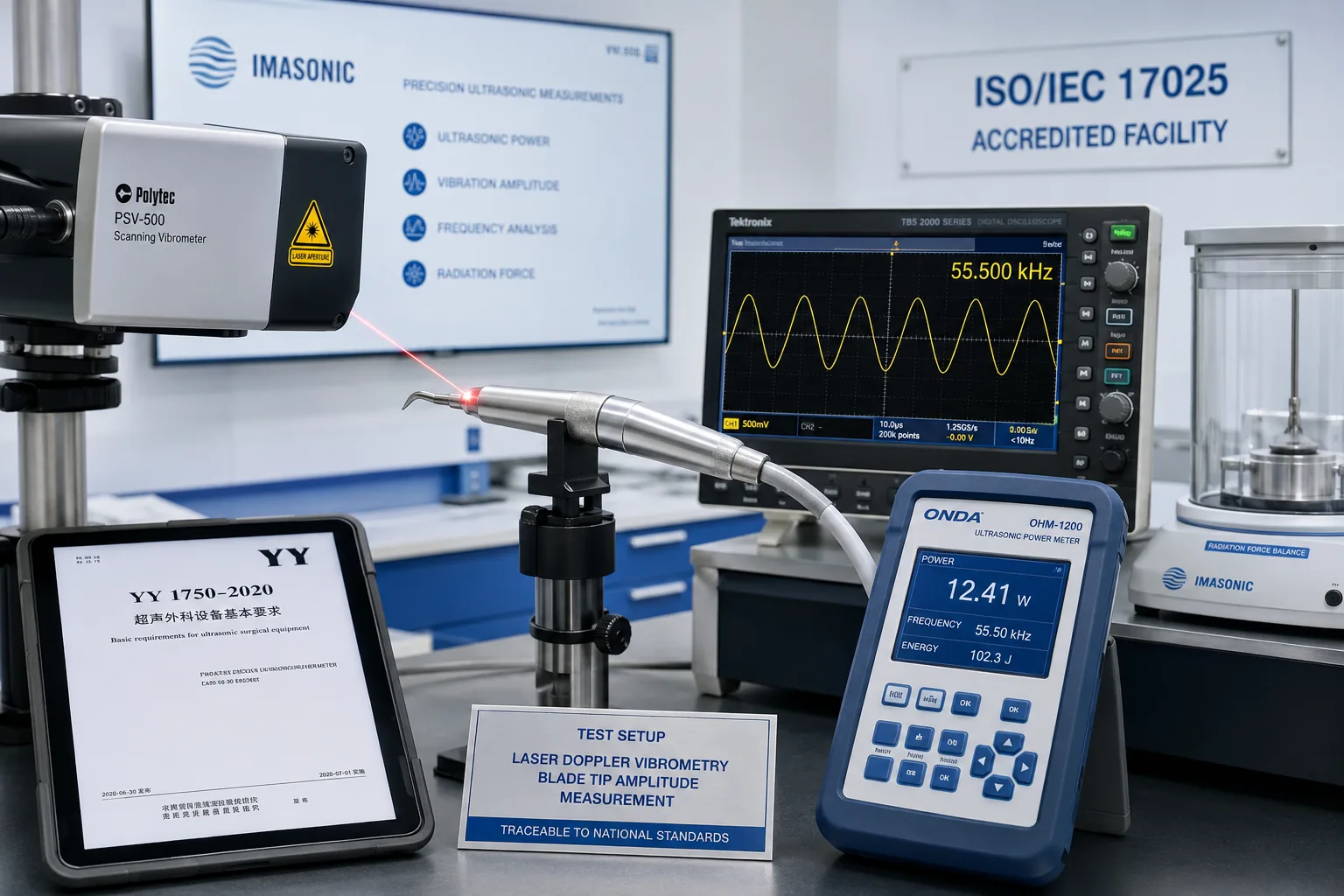
The standards governing ultrasonic scalpel testing span the Chinese GB 9706.1-2020 and GB 9706.202-2021 (electrical safety of medical electrical equipment), the YY 1750-2020 (the Chinese product standard for ultrasonic soft-tissue cutting-and-haemostasis devices), the YY/T 0644 (measurement of basic output characteristics), the international IEC 60601-1 / IEC 60601-2-2 (electrical safety), ISO 10993 / GB/T 16886 (biocompatibility), and AAMI TIR30 (cleaning and sterilisation validation for remanufactured single-use devices). An ultrasonic scalpel placed on the Chinese market requires NMPA registration as a Class III medical device with the YY 1750 + GB 9706.1 + GB 9706.202 type-test dossier; on the US market, FDA 510(k) clearance (product code "Instrument, Ultrasonic Surgical" — K012176 is the original Harmonic®) with the electrical-safety + biocompatibility + clinical performance package.
The standard stack: GB 9706, YY 1750, YY/T 0644, IEC 60601, ISO 10993
A complete ultrasonic scalpel testing project draws on a stack of Chinese national standards (GB), Chinese industry standards (YY), international standards (IEC, ISO), and US standards (FDA, ASTM, AAMI).
| Family | Standard | Scope |
|---|---|---|
| GB 9706.1-2020 (≡ IEC 60601-1) | Medical electrical equipment — general requirements for basic safety and essential performance | The level-1 electrical-safety standard for any ME device, including the ultrasonic scalpel generator |
| GB 9706.202-2021 (≡ IEC 60601-2-2) | ME equipment — particular requirements for basic safety and essential performance of high-frequency surgical equipment and high-frequency accessories | Applies where the ultrasonic scalpel system incorporates or is integrated with a high-frequency surgical output |
| YY 9706.102-2021 (≡ IEC 60601-1-2) | ME equipment — electromagnetic disturbances (EMC) | Mandatory EMC for the generator |
| YY 1750-2020 | Ultrasonic soft-tissue cutting-and-haemostasis surgical device | The Chinese product standard for the ultrasonic scalpel itself (the device class) |
| YY/T 0644-2017 | Measurement and declaration of the basic output characteristics of ultrasonic surgical systems | The Chinese method standard for measuring vibration frequency, amplitude, and power |
| GB/T 16886 (≡ ISO 10993) | Biological evaluation of medical devices | Biocompatibility of the patient-contact blade |
| ISO 11607-1/-2 | Sterile packaging of terminally-sterilised medical devices | Packaging for the single-use blade |
| AAMI TIR30 | A compendium of processes, materials, test methods, and acceptance criteria for cleaning and reusable medical devices | The reference for the remanufacturing cleaning-validation dossier |
| ASTM F2998-13 / ASTM F3145 | Standard test methods for tissue-effect characterisation of ultrasonic surgical devices (where applicable) | Tissue-cutting and coagulation test methods |
| ISO 14971 | Application of risk management to medical devices | Risk-management file for the device |
| FDA 510(k) | Product code "Instrument, Ultrasonic Surgical"; K012176 (Harmonic® original) | US premarket notification pathway |
The single most consequential fact for a Chinese manufacturer is that YY 1750-2020 is the Chinese product standard for the ultrasonic scalpel, and the device must additionally satisfy GB 9706.1 (electrical safety) and GB 9706.202 (high-frequency attachment, where applicable). The NMPA Technical Review Guideline for Ultrasonic Soft-Tissue Cutting-and-Haemostasis Devices (CMDE) provides the technical review framework.
Working principle: 55.5 kHz, 50–100 µm, and the cavitation-and-friction mechanism
The ultrasonic scalpel converts electrical energy into mechanical longitudinal vibration through a piezo-ceramic transducer in the hand-piece. The transducer is driven by the generator at its mechanical resonance frequency (typically 55.5 kHz for soft-tissue ultrasonic scalpels), producing longitudinal vibration that is amplified by the booster and the blade-tip horn (the knife blade itself, shaped as an acoustic amplifier) to the cutting tip.
| Parameter | Typical value |
|---|---|
| Vibration frequency | 55.5 kHz (55,500 cycles per second) for soft-tissue ultrasonic scalpels; 25–36 kHz for bone-cutting variants (BoneScalpel) |
| Blade-tip amplitude (peak-to-peak) | 50–100 µm, depending on the power setting (min / mid / max) and the blade geometry |
| Tip acceleration | On the order of 10⁵ m/s² (10,000 g) — sufficient to drive cavitation in the tissue fluid |
| Tip temperature during activation | 50–100 °C under tissue load (the frictional heat denatures protein) |
| Lateral thermal spread | Typically < 1.5 mm (less than monopolar electrosurgery) |
The tissue effect combines two mechanisms:
- Cavitational fragmentation — the high-frequency vibration, delivered under load, generates transient cavitation bubbles in the tissue fluid ahead of the blade; bubble collapse fragments the tissue, providing the cutting effect.
- Frictional heating — the same vibration, with the blade pressed against the tissue under coaptation pressure, generates frictional heat that denatures collagen and elastin in the vessel wall, sealing vessels up to 5 mm (and on the latest devices, 7 mm) in diameter.
The simultaneous cutting and coagulation, with no electrical current passing through the patient, is the device's clinical advantage over monopolar electrosurgery. The tissue effect depends on the tissue load (the surgical force applied): high load (the blade pressed firmly) favours cutting; low load (the blade held lightly against the tissue with coaptation) favours coagulation. The surgeon modulates between cutting and coagulation by varying the tissue load, the power setting, and the activation time.
YY 1750-2020: the Chinese product standard for ultrasonic soft-tissue cutting-and-haemostasis devices
YY 1750-2020 is the Chinese national standard for ultrasonic soft-tissue cutting-and-haemostasis devices. It applies to the ultrasonic scalpel system — the generator, the hand-piece (transducer), the blade, and any foot-control — and specifies the requirements for the basic output characteristics, the tissue effect, the safety functions, the blade-patient biocompatibility, and the device marking.
Typical YY 1750-2020 requirements (representative, not a verbatim quotation of the standard):
- Vibration frequency declared by the manufacturer; tolerance per the standard
- Blade-tip amplitude in min / mid / max settings; declared values with tolerance
- Output power in min / mid / max settings; declared values
- Maximum coaptation (vessel-sealing) diameter — typically 5 mm (Harmonic®) or 7 mm (latest-generation devices), tested in an ex-vivo porcine-vessel preparation
- Tissue cutting rate — declared for a standard tissue load
- Lateral thermal spread — declared, typically < 2 mm
- Continuous activation time — declared, typically 5–10 s
- Cool-down time between activations
- Reliability — activation cycle count to blade failure or Teflon-pad failure
- Safety functions — over-temperature cut-off, blade-jam detection, power-on self-test
- Biocompatibility of the patient-contact blade per GB/T 16886 (cytotoxicity, sensitisation, irritation, intracutaneous reactivity, acute systemic toxicity)
- Sterilisation — the blade supplied sterile (EtO or gamma); sterility assurance level (SAL) 10⁻⁶
A device whose measured vibration frequency, blade-tip amplitude, or coaptation diameter falls outside the declared tolerance fails the YY 1750-2020 type test and the production lot must be reworked.
YY/T 0644: measurement of the basic output characteristics
YY/T 0644 (the Chinese method standard for measuring the basic output characteristics of ultrasonic surgical systems) defines the test methods that produce the YY 1750-2020 declared values:
| Output characteristic | Method |
|---|---|
| Vibration frequency | Measured at the hand-piece by an accelerometer, a laser-Doppler vibrometer, or by analysis of the generator drive current; reported in kHz |
| Blade-tip amplitude | Measured by a laser-Doppler vibrometer (Polytec, Polytec OFV series, or equivalent) focused on the blade tip under no-tissue-load conditions, in min / mid / max settings; reported in µm peak-to-peak |
| Output power | Measured by a calibrated ultrasonic power meter (a radiation-force balance or a calorimeter) under no-tissue-load conditions; reported in W |
| Tissue-load behaviour | The change in vibration frequency and amplitude as a tissue load is applied; characterised by the "load curve" of the device |
The laser-Doppler vibrometer is the reference instrument for blade-tip amplitude measurement. The laser beam is focused on the polished blade tip; the Doppler shift of the reflected light, demodulated, gives the blade velocity, integrated to give the blade displacement with sub-micron resolution at the 55.5 kHz frequency. A typical measurement set-up is a Polytec OFV-5000 controller with an OFV-534 sensor head, mounted on a vibration-isolated optical table, with the hand-piece clamped in a fixture that replicates the surgical grip.
Electrical safety: GB 9706.1 and GB 9706.202
The generator of an ultrasonic scalpel is a medical electrical (ME) device and must satisfy:
- GB 9706.1-2020 (≡ IEC 60601-1) — general electrical safety: protective earth, leakage current, dielectric strength, mechanical hazards, thermal hazards, essential performance
- GB 9706.202-2021 (≡ IEC 60601-2-2) — particular requirements for high-frequency surgical equipment and high-frequency accessories, applicable where the ultrasonic system incorporates or is integrated with a high-frequency surgical output (the same generator that drives the ultrasonic hand-piece may also drive an electrosurgical pen)
- YY 9706.102-2021 (≡ IEC 60601-1-2) — electromagnetic compatibility (EMC) immunity and emissions
The electrical safety tests cover the enclosure leakage current, the patient leakage current (where the patient is connected to the device through the blade), the dielectric strength of the insulation, the protective-earth continuity, and the residual voltage after disconnection. The EMC tests cover immunity to ESD, radiated RF, EFT, surge, conducted disturbance, voltage dips, and radiated and conducted emissions per CISPR 11. A modern ultrasonic scalpel generator with a switch-mode power supply, a piezo-drive circuit, and a colour touch-screen must satisfy all of these.
EMC, biocompatibility, and sterilisation
EMC — YY 9706.102-2021 (≡ IEC 60601-1-2). The ultrasonic scalpel generator must operate correctly in the electromagnetic environment of the operating room, where EMI sources include other electrosurgical generators, surgical lasers, MRI scanners (in adjacent rooms), and mobile phones. The blade is the patient connection; the EMC tests verify that the device's safety functions (over-temperature cut-off, blade-jam detection) operate correctly under EMI.
Biocompatibility — GB/T 16886 series (≡ ISO 10993). The patient-contact blade is in contact with tissue and blood for the duration of the surgical procedure (limited contact, ≤ 24 h); the GB/T 16886.1 matrix triggers the Big Three (cytotoxicity, sensitisation, irritation) plus intracutaneous reactivity and acute systemic toxicity. The titanium blade and the Teflon pad must each satisfy the matrix. See our dedicated biocompatibility testing article for the GB/T 16886 / ISO 10993 framework.
Sterilisation — the single-use blade is supplied sterile, sterilised by ethylene oxide (EtO) or gamma radiation, with a sterility assurance level (SAL) of 10⁻⁶. The EtO residuals (EtO ≤ 4 mg, ECH ≤ 9 mg per ISO 10993-7 / GB/T 16886.7) must be within limits. The packaging must satisfy ISO 11607-1/-2 for sterile-barrier integrity.
Tissue-effect testing: cutting rate, coaptation, and lateral thermal spread
The functional performance of an ultrasonic scalpel — beyond the basic output characteristics — is the tissue effect: how fast it cuts, how large a vessel it seals, and how limited its thermal damage is. The tissue-effect tests are the most clinically relevant of the type test.
| Tissue-effect test | Method | Acceptance |
|---|---|---|
| Coaptation (vessel-sealing) diameter | Ex-vivo porcine artery at 5 or 7 mm diameter, sealed under standard coaptation pressure; burst pressure measured | Burst pressure ≥ 200 mmHg (or per the manufacturer's declaration) |
| Tissue cutting rate | Standardised tissue (bovine peritoneum, porcine muscle, or salt pork) under standard load; time-to-transect measured | Declared by the manufacturer; statistical comparison to predicate |
| Lateral thermal spread | Ex-vivo tissue; thermal camera or histology at the cut margin; the depth of the thermal-damage zone reported | Typically < 2 mm (less than monopolar electrosurgery) |
| Haemostasis score | Ex-vivo or in-vivo (porcine model); initial haemostasis score and 10-min haemostasis score per a standardised scale | ≤ 1 (no bleeding) on the standardised scale |
| Initial haemostasis time | Time from the cut to the cessation of bleeding | Declared; typically < 5 s |
The published Carungi & Simon re-manufacturing evaluation reports the animal-efficacy protocol: 3 remanufactured + 3 new Harmonic® scalpels, evaluated in a 50 kg female swine, with the device used 3 times to transect mesenteric vessels (≤ 5 mm) and 3 times to transect liver tissue. Time to transect, initial haemostasis score, 10-min haemostasis score, and time-to-haemostasis were compared between the two groups; the equivalence was confirmed at p > 0.05 for all four endpoints.
Reliability and service-life testing: activation cycling and Teflon-pad failure
The reliability test answers the question: how many activations can the blade withstand before failure? The reference protocol, derived from the Carungi & Simon evaluation, is:
- Activation protocol — 270 ten-second activations against bovine peritoneum (or intestine), with a 5-second rest between activations; the 270 × 10 s = 45 min of activation represents the maximum use of the device in a single surgical procedure (the typical use is ~120 ten-second activations per procedure)
- Cool-down — 2-minute air-cool after every 30 cycles, to prevent overheating
- Inspection — after each activation, the blade is inspected for the Teflon-pad (the protective pad on the side of the blade) remaining attached and seated
- Pass criterion — 270 (or 300) activations without Teflon-pad failure, without blade cracking (verified by dye-penetrant inspection), and without loss of cutting performance
The Carungi & Simon evaluation found that remanufactured Harmonic® scalpels withstood 300 activations without Teflon-pad failure in 100 % of the units, while new Harmonic® scalpels failed in 27 % of the units at an average of 128 cycles (range 5–270) — a counter-intuitive finding that reflects the more rigorous individual-unit functional testing that the remanufacturing process applies.
The dye-penetrant inspection for blade cracking is a complementary reliability test: the blade is dipped in a fluorescent dye penetrant, the surface dye is removed, a developer is applied, and the blade is inspected under UV light for dye bleed-out at any crack. The test detects surface cracks that would propagate under cyclic load and lead to blade fracture during use.
SUD remanufacturing: the FDA 510(k) pathway for reprocessed ultrasonic scalpels
The single-use ultrasonic scalpel blade (e.g., the Ethicon Harmonic® blade) may, under FDA regulations, be remanufactured (re-processed, cleaned, refurbished, re-sterilised) by a third-party remanufacturer and resold, provided the remanufacturer holds an FDA 510(k) clearance for the remanufactured device. The remanufacturing process must satisfy:
- FDA 21 CFR 803 (Medical Device Reporting) and 21 CFR 820 (Quality System Regulation)
- FDA guidance for reprocessing single-use devices — requires the remanufacturer to demonstrate that the cleaning, disinfection, sterilisation, and functional testing processes produce a device equivalent in safety and performance to the new device
- AAMI TIR30 — the consensus standard for cleaning-validation of reusable / remanufactured medical devices; specifies the test soil (a defined mixture of bovine serum, ovine blood, saline, with microbes), the worst-case soiling protocol, the cleaning process validation, and the acceptance criteria (residual protein, residual hemoglobin, residual endotoxin, residual viable count)
The Carungi & Simon evaluation is the published validation of the Ascent remanufacturing process for the Harmonic® blade. It demonstrates:
- Cleaning validation — protein residue ≤ 1/33 of the AAMI TIR30 limit; hemoglobin residue ≤ 1/39 of the limit; 30 sample units across 3 production lots, all visually clean
- Sterilisation validation — inoculation of the 5 most-challenging locations with 10⁶ CFU Bacillus atrophaeus spores; EtO sterilisation in 1/3 of the standard cycle; sterility assurance level (SAL) 10⁻⁶ achieved
- Performance equivalence — 300 activations without failure, equivalent to new blades (and 27 % better than new blades on the Teflon-pad-failure criterion)
- Animal efficacy equivalence — time-to-transect, initial haemostasis, 10-min haemostasis, time-to-haemostasis equivalent at p > 0.05 in the 50 kg swine model
The remanufactured ultrasonic scalpel blade is a Class II device cleared by 510(k); the original single-use blade is also a Class II device. The remanufacturer's 510(k) submission must reference the original blade and demonstrate substantial equivalence in safety and performance.
FAQ
What is the vibration frequency and blade-tip amplitude of an ultrasonic scalpel?
A soft-tissue ultrasonic (Harmonic®) scalpel operates at a vibration frequency of 55.5 kHz (55,500 cycles per second), with a blade-tip amplitude of approximately 50–100 µm peak-to-peak, depending on the power setting and blade geometry. Bone-cutting ultrasonic scalpels (BoneScalpel) operate at 25–36 kHz.
What is the difference between YY 1750-2020 and YY/T 0644?
YY 1750-2020 is the Chinese product standard — it specifies the requirements (declared values and tolerances for vibration frequency, amplitude, coaptation diameter, thermal spread, cycle life, biocompatibility). YY/T 0644 is the method standard — it specifies how to measure the basic output characteristics (vibration frequency, amplitude, power) using a laser-Doppler vibrometer and an ultrasonic power meter. A type test invokes both.
Can a single-use ultrasonic scalpel blade be remanufactured and resold?
Yes, under FDA 21 CFR Part 4 (reprocessed single-use devices), provided the remanufacturer holds an FDA 510(k) clearance. The remanufacturing process must satisfy FDA 21 CFR 820 (QSR) and the cleaning, disinfection, sterilisation, and functional testing must be validated per AAMI TIR30 to produce a device equivalent in safety and performance to the new device. China NMPA currently does not permit the remanufacturing of single-use ultrasonic scalpel blades.
What is the maximum vessel diameter that an ultrasonic scalpel can coapt?
Current-generation ultrasonic scalpels are validated to coapt (seal by frictional coaptation) vessels up to 5 mm diameter (Harmonic® standard) or up to 7 mm diameter (Harmonic ACE+ 7, latest generation). The burst pressure of the seal must be ≥ 200 mmHg.
Does an ultrasonic scalpel require biocompatibility testing?
Yes. The patient-contact blade is in contact with tissue and blood for the duration of the surgical procedure (limited contact, ≤ 24 h); the GB/T 16886.1 / ISO 10993-1 matrix triggers the Big Three (cytotoxicity, sensitisation, irritation) plus intracutaneous reactivity and acute systemic toxicity. The titanium blade and the Teflon pad must each satisfy the matrix.
Our ultrasonic scalpel testing capabilities
Beijing ZKGX Research (ISO/IEC 17025 accredited, CMA- and CNAS-accredited testing laboratory) provides complete ultrasonic scalpel testing across the YY, GB, IEC, and ISO standard stack:
- YY 1750-2020 ultrasonic soft-tissue cutting-and-haemostasis device — full product-standard conformity: vibration frequency, blade-tip amplitude, output power, maximum coaptation diameter, tissue cutting rate, lateral thermal spread, continuous activation time, reliability, safety functions.
- YY/T 0644 basic output characteristics — vibration frequency, blade-tip amplitude, and output power measured by laser-Doppler vibrometer (Polytec OFV series) and ultrasonic power meter (radiation-force balance).
- GB 9706.1-2020 (≡ IEC 60601-1) — electrical safety of the generator: protective earth, leakage current, dielectric strength, mechanical hazards, thermal hazards, essential performance.
- GB 9706.202-2021 (≡ IEC 60601-2-2) — particular requirements for high-frequency surgical equipment (where the ultrasonic system is integrated with a high-frequency output).
- YY 9706.102-2021 (≡ IEC 60601-1-2) — EMC immunity and emissions, in an anechoic chamber.
- GB/T 16886 (≡ ISO 10993) — biocompatibility of the titanium blade and Teflon pad: cytotoxicity, sensitisation, irritation, intracutaneous reactivity, acute systemic toxicity. See our biocompatibility testing article.
- Tissue-effect testing — ex-vivo coaptation (porcine artery, 5 or 7 mm), tissue cutting rate (bovine peritoneum), lateral thermal spread (thermal camera or histology), haemostasis score.
- Reliability testing — 270–300 ten-second activations against bovine peritoneum with cool-down; Teflon-pad failure inspection; dye-penetrant inspection for blade cracking.
- Remanufacturing validation — AAMI TIR30 cleaning validation with protein, hemoglobin, endotoxin, and viable-count residuals; sterilisation validation with SAL 10⁻⁶; performance equivalence to the new device.
- Sterilisation — EtO residuals per ISO 10993-7 / GB/T 16886.7; packaging per ISO 11607-1/-2.
- NMPA Class III registration support — YY 1750 + GB 9706.1 + GB 9706.202 + YY 9706.102 + GB/T 16886 + clinical evaluation + product technical requirements (PTR).
- FDA 510(k) support — full type-test dossier for the product code "Instrument, Ultrasonic Surgical".
Suitable device types include: ultrasonic scalpels (Harmonic®-class); ultrasonic shears (LCS-class); bone-cutting ultrasonic devices (BoneScalpel-class, 25–36 kHz); ultrasonic aspiration systems; integrated ultrasonic + high-frequency combination systems. Each project is delivered with a full data report (test protocol, instrument calibration, raw output-characteristic curves, raw tissue-effect data, statistical analysis, classification conclusion) in English and/or Chinese, with CMA/CNAS stamping. Contact Beijing ZKGX Research to scope the ultrasonic scalpel test battery applicable to your device and target market.