Table of Contents
- What standards govern vascular stent testing?
- How are radial stiffness and strength measured?
- How is accelerated durability (fatigue) tested?
- What corrosion testing is required?
- How are dimensional and functional attributes verified?
- How is particulate generation evaluated?
- How does the Chinese framework for stent registration work?
- FAQ
- Our vascular stent testing service
What standards govern vascular stent testing?
Vascular stent testing is governed by a tightly coordinated set of international standards (the ISO 25539 series and the ASTM F-series) that define every mechanical, material and durability property a stent must demonstrate, overlaid with the regional regulatory guidance documents (the FDA-1545 guidance, the EU MDR technical-documentation requirements, the NMPA registration framework) that frame the test results into the regulatory submission. A vascular stent is a Class III permanent implant, and the testing regime is correspondingly the most demanding of any medical-device category.
The principal reference standards our laboratory works to are:
- ISO 25539-2:2020, Cardiovascular implants — Endovascular devices — Part 2: Vascular stents (ISO 25539-2:2020) — the international product standard for vascular stents and their delivery systems. The 2020 edition introduced the "device evaluation" framework that identifies the appropriate testing and analyses for a specific stent design, and it incorporated the sample-size equations (Annex D) for the radial fatigue durability test. It covers the design attributes, the mechanical testing, the corrosion testing, the fatigue durability, the delivery-system testing and the biocompatibility for balloon-expandable and self-expanding vascular stents.
- ISO 25539-1:2017, Endovascular prostheses — the companion standard for the stent-graft (the covered stent) category, covering the dimensional verification, the dislodgement force, the fixation and seal evaluation, the leakage at the seal zone, the migration resistance and the patency-related properties.
- FDA-1545, Non-Clinical Engineering Tests and Recommended Labeling for Intravascular Stents and Associated Delivery Systems — the FDA guidance that defines the full non-clinical engineering test set for the U.S. PMA submission. The guidance is the most prescriptive of the regional documents, specifying the material characterization, the corrosion testing (fretting, pitting/crevice, galvanic), the dimensional and functional attributes, the stress/strain analysis, the fatigue analysis, the accelerated durability testing, the particulate evaluation, the MRI safety and the radiopacity.
- ASTM F2477, Standard Test Methods for in vitro Pulsatile Durability Testing of Vascular Stents — the test-method standard for the accelerated pulsatile fatigue testing that is the most demanding single test in the stent-qualification programme.
- ASTM F3067, Standard Test Method for Measurement of Stent Intrinsic Radial Stiffness and Radial Strength — the radial-compression test method that replaced the earlier WK15227 draft.
- ASTM F2081, Standard Guide for Characterization and Presentation of the Dimensional Attributes of Vascular Stents — the dimensional-characterization guide (diameter, length, percent surface area, foreshortening, recoil).
- ASTM F2079, Standard Test Method for Measuring Intrinsic Elastic Recoil of Balloon-Expandable Stents — the recoil test method.
- ASTM F2606, Standard Test Methods for Three-Point Bending of Balloon Expandable Stents and Stent Systems — the bending-flexibility test method.
- ASTM F2129, Standard Test Method for Conducting Cyclic Potentiodynamic Polarization Measurements to Determine the Corrosion Susceptibility of Small Implant Devices — the pitting-and-crevice corrosion test method for the finished stent.
- ASTM F2004 / F2082 — the austenite-finish-temperature (Af) measurement methods for the nitinol shape-memory and superelastic stents.
- ISO 10993, Biological evaluation of medical devices — the biocompatibility framework, applied to the stent material and any coating.
A point worth stating plainly because it affects every stent project: the ISO 25539-2 product standard, the FDA-1545 guidance and the ASTM test methods work together, not in substitution. The ISO standard defines what the stent must demonstrate; the ASTM methods define how each property is measured; the FDA guidance defines how the results are presented and what the acceptance criteria are for the U.S. submission. A conformity project draws from all three, and a report that quotes only the ISO standard without the corresponding ASTM test method is incomplete — the regulator cannot verify how the result was obtained. We confirm the target market and the regulatory pathway before quoting, because the test scope and the reporting format are driven by the pathway.
How are radial stiffness and strength measured?
The radial stiffness and the radial strength are the properties that determine whether the stent can resist the external compressive load the vessel applies and maintain the lumen open over its service life. The radial stiffness is the change in stent diameter as a function of the uniformly applied external radial pressure; the radial strength is the pressure at which the stent experiences the irrecoverable deformation (the collapse). Both are measured by the radial compression test, and both are among the most critical single tests in the stent-qualification programme — as the ASTM F04.30 committee and the FDA have noted, the insufficient radial stiffness is associated with the stent malapposition that may contribute to the late stent thrombosis.
The radial compression test, under ASTM F3067 (which developed from the earlier WK15227 draft), compresses the stent radially between the segmentally arranged wedge jaws of a radial-compression fixture (the Blockwise-type fixture) that generates the uniformly distributed surface pressing, simulating the pressure the artery places on the stent. The stent is inserted, compressed radially up to the minimum target diameter, and then released, while the testing software (e.g. testXpert III) measures the force-versus-diameter curve. The fixture compensates for the self-deformations and the slight frictional and inertial forces that arise during the measurement, so that the reported force is the actual radial force exerted by the stent.
The radial stiffness and the radial strength are derived from the measured force-versus-diameter curve:
- Radial stiffness — the slope of the pressure-versus-diameter curve in the elastic region. A higher radial stiffness means the stent resists the diameter reduction more strongly under the external load.
- Radial strength — the pressure at the onset of the irrecoverable deformation. Above this pressure, the stent does not return to its original diameter on unloading; it has buckled or yielded.
- Radial outward force (for the self-expanding stents) — the force the stent exerts outward against the vessel wall after deployment. The specifications include both the minimum and the maximum values, because the excessive radial force injures the surrounding tissue while the insufficient force produces the incomplete apposition.
A practical consideration from the published test-equipment literature: the radial compression test is run at the body temperature (37 °C) when the stent material is temperature-sensitive — particularly the nitinol, whose superelastic properties and whose radial force depend on the temperature relative to the Af transformation temperature. A test run at the room temperature on a nitinol stent does not produce the in-vivo-representative radial force, and the body-temperature chamber (the 37 °C chamber on the ZwickRoell zwickiLine and the equivalent machines) is the instrument that delivers the clinically representative result. A complete report states the test temperature alongside the radial-stiffness and radial-strength values, because a nitinol stent measured at the room temperature and the same stent measured at 37 °C are not directly comparable.
How is accelerated durability (fatigue) tested?
The accelerated durability test is the most demanding single test in the stent-qualification programme — the test that qualifies the stent to survive the 380 million-plus pulsatile cycles that correspond to ten years of in-vivo service at the 72-beats-per-minute heart rate. The test is run under ASTM F2477 and the ISO 25539-2:2020 framework, and it is the test that the FDA, the EU MDR and the NMPA all require for the stent registration.
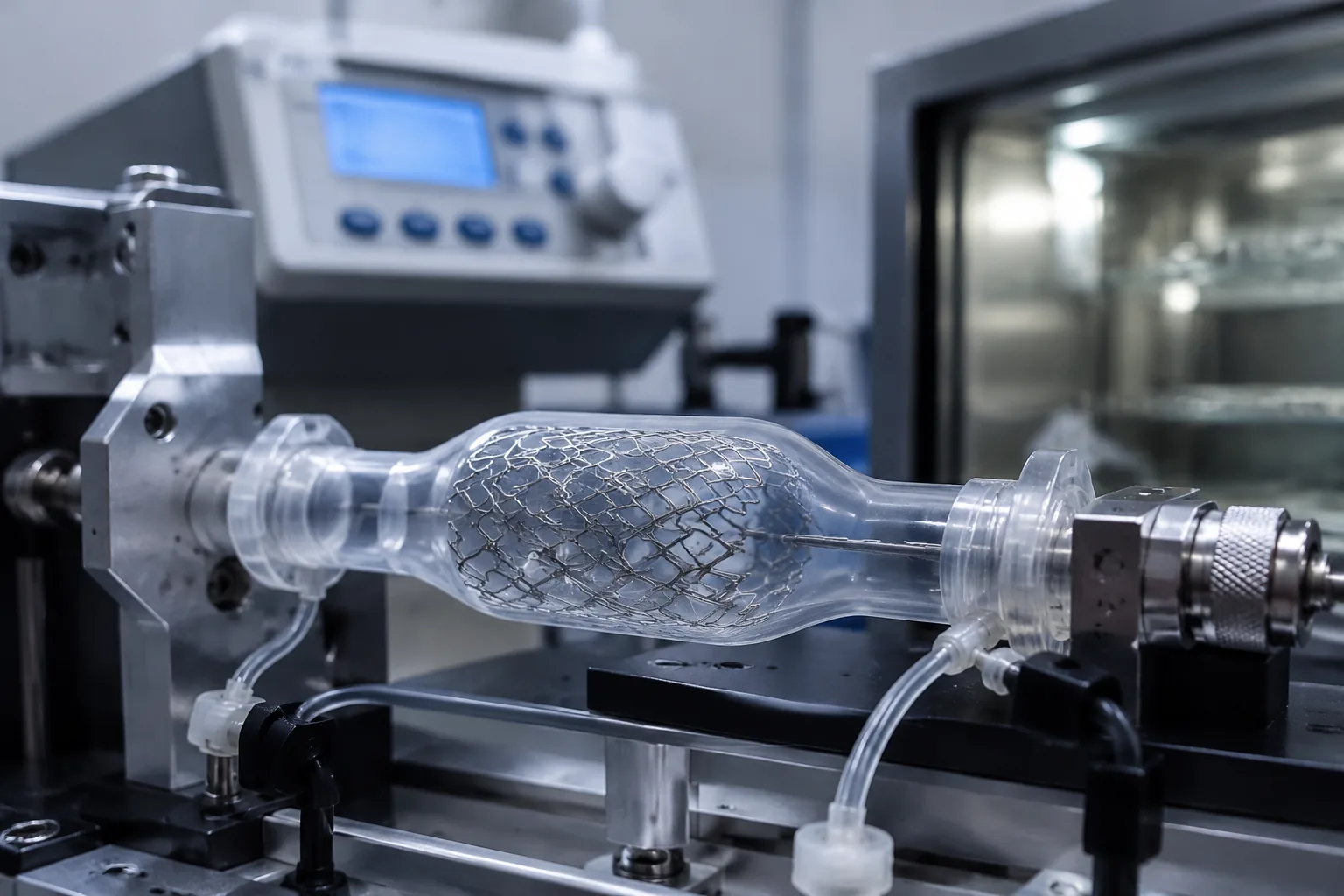
The test deploys the stent inside a silicone mock vessel — a compliant tube that simulates the in-vivo vessel compliance and that transmits the cyclic load to the stent. The mock vessel is pressurised cyclically (the single-ended or the double-ended pressurisation, each with the distinct vessel-expansion pattern), and the stent experiences the radial dilation that simulates the in-vivo pulsatile blood pressure. The test runs at the accelerated frequency (typically tens of Hz, much faster than the 1.2 Hz physiological rate) to reach the 380-million-cycle target within the practical test duration, and the stent is inspected after the test for the fractures, the fretting, the wear and the other fatigue damage.
Three features of the accelerated durability test determine whether its result is valid:
The mock vessel frequency response. The mock vessel and the deployed stent form a coupled mechanical system with a frequency-response characteristic. If the test frequency exceeds the system's resonant frequency, the cyclic load the mock vessel transmits to the stent becomes non-uniform and non-representative — the stent experiences a different load than the physiological simulation intends. The mock vessel must be characterised for its frequency response, and the test frequency must be set below the resonance. This is the reason the published test-methodology literature is so focused on the single-ended versus the double-ended pressurisation: the two regimes produce distinct vessel-expansion patterns (the single-ended propagates the pressure pulse along the stent length; the double-ended produces the constructive interference at the center), and the choice affects the cyclic-load uniformity.
The symmetric circumferential expansion. The cyclic load is transmitted uniformly to the stent only if the mock vessel undergoes the symmetric expansion around its entire circumference with every load cycle. If the mock vessel expands asymmetrically (due to the anisotropic compliance, the fixture constraint, or the pressurisation-geometry artefact), the stent experiences a non-uniform load that does not represent the in-vivo condition, and the fatigue result is not valid. The published methodology requires the verification of the symmetric expansion before the test, and the mock-vessel-compliance characterisation is part of the test setup.
The worst-case physiological loading. The test must model the worst-case physiological load the stent will experience under its intended use. The load includes the radial dilation (the pulsatile blood pressure), and may also include the bending (the vessel tortuosity), the torsion, the axial tension/compression, and the crushing (the focal, the non-focal or the uniform radial compression). The FDA recommends that the coronary stents indicated for the non-bifurcated vessels be tested in a mock vessel bent to a clinically relevant radius of curvature (15 mm for most coronary indications, representing the worst case for 90 % of the population based on the published angiographic measurements), because the tortuosity increases the micromotion and the stress concentration that drive the fatigue.
The accelerated durability test is validated against the fatigue analysis (the Goodman analysis or the equivalent) and the stress/strain analysis (the finite-element analysis) that predict the critical stress locations and the safety factors. The convergence of the analytical prediction, the bench-test result, and the post-test inspection (the SEM examination for the fractures and the fretting) is the conformity argument — the stent has been shown to survive the ten-year service under the worst-case loading without the fatigue failure. The accelerated durability test result, reported as the number of cycles survived, the fracture findings, and the correlation with the fatigue analysis, is the single most heavily scrutinised datum in the stent-qualification dossier.
What corrosion testing is required?
The corrosion testing qualifies the stent's resistance to the electrochemical and the mechanical corrosion that the in-vivo environment imposes over the years of the implantation. The stent corrosion can cause the premature structural failure, and the corrosion byproducts (the nickel ions released from the nitinol, the metal ions from the cobalt-chromium or the stainless steel) can be toxic or provoke the adverse tissue response. The corrosion testing is therefore not an afterthought — it is a core element of the stent qualification, addressed under three distinct modes.
Fretting corrosion — the corrosion that occurs at the contact between two surfaces under the relative micromotion. For the stents, the fretting corrosion is relevant in two situations: between the stent struts at the flex points where the cyclic loading produces the micromotion, and between the overlapping stents where two stents contact during the clinical use. The FDA guidance recommends that the fretting-corrosion examination be incorporated into the accelerated durability testing — the stent samples (the overlapping pairs for most indications, deployed in the mock vessel bent to the clinically relevant radius of curvature) are inspected after the fatigue cycling for the evidence of the fretting corrosion by the SEM. The results through the one-year time equivalent support the IDE application; the results through the ten-year time equivalent are submitted with the PMA.
Pitting and crevice corrosion — the localised electrochemical corrosion that can initiate at the surface defects and propagate into the stent wall. The test method is ASTM F2129, the cyclic potentiodynamic polarisation measurement that determines the corrosion susceptibility of the small implant device in the simulated physiological solution. The test records the corrosion potential, the breakdown potential and the repassivation potential, and the polarisation curve is the result that the regulator reviews. The FDA recommends testing one stent from each overlapping pair subjected to the fatigue cycling, so that the pitting-and-crevice-corrosion potential is evaluated on the sample that has been through the fatigue-induced surface damage — the damage that may reduce the corrosion resistance below the as-manufactured baseline. For the nitinol stents, the pitting-corrosion resistance is particularly sensitive to the processing variables (the heat treatment, the electropolishing), and the FDA recommends characterising the finished stent's corrosion potential rather than relying on the generic material data.
Galvanic corrosion — the corrosion that occurs when two dissimilar metals are in electrical contact in the electrolyte. For the stents, the galvanic corrosion is relevant when the stent contains more than one metal (the base stent material with the added marker bands, the tantalum or the platinum-iridium markers on the cobalt-chromium stent), and when the overlapping stents are made of different materials. The FDA recommends the methods in ASTM G71 (or the modified version incorporating the Appendix X3 of ASTM F2129 for the finished stent), using the marketed stent with the highest galvanic coupling as the counter-electrode. The galvanic-corrosion testing is run even when the alloy conforms to a specific material standard, because the manufacturing processes can affect the galvanic-corrosion potential of the finished product.
The corrosion testing is reported alongside the material-characterisation data (the composition, the surface finish, the passivation-layer microstructure for the nitinol) because the corrosion resistance is governed by the surface condition. A stent whose material composition conforms to the ASTM F138 (the 316L stainless steel) or the ASTM F562 (the cobalt-chromium alloy) can still fail the corrosion test if the surface finish is inadequate, and the corrosion testing on the finished, as-manufactured stent is the test that catches this.
How are dimensional and functional attributes verified?
The dimensional and functional attributes are the properties the physician relies on for the stent sizing, the placement and the deployment — the diameter, the length, the percent surface area, the foreshortening, the recoil, the stent integrity. The properties are measured on the finished stent, before and after the deployment, under the ASTM F2081 guide and the FDA-1545 guidance.
Dimensional verification is performed on the un-expanded stent (the as-manufactured dimensions), the balloon-expandable stent after the balloon expansion (the expanded diameter at each labelled balloon pressure), and the self-expanding stent after the unconstrained expansion. The measurements are taken at each end and in the middle of the stent, at two circumferential points 90° apart (six measurements minimum per the FDA recommendation), and the result is the diameter-versus-length map that confirms the stent matches the labelled dimensions.
Percent surface area — the percentage of the cylindrical surface area at the expanded diameter that the stent structure contacts. The percent surface area affects the biological response of the vessel (the contact area influences the tissue prolapse and the ingrowth), and it is reported for the smallest and the largest nominal expanded diameters.
Foreshortening — the decrease in the stent length between the catheter-loaded condition and the deployed condition, reported as the percentage of the loaded length. The foreshortening characteristic aids the proper stent-length selection and the accurate placement, because the deployed stent is shorter than the loaded stent by the foreshortening amount, and the physician must account for this in the lesion coverage.
Recoil (balloon-expandable stents) — the decrease in the stent diameter between the post-balloon-expansion and the after-balloon-deflation, reported as the percentage of the expanded diameter (ASTM F2079). The recoil affects the acute post-implant result, and the knowledge of the recoil helps the physician select the balloon size that achieves the target deployed diameter after the recoil.
Stent integrity — the examination of the deployed stent for the defects (the cracks, the scratches, the permanent set, the coating delamination) by the optical and the electron microscopy. The stent integrity is the test that catches the manufacturing flaws (the laser-cutting defects, the inadequate polishing) and the deployment-induced damage (the cracks from the plastic deformation during the loading or the expansion).
Crossing profile, crush resistance, kink resistance, flexibility — the additional functional attributes that characterise the stent's deliverability (the crossing profile through the lesion), its resistance to the external crushing (the parallel-plate crush, the radially-applied-load crush), its resistance to the kinking under bending (the flexibility test), and its behaviour under the simulated use (the tracking through the tortuous anatomy, the deployment in the mock vessel). These attributes are the ones that determine whether the stent can be delivered to the target site and deployed without the complications, and the complete test menu runs to over twenty distinct tests for a modern stent platform.
A practical feature of the dimensional-and-functional testing is the four-corners paradigm — the recommended default sampling that tests the largest and smallest diameters crossed with the longest and shortest lengths (the four corners of the size matrix), for each stent design. The four-corners paradigm captures the worst-case combinations of the dimensional variation, and the FDA recommends it unless the scientific rationale supports a different sampling. The stent sizes outside the four corners are not tested in the full programme, but the rationale for the omission must be documented.
How is particulate generation evaluated?
The particulate evaluation measures the total number and the size distribution of the particles the stent system generates during the simulated delivery and deployment. The particles may originate from the manufacturing process (the residual debris), the coating breakdown (the hydrophilic-coating shedding), the stent-platform material, the delivery system, or the product packaging. If the particles enter the bloodstream during the stent delivery or deployment, they present the embolic risk to the patient — the risk that is particularly critical for the coronary and the carotid stents where the end organ (the myocardium, the brain) is highly susceptible to the embolic damage.
The particulate evaluation is run under the FDA-1545 guidance and the ISO 25539-2 framework, and it requires the simulated-use setup that reproduces the delivery and the deployment in the anatomically representative mock vasculature. The stent system is tracked through the tortuous mock anatomy (the representative model of the target vessel, including the clinically relevant radius of curvature and the side-branch geometry), the stent is deployed, and the fluid that has passed through the system during the delivery and the deployment is collected and analysed for the particle count and the size distribution. The analysis is performed by the light-obscuration or the microscopic-particle-counting method, and the result is the total particle count and the size distribution per the simulated-use procedure.
The particulate evaluation is particularly demanding for the coated stents (the drug-eluting stents, the polymer-coated stents) where the coating integrity during the delivery is a documented failure mode. The hydrophilic coating on the delivery catheter, the polymer coating on the stent, and the drug-polymer matrix can all shed particles during the tracking and the deployment, and the particulate evaluation is the test that quantifies the shedding. The acceptance criteria are set based on the risk analysis that takes into account the clinical setting and the susceptibility of the end organ to the embolic damage — the coronary and the carotid stents have the stricter particulate criteria than the peripheral stents, because the end-organ susceptibility differs.
A complete particulate evaluation reports the total particle count, the size distribution, the particle-identity analysis (where the identity matters — the polymer particles, the metal particles, the coating fragments have different clinical implications), and the correlation with the simulated-use conditions. The particulate evaluation is the test that connects the stent-system design to the embolic-risk safety, and it is the test that the FDA, the EU MDR and the NMPA all require for the modern stent platforms.
How does the Chinese framework for stent registration work?
The Chinese framework for the vascular-stent registration is administered by the NMPA, and it applies the international ISO 25539-2 framework with the Chinese-specific adoption and the additional registration requirements. A vascular stent is a Class III implantable medical device in the Chinese classification, and the registration requires the full non-clinical engineering test report, the clinical-investigation data, and the quality-management-system documentation.
The Chinese framework draws from:
- The YY-series medical-device industry standards that adopt the ISO standards for the Chinese market. The vascular-stent testing is performed against the YY-series standards that correspond to the ISO 25539-2 and the ASTM test methods, with the report in Chinese for the NMPA submission. The specific YY standard numbers applicable to the vascular-stent category (the cardiovascular-implant standards, the catheter-delivery-system standards, the biocompatibility standards) are confirmed at the project scoping, because the YY-series framework is multi-standard and the applicable set depends on the stent type (the coronary, the peripheral, the carotid, the renal, the iliac, the venous) and the delivery-system design.
- The NMPA registration technical guidelines for the specific stent categories — the coronary-stent guideline, the peripheral-stent guideline, the drug-eluting-stent guideline. These guidelines define the test scope, the sample size, the acceptance criteria and the clinical-investigation requirements specific to the Chinese submission, and they are the documents that translate the ISO 25539-2 framework into the Chinese regulatory expectations.
- The accelerated durability testing to the 380-million-cycle / ten-year-equivalent target, under the ISO 25539-2 / ASTM F2477 framework, is required by the NMPA as it is by the FDA and the EU MDR. The test methodology and the acceptance criteria are aligned across the markets, because the underlying physics (the ten-year pulsatile-cycle count at the 72-bpm heart rate) is the same.
Three features of the Chinese framework affect the project scoping:
The clinical-investigation requirement. The NMPA registration for the vascular stent requires the clinical-investigation data, conducted in the Chinese clinical sites under the NMPA-approved protocol, for most stent categories. The clinical investigation is in addition to the non-clinical engineering testing, and it is the element that extends the registration timeline significantly beyond the markets that accept the foreign clinical data. The non-clinical engineering testing is the prerequisite that supports the clinical-investigation application, and the complete test report must be available before the clinical investigation begins.
The biodegradable and the drug-eluting stent categories. The NMPA has specific regulatory pathways for the biodegradable (bioresorbable) stent and the drug-eluting stent, with the additional testing for the drug substance (the drug characterization, the drug release kinetics, the drug stability) and the biodegradation (the degradation-rate testing, the degradation-product biocompatibility). These categories have the additional test scope beyond the bare-metal-stent framework, and the project must address the drug and the polymer components alongside the metallic scaffold.
The domestic-versus-imported distinction. The NMPA distinguishes the domestic-manufactured stents from the imported stents in the registration pathway, with the documentation and the testing requirements that differ in detail. An imported stent requires the home-country approval, the full Chinese test report, and the Chinese clinical investigation; a domestic stent requires the same test report and the clinical investigation, with the documentation pathway that reflects the domestic manufacturing. We confirm the manufacturing origin and the registration pathway before quoting, because the documentation scope differs.
A complete Chinese-market project tests the stent against the ISO 25539-2 / ASTM framework (the technical content is aligned with the international testing), reports the results in Chinese against the corresponding YY-series standards, and supports the clinical-investigation application and the NMPA registration dossier. A stent tested for the FDA or the EU MDR submission can usually be reported for the NMPA submission without the additional mechanical testing, but the report must be re-issued in the Chinese format with the YY-series references, and the clinical investigation must be conducted in the Chinese sites.
FAQ
Which standard should my vascular stent be tested to?
The ISO 25539-2:2020 product standard defines what the stent must demonstrate; the ASTM F-series test methods (F2477 pulsatile durability, F3067 radial stiffness/strength, F2081 dimensional, F2079 recoil, F2606 bending, F2129 pitting/crevice corrosion) define how each property is measured; the FDA-1545 guidance defines how the results are presented for the U.S. PMA submission; the NMPA registration technical guidelines define the Chinese submission. We confirm the target market and the regulatory pathway before quoting, because the test scope and the reporting format are driven by the pathway.
How many pulsatile fatigue cycles are required?
The standard target is 380 million cycles, corresponding to ten years of in-vivo service at the 72-beats-per-minute heart rate. The test is run at the accelerated frequency under ASTM F2477, in the silicone mock vessel that simulates the in-vivo compliance, with the stent inspected for the fractures and the fretting after the test. The FDA requires the results through the one-year-equivalent (≈38 million cycles) for the IDE application and through the ten-year-equivalent (≈380 million cycles) for the PMA submission.
Why is the radial compression test run at 37 °C?
Because the nitinol stent's superelastic properties and radial force depend on the temperature relative to the Af transformation temperature, and the in-vivo-representative result requires the body-temperature test. A nitinol stent measured at the room temperature and the same stent measured at 37 °C produce different radial-force values, and the 37 °C test (in the body-temperature chamber) is the one that predicts the in-vivo behaviour. The test temperature is reported alongside the radial-stiffness and radial-strength values.
What is the four-corners paradigm?
The recommended default sampling that tests the largest and smallest diameters crossed with the longest and shortest lengths of the stent size matrix — the four corners. The four-corners paradigm captures the worst-case combinations of the dimensional variation, and the FDA recommends it unless the scientific rationale supports a different sampling. For a typical coronary stent with the diameter range 2.5-4.0 mm and the length range 8-24 mm, the four corners are the 2.5×8, 2.5×24, 4.0×8 and 4.0×24 combinations.
Do you test the drug-eluting and the biodegradable stents?
Yes. The drug-eluting and the biodegradable stent categories require the additional testing beyond the bare-metal-stent framework — the drug-substance characterization, the drug-release kinetics, the polymer-coating integrity and durability, and the biodegradation behaviour. We scope the additional test requirements alongside the mechanical and the corrosion testing, and we address the drug and the polymer components as well as the metallic scaffold.
Our vascular stent testing service
Our laboratory provides vascular stent testing across the full standard stack — the ISO 25539-2:2020 product standard, the ASTM F-series test methods (F2477 pulsatile durability, F3067 radial stiffness and strength, F2081 dimensional, F2079 recoil, F2606 bending, F2129 pitting/crevice corrosion, F2004/F2082 Af transformation temperature), the FDA-1545 guidance, the ISO 10993 biocompatibility framework, and the NMPA registration guidelines for the Chinese market. Each project begins with a scoping step that confirms the stent type (coronary, peripheral, carotid, renal, iliac, venous; balloon-expandable or self-expanding; bare-metal, drug-eluting, biodegradable), the material (316L stainless steel, cobalt-chromium, nitinol, biodegradable polymer), the target market and the regulatory pathway, so the report you receive answers the question your regulator, your cardiologist or your quality system will actually ask.
We measure the radial stiffness and strength by the F3067 radial compression at the body temperature; the accelerated durability by the F2477 pulsatile fatigue to the 380-million-cycle target in the silicone mock vessel with the verified symmetric expansion and the frequency-response characterisation; the corrosion resistance by the F2129 pitting/crevice, the fretting corrosion after the fatigue cycling, and the galvanic corrosion for the multi-material designs; the dimensional and functional attributes by the F2081 guide, the F2079 recoil and the full functional-attribute menu (crossing profile, crush resistance, kink resistance, flexibility, simulated use); the particulate evaluation by the simulated-use particle counting; the material characterisation by the composition analysis and the nitinol Af measurement; and the fatigue analysis by the Goodman analysis supported by the finite-element stress/strain analysis. Reports are issued with the standard, the test method, the measured values, the acceptance criteria and the conformity conclusion explicitly stated, with the force-diameter curves, the polarisation curves, the Goodman diagrams and the SEM images included where the result depends on them, in a format suitable for the FDA PMA submission, the EU MDR technical documentation, the NMPA registration dossier or the internal quality audit.
To start a project, send us the stent type and design, the material, the size matrix, the target market, the regulatory pathway (FDA PMA, EU MDR, NMPA registration), and whether the stent is bare-metal, drug-eluting or biodegradable. We will return a project scope, sample requirement (the four-corners paradigm or the rationale-supported alternative), schedule and quotation, and begin testing on your confirmation.