Volatile organic compounds (VOC) testing is the laboratory measurement of the concentration or emission rate of organic chemicals that readily vaporize at room temperature — including benzene, toluene, xylene, formaldehyde, ethylbenzene, styrene, and many others collectively measured as TVOC (total volatile organic compounds) — in indoor air, building materials, coatings, consumer products, and environmental samples. In China, the test is governed by a matrix-specific GB framework: indoor air and civil-building engineering under GB 50325-2020 (Standard for Indoor Environmental Pollution Control of Civil Building Engineering) and GB/T 18883-2022 (Indoor Air Quality Standard); coatings and construction materials under GB 18581/18582 series; and consumer products under specific product standards. The defining analytical trait of the test is that the method is chosen by the matrix and the question — GC-MS/GC-FID for material content, thermal-desorption GC-MS for chamber emission, and GC-FID/MS for air sampling — because "VOC" means different things (a content in a paint, an emission rate from a board, or a concentration in air) depending on the application.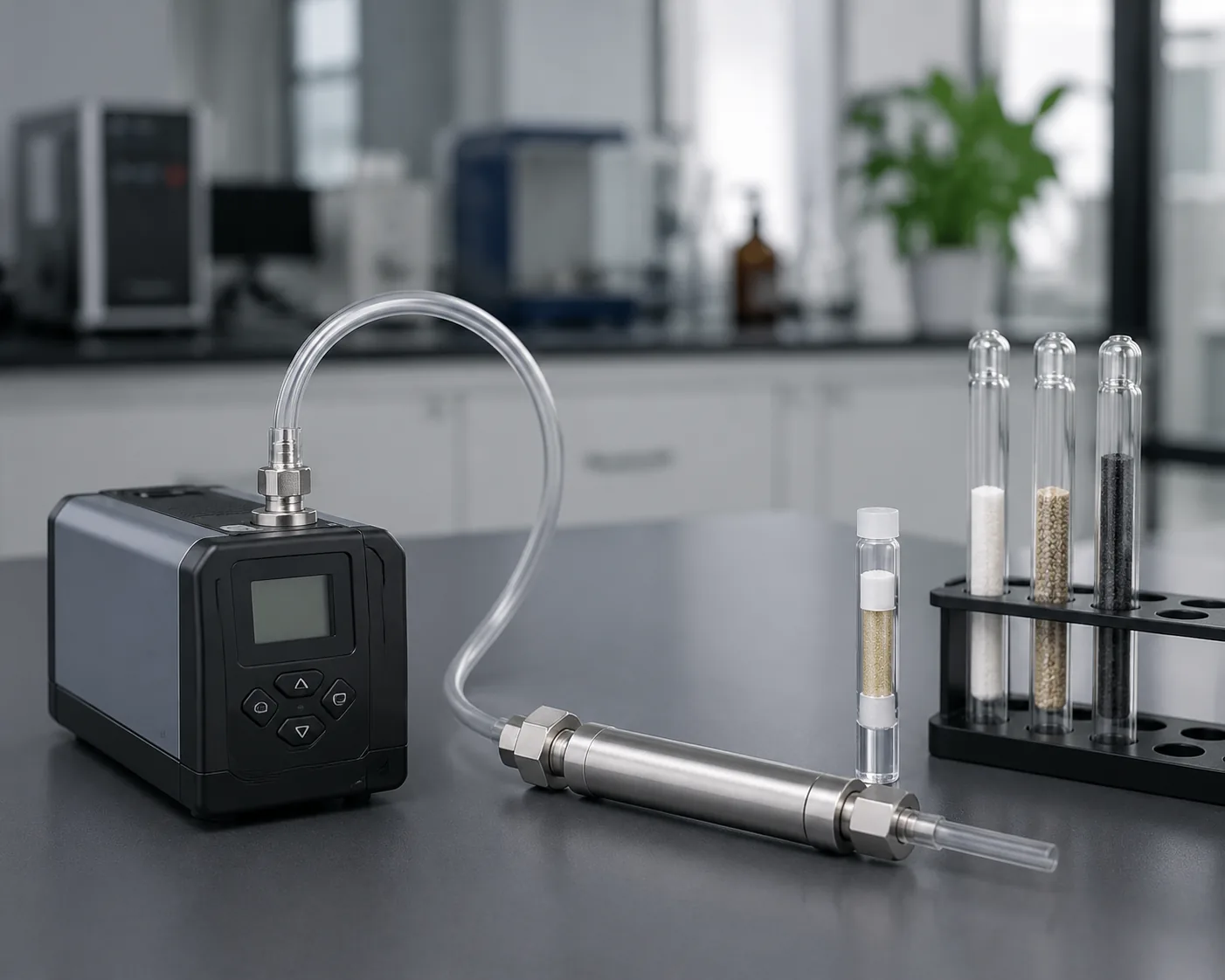
What "VOC Testing" Actually Means — Three Different Questions
The most important framing fact, and one entirely absent from the search results, is that "VOC testing" answers three fundamentally different questions depending on the matrix:
| Question | Matrix | What is measured | Method | Standard |
|---|---|---|---|---|
| "How much VOC is IN this material?" | Paints, coatings, adhesives, inks | VOC content (g/L or %) | GC-FID (ISO 11890-2), gravimetric | GB 18581/18582 |
| "How much VOC does this material EMIT?" | Building boards, furniture, flooring | VOC emission rate (mg/m²·h) in a test chamber | Chamber + thermal-desorption GC-MS (ISO 16000-6) | GB/T 17657, GB 18580 |
| "What is the VOC CONCENTRATION in this air?" | Indoor air, workplace air, ambient air | TVOC + individual VOCs (mg/m³) | Adsorbent tube + thermal-desorption GC-MS, or GC-FID | GB 50325-2020, GB/T 18883-2022 |
A VOC content test on a paint answers "how much solvent is in this can"; a VOC emission test on a building board answers "how much does this off-gas into a room"; a VOC air test answers "what is the pollutant level in this room right now." These are three different tests under three different standard families, and conflating them — as the search results do by lumping them under "VOC testing" — produces a meaningless report.
Indoor Air: GB 50325-2020 and GB/T 18883-2022
The two headline standards for indoor-air VOC in China:
GB 50325-2020 (民用建筑工程室内环境污染控制标准, Standard for Indoor Environmental Pollution Control of Civil Building Engineering) is the mandatory engineering-acceptance standard for new civil buildings. It sets the maximum allowable indoor concentrations of pollutants that a newly completed building must meet before occupancy:
| Pollutant | Class I (residential, hospital, school, kindergarten) | Class II (office, commercial, public) |
|---|---|---|
| Formaldehyde (HCHO) | ≤ 0.07 mg/m³ | ≤ 0.08 mg/m³ |
| Benzene (C₆H₆) | ≤ 0.03 mg/m³ | ≤ 0.03 mg/m³ |
| Toluene (C₇H₈) | ≤ 0.15 mg/m³ | ≤ 0.20 mg/m³ |
| Xylene (C₈H₁₀) | ≤ 0.20 mg/m³ | ≤ 0.20 mg/m³ |
| TVOC | ≤ 0.45 mg/m³ | ≤ 0.50 mg/m³ |
The 2020 revision tightened the formaldehyde and benzene limits significantly (formaldehyde from 0.08 to 0.07 in Class I; benzene from 0.09 to 0.03), reflecting growing health concerns. The method is adsorbent-tube air sampling + thermal-desorption GC-MS (for TVOC and individual VOCs) and phenol reagent spectrophotometry or AHMT for formaldehyde.
GB/T 18883-2022 (室内空气质量标准, Indoor Air Quality Standard) is the broader recommended indoor-air-quality standard, covering not only the VOC pollutants but also CO₂, PM2.5, PM10, ozone, temperature, humidity, and air velocity (covered in the HVAC testing article). Its TVOC limit (≤ 0.60 mg/m³) and formaldehyde limit (≤ 0.10 mg/m³) are slightly less strict than GB 50325's building-acceptance limits, because GB/T 18883 applies to any indoor space at any time, not just newly completed buildings. The 2022 revision added PM2.5 and tightened several parameters.
Coatings and Materials: GB 18581 / GB 18582
For coatings, adhesives, and construction materials, VOC is governed as a product content limit:
- GB 18581-2020 (木器涂料中有害物质限量, Limit of Harmful Substances in Woodware Coatings) — sets the maximum VOC content (g/L) by coating type.
- GB 18582-2020 (建筑用墙面涂料中有害物质限量, Limit of Harmful Substances in Architectural Wall Coatings) — interior and exterior wall paints.
- GB 18583-2016 (胶粘剂中有害物质限量, Limit of Harmful Substances in Adhesives).
The method for VOC content in coatings is the gravimetric/GC-FID method (the same ISO 11890-2 principle the Measurlabs competitor describes for the EU Paints Directive): the coating is weighed, heated to drive off volatiles, the total volatiles minus water minus exempt compounds gives the VOC content in g/L.
For building boards and engineered wood products, the VOC of concern is the formaldehyde emission rate, governed by GB 18580-2017 (室内装饰装修材料 人造板及其制品中甲醛释放限量), covered in the Wood testing article (where the just-published GB 18580-2025 made E0 mandatory for finished panels).
The Analytical Methods
Three method families dominate VOC testing, each suited to a different question:
- Thermal-desorption GC-MS — the reference method for air sampling and chamber emission testing. Air is drawn through an adsorbent tube (Tenax TA, or multi-bed), the trapped VOCs are thermally desorbed into a GC-MS, where they are separated by retention time and identified by mass spectrum. This is the ISO 16000-6 / GB 50325 method for TVOC and individual VOCs in air.
- GC-FID — for VOC content in coatings and liquid products. The sample is diluted and injected into a GC with a flame-ionization detector, which responds to all organic carbons. Used per ISO 11890-2 for the Paints Directive content compliance.
- DNPH-HPLC for formaldehyde — formaldehyde is a special case (it is too volatile and reactive for standard GC-MS). It is trapped on a 2,4-DNPH cartridge (where it forms a stable derivative), then analyzed by HPLC-UV. Alternatively, the phenol reagent (spectrophotometric) or AHMT method is used.
The Health Basis
VOCs are regulated because many have documented health effects at indoor concentrations:
- Benzene — IARC Group 1 (carcinogenic), causes leukaemia. The strictest-regulated VOC in indoor air (0.03 mg/m³ in GB 50325 Class I).
- Formaldehyde — IARC Group 1, nasal and nasopharyngeal cancer, strong respiratory irritant and sensitizer.
- Toluene, xylene, styrene — neurotoxic (headache, dizziness, fatigue) at elevated concentrations.
- TVOC — the sum parameter; above 0.3–0.5 mg/m³, occupants report irritation and discomfort, even if no single compound exceeds its individual limit.
Why the Search Results Are Off the Compliance Intent
The search results for "VOC testing" are dominated by content that describes the methods but does not frame the GB compliance structure:
- Measurlabs VOC testing service — covers construction materials (EU Paints Directive, ISO 11890-2), medical devices (ISO 10993-18, ISO 18562), toys (EN 71-9/10/11), food contact materials (EC 1935/2004), fuels (EN 228), and environmental (EPA 8260). EU/ISO/EPA standards, zero GB.
- Canadian ECCC Guidance Document — VOC concentration limits for ~130 product categories, CARB Method 310 alignment. Canadian regulation, zero GB.
- General VOC-testing lab pages — cite ISO 16000-6, ASTM D5116, EPA methods. Western standards, zero GB.
None tells a Chinese building owner, a coatings manufacturer, an indoor-air investigator, or a product-quality lab which GB standard governs their VOC measurement, what the GB 50325 / GB/T 18883 limits are, or how to choose between content/emission/air methods. That compliance question is what this article addresses.
Our Testing Capabilities
Beijing ZKGX Research conducts VOC testing across the matrix-specific GB framework:
- Indoor air (GB 50325-2020 / GB/T 18883-2022): TVOC, benzene, toluene, xylene, formaldehyde by adsorbent-tube sampling + thermal-desorption GC-MS (TVOC and individual VOCs) and DNPH-HPLC / phenol-reagent spectrophotometry (formaldehyde), with the Class I/II acceptance limits for new buildings and the broader IAQ limits for occupied spaces.
- Coatings and materials (GB 18581/18582/18583): VOC content (g/L) by gravimetric / GC-FID per the coating-type limits.
- Building boards (GB 18580-2017 / 2025): formaldehyde emission rate by the 1 m³ chamber method (clause 4.60 of GB/T 17657), covered in the wood testing article.
- Environmental (HJ methods): VOC in water and soil by purge-and-trap GC-MS or headspace GC.
- Sample types: indoor air (residential, office, hospital, school), coatings (wood, wall, architectural), adhesives, engineered wood panels, and environmental samples.
- Deliverable: a test report identifying the matrix, the applicable standard (GB 50325 / GB/T 18883 / GB 18581 / GB 18580), the method, the TVOC and individual-VOC values, and pass/fail against the applicable limit.
If you have an indoor-air, coatings, or material sample requiring VOC verification, contact our testing team to scope the matrix, the applicable GB standard, and the correct method (content, emission, or air).
Frequently Asked Questions
What standard governns VOC testing in China?
It depends on the matrix. Indoor air in new buildings is under GB 50325-2020 (Class I: TVOC ≤ 0.45 mg/m³, formaldehyde ≤ 0.07, benzene ≤ 0.03). Indoor air quality in general is under GB/T 18883-2022. Coatings and adhesives content is under GB 18581/18582/18583. Building-board formaldehyde emission is under GB 18580-2017/2025. A report must name the matrix and the applicable standard.
What is the difference between GB 50325 and GB/T 18883 for indoor air?
GB 50325-2020 is the mandatory building-acceptance standard — it sets the maximum pollutant levels a newly completed building must meet before occupancy, with stricter Class I limits for residential/school/hospital buildings. GB/T 18883-2022 is the broader recommended indoor-air-quality standard applicable to any occupied space, with slightly less strict limits (TVOC ≤ 0.60, formaldehyde ≤ 0.10) because it covers long-term occupancy, not just new-building acceptance.
What is TVOC?
TVOC (total volatile organic compounds) is the summed concentration of all volatile organic compounds detected in an air sample, reported as mg/m³. It is measured by adsorbent-tube sampling + thermal-desorption GC-MS, summing the areas of all identified and unidentified VOC peaks (typically C₆–C₁₆). GB 50325 Class I limits TVOC to 0.45 mg/m³.
Is formaldehyde included in TVOC?
No — formaldehyde is measured separately. Formaldehyde is too volatile and reactive for standard thermal-desorption GC-MS, so it is measured by DNPH-HPLC (derivatization on a cartridge, then HPLC-UV) or by phenol-reagent / AHMT spectrophotometry. Formaldehyde has its own individual limit in GB 50325 (≤ 0.07 mg/m³ Class I) separate from the TVOC limit.
What method is used for VOC content in paints?
The gravimetric / GC-FID method (ISO 11890-2 principle): the coating is weighed and heated to determine total volatiles, then water and exempt compounds are subtracted, giving the VOC content in g/L. GB 18581-2020 (wood coatings) and GB 18582-2020 (wall coatings) specify the category-specific maximum g/L limits.