Wood testing is the laboratory verification of wood and wood-based products against the Chinese national standards that govern their mechanical performance, physical properties, and — for engineered panels — formaldehyde emissions. Wood testing splits into two distinct domains that are governed by different standards and answer different questions: solid and structural wood (sawn timber, glulam) is tested for mechanical strength and stiffness, while wood-based panels (plywood, MDF, particleboard, laminate flooring) are tested for physical properties and, critically, for formaldehyde release. Confusing the two is the most common error in wood testing.
Why "Wood Testing" Splits Into Two Domains
The single most important framing fact, and the one most explanations omit, is that "wood testing" is not one test category. The governing standard and the measured parameters depend entirely on whether the product is solid/structural wood or a wood-based panel:
| Domain | Products | What is tested | Governing standards |
|---|---|---|---|
| Solid & structural wood | Sawn timber, lumber, glulam beams | Mechanical: bending strength, compression, MOE, hardness, fastener holding | GB/T 1927 series-2022 (test methods) + GB 50005-2017 (structural design) |
| Wood-based panels | Plywood, MDF, OSB, particleboard, laminate/engineered flooring | Formaldehyde release + physical/mechanical properties | GB 18580-2025 (formaldehyde limits) + GB/T 17657-2022 (test methods) |
A sawn-timber beam destined for a roof structure is tested for bending strength and stiffness because the question is "will it carry the load." A sheet of MDF destined for an interior cabinet is tested for formaldehyde release because the question is "will it pollute the indoor air." These are different products, different hazards, and different standards, and a test report that applies panel-formaldehyde thinking to structural timber (or vice versa) is a category error.
Solid and Structural Wood Testing
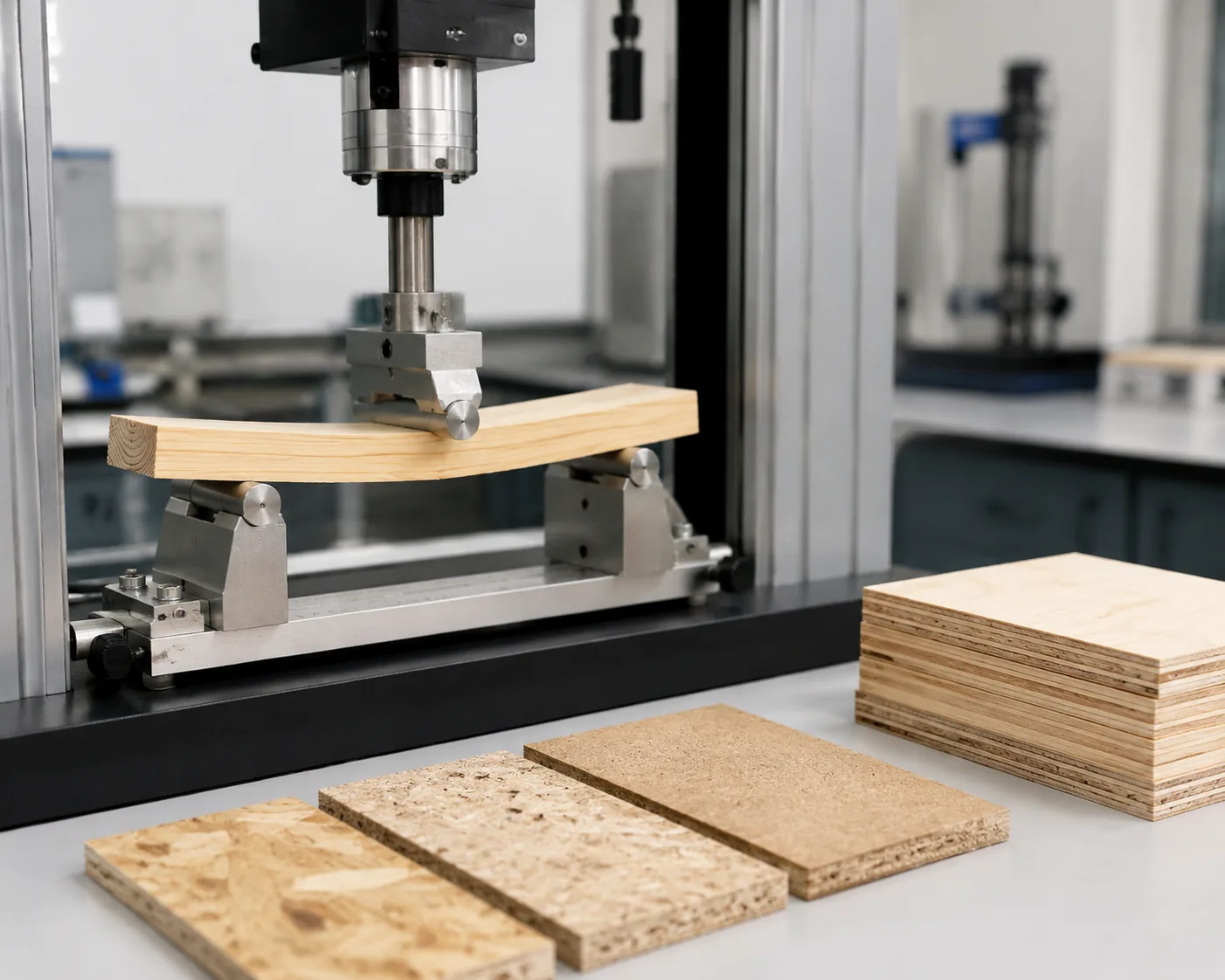
Solid wood and structural timber are tested for the mechanical properties that determine whether the material can carry structural load. The test methods are defined in the GB/T 1927 series-2022 (Test Methods for Physical and Mechanical Properties of Small Clear Wood Specimens), which consolidated and replaced the older GB/T 1935 (compression), GB/T 1936 (bending/MOE), and related standards into a unified series.
The principal mechanical tests:
| Test | What it measures | Method reference |
|---|---|---|
| Bending strength (MOR) | Resistance to breaking under bending load — modulus of rupture | GB/T 1927.10 |
| Modulus of elasticity (MOE) | Stiffness, resistance to deformation under load | GB/T 1927.12 |
| Compression parallel to grain | Resistance to crushing along the grain (column behavior) | GB/T 1927.11 |
| Compression perpendicular to grain | Resistance to crushing across the grain (bearing) | GB/T 1927 series |
| Tensile strength | Resistance to pulling apart along the grain | GB/T 1927 series |
| Shear strength | Resistance to sliding failure, critical for glued joints | GB/T 1927 series |
| Hardness (Janka) | Resistance to indentation — flooring suitability | GB/T 1927 series |
| Fastener withdrawal | Holding power of nails and screws | GB/T 1927 series |
These measured values feed into GB 50005-2017 (Standard for Design of Timber Structures), which assigns mechanical-grade design values (bending strength, compression, MOE) to visually graded and machine-graded timber. For structural use, the laboratory test results establish the strength grade that the design standard then permits for a given application. Note also that wood mechanical properties vary with moisture content — specimens are conditioned to a reference moisture content (commonly 12%) befOre testing, and results are reported with the moisture basis.
Wood-Based panel testing: Formaldehyde (GB 18580-2025)
For wood-based panels used indoors — plywood, MDF, OSB, particleboard, laminate flooring — the dominant compliance parameter is not mechanical strength but formaldehyde release, because the adhesives (urea-formaldehyde, etc.) used to bond the panel continuously emit formaldehyde into indoor air. The governing limit standard is GB 18580 (Indoor Decorating and Refurbishing Materials — Limit of Formaldehyde Emission of Wood-Based Panels and Finishing Products), and a major revision took effect this year.
GB 18580-2025, effective 2026-06-01, raised the bar significantly:
| Product type | Formaldehyde limit | Grade |
|---|---|---|
| Panel substrates (raw plywood, particleboard, blockboard) | ≤ 0.124 mg/m³ | E1 |
| Finished panel products (engineered/laminate flooring, finished panels) | ≤ 0.050 mg/m³ | E0 (newly mandatory) |
The key change: the new edition makes E0 mandatory for finished panel products, where the previous edition required only E1. The even stricter ENF grade (no-added-formaldehyde, ≤ 0.025 mg/m³) remains a higher voluntary tier. The test method for the formaldehyde value is specified as clause 4.60 of GB/T 17657-2022 (the 1 m³ climate-chamber method). For any panel product placed on the Chinese market from 2026-06-01 onward, an E0 test result (not merely E1) is now the compliance baseline for finished products.
Wood-based panel testing: Physical and Mechanical (GB/T 17657)
Beyond formaldehyde, wood-based panels are tested for their physical and mechanical properties by the methods in GB/T 17657-2022 (Test Methods for Evaluating the Properties of Wood-Based Panels and Decorative Wood-Based Panels). This single standard consolidates the panel test methods that GB 18580 and the product standards reference. Key items:
- Internal bond strength — the panel's resistance to delamination (pulling apart across its thickness).
- Bending strength and MOE — the panel's resistance to bending and its stiffness, measured in both major axes.
- Surface bonding strength — for decorative/laminated panels, the adhesion of the surface layer.
- Thickness swelling after water immersion — resistance to moisture absorption, critical for flooring and humid-service panels.
- Screw/nail withdrawal strength — fastener holding in the panel.
- Density and moisture content — basic physical characterization.
GB/T 17657-2022 also contains the formaldehyde-release test method (clause 4.60) referenced by GB 18580-2025, so the limit standard (how much is allowed) and the method standard (how to measure it) are a paired set.
How to Choose the Right Test
The practical first step is product classification, because everything — standards, parameters, limits — follows from it:
- Solid wood / structural timber (load-bearing sawn lumber, glulam beams) → mechanical tests per GB/T 1927 series-2022, with design values per GB 50005-2017.
- Raw wood-based panel substrate (uncased plywood, particleboard, blockboard sold as material) → formaldehyde per GB 18580-2025 (E1, ≤ 0.124 mg/m³) + physical/mechanical per GB/T 17657-2022.
- Finished wood-based panel product (laminate/engineered flooring, finished cabinet panels) → formaldehyde per GB 18580-2025 (E0, ≤ 0.050 mg/m³, mandatory from 2026-06-01) + physical/mechanical per GB/T 17657-2022.
A clear test report identifies the product class first, then cites the standard set that applies.
Our Testing Capabilities
Beijing ZKGX Research conducts wood and wood-product testing across both domains:
- Solid & structural wood — bending strength (MOR), modulus of elasticity, compression parallel/perpendicular to grain, tensile and shear strength, Janka hardness, and fastener withdrawal, per the GB/T 1927 series-2022; mechanical-grade values referenced to GB 50005-2017.
- Wood-based panels — formaldehyde release per GB 18580-2025 (E1 for substrates, mandatory E0 for finished products, ENF for the no-added-formaldehyde tier), tested by the clause 4.60 method of GB/T 17657-2022; plus internal bond, bending strength/MOE, surface bond, thickness swelling, density, moisture content, and fastener withdrawal per GB/T 17657-2022.
- Sample types — sawn timber and lumber, glulam beams, plywood, MDF, OSB, particleboard, blockboard, and laminate/engineered flooring.
- Deliverable — a test report stating the product class, the applied standards, the measured values with method citations, and pass/fail against the applicable limit (including the new E0 requirement for finished panels).
If you have a wood or wood-product sample requiring verification, contact our testing team to scope the product class, the parameters, and the applicable formaldehyde grade.
Frequently Asked Questions
What standard governs wood testing?
It depends on the product. Solid and structural wood is tested for mechanical properties under the GB/T 1927 series-2022, with design values referenced to GB 50005-2017. Wood-based panels are tested for formaldehyde under GB 18580-2025 and for physical/mechanical properties under GB/T 17657-2022. The two domains have different standards.
What is the formaldehyde limit for wood panels?
Under GB 18580-2025 (effective 2026-06-01), raw panel substrates must meet E1 (≤ 0.124 mg/m³), and finished panel products (laminate flooring, finished panels) must meet E0 (≤ 0.050 mg/m³) — E0 is newly mandatory for finished products. The ENF grade (≤ 0.025 mg/m³) is a higher voluntary tier.
Is wood testing the same as the Janka hardness species ranking?
No. The Janka ranking is a consumer flooring lookup that compares the indentation hardness of wood species. Wood laboratory testing verifies mechanical, physical, or formaldehyde compliance against national standards. Janka hardness is one of many mechanical tests, not the purpose of wood testing.
What changed in GB 18580-2025?
The 2025 edition (effective 2026-06-01) raises the requirement for finished panel products from E1 to mandatory E0 (≤ 0.050 mg/m³), and the formaldehyde test method is specified as clause 4.60 of GB/T 17657-2022. Raw substrates remain at E1. Any finished panel product placed on the Chinese market from 2026-06-01 must meet E0.
Why is structural timber not tested for formaldehyde?
Structural timber (sawn lumber, glulam) carries load and is graded for mechanical strength; it does not contain the panel-bonding adhesives that emit formaldehyde. Formaldehyde testing applies to wood-based panels, which are bonded with formaldehyde-releasing adhesives and used in indoor air environments.