Why Is Aluminum Composite Panel Testing Essential?
Aluminum composite panels (ACPs), also known as aluminum-plastic composite panels, are among the most widely used cladding materials in modern construction. Their combination of lightweight construction, excellent flatness, uniform color, and easy fabrication has made them a standard choice for building curtain walls, facades, interior decoration, signage, and even transportation applications such as buses and subway vehicles.
However, the growing market demand has led to a flood of products with varying quality. Inferior aluminum composite panels may suffer from coating delamination, poor weathering resistance, inadequate mechanical strength, or insufficient fire performance — all of which can result in premature failure, costly remediation, and safety risks. Testing is the only reliable way to verify that a panel meets the performance claims of its manufacturer and the requirements of applicable standards.
The consequences of using untested or substandard ACPs are severe:
- Coating failure — peeling, chalking, or color fading that degrades the building's appearance and exposes the aluminum to corrosion
- Structural weakness — low peel strength can lead to panel delamination under wind load or thermal cycling
- Fire hazard — non-compliant core materials may not meet fire safety requirements
- Regulatory non-compliance — projects using uncertified panels may fail building code inspections
Only aluminum composite panels that pass rigorous testing can be purchased and installed with confidence.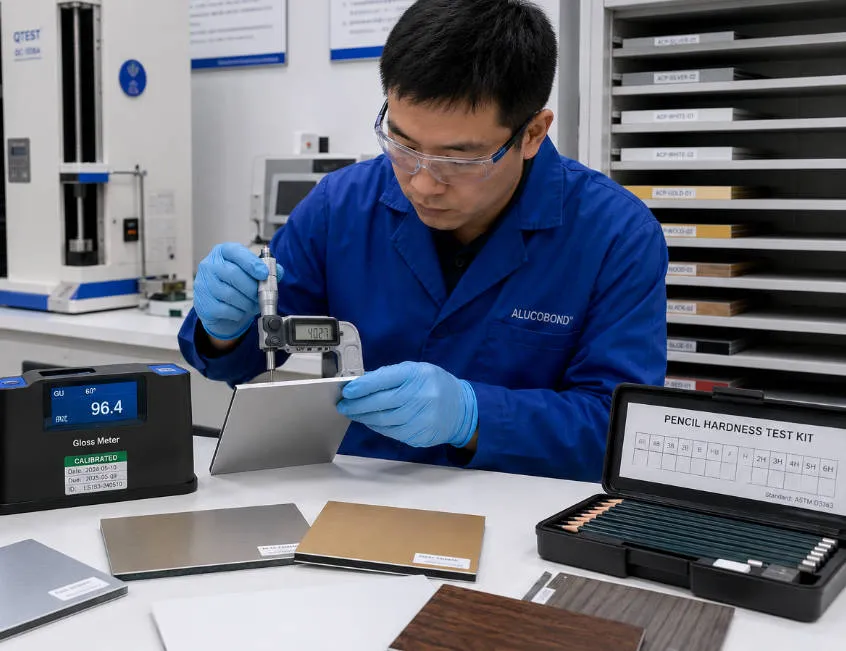
Key Testing Standards for Aluminum Composite Panels
Multiple national and international standards govern the testing of aluminum composite panels. The following table summarizes the most important frameworks:
| Standard System | Key Standards | Scope |
|---|---|---|
| China (GB/T) | GB/T 17748-2008 | Aluminum-plastic composite panel for building curtain wall |
| China (GB/T) | GB/T 22412-2008 | Ordinary decorative aluminum-plastic composite board |
| USA | AAMA, ASTM | American architectural and materials testing standards |
| Europe | EN, ISO, BS | European material and performance standards |
| Europe | QUALICOAT | Coating quality and weathering performance regulations |
| International | Global inspection, verification, testing, and certification |
GB/T 17748-2008 is the primary Chinese standard for curtain wall-grade ACPs, covering mechanical properties, coating performance, and material composition requirements. GB/T 22412-2008 applies to general decorative panels with somewhat less stringent requirements. International projects often require compliance with multiple standard systems — a QUALICOAT-certified panel that also meets ASTM requirements provides the broadest acceptance.
Test Environment and Specimen Preparation
Proper test conditions are critical to obtaining reliable, reproducible results. Both Chinese national standards and international best practices specify strict environmental and specimen requirements:
Test Environment
- Specimens must be conditioned in the standard environment specified by GB/T 2918 for a minimum of 24 hours befOre testing
- All tests should be conducted under these same conditions unless otherwise specified
- Temperature and humidity control ensure that test results are not influenced by ambient conditions
Specimen Preparation
- Specimen location must be at least 50 mm from the product edge to avoid edge effects
- Size and quantity of specimens are agreed upon between the testing laboratory and the client
- Consideration must be given to the consistency of decorative surface performance in both vertical and horizontal directions
- Requirements for the vertical, horizontal, front, and back sides of the product should also be consistent
Key Terminology
| Term | Definition |
|---|---|
| Wave | Non-decorative wavy lines or bumps on the product's decorative surface |
| Spot | Partial defect of the product's decorative surface layer |
| Bubble | Partial bulge of the aluminum or decorative surface |
| Coating flexibility | The minimum number of wrappings when the coated aluminum surface faces outward and bends 180 degrees around a mandrel without cracking or detachment |
Domestic Testing Methods and Key Performance Parameters
The main test items for aluminum composite panels under Chinese standards include:
| Test Item | Parameter Evaluated | Key Standard Reference |
|---|---|---|
| Appearance quality | Surface defects (waves, spots, bubbles) | Visual inspection |
| Sheet thickness | Total panel thickness | Caliper measurement |
| Aluminum thickness | Individual aluminum skin thickness | Micrometer (0.001 mm resolution) |
| Coating thickness | Total coating layer thickness | Coating thickness gauge |
| Surface pencil hardness | Scratch resistance of coating surface | GB/T 6739 |
| Coating gloss deviation | Uniformity of surface gloss | GB/T 9754 |
| Coating flexibility | Crack and detachment resistance under bending | Mandrel bend test |
| Coating adhesion | Bond strength between coating and aluminum | Adhesion test |
| Impact resistance | Resistance to mechanical impact | Impact test apparatus |
| Coating hydrochloric acid resistance | Chemical resistance to acid exposure | Immersion/spot test |
| Coating oil resistance | Chemical resistance to oil staining | Stain resistance test |
| Bending strength | Structural flexural capacity of panel | Three-point or four-point bend |
| Peel strength | Bond strength between aluminum and core | 180-degree peel test |
Each parameter has specific minimum requirements defined in the applicable standard. Leading manufacturers often exceed these minimums significantly — a sign of strong quality commitment and competitive advantage in both domestic and international markets.
Core Testing Procedures in Detail
Aluminum Thickness Measurement
Aluminum material is removed from the composite panel sample and used as the test specimen. A thickness measuring instrument with a minimum resolution of 0.001 mm is used — coating thickness is excluded from the measurement. At least five measurements are taken on each specimen, including four corners and the center. Both the minimum value and the arithmetic mean of all measurements are reported as the test result.
Coating Thickness Measurement
Coating thickness refers to the total coating layer thickness. Measurements follow the same methodology as aluminum thickness: at least five points per specimen (four corners plus center), with both the minimum value and arithmetic mean reported. Coating thickness directly affects weathering performance and service life — insufficient coating leads to premature color fading and corrosion.
Surface Pencil Hardness (GB/T 6739)
Pencil hardness is a widely used method for evaluating coating film hardness. The test uses pencil leads graded from the hardest (6H) down through 5H, 4H, 3H, 2H, H, HB (medium hardness), B, 2B, to the softest (6B). After testing, the coating surface must show no furrow or scratch. The minimum of all measured values is reported as the test result. Higher pencil hardness indicates better scratch and abrasion resistance.
Coating Gloss Deviation (GB/T 9754)
Gloss is measured at sufficient locations on the specimen — at least five points per specimen, including four corners and center. During testing, the production direction of the specimen must be consistent. The difference between the maximum and minimum values across all measurements is used as the test result. Low gloss deviation indicates uniform coating quality and consistent surface appearance.
Coating Flexibility
The coating flexibility test evaluates the coating's ability to withstand bending without cracking or detaching. The coated aluminum surface faces outward and is bent 180 degrees around a mandrel of specified diameter. The test determines the minimum number of mandrel wrappings the coating can endure without failure. This parameter is critical for panels that will be formed, curved, or rolled during installation.
Coating Adhesion
Adhesion testing measures the bond strength between the coating and the aluminum substrate. Both dry adhesion and boiling water adhesion are commonly tested. Boiling water adhesion is particularly demanding — the specimen is immersed in boiling water for a specified period, then evaluated for coating detachment. Panels that maintain adhesion after boiling water exposure demonstrate excellent coating bonding suitable for harsh environmental conditions.
Impact Resistance
Impact resistance testing evaluates the panel's ability to withstand mechanical impact without coating damage or structural failure. A weighted impactor is dropped from a specified height onto the panel surface. The specimen is examined for cracks, delamination, or coating detachment after impact. This test simulates real-world conditions such as hail, construction debris, and handling damage.
Chemical Resistance
Chemical resistance testing evaluates the coating's ability to resist damage from exposure to acids, alkalis, oils, and other chemicals. Common tests include hydrochloric acid resistance (muriatic acid spot or immersion test) and oil resistance (stain resistance test). The coating surface is examined for discoloration, softening, gloss loss, or other signs of chemical attack after exposure. This is particularly important for panels in industrial environments, coastal areas, or urban settings with high pollution.
Falling Sand Abrasion
The falling sand abrasion test (also known as sand abrasion resistance) evaluates the coating's resistance to abrasive wear. Standardized sand is allowed to fall onto the coated surface from a specified height and angle until the coating is worn through to the substrate. The volume or weight of sand required to wear through the coating is the measure of abrasion resistance. This test is relevant for ground-floor applications and high-traffic areas where panels may be subject to airborne particulate erosion.
Peel Strength: The Critical Performance Factor
Peel strength — the bond strength between the aluminum skin and the core material — is arguably the single most critical performance parameter for aluminum composite panels. Low peel strength leads to panel delamination, which can cause bulging, water ingress, and catastrophic facade failure under wind load.
Six key factors affect the peel strength of aluminum composite panels:
| Factor | Influence on Peel Strength |
|---|---|
| 1. Aluminum foil quality | Surface cleanliness, alloy composition, and mechanical properties of the aluminum skin directly affect adhesion |
| 2. Pre-treatment of aluminum plates | Chemical or mechanical surface preparation creates the optimal surface profile for polymer adhesion |
| 3. Core material selection | The polymer core formulation must be compatible with both the aluminum surface and the adhesive system |
| 4. Polymer membrane selection | The choice of adhesive polymer film determines the chemistry of the aluminum-to-core bond |
| 5. Production equipment | Continuous co-extrusion line precision affects bond uniformity and consistency across the panel |
| 6. Co-extrusion process parameters | Temperature, pressure, speed, and line tension must be precisely controlled for optimal bonding |
A 180-degree peel test is the standard method: the aluminum skin is peeled back from the core at a controlled speed and angle, and the force required is measured. Results are reported in N/mm (newtons per millimeter of width). Leading manufacturers target peel strength values well above the minimum standard requirements.
Material Requirements for Curtain Wall Panels
aluminum alloy Requirements
Curtain wall-grade aluminum composite panels must use aluminum alloys from the 3000 series (e.g., 3003), 5000 series (e.g., 5005), or other series with proven corrosion resistance and mechanical properties. Material properties must meet the requirements of GB/T 3880.2. The alloy series selection affects the panel's formability, corrosion resistance, and long-term durability.
Coating Material Requirements
Curtain wall panel coatings should use fluorocarbon resin (PVDF — polyvinylidene fluoride) with excellent weatherability, or materials with comparable or better properties. PVDF is the industry benchmark for exterior coating performance, providing exceptional resistance to UV degradation, color fading, and chemical attack.
Important clarification on PVDF content:
- 70% fluorocarbon resin refers to PVDF accounting for 70% of the resin raw materials in the paint formulation
- The final PVDF content in the aluminum composite coating is approximately 25-45%, because the paint also contains pigments and other components, and a non-fluorocarbon primer layer is typically applied beneath the PVDF topcoat
- Pure PVDF resin is not suitable for direct coating — it must be modified with other materials to achieve proper application performance
Core Material Requirements
For curtain wall applications, more than 80% of the raw materials used for core materials must be inorganic materials. This requirement is critical for fire safety performance. Core material composition directly affects the panel's fire rating, smoke generation, and toxicity characteristics.
International Testing and Certification
is a global leader in inspection, verification, testing, and certification, recognized as a worldwide benchmark for quality and integrity. provides comprehensive testing for aluminum composite panels including:
| Test | What It Evaluates |
|---|---|
| Chemical resistance | Resistance to acid and chemical corrosion |
| Pencil hardness | Coating scratch resistance (6H to 6B scale) |
| Coating flexibility | Crack and detachment resistance under bending |
| Falling sand abrasion | Abrasive wear resistance |
| Dry adhesion | Bond strength between coating and substrate (ambient conditions) |
| Boiling water adhesion | Bond strength after boiling water immersion |
| Impact resistance | Resistance to mechanical impact without coating failure |
| Muriatic acid resistance | Specific acid corrosion resistance |
certification provides international credibility and is often required for export markets. A comprehensive test report demonstrating compliance across all parameters gives architects, contractors, and building owners confidence that the panels meet global quality expectations.## Industry Applications
Aluminum composite panel testing is critical across multiple construction sectors:
| Application | Key Testing Priorities |
|---|---|
| Building curtain walls | Peel strength, coating weatherability, fire performance, wind load resistance |
| Interior decoration | Coating adhesion, surface hardness, chemical resistance |
| Signage and advertising | Color uniformity, coating gloss, UV resistance |
| Transportation (buses, subways) | Impact resistance, fire performance, vibration durability |
| Industrial cladding | Chemical resistance, abrasion resistance, corrosion protection |
Each application demands different performance priorities. A curtain wall panel must excel in weatherability and structural bonding, while a transportation panel prioritizes fire safety and impact resistance. Testing ensures the panel specified for each application actually delivers the required performance.
Summary
Aluminum composite panel testing spans visual inspection, dimensional measurement, coating performance, mechanical strength, chemical resistance, and fire safety — each category essential for different applications and markets. Chinese standards (GB/T 17748-2008, GB/T 22412-2008), American standards (AAMA, ASTM), European standards (EN, ISO, BS, QUALICOAT), and international certification () collectively ensure that panels meet the performance requirements of diverse global markets. Peel strength remains the single most critical parameter, influenced by aluminum quality, surface preparation, core material, adhesive selection, and production process control. Panels that consistently exceed minimum standard requirements demonstrate the quality commitment that earns trust in both domestic and international construction projects.