Table of Contents
- What is the Ames test?
- Principle: how a reverse mutation signals mutagenicity
- The five tester strains required by OECD TG 471
- Why the S9 metabolic activation system is mandatory
- Plate incorporation, pre-incubation, and fluctuation methods
- Positive and negative controls for each strain
- Result interpretation: the three-criterion judgement
- Which standards govern the Ames test?
- Where the Ames test fits in ICH M7(R2) and ICH S2(R1)
- Enhanced Ames test for N-nitrosamines
- Sample types and applicability
- Limitations and confirmatory follow-on testing
- FAQ
- Our Ames test capabilities
What is the Ames test?
The Ames test (bacterial reverse mutation assay) is a short-term in vitro assay that uses histidine- or tryptophan-auxotrophic strains of Salmonella typhimurium and Escherichia coli to detect whether a chemical causes gene mutations. It was developed by Bruce N. Ames at the University of California, Berkeley in the early 1970s, and is now the most widely used initial screen for mutagenic potential worldwide, with a historically reported concordance of 50–83 % with rodent carcinogenicity bioassays. Because mutation is a primary mechanism of carcinogenesis, a positive Ames test flags a chemical as a putative carcinogen long before any animal data exist.
In modern regulatory practice the Ames test is the anchor of every genetic toxicology battery. ICH S2(R1) lists it as the mandatory bacterial gene-mutation endpoint in both Option 1 and Option 2; ICH M7(R2) treats an Ames-negative result as sufficient evidence to classify a drug impurity as Class 5 (non-mutagenic) and remove it from further genotoxic control. The OECD Test Guideline TG 471 (1997, still current) defines the internationally harmonised method, and is adopted in China as GB 15193.4-2014 for food safety assessment and as General Monograph 1141 of the Chinese Pharmacopoeia (4th Section) for drug registration — three standards that, although they share the same biological principle, sit in three different regulatory silos and apply to three different product categories.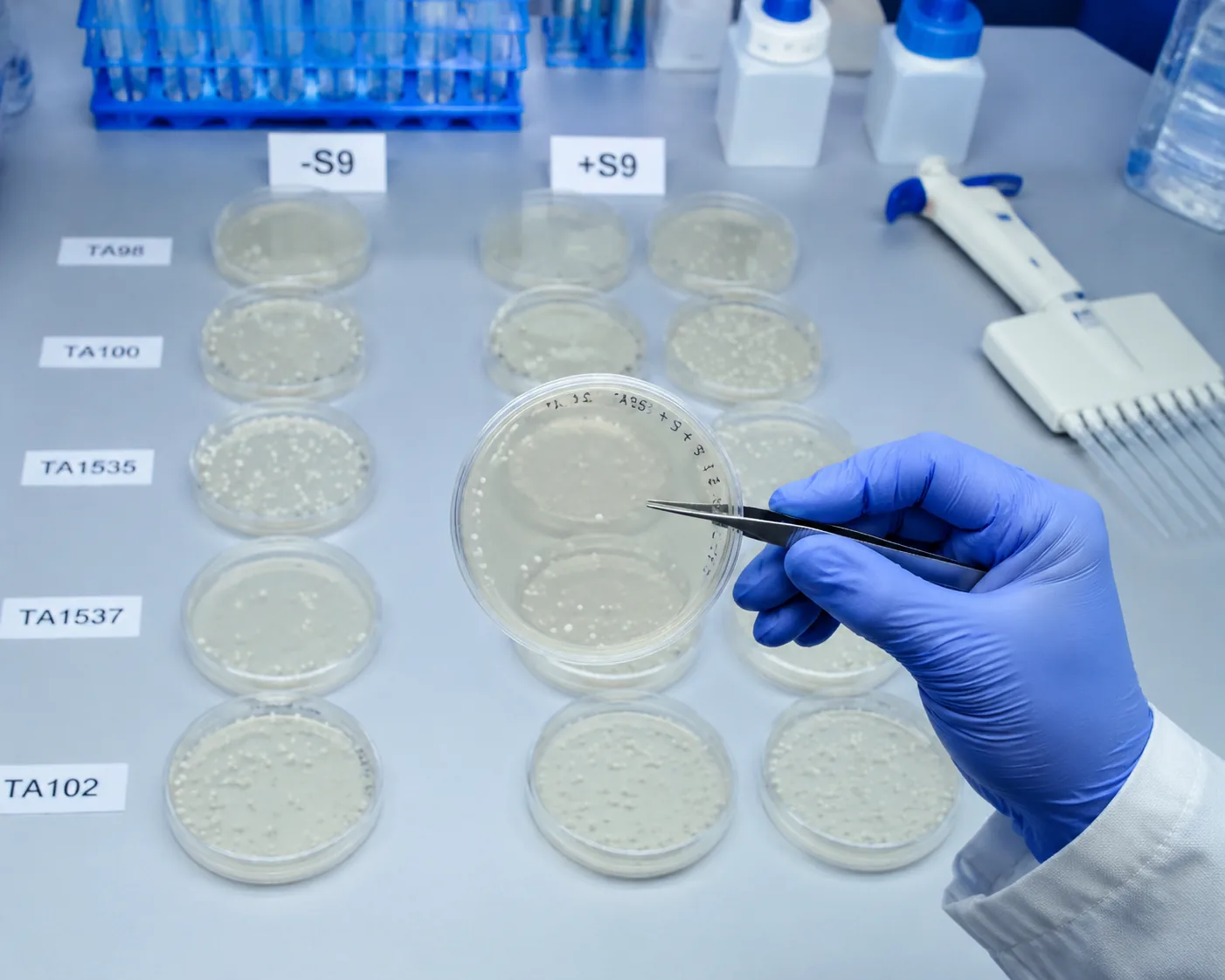
Principle: how a reverse mutation signals mutagenicity
The Ames test exploits the fact that certain mutations can be reversed. The tester strains carry a point mutation (base substitution or frameshift) in a gene of the histidine operon (in S. typhimurium) or the tryptophan operon (in E. coli). Because of this mutation the strains cannot synthesise histidine or tryptophan, and will not grow on minimal medium lacking the amino acid. When the strain is exposed to a mutagen, some cells undergo a second — reverse — mutation that restores a functional copy of the gene; these revertants regain the ability to synthesise the amino acid and form visible colonies on minimal medium.
The number of revertant colonies per plate is the assay readout. A mutagen produces a dose-related increase in revertants; the negative (solvent) control yields only the small number of spontaneous revertants characteristic of each strain. Three additional genetic modifications make the tester strains sensitive enough to detect the low mutation rates produced by environmental and pharmaceutical concentrations:
- rfa mutation — a defective lipopolysaccharide cell wall that allows bulky and hydrophobic molecules to penetrate the bacterium.
- uvrB deletion — eliminates excision repair, so DNA lesions created by the mutagen persist and are scored instead of being silently repaired.
- pKM101 plasmid (R-factor) — encodes error-prone repair that increases the probability that a DNA lesion is converted into a heritable mutation.
These three modifications together raise the sensitivity of the tester strains by one to two orders of magnitude relative to wild-type Salmonella, which is why the modern Ames test detects mutagens that the original 1970s protocol missed.
The five tester strains required by OECD TG 471
OECD TG 471 mandates at least five strains in every regulatory Ames test, and the standard panel is non-negotiable for any submission to a major regulator. The composition is:
| Strain | Species | Mutation detected | Genetic features |
|---|---|---|---|
| TA1535 | S. typhimurium | Base-pair substitution (hisG46) | rfa, ΔuvrB |
| TA1537 (or TA97 / TA97a) | S. typhimurium | Frameshift (hisC3076 / hisD6610) | rfa, ΔuvrB |
| TA98 | S. typhimururium | Frameshift (hisD3052) | rfa, ΔuvrB, pKM101 |
| TA100 | S. typhimurium | Base-pair substitution (hisG46) | rfa, ΔuvrB, pKM101 |
| TA102 or E. coli WP2 uvrA (or WP2 uvrA pKM101) | S. typhimurium / E. coli | Cross-linking / oxidative (TA102, hisG428 on pAQ1) or base-pair substitution at trpE (WP2) | TA102: rfa, pKM101, pAQ1; WP2: ΔuvrA |
Each strain targets a different mutational mechanism, which is why the full battery is required rather than a single representative strain. TA98 and TA100 alone detect roughly 93 % of the mutagens detected by the full TG 471 battery (Kamber et al., Mutagenesis 2009, ScienceDirect 2018 re-evaluation), but the remaining strains catch the 7 % of mutagens that act through cross-linking (TA102 / WP2), specific frameshift mechanisms (TA1537), or base-pair substitutions that the pKM101-bearing strains miss (TA1535). Dropping any of the five strains from a regulatory submission is grounds for rejection.
Before each experiment every strain must be confirmed for: histidine or tryptophan dependence; the rfa cell-wall permeability phenotype (crystal violet sensitivity); uvrB deficiency (UV sensitivity); and the presence of the pKM101 plasmid (ampicillin resistance). Strain identity is documented and held with the study raw data; an Ames test run with an uncharacterised strain is invalid.
Why the S9 metabolic activation system is mandatory
Many chemicals are not mutagenic themselves but become mutagenic after hepatic metabolism — the classic example is benzo[a]pyrene, which is inert in the parent form and mutagenic only as the CYP1A1-generated diol epoxide. Bacteria do not have mammalian metabolic enzymes, so an Ames test run without a metabolic activation system would miss this entire class of pro-mutagens.
OECD TG 471 therefore requires every Ames study to be run in parallel with and without an exogenous metabolic activation system, conventionally the Aroclor 1254-induced rat liver S9 fraction. S9 is the 9,000 × g supernatant of homogenised liver from rats pre-treated with Aroclor 1254 (a PCB mixture that induces CYP1A1, 1A2, 2B and 3A families). When supplemented with NADP and glucose-6-phosphate as a regenerating system, S9 carries out the Phase I oxidation reactions that generate electrophilic metabolites in vivo. The standard S9 concentration in the plate incorporation method is 10 % v/v in the top agar; the pre-incubation method uses 5–30 % v/v depending on the chemical class.
A chemical is judged mutagenic only if it produces a positive response either without S9 (directly acting mutagen) or with S9 (pro-mutagen activated by metabolism) or in both. A chemical that is negative in both arms — at adequate cytotoxic concentrations, with valid positive controls — is classified as non-mutagenic in the Ames test, which under ICH M7(R2) is sufficient to classify a drug impurity as Class 5.
Plate incorporation, pre-incubation, and fluctuation methods
Three procedural variants are accepted under TG 471; the choice depends on the physicochemical class of the test article.
- Plate incorporation method (standard). Tester strain (≈10⁸ cells), test article or control, and S9 mix (or buffer) are added to molten top agar with a trace of histidine/biotin, mixed, and poured over a minimal glucose agar plate. After 48 h at 37 °C, revertant colonies are counted. This is the most widely used variant and the default for general chemicals.
- Pre-incubation method. Strain, test article, and S9 mix are incubated together at 37 °C for 20–60 min (30 min for the enhanced N-nitrosamine protocol) before top agar is added and the plate is poured. Pre-incubation is required for short-lived reactive metabolites that would be diluted below their effective concentration in the standard pour-plate, and is the method of choice for azo compounds, diazo compounds, and N-nitrosamines.
- Fluctuation method (microplate, 96- or 384-well). The assay is performed in liquid culture with a pH indicator; revertant growth acidifies the well and turns the indicator from purple to yellow. Wells are scored positive/negative and compared against solvent-control spontaneous reversion rates using a Poisson-based statistical table. The fluctuation method is the basis for high-throughput early-drug-discovery screening (e.g. Xenometrix Ames MPF, Eurofins mini-Ames) and requires only 5–50 mg of test article, against the 1–10 g required for a full regulatory plate study.
For regulatory submission the plate incorporation or pre-incubation method is standard. At least five analysable concentrations are tested, spaced at half-log intervals, in triplicate, with the top concentration limited by solubility or by cytotoxicity (a ≥50 % reduction in revertants or a thinning of the bacterial background lawn). The top concentration for a soluble, non-toxic chemical is 5 mg/plate (5,000 µg/plate) per TG 471; lower for medical devices (extract limits per ISO 10993-12 / GB/T 16886.12) and for combination products.
Positive and negative controls for each strain
Each Ames run must include concurrent positive controls for every strain, both with and without S9, to prove that the strain is responsive and that the S9 is metabolically competent. The negative (vehicle) control establishes the spontaneous reversion rate that the test article is compared against. Standard positive controls per OECD TG 471:
| Strain | − S9 positive control | + S9 positive control |
|---|---|---|
| TA1535 | Sodium azide (NaN₃) | 2-Aminoanthracene (2-AA) |
| TA1537 / TA97 | 9-Aminoacridine (9-AA) or ICR-191 | 2-Aminoanthracene |
| TA98 | 2-Nitrofluorene (2-NF) or 4-Nitro-o-phenylenediamine | 2-Aminoanthracene |
| TA100 | Sodium azide | 2-Aminoanthracene |
| TA102 | Mitomycin C (MMC) or cumene hydroperoxide | 2-Aminoanthracene |
| E. coli WP2 uvrA | 4-Nitroquinoline-N-oxide (4-NQO) | 2-Aminoanthracene |
The single positive control that proves S9 metabolic activity is 2-aminoanthracene, a pro-mutagen that gives a positive response only after CYP-mediated activation; a failure of 2-AA to produce a response in any strain in the +S9 arm invalidates the S9 batch and the entire study. Solvent (vehicle) controls are run in parallel at the same volume used for the test article; the solvent must not itself be toxic or mutagenic at the chosen concentration.
Result interpretation: the three-criterion judgement
The single most common gap in published Ames content is the lack of an explicit judgement rule. A result is not called positive merely because the test plate has more colonies than the control plate. Under OECD TG 471, GB 15193.4, and General Monograph 1141, a result is judged positive only when all three of the following conditions are met simultaneously:
- A ≥ 2-fold increase in revertant count relative to the concurrent solvent control — expressed as MR (mutation ratio) ≥ 2 in GB 15193.4. MR = (revertants per plate in the test group) ÷ (revertants per plate in the solvent control).
- A dose-related (monotonic) increasing trend across at least two or three consecutive concentrations — the response must track with dose, not merely spike at one concentration.
- Reproducibility — the positive response must be reproducible in an independent repeat experiment, ideally with a different method (plate incorporation confirmed by pre-incubation, or vice versa).
A result that meets one or two of these criteria but not all three is equivocal and triggers a follow-on experiment with adjusted concentrations or an alternative method. A result that fails all three is negative under that strain and condition. The judgement is made strain-by-strain and S9-arm-by-S9-arm; the overall study is called positive if any one strain under any one condition meets all three criteria.
This three-criterion rule — fold-increase, dose-response, reproducibility — is the explicit numerical criterion that most SERP articles gloss over, and is the single most important thing to get right when reading or producing an Ames report. A study report that calls a result positive without documenting all three is not defensible to a regulator.
Which standards govern the Ames test?
The Ames test is governed by a tier of international and Chinese standards depending on the product class.
| Standard | Scope | Applies to |
|---|---|---|
| OECD Test Guideline 471 (1997, current) | International harmonised method; ≥5 strains, ±S9, plate or pre-incubation | Chemicals, pesticides, pharmaceuticals — basis for REACH, OECD-GLP submissions |
| ICH S2(R1) (2011) | Genotoxicity test battery for human pharmaceuticals | Drug substance and drug product registration (FDA / EMA / NMPA) |
| ICH M7(R2) (2023) | DNA-reactive (mutagenic) impurities in pharmaceuticals | Drug impurities, including N-nitrosamines (CPCA approach, enhanced Ames) |
| GB 15193.4-2014 | Chinese national food safety standard — bacterial reverse mutation test | Food, health food, food additives, food-related products registration |
| Chinese Pharmacopoeia General Monograph 1141 (4th Section, 2020 / 2025 ed.) | Bacterial reverse mutation test for drug registration | Drug substance and drug product in China |
| GB/T 15670.12-2017 | Pesticide registration toxicology test — bacterial reverse mutation test | Pesticide registration in China |
| GB/T 16886.3-2019 | Medical device genetic toxicity (≡ ISO 10993-3) | Medical device extracts in China |
| ISO 10993-3:2014 | Medical device genetic toxicity | Medical devices internationally |
The single most consequential fact for a Chinese laboratory is that the same biological assay must be conducted and reported to three different Chinese standards depending on the product being registered — GB 15193.4 for food, Pharmacopoeia 1141 for drugs, GB/T 15670.12 for pesticides, GB/T 16886.3 for medical devices. Each standard adopts OECD TG 471 in principle but has China-specific reporting, strain-characterisation, and documentation requirements that a testing laboratory must satisfy.
Where the Ames test fits in ICH M7(R2) and ICH S2(R1)
Two ICH guidelines drive Ames testing in pharmaceutical development, and their requirements are different.
ICH S2(R1) defines the standard genotoxicity battery for a drug substance or product. Two testing options are offered:
- Option 1 — (1) Ames test; (2) a chromosomal-damage test in mammalian cells (in vitro metaphase chromosome aberration, or in vitro micronucleus); (3) an in vivo chromosomal-damage test in rodent hematopoietic cells (micronucleus or metaphase).
- Option 2 — (1) Ames test; (2) an in vivo genotoxicity assessment in two tissues (typically a rodent micronucleus plus a second in vivo endpoint, e.g. liver Comet or transgenic gene mutation).
The Ames test is mandatory in both options and is run as the first step; a positive Ames test does not necessarily stop development but forces a weight-of-evidence discussion and additional follow-on testing.
ICH M7(R2) governs DNA-reactive impurities in pharmaceuticals and assigns each impurity to one of five classes:
| Class | Definition | Control action |
|---|---|---|
| Class 1 | Known mutagenic carcinogen | Avoid or limit to substance-specific AI |
| Class 2 | Known mutagen, unknown carcinogenic potential | Limit to substance-specific or default AI (1.5 µg/day) |
| Class 3 | Alerting structure, unrelated to drug substance, no mutagenicity data | Run Ames test; if negative → Class 5; if positive → Class 2 |
| Class 4 | Alerting structure, same alert as drug substance (drug is Ames-negative) | Treat as non-mutagenic; no additional control |
| Class 5 | No structural alert, or Ames-negative | No additional control above ICH Q3A/Q3B |
A negative Ames result is the pivotal piece of evidence that reclassifies a Class 3 impurity as Class 5, removing it from M7 control entirely. The Ames result overrides any (Q)SAR structural-alert prediction — this is the explicit rule in the M7(R2) Q&A document.
Enhanced Ames test for N-nitrosamines
The 2018–2023 N-nitrosamine crisis (ranitidine, valsartan, nizatidine recalls) exposed a limitation of the standard Ames test: many N-nitrosamines are weakly mutagenic or negative under standard TG 471 conditions but are potent rodent carcinogens in vivo. The standard assay uses 10 % v/v rat S9; N-nitrosamines require higher S9 concentrations and a longer pre-incubation to generate the alkylating metabolites that produce their mutagenic signature.
ICH M7(R2) therefore introduced the enhanced Ames test for N-nitrosamines, with the following modifications to the standard protocol:
- Pre-incubation method mandatory (plate incorporation is not acceptable).
- 30 minutes pre-incubation at 37 °C (vs the standard 20 min).
- 30 % v/v S9 (vs the standard 10 %), to provide sufficient CYP2E1 / CYP2A6 activity for α-hydroxylation.
- Hamster S9 preferred over rat S9 for some N-nitrosamine subclasses, on the basis of better predictive concordance with rodent carcinogenicity.
A negative enhanced Ames result on an N-nitrosamine does not, on its own, justify Class 5 classification under M7(R2); in vivo follow-on testing is generally expected, and the AI is set by the Carcinogenic Potency Categorization Approach (CPCA) — 1.5 µg/day for the most potent categories, scaling up to 1500 µg/day for the least potent. This is the one category of impurity where the standard Ames test alone is insufficient, and it is a gap in most SERP content.
Sample types and applicability
The Ames test applies to any chemical, extract, or environmental sample for which an assessment of mutagenic potential is required. Typical sample categories include:
- Pharmaceutical drug substances and drug products — submitted under ICH S2(R1) for the active moiety, and under ICH M7(R2) for impurities and degradants.
- Drug impurities and degradants — particularly N-nitrosamines, azo compounds, and alerting structures that trigger Class 3 classification.
- Food additives, health foods, novel foods, and food-related products — submitted under GB 15193.4 for Chinese registration.
- Pesticide active ingredients and formulations — submitted under GB/T 15670.12 for Chinese pesticide registration, and under OECD TG 471 for international registration.
- Medical device extracts — prepared per ISO 10993-12 / GB/T 16886.12, tested under GB/T 16886.3 / ISO 10993-3.
- Cosmetics ingredients — under the EU Cosmetics Regulation and China's Cosmetic Safety Assessment Technical Guidelines, with a total reliance on in vitro testing because of the animal-testing ban.
- Environmental samples — wastewater, air-particulate extracts, soil extracts, industrial effluent — using the fluctuation method for higher sample volumes and lower detection limits.
- Herbal medicines and traditional medicine extracts — under Chinese Pharmacopoeia 1141 for drug registration.
Test-article requirements for a regulatory study are typically 1–10 g of solid or 1–10 mL of liquid, depending on solubility and the top concentration needed; the miniaturised fluctuation method reduces this to 5–50 mg for early screening.
Limitations and confirmatory follow-on testing
The Ames test is a prokaryotic assay and has well-characterised limitations:
- Not a mammalian cell. Salmonella is a prokaryote; it does not replicate the chromosomal structure, DNA repair repertoire, or metabolic activation of mammalian cells. A chemical that acts by aneuploidy, chromosomal rearrangement, or mammalian-specific metabolic activation will be missed.
- S9 is rat, not human. Although Aroclor-induced rat S9 is the standard, rat and human CYP profiles differ; some chemicals (e.g. certain nitrosamines, allylic compounds) are missed by rat S9 and detected only by human S9, which is now commercially available.
- False positives from nitrate moieties. Drugs containing a nitrate group (e.g. nitroglycerin) generate nitric oxide that can give a false positive in Ames; the substance is nonetheless used clinically, and the Ames result must be interpreted alongside the pharmacology.
- Concordance with carcinogenicity is 50–83 %, not 100 %. Ames is a screen, not a definitive carcinogenicity test; a positive Ames result triggers long-term carcinogenicity follow-on rather than immediate discontinuation.
For these reasons, a positive Ames result is followed by a mammalian cell assay (in vitro micronucleus or chromosome aberration) and, if needed, an in vivo assay, per ICH S2(R1). A negative Ames result in a Class 3 impurity, by contrast, is sufficient to close the genotoxic assessment and reclassify the impurity as Class 5.
FAQ
What is the Ames test and why is it done?
The Ames test is a bacterial reverse mutation assay that uses Salmonella typhimurium and E. coli tester strains to detect whether a chemical causes gene mutations. It is done as the first step of every regulatory genetic toxicology battery because mutation is a primary mechanism of carcinogenesis, and Ames is the cheapest and fastest way to flag a potential carcinogen.
What are the five strains required by OECD 471?
TA1535, TA1537 (or TA97 / TA97a), TA98, and TA100 in Salmonella typhimurium, plus either TA102 or E. coli WP2 uvrA (or WP2 uvrA pKM101). Each strain detects a different mutation mechanism; the full five-strain battery is mandatory for regulatory submission.
What is the positive judgement criterion for an Ames test?
A result is positive only when all three conditions are met: (1) revertant count ≥ 2× the concurrent solvent control (MR ≥ 2 in GB 15193.4); (2) a dose-related increasing trend across ≥ 2–3 concentrations; (3) reproducibility in an independent repeat experiment. Meeting one or two criteria is equivocal; failing all three is negative.
What is S9 and why is it required?
S9 is the 9,000 × g supernatant of Aroclor 1254-induced rat liver, supplemented with NADP and glucose-6-phosphate. It supplies mammalian Phase I metabolic enzymes (chiefly CYP1A1, 1A2, 2B, 3A) that convert pro-mutagens (e.g. benzo[a]pyrene) into their mutagenic metabolites. Every Ames study is run with and without S9; the +S9 arm is what detects pro-mutagens that would otherwise be missed.
What is the difference between GB 15193.4 and Pharmacopoeia 1141?
Both adopt OECD TG 471 in principle but apply to different product categories in China: GB 15193.4 is the national food safety standard for food, health food, and food-related products; General Monograph 1141 of the Chinese Pharmacopoeia (4th Section) applies to drug substance and drug product registration. A testing laboratory operating for both sectors must satisfy both sets of documentation and strain-characterisation requirements.
Our Ames test capabilities
Beijing ZKGX Research (ISO/IEC 17025 accredited testing laboratory) provides regulatory Ames testing to OECD TG 471, ICH S2(R1), ICH M7(R2), GB 15193.4-2014, Chinese Pharmacopoeia General Monograph 1141, GB/T 15670.12-2017, and GB/T 16886.3-2019 / ISO 10993-3, depending on the product category and target market.
We perform the complete regulatory and screening battery:
- Standard five-strain regulatory panel — TA1535, TA1537 (or TA97a), TA98, TA100, plus TA102 or E. coli WP2 uvrA — with full strain characterisation (histidine/tryptophan dependence, rfa, uvrB, pKM101) documented per study.
- Plate incorporation and pre-incubation methods — run in parallel where the chemistry warrants, under ±S9 (Aroclor 1254-induced rat liver S9) at standard and elevated concentrations.
- Enhanced Ames test for N-nitrosamines — pre-incubation at 37 °C for 30 min with 30 % v/v S9 (hamster or rat), per ICH M7(R2), with CPCA-aligned reporting.
- Mini-Ames / fluctuation method — 96- or 384-well microplate format, requiring 5–50 mg of test article, suitable for early drug-discovery screening.
- Three-criterion judgement and full data report — fold-increase (MR ≥ 2), dose-response, and reproducibility assessed strain-by-strain and S9-arm-by-S9-arm, with concurrent positive and negative controls, cytotoxicity assessment, and GLP-compliant raw-data package.
Suitable sample types include: pharmaceutical drug substances and drug products; drug impurities and degradants (including N-nitrosamines); food additives, health foods, and food-related products; pesticide actives and formulations; medical device extracts (per ISO 10993-12); cosmetics ingredients; environmental samples (wastewater, air-particulate extracts, soil extracts); and herbal medicine extracts. We also provide the companion mammalian cell assays (in vitro micronucleus, chromosome aberration) and in vivo follow-on testing required under ICH S2(R1) Option 1 or Option 2, so that a complete genotoxicology dossier can be assembled from a single laboratory. Each study is delivered with a full data report (study protocol, strain characterisation certificates, S9 activity validation, raw plate counts, statistical analysis, three-criterion judgement, and a defensible conclusion certificate). Contact Beijing ZKGX Research to discuss the standard applicable to your product and to schedule a study.