Table of Contents
- What is anthocyanin testing?
- The standard stack: GB 5009.185, AOAC, EU 1333/2008, FAO JECFA, ISO
- The six anthocyanidin aglycones and their glycosides
- Sample preparation: extraction, purification, and the 30 °C rule
- The pH differential method: total monomeric anthocyanins by UV-Vis
- HPLC-DAD and HPLC-MS/MS: identification and quantification of individual anthocyanins
- Authenticity testing: anthocyanin fingerprinting for juice adulteration
- Stability and degradation kinetics
- Regulatory status: E163 food colour, GB 2760, and health claims
- FAQ
- Our anthocyanin testing capabilities
What is anthocyanin testing?
Anthocyanin testing is the measurement and validation of the identity, concentration, and stability of anthocyanins — the water-soluble glycosylated pigments responsible for most of the red, blue, and purple colours of fruits, vegetables, grains, flowers, and leaves — in a food, beverage, dietary-supplement, plant-extract, or biological-fluid matrix. The output of an anthocyanin test is a dossier covering the total anthocyanin content (by the pH differential UV-Vis method), the individual anthocyanin profile (by HPLC-DAD and HPLC-MS/MS, identifying and quantifying the 6 aglycone backbones × their glycosides and acylated derivatives — over 600 individual compounds), the authenticity fingerprint (the ratio of individual anthocyanins that identifies the botanical source and detects adulteration with cheaper juices or synthetic dyes), and the stability (the degradation kinetics under the processing and storage conditions).
Anthocyanins belong to the flavonoid class, distinguished from other flavonoids by their ability to form the flavylium (2-phenylbenzopyrylium) cation in acidic aqueous solution. The structural diversity is enormous: 6 anthocyanidin aglycones (cyanidin, delphinidin, pelargonidin, peonidin, petunidin, malvidin) × 5 common sugars (glucose, galactose, arabinose, rhamnose, xylose) × acylation with cinnamic or aliphatic acids gives over 600 individual anthocyanins identified to date, with the most common being the 3-glucosides and 3-rutinosides of cyanidin and delphinidin. The biological, functional-food, and food-colouring roles of anthocyanins have driven a strong regulatory and industrial interest in their accurate measurement.
The standards governing anthocyanin testing span the Chinese GB 5009.185-2016 National food safety Standard — Determination of Anthocyanins in Foods (the HPLC method for the 6 anthocyanidin-3-glucosides), the AOAC Official Method 2005.02 (the pH differential total monomeric anthocyanin method) and AOAC 2018.06 (HPLC-MS/MS for individual anthocyanins in fruit juices), the EU Regulation 1333/2008 (E163 grape-skin anthocyanin food-colour specification), the FAO JECFA E163 monograph (the international food-colour specification), and the ISO fruit-and-vegetable test methods. A grape-skin anthocyanin extract placed on the Chinese market as a food colour must satisfy the applicable GB standard (GB 1886.x for the extract; GB 5009.185 for the food-matrix determination), with usage regulated by GB 2760; on the EU market, the E163 specification under Commission Regulation (EU) No 231/2012; on the US market, the FDA 21 CFR 73.169 grape-colour-exempt status.
The standard stack: GB 5009.185, AOAC, EU 1333/2008, FAO JECFA, ISO
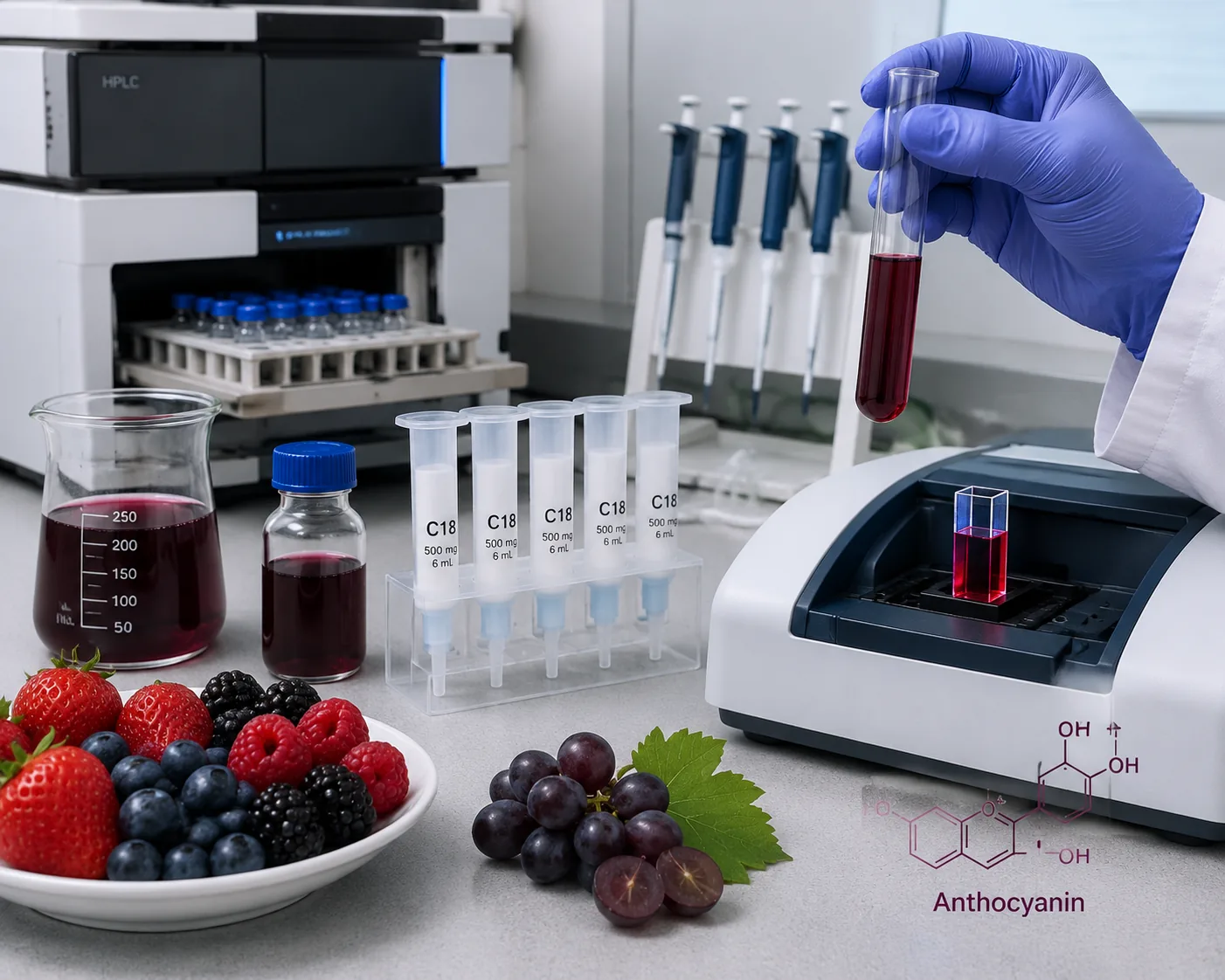
A complete anthocyanin testing project draws on a stack of Chinese, international, US, and EU standards.
| Family | Standard | Scope |
|---|---|---|
| GB 5009.185-2016 | National Food Safety Standard — Determination of Anthocyanins in Foods | The Chinese national HPLC method for the determination of the 6 anthocyanidin-3-glucosides (cyanidin, delphinidin, pelargonidin, peonidin, petunidin, malvidin 3-glucoside) in foods, with the C18 reversed-phase HPLC-UV/Vis method |
| GB 1886.x series | Food additive — grape-skin extract (E163) and related natural-colour additive monographs | The Chinese product standards for the food-colour-grade anthocyanin extracts |
| GB 2760-2024 | National Food Safety Standard — Use of Food Additives | The Chinese usage scope — grape-skin extract (E163) permitted in specified food categories at specified maximum use levels |
| AOAC Official Method 2005.02 | Total Monomeric Anthocyanin by the pH Differential Method | The international total-anthocyanin UV-Vis method (the "gold standard" of total anthocyanin quantification) |
| AOAC Official Method 2014.07 (and 2018.06) | Anthocyanins in fruit juices by LC-MS/MS (and updates) | The international LC-MS/MS method for individual anthocyanin identification and quantification in fruit juices and beverages |
| EU Regulation 1333/2008 (with amendments) | Food additives authorised in food — E163 grape-skin extract | The EU food-colour regulation; E163 is permitted in specified food categories with specified maximum use levels |
| Commission Regulation (EU) No 231/2012 | Specifications for food additives — E163 | The EU purity specification for E163 grape-skin anthocyanin extract |
| FAO JECFA E163 (Compendium of Food Additive Specifications) | Grape-skin extract | The international food-colour specification, harmonised with EU 231/2012 |
| FDA 21 CFR 73.169 | Grape skin extract (enocianina) — colour additive exempt from batch certification | The US food-colour-exempt status of grape-skin extract |
| ISO 1709 (and related ISO 7802, 12081) | (Older ISO methods — largely superseded by AOAC and GB) | Historical reference |
| Mazza, Cacace & Kay (J. AOAC Int. 87:129, 2004) | Methods of analysis for anthocyanins in plants and biological fluids | The reference review of the analytical methods (extraction, purification, pH differential, HPLC, MS, NMR) |
The single most consequential fact for a Chinese manufacturer is that GB 5009.185-2016 is the NMPA / SAMR-mandated method for anthocyanin determination in foods, and the food-colour-grade anthocyanin extract (E163) is regulated by GB 1886.x with usage under GB 2760. A grape-skin extract placed on the Chinese market must satisfy both.
The six anthocyanidin aglycones and their glycosides
The anthocyanin family is built on six anthocyanidin aglycones (the flavylium-cation backbone without the sugar), classified by the number and position of hydroxyl and methoxyl groups on the B-ring of the flavan nucleus:
| Aglycone | B-ring substitution | R1 | R2 | R3 | Colour | Most common source |
|---|---|---|---|---|---|---|
| Pelargonidin | 4′-OH (single hydroxyl) | H | OH | H | Orange-red | Strawberries, red radish, kidney beans |
| Cyanidin | 3′,4′-diOH | OH | OH | H | Red-magenta | The most common anthocyanidin in nature; apples, red cabbage, elderberry, blackberry |
| Delphinidin | 3′,4′,5′-triOH | OH | OH | OH | Blue-magenta | Delphinium, eggplant, concord grape, blueberry |
| Peonidin | 3′-OMe, 4′-OH (methylated cyanidin) | OMe | OH | H | Red-magenta | Peony, cranberry, grape |
| Petunidin | 3′-OMe, 4′,5′-diOH | OMe | OH | OH | Purple | Petunia, grape, blueberry |
| Malvidin | 3′,5′-diOMe, 4′-OH | OMe | OH | OMe | Purple | Malva, red wine grape, blueberry |
The colour of each aglycone is modulated by:
- The glycosylation (the sugar attached at C-3, C-5, or C-7) — increases water solubility and structural stability
- The acylation of the sugar with cinnamic acids (p-coumaric, caffeic, ferulic) or aliphatic acids (acetic, malonic, succinic) — further increases stability
- The pH of the matrix (the four species — flavylium cation, quinonoidal base, pseudobase, chalcone — coexist in equilibrium; the bright-red flavylium predominates at pH < 2, the colourless pseudobase at pH 4-5)
- The copigmentation with other flavonoids, the metal complexing with Al, Fe, Mg, and the temperature / oxygen exposure
The most common anthocyanins in foods are the 3-glucosides (the 3-O-β-D-glucopyranoside of each aglycone) and the 3-rutinosides (the 3-O-β-rutinoside); these are the primary targets of the GB 5009.185-2016 HPLC method and of the AOAC 2014.07 LC-MS/MS method. The acylated anthocyanins (the 3-(6-p-coumaroyl)glucosides, the 3-(6-malonyl)glucosides) are additional targets in the more comprehensive LC-MS/MS methods.
Sample preparation: extraction, purification, and the 30 °C rule
The sample preparation is the most critical step of the anthocyanin test — anthocyanins are structurally labile (susceptible to heat, pH, oxygen, light, and enzymatic degradation by polyphenol oxidase and glycosidase) and the extraction must preserve the native structures.
Extraction — The most common extraction solvents are acidified methanol (70-80 % methanol + 0.01 % HCl or 1 % formic acid), acidified ethanol (the food-grade alternative), or aqueous acetone. The acid protonates the flavylium cation (the red, stable form at pH < 2). The critical constraints are:
- Temperature ≤ 30 °C — a higher temperature degrades the anthocyanins (the Mazza 2004 study reported a reduction from 70 % to 54 % of total phenolics in black-currant ethanolic extracts when the extraction temperature was raised from 6 °C to 74 °C)
- No mineral acids for the acylated anthocyanins — acylated anthocyanins are degraded in HCl or H₂SO₄; organic acids (acetic, formic) are used for the acylated forms
- Solvent-to-sample ratio of 13-18 mL/g dry-weight basis, with one or two re-extractions
Purification — The crude extract contains sugars, acids, amino acids, proteins, and other polyphenolics that interfere with the HPLC. The standard purification is:
- C18 SPE cartridge (e.g. Waters Sep-Pak C18) — pre-conditioned with methanol, then water or dilute acid; the anthocyanins bind the C18; the sugars and acids are washed off with water; the anthocyanins are eluted with acidified methanol
- Ethyl acetate wash — removes the less-polar polyphenolics (flavonols, phenolic acids) that would otherwise co-elute with the anthocyanins on HPLC
Recovery — The C18 SPE recovery for the major anthocyanins is 90-99.7 % (per the Mazza 2004 review and the Giusti 1999 protocol), making the SPE the reliable purification for quantitative HPLC.
Biological fluids (plasma, urine) — The anthocyanin concentrations in biological fluids are at the limit of detection of the current methods (< 1 % of the ingested dose in blood, 1-5 % in urine); the sample preparation for biological fluids adds acidification to pH 1-2, centrifugation, SPE C18 cleanup, and concentration under nitrogen before the HPLC injection.
The pH differential method: total monomeric anthocyanins by UV-Vis
The pH differential method (the AOAC Official Method 2005.02, originally described by Fuleki & Francis 1968 and refined by Wrolstad and Giusti) is the reference method for the total monomeric anthocyanin content — the single most-reported anthocyanin number in the food and supplement industry.
Principle — Anthocyanins exist as the bright-red flavylium cation at pH 1.0 and as the colourless hemiacetal (pseudobase) at pH 4.5. By measuring the absorbance at λ_max (typically 510-540 nm) at both pH values and taking the difference, the contribution of the anthocyanins is isolated from the background absorbance of other polyphenolics and the polymeric anthocyanins (which retain colour at pH 4.5).
Procedure:
- Dilute the sample in pH 1.0 buffer (0.025 M potassium chloride, HCl-adjusted) and in pH 4.5 buffer (0.4 M sodium acetate, HCl-adjusted)
- Equilibrate 15 min at room temperature
- Measure the absorbance at λ_max (typically 520 nm) and at 700 nm (the haze correction)
- Calculate the absorbance difference:
ΔA = (Aλmax − A_700)_pH1.0 − (Aλmax − A_700)_pH4.5
- Calculate the total monomeric anthocyanin content:
TMA (mg/L, as cyanidin-3-glucoside equivalent) = (ΔA × MW × DF × 1000) / (ε × L)
where:
- MW = 449.2 g/mol (cyanidin-3-glucoside molecular weight) — the most common reference; or 493.4 for peonidin-3-glucoside, 528.8 for petunidin-3-glucoside
- ε = 26,900 L·mol⁻¹·cm⁻¹ (molar extinction coefficient of cyanidin-3-glucoside); or 28,000 for malvidin-3-glucoside
- DF = dilution factor
- L = path length (cm, typically 1 cm)
The result is reported as milligrams of cyanidin-3-glucoside equivalent per 100 g (or per litre) — the convention of the food-science and the dietary-supplement industry.
HPLC-DAD and HPLC-MS/MS: identification and quantification of individual anthocyanins
The pH differential method gives the total anthocyanin content; the individual anthocyanins are identified and quantified by HPLC-DAD (diode-array detector, per GB 5009.185-2016 and AOAC 2014.07) and HPLC-MS/MS (the structural-confirmation method, per AOAC 2018.06).
| HPLC element | GB 5009.185-2016 / AOAC 2014.07 typical |
|---|---|
| Column | C18 reversed-phase (e.g. 4.6 × 250 mm, 5 µm Agilent Zorbax SB-C18 or equivalent) |
| Mobile phase A | 5 % formic acid in water |
| Mobile phase B | 100 % methanol (or acetonitrile) |
| Gradient | A binary linear gradient from ~10 % B to ~30 % B over 20-30 min, with column re-equilibration |
| Flow rate | 0.8-1.0 mL/min |
| Detection (DAD) | 520 nm (the anthocyanin λ_max) plus 280 nm (the total polyphenolic detection) for cross-reference |
| Detection (MS/MS) | ESI+ (the flavylium cation is positively charged); MRM transition per anthocyanin (e.g. m/z 449 → 287 for cyanidin-3-glucoside) |
| Calibration | External standard — cyanidin-3-glucoside, malvidin-3-glucoside, peonidin-3-glucoside, delphinidin-3-glucoside (commercial standards available from Extrasynthese, Sigma, Polyphenols AS) |
| Identification | Retention time match to the standard; DAD spectrum match (λ_max 510-540 nm); MS/MS MRM transition match |
The HPLC-DAD method of GB 5009.185-2016 quantifies the 6 anthocyanidin-3-glucosides against their respective external standards. The HPLC-MS/MS method (AOAC 2018.06) additionally identifies the rutinosides, the galactosides, the arabinosides, and the acylated derivatives — extending the analysis from 6 to 30-50 individual anthocyanins in a typical fruit matrix.
Authenticity testing: anthocyanin fingerprinting for juice adulteration
The anthocyanin fingerprint — the relative proportions of the individual anthocyanins — is a powerful tool for the authenticity testing of red and black fruit juices. Each botanical source has a characteristic fingerprint; an adulteration with a cheaper juice (e.g. apple juice, grape juice, or water) or with a synthetic dye (e.g. amaranth, Ponceau 4R) alters the fingerprint and is detected.
Examples of source-specific fingerprints:
- Pomegranate — dominated by cyanidin-3-glucoside, cyanidin-3,5-diglucoside, delphinidin-3-glucoside, delphinidin-3,5-diglucoside
- Concord grape — dominated by malvidin-3-glucoside, malvidin-3,5-diglucoside, peonidin-3-glucoside (the diglucosides are characteristic of the Vitis labrusca Concord, not the Vitis vinifera wine grape)
- Elderberry — dominated by cyanidin-3-glucoside, cyanidin-3-sambubioside
- Blackcurrant — dominated by delphinidin-3-glucoside, delphinidin-3-rutinoside, cyanidin-3-glucoside, cyanidin-3-rutinoside
- Raspberry — dominated by cyanidin-3-sophoroside, cyanidin-3-glucoside, cyanidin-3-rutinoside
The 2016 AOAC poster cited in the file (the Driscoll's Maravilla raspberry case) is a real-world example: the new raspberry variety showed the "normal" raspberry pigments but at ratios different from the established varieties, requiring an update of the reference fingerprint database to avoid false-positive adulteration calls.
The authenticity testing is performed by the HPLC-DAD or HPLC-MS/MS fingerprint, compared to a reference database (the EU Joint Research Centre, the AOAC, or an in-house database). A juice whose fingerprint deviates from the declared source by more than the natural variability is judged to be adulterated. The synthetic-dye adulteration is detected by the presence of dyes that are not naturally-occurring anthocyanins — identified by their HPLC retention time, DAD spectrum, and MS/MS transition.
Stability and degradation kinetics
Anthocyanins degrade during the food processing (pasteurisation, sterilisation, drying) and the storage (the shelf life of the beverage, the jam, the supplement). The degradation kinetics — the rate of loss as a function of temperature, pH, light, and oxygen — is a routine testing requirement for the shelf-life claim of an anthocyanin-containing product.
| Factor | Effect on anthocyanin stability |
|---|---|
| Temperature | The dominant factor — Arrhenius kinetics; the half-life t₁/₂ decreases with increasing temperature (e.g. a typical strawberry juice has t₁/₂ ~ 8 h at 80 °C, ~ 30 days at 4 °C) |
| pH | Anthocyanins are most stable at pH < 2 (the flavylium cation); unstable at pH > 4 (the colourless pseudobase, susceptible to degradation to chalcone and to ring-opening) |
| Oxygen | Oxidative degradation — the ascorbic acid in the matrix can accelerate the loss (the ascorbic-acid–anthocyanin condensation) |
| Light | Photo-oxidation — amber packaging and opaque storage extend the shelf life |
| Enzymes | Polyphenol oxidase (PPO) and anthocyanase (glycosidase) in the raw fruit — inactivated by blanching or by pasteurisation |
| Metal ions | Al, Fe, Mg, Sn — form metal-anthocyanin complexes that change the colour (the "tin-lake" of canned fruit) |
The stability testing is run at the processing temperature and the storage temperature, with sampling at defined intervals and the pH differential total-anthocyanin measurement at each time point. The first-order rate constant k and the half-life t₁/₂ = ln(2)/k are reported; the Arrhenius activation energy E_a characterises the temperature dependence.
Regulatory status: E163 food colour, GB 2760, and health claims
| Market | Anthocyanin as food colour | Anthocyanin health claim |
|---|---|---|
| China (SAMR) | Grape-skin extract (E163) per GB 2760-2024 — permitted in specified food categories (beverages, confectionery, dairy) at specified maximum use levels; the food-colour-grade extract per GB 1886.x | No approved health claim; the "antioxidant" claim is restricted to the GB 7718-2011 labelling rules |
| EU | E163 per Regulation 1333/2008 Annex II — permitted in specified food categories at specified maximum use levels; the specification per Commission Regulation 231/2012 | No authorised health claim for anthocyanins per EFSA (the EFSA ANS Panel has rejected several anthocyanin health-claim applications for insufficient evidence of cause-and-effect) |
| US (FDA) | Grape-skin extract (enocianina) per 21 CFR 73.169 — colour additive exempt from batch certification; the grape-skin extract is permitted in non-beverage foods | No authorised health claim; structure-function claims under the DSHEA (e.g. "supports antioxidant activity") are permitted on dietary supplements with the FDA disclaimer |
| Japan | Grape-skin colour per the MHLW Food Additives Directory | "Foods for Specified Health Uses" (FOSHU) — anthocyanin claims have been approved for the visual-function category |
The EU's rejection of the EFSA ANS Panel's anthocyanin health-claim applications is based on the variability of the test materials (different anthocyanin profiles across the grape varieties and the extraction processes) and the lack of the cause-and-effect evidence in human clinical trials. A manufacturer seeking a health claim should expect the claim to be evaluated on the specific test material, not on the "anthocyanins" class.
FAQ
What is the difference between the pH differential method and the HPLC method?
The pH differential method (AOAC 2005.02) measures the total monomeric anthocyanin content by UV-Vis — fast, simple, requires only a spectrophotometer, reported as cyanidin-3-glucoside equivalent. The HPLC-DAD method (GB 5009.185-2016, AOAC 2014.07) separates and quantifies the individual anthocyanins — slower, requires an HPLC, reported as the concentration of each of the 6 anthocyanidin-3-glucosides. The two methods are complementary; the pH differential is for total, the HPLC is for the individual.
What are the six anthocyanidins and how do they differ?
The six common anthocyanidin aglycones are pelargonidin (orange-red, single hydroxyl on B-ring), cyanidin (red-magenta, the most common in nature), delphinidin (blue-magenta, three hydroxyls), peonidin (methylated cyanidin), petunidin (methylated delphinidin), and malvidin (twice-methylated). They differ by the number and position of the hydroxyl and methoxyl groups on the B-ring, which determines the colour.
Why is the extraction temperature limited to 30 °C?
Anthocyanins are thermally labile — at temperatures above 30 °C the glycosidic bond and the acyl group hydrolyse, the aglycone degrades to colourless chalcone, and the anthocyanin content drops. The Mazza 2004 study reported a reduction from 70 % to 54 % of total phenolics in black-currant extracts when the extraction temperature was raised from 6 °C to 74 °C.
How does the anthocyanin fingerprint detect juice adulteration?
Each botanical source has a characteristic ratio of the individual anthocyanins (the pomegranate, the grape, the elderberry, the blackcurrant, the raspberry fingerprints). Adulteration with a cheaper juice or a synthetic dye alters the fingerprint; an HPLC-DAD or HPLC-MS/MS analysis compared to a reference database detects the deviation. The 2016 AOAC poster cited the Driscoll's Maravilla raspberry case as an example of a new variety whose fingerprint required a database update.
Does the EU authorise a health claim for anthocyanins?
No. The EFSA ANS Panel has rejected several anthocyanin health-claim applications, citing the variability of the test materials and the lack of cause-and-effect evidence in human clinical trials. A "supports antioxidant activity" structure-function claim is permitted on dietary supplements in the US under the DSHEA.
Our anthocyanin testing capabilities
Beijing ZKGX Research (ISO/IEC 17025 accredited, CMA- and CNAS-accredited testing laboratory) provides complete anthocyanin testing across the GB, AOAC, EU, FAO JECFA, and ISO standard stack:
- GB 5009.185-2016 HPLC determination of the 6 anthocyanidin-3-glucosides (cyanidin, delphinidin, pelargonidin, peonidin, petunidin, malvidin 3-glucoside) in foods.
- AOAC 2005.02 pH differential method — total monomeric anthocyanin content, reported as cyanidin-3-glucoside equivalent.
- AOAC 2014.07 / 2018.06 HPLC-DAD and HPLC-MS/MS — individual anthocyanin identification and quantification, including the rutinosides, galactosides, arabinosides, and acylated derivatives (30-50 individual compounds in a typical fruit matrix).
- GB 1886.x / E163 / FAO JECFA E163 / FDA 21 CFR 73.169 food-colour-grade grape-skin extract specification — identification, purity, heavy metals, residual solvents.
- GB 2760-2024 usage-scope verification — confirmation that the intended food-category usage is permitted and the level is within the maximum use level.
- Authenticity / fingerprint testing — HPLC-DAD and HPLC-MS/MS fingerprint against the reference database; adulteration detection with cheaper juices or with synthetic dyes (amaranth, Ponceau 4R).
- Stability testing — accelerated and long-term storage; first-order degradation kinetics; half-life t₁/₂; Arrhenius activation energy E_a.
- Sample preparation — acidified methanol / ethanol / aqueous acetone extraction at ≤ 30 °C; C18 SPE purification with 90-99.7 % recovery; ethyl-acetate wash for the polyphenolic interference.
- Biological fluids (research) — acidification, centrifugation, SPE C18 cleanup, concentration under nitrogen, HPLC-MS/MS.
Suitable sample matrices include: fruit juices and beverages (pomegranate, grape, blueberry, blackcurrant, elderberry, raspberry, strawberry, cranberry); fruit purees and jams; dried fruit powders and dietary supplements; plant extracts and natural food colours (E163 grape-skin extract); wine; cereals (purple wheat, black rice, purple corn); biological fluids (research). Each project is delivered with a full data report (test protocol, instrument calibration, raw UV-Vis and HPLC data, statistical analysis, identification-test evidence, classification conclusion per the applicable standard) in English and/or Chinese, with CMA/CNAS stamping. Contact Beijing ZKGX Research to scope the anthocyanin test applicable to your product and target market.