The damp heat cyclic test (IEC 60068-2-30, Test Db; GB/T 2423.4) is the environmental test that exposes a specimen to a repeating 24-hour cycle of high humidity combined with cyclic temperature change, so that moisture condenses on and within the specimen during the cooling phase. Unlike the steady-state Damp Heat Test (IEC 60068-2-78), which soaks a product at constant temperature and humidity, the cyclic test is specifically designed to produce condensation — and it is this condensation, not the humidity itself, that drives the failures the test detects.
What Is the Damp Heat Cyclic Test?
The damp heat cyclic test is defined in IEC 60068-2-30 (Environmental testing — Part 2-30: Tests — Test Db: Damp heat, cyclic, 12 + 12 h cycle), adopted in China as GB/T 2423.4. Its purpose is to assess the suitability of components, equipment, and other articles for use, transportation, and storage under conditions of high humidity combined with cyclic temperature changes — the conditions that produce dew formation and surface condensation.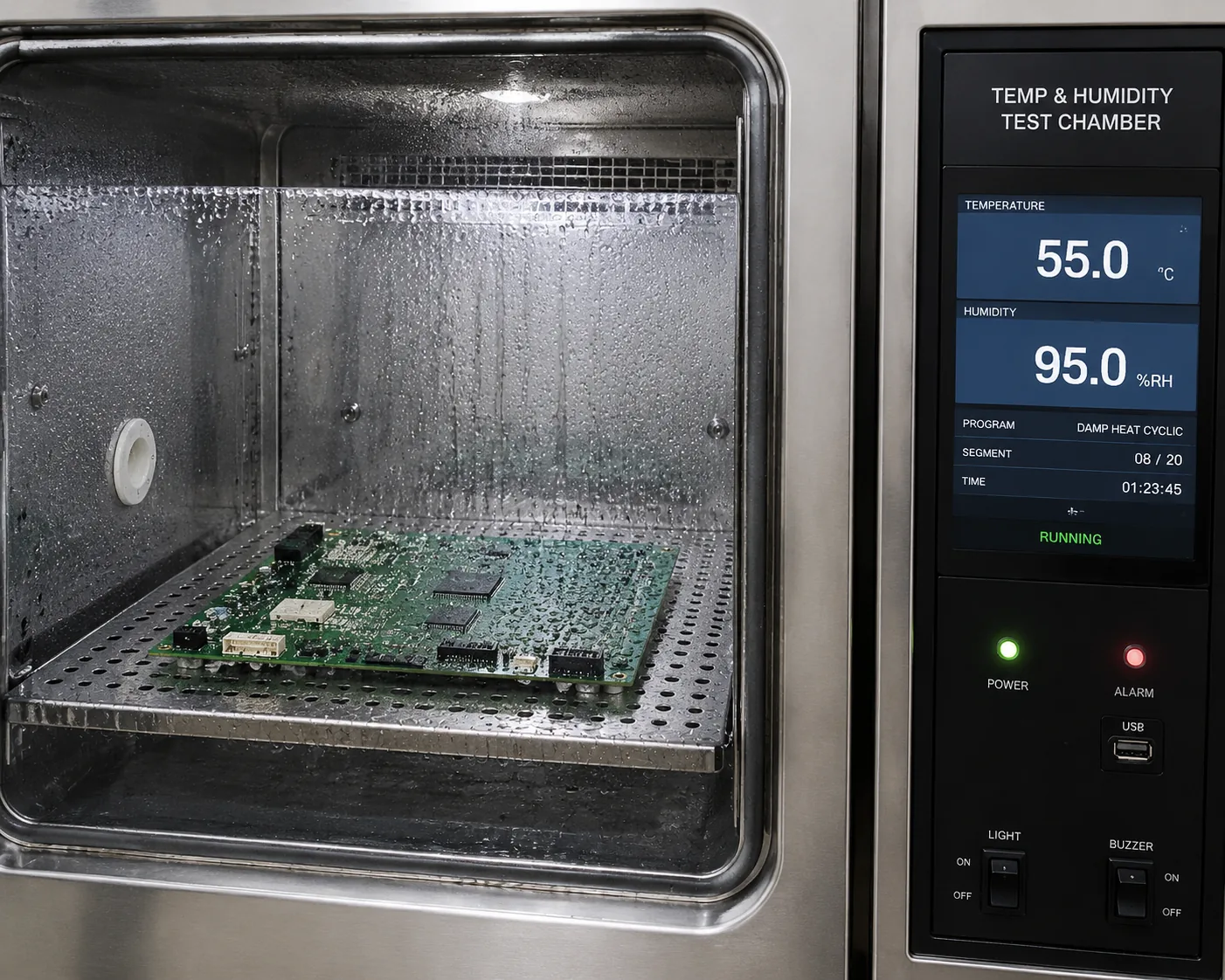
The mechanism that distinguishes the cyclic test from every other humidity test is breathing and condensation:
- During the warm, humid half of the cycle, the air inside an enclosure expands and some escapes.
- During the cooling half, that air contracts and draws in moisture-laden ambient air ("breathing").
- As the specimen surface cools below the dew point, the moisture condenses as liquid water on and within the product.
This condensed water is what migrates into seals, creeps along interfaces, and lowers insulation resistance — failures that a constant-humidity soak simply will not reproduce. For this reason the cyclic test is specified for sealed or semi-sealed products, outdoor equipment, and anything whose real-world failure mode is condensation rather than long-term absorption.
Cyclic vs Steady-State Damp Heat: Which Test for Which Failure?
The most common confusion on the SERP is treating "damp heat test" as one test. There are two distinct procedures governed by two distinct standards, and they detect physically different failure modes.
| Cyclic damp heat (Test Db) | Steady-state damp heat (Test Cab) | |
|---|---|---|
| Standard | IEC 60068-2-30 / GB/T 2423.4 | IEC 60068-2-78 / GB/T 2423.3 |
| Profile | 24 h cycle: 12 h warm + 12 h cool, repeated | Constant T and RH, held for days to weeks |
| Typical conditions | 40 °C or 55 °C; ≥ 95% RH on the rise | 40 °C / 93% RH (or 85/85), constant |
| Condensation | Produced intentionally on cooling | Not produced (no temperature swing) |
| Primary mechanism | Breathing + condensation | Moisture absorption and permeation |
| Failure modes detected | Condensation corrosion, dew-induced insulation drop, moisture ingress through breathing | Bulk absorption, long-term material degradation, diffusion |
A product that must survive tropical day-night cycling is tested to IEC 60068-2-30; a product whose concern is long-term moisture soak in a constant humid warehouse is tested to IEC 60068-2-78. Many qualification programs run both, but they are not interchangeable and a test report that does not name the variant is incomplete.
The IEC 60068-2-30 Cycle Profile, Phase by Phase
Each cycle is 24 hours, structured as a 12-hour temperature-rise-and-dwell followed by a 12-hour temperature-fall. The profile an engineer programs into the chamber controller is:
1. Stabilization — the specimen is held at 25 °C ±3 K while relative humidity is raised to not less than 95%.
2. Temperature rise (first ~3 hours) — temperature rises to the upper value (40 °C or 55 °C) within 3 h ±30 min. Relative humidity remains ≥ 95% throughout the rise, with the last 15 minutes allowed down to ≥ 90%.
3. Upper-temperature dwell — temperature is held at the upper value ±2 K for a total of 12 h ±30 min (from the start of the rise). Relative humidity is controlled at (93 ±3)%, again with the first and last 15 minutes allowed down to ≥ 90%.
4. Temperature fall (the next 12 hours) — temperature is reduced to 25 °C ±3 K within 3 to 6 hours. This is the phase where the dew point is crossed and condensation forms on the specimen surface. The exact tolerances in this phase define the two variants (below).
5. Recovery — after the final cycle the specimen is returned to standard atmospheric conditions (25 °C ±3 K) under controlled humidity, so that it stabilizes without introducing further condensation before post-test measurement.
The cycle is then repeated for the number of cycles specified by the relevant specification.
Severity: Upper Temperature and Number of Cycles
Severity is defined by the combination of upper temperature and cycle count. Per the standard's recommended combinations:
| Upper temperature | Permissible number of cycles |
|---|---|
| 40 °C | 2, 6, 12, 21, or 56 |
| 55 °C | 1, 2, or 6 |
A 55 °C / 6-cycle test is a common automotive and industrial severity; 40 °C / 56 cycles approximates a long tropical exposure. The lower-temperature path allows more cycles because each cycle stresses the specimen less, while the higher-temperature path allows fewer because each cycle is more aggressive.
Variant 1 vs Variant 2: The Only Difference Is the Cooling Phase
The standard defines two cycle variants. They are identical in every respect except the temperature-fall period — the rise, the dwell, the humidity, and the total cycle length are the same. The difference is:
- Variant 1 — the cooling phase has tighter tolerances on relative humidity and on the rate of temperature fall (a defined descent rate applies in the first ~1.5 h, with RH ≥ 95% except the first 15 min). It is the variant specified for specimens where the failure mode is moisture penetration through the breathing effect — i.e., enclosed products with seals or gaskets where condensation inside the enclosure is the concern.
- Variant 2 — the cooling phase allows wider tolerances on both relative humidity and the rate of temperature fall. It is used when the test equipment cannot hold the tighter tolerances, or when the specimen does not require the precise breathing-effect reproduction. It offers good reproducibility for general specimens.
In practice: choose Variant 1 when you must reproduce internal condensation in a sealed enclosure; choose Variant 2 for general-purpose qualification of PCBs and mechanical subassemblies where surface condensation is the concern and chamber capability is the constraint.
What Failures Does the Damp Heat Cyclic Test Reveal?
Because the test produces real condensation, it accelerates the exact failure modes that appear in field service in humid, cycling climates:
- Corrosion of metal parts and printed-circuit-board traces where condensation pools.
- Drop in insulation resistance as moisture penetrates conformal coating or undercapsulates — frequently the first measurable electrical symptom.
- Delamination of PCB layers and swelling of composite materials as condensed water wicks along interfaces.
- Reduced dielectric strength of insulating materials, detectable as a lowered withstand voltage after cycling.
- Arcing where safety creepage/clearance was insufficient for the wet condition — a defect that often only surfaces under condensation, not under dry high voltage.
- Fogging and malfunction of optical devices and displays.
A common real-world finding: an electric-vehicle inverter whose PCB conformal coating was too thin passed every dry test but showed insulation resistance below design after IEC 60068-2-30 cycling — exactly the kind of design defect the cyclic test exists to catch before field deployment.
Test Equipment and Measurement Requirements
The accuracy of a cyclic damp heat test depends entirely on whether the chamber can actually hold the profile tolerances, particularly during the cooling phase where condensation must be reproduced rather than suppressed. The chamber and instrumentation requirements are:
- Temperature range sufficient to cover the upper value plus margin (typically a chamber rated to at least 85 °C to handle 55 °C cycling with stable control).
- Humidity capability of ≥ 95% RH at the upper temperature, with stability of ±2% RH and ±0.5 °C or better.
- Programmable ramp control — the 3 h ±30 min rise and the 3–6 h fall must be programmed precisely; a chamber that cannot control the descent rate cannot run Variant 1.
- Water quality — humidification water should be deionized or distilled with conductivity monitoring, because impurities in the steam directly contaminate the specimen and confound corrosion results. Recirculated humidification water is avoided for the same reason.
- Continuous data logging of temperature and humidity throughout every cycle, since the test report must demonstrate that the profile tolerances were met — not merely that the chamber was set to them.
Specimens are mounted to allow free airflow (typically ≥ 10 cm from chamber walls) and to avoid thermal bridging; powered and unpowered configurations are both valid, specified by the relevant product standard.
Our Testing Capabilities
Beijing ZKGX Research conducts the damp heat cyclic test (IEC 60068-2-30 / GB/T 2423.4, Test Db) as part of its environmental testing scope:
- Standards covered: IEC 60068-2-30 (Test Db), GB/T 2423.4; alongside the steady-state test IEC 60068-2-78 / GB/T 2423.3 and the composite temperature/humidity cyclic test IEC 60068-2-38 / GB/T 2423.34 for completeness.
- Profiles: both Variant 1 and Variant 2; upper temperatures of 40 °C and 55 °C; the full range of cycle counts (1, 2, 6, 12, 21, 56).
- Sample types: electronic control units, sensors and actuators, battery systems, lighting, infotainment, sealed enclosures, PCB assemblies, and mechanical subassemblies.
- Conditioning: deionized humidification water with conductivity monitoring, non-recirculated; chamber stability ±0.5 °C / ±2% RH.
- Deliverable: a test report stating the programmed profile, the logged temperature/humidity record demonstrating tolerance compliance, the variant and severity applied, and the before/after measurement results.
If you have a specimen or a product specification calling up IEC 60068-2-30, contact our testing team to scope the variant, severity, and cycle count.
Frequently Asked Questions
What is the difference between IEC 60068-2-30 and IEC 60068-2-78?
IEC 60068-2-30 (Test Db) is the cyclic damp heat test — a 24-hour 12+12 h cycle that intentionally produces condensation on cooling. IEC 60068-2-78 (Test Cab) is the steady-state test — constant temperature and humidity held for days to weeks, with no temperature swing and therefore no condensation. The cyclic test detects condensation-driven failures; the steady-state test detects absorption-driven failures.
What are the conditions of the damp heat cyclic test?
The standard profile is a 24-hour cycle: temperature rises to 40 °C or 55 °C within 3 h ±30 min at ≥ 95% RH, dwells at the upper value ±2 K at (93 ±3)% RH for 12 h, then falls to 25 °C ±3 K over 3–6 hours during which condensation forms. The cycle is repeated for the specified number of cycles (1, 2, 6 at 55 °C; up to 56 at 40 °C).
What is the difference between Variant 1 and Variant 2 of IEC 60068-2-30?
The two variants are identical except in the temperature-fall period. Variant 1 imposes tighter tolerances on humidity and descent rate and is specified for specimens where internal condensation from the breathing effect must be reproduced. Variant 2 allows wider tolerances during cooling and is used for general-purpose qualification where the chamber or the specimen does not require the tighter control.
How many cycles should a damp heat cyclic test run?
The cycle count is a severity choice defined in the relevant product specification. Per the standard's recommended combinations: at 55 °C, 1, 2, or 6 cycles; at 40 °C, 2, 6, 12, 21, or 56 cycles. A 55 °C / 6-cycle test is a common automotive severity.
Does the damp heat cyclic test replace Salt spray testing?
No. The cyclic damp heat test reproduces condensation and humidity-driven corrosion; salt spray (ISO 9227) reproduces chloride-induced corrosion. They detect different mechanisms and are normally specified together in a full environmental qualification program, not as substitutes.