Table of Contents
- What is dimethyl phthalate (DMP) testing?
- DMP versus the regulated phthalates: a critical regulatory distinction
- The standard stack: OSHA, EPA, EN, GB, REACH
- Air-matrix testing: OSHA Method 104 and NIOSH 5020
- Water and wastewater testing: EPA 606, 525.2, 625
- Food and food-contact-material testing: GB 31604.30-2025 and GB/T 21928-2008
- Toys and children's products: EN 14372, GB/T 22048-2022, GB 6675.4, CPSIA
- Cosmetics testing: EU Regulation 1223/2009 and China's *Safety Technical Standards'
- Analytical method: GC-MS, GC-FID, and the phthalate ion-fragment signature
- DMP physical properties, uses, and environmental fate
- Toxicity and occupational exposure limits
- FAQ
- Our DMP testing capabilities
What is dimethyl phthalate (DMP) testing?
Dimethyl phthalate (DMP, CAS 131-11-3, C₁₀H₁₀O₄, MW 194.19) testing is the measurement and validation of DMP concentration in a defined matrix — workplace air, ambient air, drinking water, wastewater, food, food-contact materials, toys and children's products, cosmetics, or the PVC/cellulose-acetate plastic article itself — against the occupational-exposure, environmental, food-contact, toy, and cosmetic standards that govern its presence in that matrix. The output of a DMP test is a quantitative concentration reported against the applicable limit (an OSHA PEL, an EPA maximum contaminant level, a GB 9685 specific migration limit, a GB 6675.4 toy-plasticiser limit, or a EU cosmetics prohibition), supported by the underlying GC-MS or GC-FID chromatogram and the traceability chain to the DMP reference standard.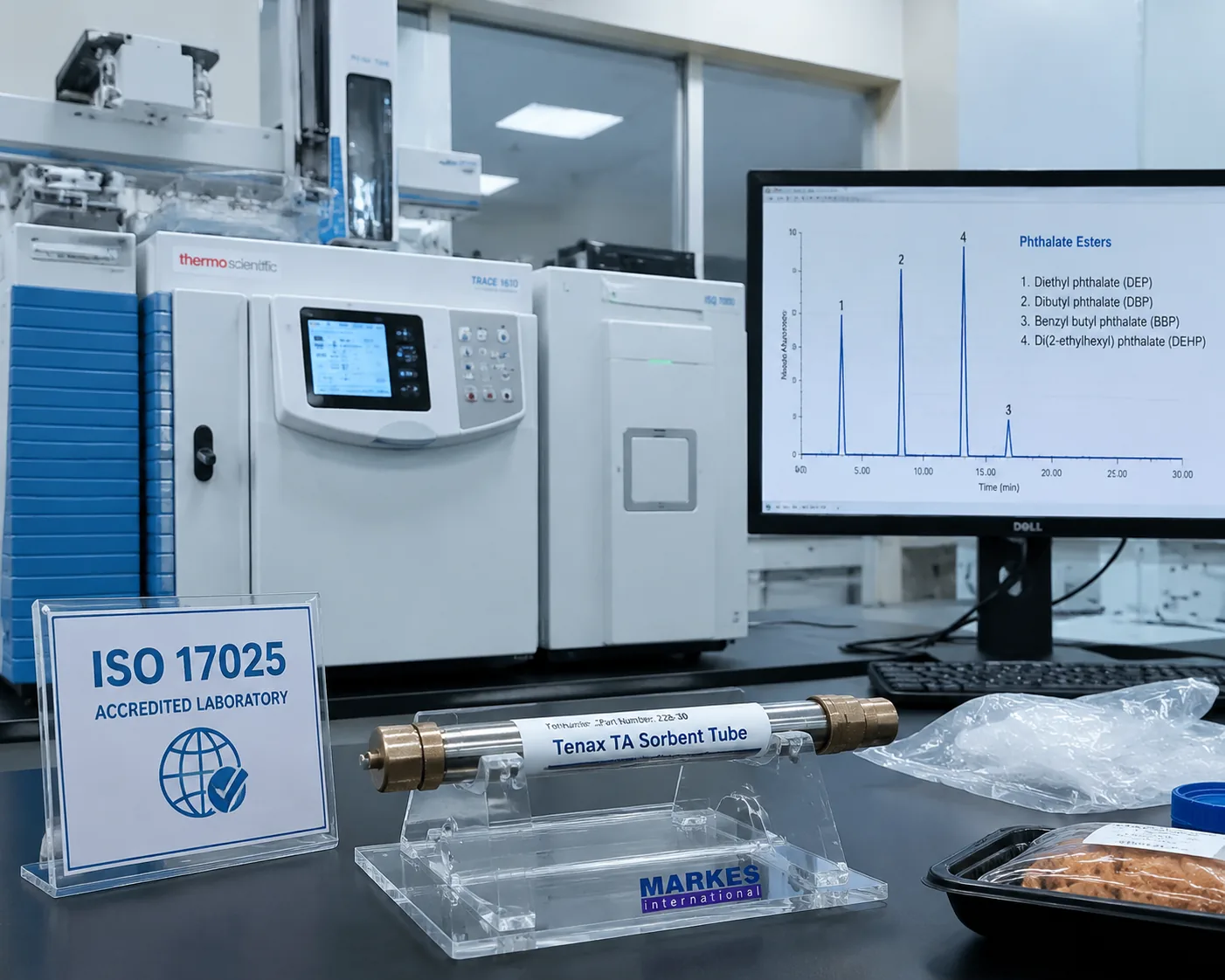
DMP is the shortest-chain member of the ortho-phthalate ester (PAE) family — the dimethyl ester of phthalic acid — and occupies an unusual position in the regulatory landscape of phthalates. While the medium- and long-chain phthalates (DBP, BBP, DEHP, DIBP, DINP, DIDP, DnOP) are subject to restriction under REACH Annex XVII, listed as Substances of Very High Concern (SVHC) on the REACH candidate list, and limited to 0.1 % in toys and childcare articles, DMP itself is not on the REACH SVHC list and is not restricted under REACH Annex XVII. It is not listed under the EU Cosmetics Regulation's prohibited-phthalate group, in contrast to DBP/DEHP/DnOP/BBP/DCHP which are prohibited. China's Safety Technical Standards for Cosmetics (2015 edition) similarly does not list DMP among its prohibited or restricted phthalates. This "non-restricted but monitored" status — distinct from the regulated phthalates — is the single most important fact about DMP regulatory testing, and the single most common source of mis-classification by testing laboratories that apply a generic "phthalate screen" without distinguishing DMP from its regulated cousins.
DMP versus the regulated phthalates: a critical regulatory distinction
A DMP testing program begins by establishing what DMP is not. The phthalate regulatory landscape is built around the five "regulated phthalates" (DBP, BBP, DEHP, DIBP, DnOP) and the "restricted in toys" group (DBP, BBP, DEHP, DINP, DIDP, DnOP). DMP and DEP (the diethyl homologue) sit outside both groups in most jurisdictions.
| Phthalate | CAS | REACH SVHC | REACH Annex XVII (toys/childcare 0.1 %) | EU Cosmetics | China cosmetics | China toy GB 6675.4 0.1 % |
|---|---|---|---|---|---|---|
| DMP | 131-11-3 | No | No | Permitted | Permitted | No |
| DEP | 84-66-2 | No | No | Permitted | Permitted | No |
| DBP | 84-74-2 | Yes | Yes | Prohibited | Prohibited | Yes |
| BBP | 85-68-7 | Yes | Yes | Prohibited | Prohibited | Yes |
| DEHP | 117-81-7 | Yes | Yes | Prohibited | Prohibited | Yes |
| DIBP | 84-69-5 | Yes | Yes | — | — | — |
| DINP | 28553-12-0 / 68515-48-0 | Yes | Yes (mouthable) | Restricted | Restricted | Yes (mouthable) |
| DIDP | 26761-40-0 / 68515-49-1 | Yes | Yes (mouthable) | Restricted | Restricted | Yes (mouthable) |
| DnOP | 117-84-0 | No | Yes (mouthable, with DINP/DIDP) | Prohibited | Prohibited | Yes (mouthable) |
A laboratory that screens a toy for "phthalates" and reports DMP above 0.1 % has not found a regulatory non-conformance — DMP is permitted in toys. The same laboratory that screens the same toy and reports DEHP above 0.1 % has found a non-conformance. The report must distinguish the two, and the analyst must understand which of the 6-or-16-or-19 phthalates in the method's target list carry which regulatory limit in which product category. This is the DMP-specific testing problem in its essence.
The standard stack: OSHA, EPA, EN, GB, REACH
A complete DMP testing project draws on a stack of matrix-specific international, US, EU, and Chinese standards.
| Family | Standard | Matrix | Method |
|---|---|---|---|
| OSHA Method 104 | OSHA Salt Lake Technical Center | Workplace air | OVS-Tenax tube, toluene desorption, GC-FID; covers DMP, DEP, DBP, DEHP, DNOP |
| NIOSH 5020 | NIOSH Manual of Analytical Methods | Workplace air | Similar Tenax sampling + GC-FID or GC-MS |
| EPA Method 606 | Clean Water Act | Wastewater (effluent) | GC-ECD or GC-MS after methylene chloride extraction; covers DMP and 5 other phthalates |
| EPA Method 625 | Clean Water Act | Wastewater | GC-MS after continuous liquid-liquid extraction; full Base/Neutral/Acid screen including DMP |
| EPA Method 525.2 | Safe Drinking Water Act | Drinking water | SPE extraction + GC-MS; DMP among the semi-volatile organics |
| EPA Method 8061 | RCRA / SW-846 | Solid waste, soil, sediment | GC-ECD after extraction; 16 phthalates |
| EPA Method 8270 | RCRA / SW-846 | Solid waste, soil, sediment | GC-MS; full semi-volatile screen including DMP |
| EN 14372:2004 | CEN | Cutlery and feeding containers for children | GC-MS after dissolution; 6 phthalates (DBP, BBP, DEHP, DnOP, DPHP, DINP/DIDP); 0.1 % per item |
| EN 15777:2009 | CEN | Textiles | GC-MS after solvent extraction; phthalate screen |
| GB 31604.30-2025 | China NHC | Food-contact materials (plastic, rubber, coating, adhesive) — 19 PAEs including DMP | GC-MS for residual content; GC-MS after migration for specific migration |
| GB/T 21928-2008 | China | Food plastic packaging — 16 PAEs including DMP | GC-MS |
| GB 9685-2016 | China NHC | Food-contact additives — list and SML | Specifies which phthalates are permitted in food-contact materials, the maximum use level, and the SML |
| GB/T 22048-2022 | China | Toys and children's products | GC-MS for the regulated phthalates (DBP/BBP/DEHP/DNIP/DIDP/DnOP/DIBP); DMP reported if requested but no limit |
| GB 6675.1-2014 / GB 6675.4 | China | Toy safety — plasticiser requirements | DEHP/DBP/BBP ≤ 0.1 % in all toys; DINP/DIDP/DnOP ≤ 0.1 % in mouthable toys |
| GB/T 21911-2008 (withdrawn 2017) | China | Food — 16 PAEs | GC-MS; superseded for food by GB 5009.271-2016 |
| GB 5009.271-2016 | China NHC | Food — 16 PAEs including DMP | GC-MS |
| GB 5749-2022 | China NHC | Drinking water quality standard | PAEs listed where applicable (DEHP 8 µg/L); DMP no specific limit |
| REACH Annex XVII / SVHC candidate list | EU | All articles | Restriction of regulated phthalates; DMP not restricted |
| EU Regulation 1223/2009 | EU | Cosmetics | DBP/BBP/DEHP/DnOP/DCHP prohibited; DMP permitted |
| CPSIA section 108 | US | Children's toys and childcare articles | DEHP/DBP/BBP ≤ 0.1 % in all; DINP/DIDP/DnOP ≤ 0.1 % in mouthable; DMP not regulated |
The single most consequential fact for a Chinese laboratory is that GB 31604.30-2025 (the current food-contact-material method, replacing the 2016 version) covers 19 PAEs including DMP, while GB 9685-2016 (the positive-list for food-contact additives) does not include DMP among its permitted phthalates — meaning that any detectable migration of DMP from a food-contact material into food is technically non-compliant, even though DMP is not on any SVHC list. This is the "permitted in products but not permitted to migrate into food" subtlety that catches laboratories that treat DMP as unregulated.
Air-matrix testing: OSHA Method 104 and NIOSH 5020
For workplace-air monitoring of DMP, OSHA Method 104 (1994, still in force) is the reference method, with NIOSH 5020 as the equivalent. The method covers the five phthalates together (DMP, DEP, DBP, DEHP, DNOP) because they co-occur in workplace air at plasticiser-using facilities.
Sampling — Air is drawn through an OVS-Tenax tube (a glass-fibre filter in front to stop aerosol droplets, Tenax resin behind to adsorb vapour) at 1.0 L/min for 240 L total (4 hours). The glass-fibre/Tenax combination is required because phthalates partition between aerosol and vapour phases; filter-only sampling under-collects the vapour phase and gives a falsely low result. The older OVS-2 (XAD-2 resin) method was replaced because XAD-2 beads cling to the glass tube wall and prevent quantitative transfer to the desorption vial.
Analysis — The Tenax resin and the glass-fibre filter are transferred to a single vial, desorbed with carbon disulphide (CS₂) (or toluene per the updated method) and analysed by GC-FID. The detection limit of the analytical procedure is 0.16 ng for DMP on column; the reliable quantitation limit (RQL) in air is 90 µg/m³ for DMP, the highest of the five phthalates because DMP has the lowest GC response factor on FID per unit mass (it has the lowest carbon-to-oxygen ratio of the five).
Exposure limits — The OSHA Permissible Exposure Limit (PEL) is 5 mg/m³ TWA (8-hour time-weighted average) for DMP, DEP, DBP, and DEHP; the ACGIH Threshold Limit Value (TLV) is also 5 mg/m³ TWA for DMP, with no STEL. There is no OSHA PEL for DNOP. The German DFG MAK for DMP is 5 mg/m³; the Chinese GBZ 2.1-2019 occupational exposure limit for DMP is 5 mg/m³ PC-TWA (8-hour) with no PC-STEL.
Water and wastewater testing: EPA 606, 525.2, 625
For the aqueous matrix, three EPA methods cover DMP at different detection-limit requirements.
| Method | Matrix | Sample preparation | Detector | DMP detection limit |
|---|---|---|---|---|
| EPA 606 | Wastewater effluent | Methylene chloride liquid-liquid extraction | GC-ECD | ~0.1 µg/L |
| EPA 625 | Wastewater effluent | Continuous liquid-liquid extraction at pH 6-9 | GC-MS (full scan) | ~5 µg/L |
| EPA 525.2 | Drinking water | Solid-phase extraction (C18 or HLB cartridge) | GC-MS (SIM) | ~0.1 µg/L |
| EPA 8061 / 8270 | Soil, sediment, solid waste | Sonication or Soxhlet with methylene chloride | GC-ECD (8061) or GC-MS (8270) | ~0.5 mg/kg (soil) |
Drinking water — The WHO Guideline value for DEHP in drinking water is 8 µg/L; the US EPA has not issued a specific DMP maximum contaminant level (MCL), and DMP is not on the EPA Contaminant Candidate List 4 (CCL4). The Chinese GB 5749-2022 Standards for Drinking Water Quality includes DEHP at 8 µg/L but does not set a specific limit for DMP. Laboratories that report "non-detect for DMP in drinking water" against the WHO DEHP limit are conflating two different analytes.
Wastewater — DMP is reliably detected by EPA 625 (the broad base/neutral/acid screen) in industrial effluent from cellulose-acetate, photographic-film, and adhesive factories. The method requires pH adjustment to 6-9 before extraction to ensure recovery of the DMP ester, which is base-sensitive and will hydrolyse to mono-methyl phthalate and methanol at high pH.
Food and food-contact-material testing: GB 31604.30-2025 and GB/T 21928-2008
The food / food-contact matrix is governed in China by two complementary standards:
GB 31604.30-2025 National food safety Standard — Food Contact Materials and Articles — Determination of Phthalate Esters and their Specific Migration is the current method (2025 revision, replacing the 2016 version). It covers 19 phthalate esters including DMP, applied to plastic, rubber, coating, adhesive, and other food-contact material types. Part 1 of the standard measures the residual content of the 19 PAEs in the material itself; Part 2 measures the specific migration into food simulants (10 % ethanol for aqueous foods, 20 % ethanol for acidic/alcoholic, 50 % ethanol for dairy/oily, isooctane for fatty, all per GB 31604.1).
The positive list of permitted food-contact additives and their specific migration limits (SML) is GB 9685-2016. DMP is not on the GB 9685 positive list — meaning that any detectable migration of DMP from a food-contact material into a food simulant is technically a non-compliance, even at trace levels. The laboratory must therefore report DMP migration at the method's limit of detection (typically 0.05 mg/kg in the simulant), not at the SML, because there is no SML for DMP. This is a common source of mis-reporting: laboratories trained on DEHP (which has a 1.5 mg/kg SML) apply the same reporting logic to DMP and incorrectly pass a sample that should fail.
GB/T 21928-2008 Determination of Phthalate Esters in Food Plastic Packaging Materials covers 16 PAEs including DMP in the plastic packaging material itself (not the migration). It is GC-MS based, with a method detection limit of ~0.05 mg/kg in the plastic.
GB 5009.271-2016 National Food Safety Standard — Determination of Phthalate Esters in Foods is the method for measuring PAEs already present in the food matrix (the 2011 Taiwanese plasticiser-contamination event drove its development); it covers 16 PAEs including DMP at LOD ~0.05 mg/kg.
Toys and children's products: EN 14372, GB/T 22048-2022, GB 6675.4, CPSIA
The toy / children's product matrix is where DMP regulatory distinctness matters most.
EN 14372:2004 Child use and care articles — Cutlery and feeding containers — Safety requirements and test methods specifies 0.1 % (1000 mg/kg) limits for DBP, BBP, DEHP, DnOP, DPHP, and DINP/DIDP in the plastic material — DMP is not on the EN 14372 list of regulated phthalates.
GB/T 22048-2022 Determination of Specific Phthalate Plasticisers in Toys and Children's Products is the Chinese GC-MS method for the regulated phthalates in toys (DEHP, DBP, BBP, DnOP, DINP, DIDP, DIBP per GB 6675.1-2014 §5.3.7). DMP can be reported if requested by the client, but it does not carry a regulatory limit and is not part of the standard scope.
GB 6675.1-2014 / GB 6675.4-2014 Toy Safety sets the limits:
- DEHP + DBP + BBP: each ≤ 0.1 % (1000 mg/kg) in all toys and children's products
- DINP + DIDP + DnOP: each ≤ 0.1 % in mouthable toys and children's products
DMP is not on either list.
US CPSIA section 108 (Consumer Product Safety Improvement Act) is the US equivalent:
- DEHP, DBP, BBP: ≤ 0.1 % in all children's toys and childcare articles
- DINP, DIDP, DnOP: ≤ 0.1 % in mouthable toys (DINP limit expanded in 2017 via CPSC rule)
- DMP: not regulated
A laboratory that runs a toy-phthalate screen and reports DMP "above 0.1 %" has reported a non-substance — there is no 0.1 % limit for DMP in toys. The report must distinguish the regulated six from the unregulated DMP.
Cosmetics testing: EU Regulation 1223/2009 and China's Safety Technical Standards
In cosmetics, the regulated phthalates are DBP, BBP, DEHP, DnOP, and DCHP — these are prohibited as intentionally-added substances in cosmetics under EU Regulation 1223/2009 Annex II and under China's Safety Technical Standards for Cosmetics (2015 edition, in force). DEP is widely used as a solvent and fixative in perfumes and is permitted with no specific limit; DMP is also permitted with no specific limit, though its use in cosmetics is much less common than DEP.
The cosmetics testing method is GC-MS after solvent extraction, with sample preparation depending on the formulation (liquid, cream, powder, lipstick). The target list typically covers DMP, DEP, DBP, BBP, DEHP, DnOP, DCHP, DMP, DIBP, DINP, DIDP — 10 to 16 PAEs depending on the laboratory's method scope. A laboratory that reports "phthalates detected" in a cosmetic should name the specific phthalate: a DBP positive is a non-conformance; a DMP positive is informational only.
Analytical method: GC-MS, GC-FID, and the phthalate ion-fragment signature
The instrumental method for DMP is overwhelmingly GC-MS for trace and product-matrix analysis and GC-FID for higher-concentration workplace air and product analysis.
GC-MS — The electron-ionisation mass spectrum of DMP is dominated by the protonated phthalic anhydride ion at m/z 149, which is the universal phthalate-ester signature fragment (formed by a McLafferty +1 rearrangement on the alkyl chain). The molecular ion at m/z 194 is small but visible. For DMP specifically, additional diagnostic ions are m/z 163 (loss of OCH₃) and m/z 133 (loss of COOCH₃). The SIM (selected-ion-monitoring) method typically uses m/z 163, 164, 77 for DMP (the m/z 163 is more specific than 149 for DMP because DMP is the only phthalate ester that loses a methoxy to give 163). The retention time on a 5 %-phenyl 95 %-dimethylpolysiloxane column (DB-5MS, HP-5MS, equivalent) is short — DMP is the earliest-eluting of the common phthalates due to its lowest molecular weight and lowest boiling point (282 °C).
GC-FID — For OSHA Method 104 (workplace air) and for higher-concentration product analysis, GC-FID gives adequate sensitivity and lower instrument cost. The FID response is proportional to the carbon mass of the analyte, which gives DMP the lowest response per unit mass of the five common phthalates (DMP has 10 carbons vs DEHP's 24). The OSHA 104 method's RQL for DMP (90 µg/m³) is correspondingly the highest of the five.
Sample preparation —
- Air (OSHA 104): Tenax tube + glass-fibre filter; CS₂ desorption; direct injection.
- Water (EPA 525.2): SPE on C18 or HLB; elution with ethyl acetate; concentration; injection.
- Wastewater (EPA 625): Continuous liquid-liquid extraction at pH 6-9 with methylene chloride; concentration; injection.
- Food / food-contact (GB 31604.30): Homogenise the sample; extract with ethyl acetate or acetonitrile; SPE clean-up if needed; inject.
- Toys / plastic (GB/T 22048, EN 14372): Dissolve the plastic in tetrahydrofuran; precipitate the polymer with methanol; inject the supernatant.
- Cosmetics: Liquid-liquid extraction with ethyl acetate or hexane; SPE clean-up; inject.
The phthalate-laboratory contamination problem — Phthalates, including DMP, are ubiquitous laboratory contaminants (PVC tubing, plastic vial caps, plastic volumetric ware, glove powder, GC septa). The blank is the most important QC sample in a phthalate analysis; every batch must include a method blank, and the blank value must be below the LOD before sample results are reported. The laboratory must use glass (not plastic) volumetric ware, PTFE (not PVC) tubing, and phthalate-free solvents. A laboratory that reports DMP "detected" at 50 µg/kg without a clean method blank is reporting its own contamination.
DMP physical properties, uses, and environmental fate
| Property | Value |
|---|---|
| CAS | 131-11-3 |
| Molecular formula | C₁₀H₁₀O₄ |
| Molecular weight | 194.19 g/mol |
| Boiling point | 282-284 °C |
| Melting point | 0 to 2 °C |
| Specific gravity | 1.190-1.193 |
| Vapour pressure | < 1.3 Pa (0.01 mmHg) at 25 °C |
| Flash point | 146 °C (closed-cup) |
| Water solubility | 0.4 g/L at 25 °C |
| Log K_ow | 1.65 |
Uses — DMP is a plasticiser for cellulose acetate and cellulose acetate butyrate (eyewear frames, toothbrush handles, photographic film, tool handles, adhesive) and historically as an insect repellent (it was the standard mosquito repellent in the Pacific theatre of WWII). It is not used as a PVC plasticiser — that role belongs to the longer-chain phthalates (DEHP, DINP, DIDP) and to the non-ortho alternatives (DOTP, ATBC, DEHT). DMP is also used as a solvent in some organic syntheses and as a carrier in solid rocket propellant.
Environmental fate — In air, DMP has a half-life of approximately 3 days by reaction with photochemically produced hydroxyl radicals. In water, the half-life is longer (~50 days) because hydrolysis of the methyl ester is slow at neutral pH; biodegradation by acclimated microorganisms is the dominant removal mechanism. DMP's log K_ow of 1.65 places it among the more water-soluble phthalates and means it does not bioaccumulate (unlike DEHP, with a log K_ow of 7.5, which bioaccumulates in aquatic organisms and human adipose tissue).
Toxicity and occupational exposure limits
DMP is the lowest-toxicity member of the common phthalate family. Key toxicological findings:
| Endpoint | DMP finding |
|---|---|
| Acute oral toxicity (rat LD₅₀) | ~2400-6900 mg/kg (low-to-moderate acute toxicity) |
| Skin irritation | Not irritating; not absorbed through skin |
| Eye irritation | Mild to moderate irritant |
| Carcinogenicity | Not classified by IARC, NTP, or EPA; not known to cause cancer in humans or animals |
| Reproductive / developmental toxicity | Not a reproductive toxicant at typical exposure levels; high-dose injection in pregnant rats produced some birth defects (3 g/kg intraperitoneal, far above any realistic exposure) |
| Genotoxicity | Negative in Ames test and in chromosomal aberration assays |
| Endocrine disruption | Not on the EU endocrine disruptor candidate list; the DMP molecule is too small to bind effectively to oestrogen or androgen receptors (the longer-chain DBP/DEHP are the active endocrine disruptors) |
| Occupational exposure (OSHA PEL) | 5 mg/m³ TWA (8-hour) |
| Occupational exposure (ACGIH TLV) | 5 mg/m³ TWA; no STEL |
| Occupational exposure (China GBZ 2.1-2019) | 5 mg/m³ PC-TWA; no PC-STEL |
The absence of endocrine-disruption classification is the key toxicological distinction between DMP and the regulated phthalates. DBP and DEHP are classified reproductive toxicants (Repr. 1B) under EU CLP because their longer alkyl chains fit the androgen receptor and disrupt testosterone synthesis in the developing male foetus. DMP's methyl chain is too short for this binding, and the extensive in vitro and in vivo evidence base supports its non-reproductive-toxicant classification.
FAQ
Is DMP a regulated phthalate under REACH or in toys?
No. DMP is not on the REACH SVHC candidate list, not restricted under REACH Annex XVII, and not regulated under GB 6675.4 / EN 14372 / CPSIA section 108 in toys. The regulated phthalates in toys are DEHP, DBP, BBP (all toys), and DINP, DIDP, DnOP (mouthable toys). DMP may be reported in a phthalate screen but does not carry a 0.1 % limit.
What is the OSHA PEL for DMP?
The OSHA Permissible Exposure Limit is 5 mg/m³ TWA (8-hour time-weighted average), the same as for DEP, DBP, and DEHP. The ACGIH TLV is 5 mg/m³ TWA with no STEL. The Chinese occupational limit (GBZ 2.1-2019) is 5 mg/m³ PC-TWA.
Can a food-contact material contain DMP?
DMP is not on the Chinese GB 9685 positive list of permitted food-contact additives. Any detectable migration of DMP from a food-contact material into a food simulant is technically non-compliant, even though DMP is not SVHC-restricted. The laboratory must report DMP migration at the method's LOD, not at a non-existent SML.
What is the GC-MS signature of DMP?
DMP shows the universal phthalate ion at m/z 149 (protonated phthalic anhydride) and DMP-specific ions at m/z 163 (loss of OCH₃), 164, and 77. The SIM method uses m/z 163, 164, 77 for DMP. DMP is the earliest-eluting of the common phthalates on a DB-5MS column due to its lowest boiling point (282 °C).
Is DMP an endocrine disruptor?
No. DMP is not on the EU endocrine-disruptor candidate list and is not classified as a reproductive toxicant under EU CLP. The longer-chain phthalates (DBP, DEHP) are the active endocrine disruptors; DMP's short methyl chain does not fit the androgen receptor.
Our DMP testing capabilities
Beijing ZKGX Research (ISO/IEC 17025 accredited, CMA- and CNAS-accredited testing laboratory) provides complete DMP testing across the six matrices where DMP is measured, against the international and Chinese standard stack:
- Workplace air — OSHA Method 104 / NIOSH 5020; OVS-Tenax tube sampling, toluene or CS₂ desorption, GC-FID; reporting against the 5 mg/m³ OSHA PEL / ACGIH TLV / China GBZ 2.1-2019 PC-TWA.
- Drinking water — EPA Method 525.2 SPE + GC-MS (SIM); reporting against WHO/EPA/GB 5749-2022 where applicable.
- Wastewater — EPA Method 606 (GC-ECD) or EPA Method 625 (GC-MS).
- Food — GB 5009.271-2016 GC-MS for 16 PAEs including DMP, with method-blank QC.
- Food-contact materials — GB 31604.30-2025 (19 PAEs including DMP, residual content + specific migration); GB/T 21928-2008 (16 PAEs in plastic packaging); reporting against GB 9685 (DMP not on positive list — any detectable migration is non-compliant).
- Toys and children's products — GB/T 22048-2022 + GB 6675.4 + EN 14372 + CPSIA section 108; reports distinguish the regulated six phthalates (with 0.1 % limit) from DMP (no limit).
- Cosmetics — GC-MS after solvent extraction; reports distinguish the prohibited phthalates (DBP/BBP/DEHP/DnOP/DCHP) from the permitted DMP and DEP.
Our phthalate methods run on GC-MS with the full 16- or 19-phthalate target list, with DMP-specific SIM ions (m/z 163, 164, 77) and DMP-specific retention-time confirmation, against a traceable DMP reference standard (ISO 17034 CRM). Every batch includes a method blank, a matrix spike, and a continuing-calibration verification, with blank-corrected reporting. The laboratory uses glass volumetric ware, PTFE tubing, and phthalate-free solvents to control the phthalate-contamination problem that is the principal source of false positives in phthalate analysis.
Suitable sample matrices include: workplace air (Tenax tube); drinking water, groundwater, surface water, wastewater; food and beverages; food-contact plastic, rubber, coating, and adhesive materials; children's toys and childcare articles; cosmetic products; PVC and cellulose-acetate plastic articles; solid waste and soil. Each project is delivered with a full data report (test protocol, instrument calibration, raw chromatograms, method-blank QC, statistical analysis, traceability chain to the DMP reference standard, classification conclusion per matrix-specific limit) in English and/or Chinese, with CMA/CNAS stamping. Contact Beijing ZKGX Research to scope the DMP test battery applicable to your product and target market.