Table of Contents
- What is disinfectant virucidal testing?
- The standard stack: EN 14476, EN 17111, EN 16777, EPA OCSPP, AOAC, GB 27953
- The CEN TC 216 three-phase, four-area framework
- The four product-application areas and their test conditions
- The test virus panel: enveloped vs non-enveloped, and the resistance hierarchy
- The EN 14476 quantitative suspension test: procedure and acceptance
- The carrier methods EN 17111 and EN 16777: when suspension does not reflect reality
- The 2025 revision: replacing formaldehyde with glutaraldehyde and peracetic acid
- The reference substance and the lg-reduction range
- EPA OCSPP 810.2200 and AOAC 966.04: the US framework
- GB 27953 and the Chinese Disinfection Technical Specification
- FAQ
- Our disinfectant virucidal testing capabilities
What is disinfectant virucidal testing?
Disinfectant virucidal testing is the laboratory measurement of the ability of a chemical disinfectant or antiseptic — a hand rub, a surface wipe, an instrument soak, a textile treatment, a mouthwash — to inactivate (destroy the infectivity of) a defined panel of test viruses under standardised test conditions that simulate the intended use. The output of a virucidal test is a log₁₀ reduction factor (lg R) of the virus titre after a defined contact time at a defined temperature, in the presence of an interfering substance that simulates the soiling conditions of the intended use. A virucidal claim on the product label requires the test to demonstrate ≥ 4 log₁₀ reduction (a 99.99 % reduction) against the relevant test viruses, with the product tested at its worst-case use concentration (the lowest concentration, the shortest contact time, the lowest temperature, the highest interfering-substance load).
The test is governed in Europe by the EN 14476:2019 (+ A1:2023 + the 2025 revision under CEN TC 216) Chemical disinfectants and antiseptics — Quantitative suspension test for the evaluation of virucidal activity in the medical area (and its sister standards EN 17111 for instrument carrier tests, EN 16777 for surface carrier tests, and EN 13610 for food / industrial area), in the US by the EPA OCSPP 810.2200 Product Performance Test Guideline for Virucidal Effectiveness (the EPA Office of Chemical Safety and Pollution Prevention guideline for registering disinfectant products with virucidal claims) and the AOAC Official Method 966.04 Sporicidal Activity of Disinfectants (the historical US method), and in China by the GB 27953-2020 Testing Method for Virucidal Efficacy of Disinfectants and the Ministry of Health Disinfection Technical Specification (2002). A disinfectant placed on the EU market with a virucidal claim must satisfy EN 14476 and the associated Biocidal Products Regulation (EU) No 528/2012 (BPR); on the US market, the EPA OCSPP 810.2200 and the Federal Insecticide, Fungicide, and Rodenticide Act (FIFRA) registration; on the Chinese market, GB 27953 and the SAMR / National Health Commission disinfectant registration.
The standard stack: EN 14476, EN 17111, EN 16777, EPA OCSPP, AOAC, GB 27953
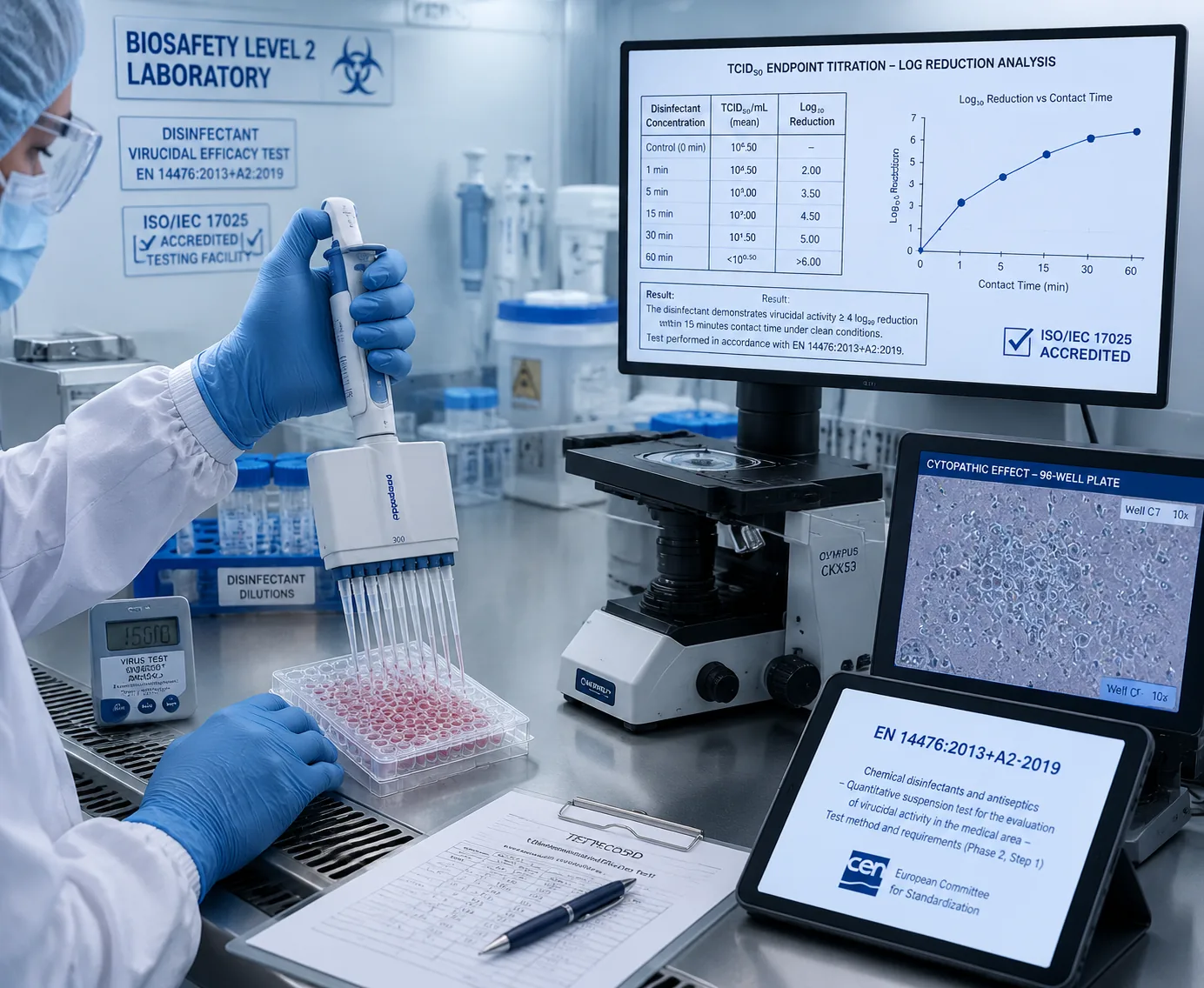
A complete virucidal testing project draws on a stack of European, US, international, and Chinese standards.
| Family | Standard | Scope |
|---|---|---|
| EN 14476:2019 + A1:2023 (revision 2025 in progress) | Quantitative suspension test for the evaluation of virucidal activity in the medical area — Phase 2 / Step 1 | The European suspension test for hand rubs, hand washes, instrument disinfectants, surface disinfectants, textile disinfectants used in the medical area |
| EN 16777:2018 | Quantitative non-porous surface test for virucidal activity in the medical area — Phase 2 / Step 2 | The European carrier test for surface disinfectants (no mechanical action) |
| EN 17111:2018 | Quantitative carrier test for virucidal activity for instruments — Phase 2 / Step 2 | The European carrier test for medical-instrument disinfectants |
| EN 13610:2002 | Quantitative suspension test for virucidal activity in the food and industrial area | The European suspension test for food / industrial disinfectants |
| EN 14348 / EN 14563 | (Related) Mycobactericidal and tuberculocidal activity | The companion standards for mycobacteria, which (like non-enveloped viruses) are highly resistant to disinfectants |
| EPA OCSPP 810.2200 | Product Performance Test Guideline for Virucidal Effectiveness of Disinfectants | The US EPA guideline for registering disinfectant products with virucidal claims; uses a single virus-specific test (one virus per claim) rather than a virus panel |
| AOAC Official Method 966.04 | Sporicidal Activity of Disinfectants | The historical US method, applicable to the most-resistant organism class (bacterial spores); used as the upper benchmark |
| ASTM E1053 | Standard Test Method for Efficacy of Virucidal Agents against Viruses in Suspension | The US ASTM standard, an alternative to EPA OCSPP 810.2200 for suspension virucidal tests |
| ASTM E2197 | Standard Quantitative Disk Carrier Test Method for Determining the Bactericidal, Virucidal, Fungicidal, Mycobactericidal, and Sporicidal Activities of Liquid Chemical Germicides | The US ASTM carrier test |
| ISO 21702:2019 | Measurement of antiviral activity on plastics and other non-porous surfaces | International standard for treated articles (antiviral plastic / textile surfaces) |
| GB 27953-2020 | 《消毒剂病毒灭活效果检验方法》(Testing method for virucidal efficacy of disinfectants) | The Chinese national standard for virucidal testing of disinfectants |
| Chinese MoH Disinfection Technical Specification (2002, with revisions) | 《消毒技术规范》 — Volume I, Part II "Test methods for virucidal efficacy" | The Chinese technical specification that provides the cell-culture and virus-titration methods used in GB 27953 |
| Regulation (EU) No 528/2012 (BPR) | Biocidal Products Regulation | The EU framework for placing biocidal products (including disinfectants) on the market; product-type PT1 (human hygiene), PT2 (disinfectants), PT4 (food and feed) |
The single most consequential fact for a Chinese manufacturer is that GB 27953-2020 and the Chinese Disinfection Technical Specification are the NHC / SAMR-mandated framework, and they adopt principles similar to the EN framework with the Chinese documentation conventions. A disinfectant placed on the Chinese market with a virucidal claim must satisfy GB 27953 testing at a CMA/CNAS-accredited laboratory and be registered with the SAMR.
The CEN TC 216 three-phase, four-area framework
The European Committee for Standardisation (CEN) Technical Committee 216 (TC 216) "Chemical disinfectants and antiseptics" has, since 1989, developed a structured framework for testing disinfectant efficacy — the three-phase, four-area model. The phase defines the test type; the area defines the application.
| Phase | Test type | Use |
|---|---|---|
| Phase 1 | Suspension test — basic bactericidal / fungicidal / sporicidal activity, no specific application | Cannot be used for any product claim; a screening test only |
| Phase 2 / Step 1 | Quantitative suspension test — organisms in suspension exposed to the disinfectant at defined concentration, time, temperature, and interfering substance | The standard laboratory test; EN 14476 is the Phase 2 / Step 1 virucidal standard for the medical area |
| Phase 2 / Step 2 | Quantitative carrier test — organisms dried on a carrier (stainless steel, glass, PVC) and exposed to the disinfectant | Simulates practical conditions more accurately than the suspension test; EN 17111 (instruments) and EN 16777 (surfaces) are the Phase 2 / Step 2 virucidal standards |
| Phase 3 | Field test under practical in-use conditions | No standards currently drafted |
The four application areas within Phase 2 are:
- Medical area (the EN 14476 / EN 17111 / EN 16777 family)
- Veterinary area (EN 14624 / EN 1717 family)
- Food and industrial area (EN 13610 for virucidal, EN 1276 for bactericidal)
- Domestic area (EN 14476 where claimed for domestic use)
A virucidal claim on the product label must specify the area, the phase / step, the virus(es), the contact time, the temperature, and the interfering substance. A test at Phase 2 / Step 1 in clean conditions (PBS) at 1 min does not support a claim of surface disinfection at dirty conditions (BSA + yeast) at 5 min; each claim requires its own test.
The four product-application areas and their test conditions
EN 14476 distinguishes four product-application categories within the medical area, each with its own standard test conditions.
| Product category | Required contact time (typical) | Required temperature | Required interfering substance | Required virus panel |
|---|---|---|---|---|
| Hygienic handrub | 30 s | 20 °C | Clean (PBS) | Adenovirus 5, Murine norovirus (MNV), Poliovirus 1, Modified vaccinia virus Ankara (MVA) |
| Hygienic handwash | 30-60 s | 20 °C | Clean (PBS) | As above |
| Instrument disinfection | 5-60 min | 20 °C (or as claimed) | Clean (PBS) or dirty (BSA + serum + yeast) | As above, plus any virus relevant to the instrument use |
| Surface disinfection | 1-60 min | 20 °C (or as claimed) | Clean (PBS) or dirty (BSA + serum + yeast) | As above |
| Textile disinfection | 30-60 min | 20 °C (or as claimed) | Clean or dirty | As above |
The worst-case test conditions are the lowest concentration, the shortest contact time, the lowest temperature, and the highest interfering-substance load at which the product is claimed to be effective. A product claimed effective "1 min, 20 °C, clean conditions" is tested at those conditions; a product claimed "5 min, 10 °C, dirty conditions" is tested at those.
The test virus panel: enveloped vs non-enveloped, and the resistance hierarchy
The virucidal activity of a chemical disinfectant is determined by the structure of the virus — in particular by the envelope. The resistance hierarchy (Klein & Deforest 1983, codified in EN 14476 and the WHO guidance) classifies viruses by their susceptibility to disinfectants:
| Resistance class | Viruses (representative) | Why they are in this class |
|---|---|---|
| Most resistant — small non-enveloped viruses with strong hydrophilic properties | Parvoviruses (MVM, PPV), Picornaviruses (Poliovirus 1, HAV, Foot-and-mouth) | No envelope to attack; small, dense protein capsid; hydrophilic surface that resists detergent action |
| Resistant — non-enveloped viruses with reduced hydrophilic properties | Adenoviruses, Rotaviruses, Noroviruses (MNV), Caliciviruses, Papillomaviruses | Larger capsid; some lipid-like structures; slightly more susceptible than parvoviruses |
| Moderately resistant — enveloped viruses with low lipid content | Hepatitis B virus (HBV), Poxviruses (Vaccinia) | The envelope is present but with low lipid content; intermediate susceptibility |
| Susceptible — enveloped viruses with high lipid content | Coronaviruses (SARS-CoV-2, MERS, SARS), HIV, HCV, Herpesviruses, Influenza, BVDV | High-lipid envelope that is readily disrupted by detergent / solvent / aldehyde disinfectants |
The EN 14476 virus panel for the medical-area virucidal claim is:
- Modified Vaccinia virus Ankara (MVA) — a representative of the moderately-resistant enveloped viruses (Poxviridae); also the WHO reference virus for enveloped-virus claims
- Adenovirus type 5 (AdV-5) — a representative of the non-enveloped viruses with reduced hydrophilicity
- Murine Norovirus (MNV, strain S99) — a surrogate for human norovirus, the most clinically important non-enveloped enteric virus
- Poliovirus type 1 (Sabin vaccine strain LSc-2ab) — a representative of the most-resistant small non-enveloped viruses (Picornaviridae); historically the WHO reference for the most-resistant class
- Minute Virus of Mice (MVM, strain Crawford) — for products claiming activity against parvoviruses, the most-resistant class
- Bovine Enterovirus type 1 (ECBO, strain VR-248) — for some veterinary-area claims
A "limited virucidal" claim (only enveloped viruses) requires MVA only; a "virucidal" claim (all classes) requires the full panel of MVA + AdV-5 + MNV (or Poliovirus-1). The post-COVID-19 market has driven a strong demand for "enveloped-virus including coronavirus" claims — and these are the easiest to support, because the high-lipid enveloped viruses are the most susceptible class.
The EN 14476 quantitative suspension test: procedure and acceptance
The EN 14476 quantitative suspension test (Phase 2 / Step 1) is the workhorse of European virucidal testing. The procedure:
- Test virus suspension — Prepared to a titre of ≥ 10⁸ TCID₅₀/mL (sufficient to demonstrate a 4 log reduction).
- Interfering substance — 1 part virus suspension + 1 part interfering substance (PBS for clean conditions; BSA 3 g/L + serum 1.5 mL/L + yeast 1 g/L for dirty conditions, simulating the protein load of blood / saliva / soil).
- Disinfectant — 8 parts of the test product (final test concentration = 80 % of the product as-supplied, because of the dilution by the virus + interfering substance; for concentrates, the test concentration is the use-dilution).
- Contact — The mixture is held at the test temperature (20 °C typical; or as claimed) for the contact time (30 s to 60 min).
- Neutralisation — At the end of the contact time, the reaction is immediately stopped by a neutraliser (typically a thiosulphate / polysorbate / lecithin buffer) that inactivates the disinfectant without affecting the virus or the cells.
- End-point titration — The surviving virus is quantified by end-point titration in cell culture; tenfold dilutions (10⁻¹ to 10⁻⁸) inoculated onto the indicator cells (8 wells per dilution); incubated; the cytopathic effect (CPE) is scored; the TCID₅₀ is calculated by the Spearman-Kärber method.
- lg reduction — Calculated as lg R = lg TCID₅₀ (virus control at T₀) − lg TCID₅₀ (test at contact time).
Acceptance criterion — The product demonstrates ≥ 4 log₁₀ reduction (99.99 % reduction) of each test virus under each test condition claimed. The virus control must show that the virus was stable over the contact time (the lg TCID₅₀ at T₀ and Tₓ must agree within 0.5 log); the cytotoxicity control must show that the disinfectant is not cytotoxic to the indicator cells at the dilution tested; the cell control must show that the indicator cells are healthy.
The carrier methods EN 17111 and EN 16777: when suspension does not reflect reality
The Phase 2 / Step 1 suspension test is the standard, but it does not fully reflect the practical conditions of disinfectant use. Viruses dried on a surface are more resistant to disinfectants than viruses in suspension (the drying concentrates the virus, the protein load of the drying matrix protects the virus, and the surface may shield the virus from the disinfectant). To address this gap, CEN TC 216 developed the carrier methods:
| Standard | Carrier | Application | Method |
|---|---|---|---|
| EN 17111:2018 | Medical instruments (flexible endoscopes, surgical instruments) | Instrument disinfection | Virus dried on the instrument surface; disinfectant applied; surviving virus eluted and titrated |
| EN 16777:2018 | Non-porous surfaces (stainless steel, glass, PVC) | Surface disinfection | Virus dried on the carrier; disinfectant applied without mechanical action (no wiping); surviving virus eluted and titrated |
| EN 16615:2015 | Non-porous surfaces (4-field test) | Surface disinfection with mechanical action | A more realistic test that simulates the wiping action |
The carrier test is generally required in addition to the suspension test for surface and instrument claims; the suspension test alone may be acceptable for hand-rub claims (where the virus is not dried).
The 2025 revision: replacing formaldehyde with glutaraldehyde and peracetic acid
The EN 14476 reference substance — the disinfectant run alongside every test virus as an internal quality control — has historically been formaldehyde (0.7 % w/v). The reference substance must give a lg reduction within a defined range (e.g. 1-2 log for the moderately-resistant viruses), demonstrating that the test virus is of the expected stability and that the test is functioning correctly.
Formaldehyde has become unacceptable for laboratory use: the 2004 WHO toxicological assessment, the German indoor exposure limit, and the IARC classification of formaldehyde as a carcinogen have led to increasing restrictions on laboratory use. CEN TC 216 Working Group 1 (human medicine) initiated the 2023-24 international ring trial to identify a replacement, with 17 participating laboratories across Europe. The ring trial evaluated two candidate replacement substances — glutaraldehyde (GDA) and peracetic acid (PAA) — against the six test viruses of EN 14476 (MVA, AdV-5, MNV, MVM, Poliovirus-1, ECBO), and defined the new lg-reduction ranges that will be incorporated into the 2025 revision.
The ring trial (Roesch et al., GMS Hygiene and Infection Control 2025, Vol. 20) reported:
| Reference substance / virus | Concentration:time | Mean lg R | Reproducibility |
|---|---|---|---|
| GDA / MVA | 50 ppm : 5 min | 1.40 ± 0.23 | Good |
| GDA / Adenovirus 5 | 50 ppm : 30 min | 1.99 ± 0.66 | Acceptable (slightly elevated for AdV-5) |
| GDA / MNV | 100 ppm : 30 min | 2.09 ± 0.15 | Good |
| GDA / MVM | 500 ppm : 30 min | 1.68 ± 0.40 | Good |
| GDA / Poliovirus-1 | 500 ppm : 30 min | 2.77 ± 0.29 | Good |
| PAA / ECBO | 25 ppm : 30 min | 0.57 ± 0.46 | Lower range; marginal for reference use |
| PAA / ECBO | 100 ppm : 30 min | 3.43 ± 0.46 | Good |
The ring-trial data support the substitution of formaldehyde by GDA (with the specific concentration:time ratios per virus) and by PAA (at higher concentrations for the resistant viruses) — the 2025 revision of EN 14476 will incorporate the new reference substances and ranges.
The reference substance and the lg-reduction range
The reference substance is the internal quality control of every virucidal test. The principle: alongside the test product, the laboratory runs the reference substance (historically formaldehyde, now GDA or PAA) against the same test virus. The lg reduction of the reference substance must fall within a defined range (e.g. 1.40 ± 0.23 for GDA against MVA at 50 ppm : 5 min). If the reference-substance lg reduction is outside the range, the test is invalid — the test virus was either too sensitive (passage number too high) or too resistant (passage number too low), or the test conditions were off. The reference substance is the guarantee of comparability across laboratories and across time.
The 2025 revision's introduction of GDA and PAA as reference substances, with their virus-specific ranges, is a quality-assurance improvement: the new substances are less toxic to the laboratory user, more rapidly active (steeper inactivation kinetics), and more representative of the modern disinfectant chemistries (peroxide + quat combinations) that are the current market.
EPA OCSPP 810.2200 and AOAC 966.04: the US framework
In the US, virucidal claims for disinfectant products are regulated by the EPA under FIFRA (the Federal Insecticide, Fungicide, and Rodenticide Act), and the test methods are defined by the EPA Office of Chemical Safety and Pollution Prevention (OCSPP, formerly OPP).
- EPA OCSPP 810.2200 Product Performance Test Guideline for Virucidal Effectiveness of Disinfectants — The EPA guideline for virucidal claims. Unlike the European EN framework (which uses a virus panel), the EPA guideline typically uses a single virus per claim — the manufacturer chooses the specific virus (e.g. SARS-CoV-2, Influenza A, Norovirus, HBV, HCV, HIV) and the test supports the claim for that virus only. The test is run as a carrier test (dried virus on a glass or stainless-steel carrier), with ≥ 3 independent replicates, and the acceptance criterion is no detectable virus in the post-test eluate (i.e. ≥ 3 log reduction below the limit of detection, in practice ≥ 4-5 log).
- AOAC Official Method 966.04 Sporicidal Activity of Disinfectants — The historical US method for the most-resistant class (bacterial spores, Bacillus subtilis and Clostridium sporogenes). It is the upper benchmark for disinfectant claims — a product that passes 966.04 is generally considered capable of inactivating any virus.
- ASTM E1053 (suspension) and ASTM E2197 (carrier) — The US ASTM standards, used as alternatives to the EPA OCSPP guideline and commonly cited in scientific literature.
The US framework is generally less prescriptive than the European EN framework on the test conditions (concentration, contact time, temperature, interfering substance) but more specific on the virus (one virus per claim, with the virus strain specified). A manufacturer targeting both markets must run the EN panel (for the EU BPR registration) and the EPA single-virus tests (for the US FIFRA registration).
GB 27953 and the Chinese Disinfection Technical Specification
In China, the virucidal efficacy of disinfectants is regulated by:
- GB 27953-2020《消毒剂病毒灭活效果检验方法》(Testing method for virucidal efficacy of disinfectants) — the Chinese national standard, defining the test viruses, the cell cultures, the test procedure (suspension and carrier), the lg-reduction calculation, and the acceptance criterion.
- Chinese Ministry of Health Disinfection Technical Specification (2002, with revisions through 2019)《消毒技术规范》— Volume I, Part 2 "Test methods for virucidal efficacy", which provides the detailed cell-culture, virus-titration, neutralisation, and cytotoxicity-control methods that GB 27953 invokes.
The GB 27953 framework adopts principles similar to the European EN framework: a quantitative suspension test, with the virus panel (typically including Poliovirus-1, Adenovirus, Vaccinia virus, and for the COVID-era claims, a SARS-CoV-2 surrogate), and an acceptance criterion of ≥ 4 log₁₀ reduction. A disinfectant placed on the Chinese market with a virucidal claim must satisfy GB 27953 testing at a CMA/CNAS-accredited laboratory and be registered with the SAMR under the Regulation on the Administration of Disinfectants.
FAQ
What is the difference between EN 14476 Phase 2 / Step 1 (suspension) and Phase 2 / Step 2 (carrier)?
Phase 2 / Step 1 (EN 14476) is a suspension test — the virus is in liquid suspension and exposed to the disinfectant in a homogeneous mixture. Phase 2 / Step 2 (EN 17111 for instruments, EN 16777 for surfaces) is a carrier test — the virus is dried on a surface (stainless steel, glass, PVC) and the disinfectant is applied to the dried virus. The carrier test is more realistic because dried viruses are more resistant to disinfectants than suspended viruses.
What are the test viruses of EN 14476 and why?
The European EN 14476 medical-area virucidal panel is Modified Vaccinia Ankara (MVA), Adenovirus 5 (AdV-5), Murine Norovirus (MNV), Poliovirus 1 (Sabin), and (for parvovirus claims) Minute Virus of Mice (MVM). MVA is the WHO reference for enveloped viruses; Poliovirus 1 is the historical reference for the most-resistant class (small non-enveloped). The panel spans the four resistance classes (susceptible enveloped → moderately resistant enveloped → resistant non-enveloped → most-resistant small non-enveloped).
Why is the EN 14476 acceptance criterion ≥ 4 log₁₀ reduction?
The 4 log₁₀ reduction (99.99 % reduction) is the minimum virucidal claim under the European standard. It is the level at which a disinfectant is considered to have meaningful antiviral activity against the target virus, after accounting for the ~1-2 log loss of virus titre in the test procedure itself (cytotoxicity, neutralisation, dilution).
Why is formaldehyde being replaced as the EN 14476 reference substance?
Formaldehyde has been classified as a carcinogen by IARC, restricted by indoor-exposure limits (German BfR), and is generally unsafe for routine laboratory use. The 2023-24 CEN TC 216 ring trial (Roesch et al., 2025) identified glutaraldehyde (GDA) and peracetic acid (PAA) as suitable replacements, with the lg-reduction ranges defined for each test virus. The 2025 revision of EN 14476 will incorporate the new reference substances.
Does the EPA use the same virus panel as EN 14476?
No. The EPA OCSPP 810.2200 guideline typically uses a single virus per claim — the manufacturer chooses the specific virus (SARS-CoV-2, Influenza A, Norovirus, HBV, HIV) and the test supports the claim for that virus only. The EN framework uses a panel that spans the four resistance classes. A manufacturer targeting both markets must run both test packages.
Our disinfectant virucidal testing capabilities
Beijing ZKGX Research (ISO/IEC 17025 accredited, CMA- and CNAS-accredited testing laboratory) provides complete virucidal efficacy testing across the EN, EPA, AOAC, ASTM, ISO, and Chinese standard stack:
- EN 14476:2019 + A1:2023 quantitative suspension test for the medical area — hygienic handrub, hygienic handwash, instrument disinfection, surface disinfection, textile disinfection; ≥ 4 log₁₀ reduction criterion against the full panel (MVA, Adenovirus 5, MNV, Poliovirus-1, MVM).
- EN 16777:2018 quantitative non-porous surface carrier test (Phase 2 / Step 2) — for surface-disinfection claims.
- EN 17111:2018 quantitative instrument carrier test (Phase 2 / Step 2) — for instrument-disinfection claims.
- EN 13610:2002 quantitative suspension test for the food and industrial area — for food-contact and industrial disinfectants.
- 2025 reference-substance transition — testing against the new GDA and PAA reference ranges (in parallel with formaldehyde where still required), per the CEN TC 216 ring trial.
- EPA OCSPP 810.2200 virucidal effectiveness — single-virus claims (SARS-CoV-2, Influenza A, Norovirus, HBV, HCV, HIV, Coronavirus 229E, Rotavirus); carrier test; ≥ 3 independent replicates.
- AOAC 966.04 sporicidal activity — the upper benchmark (Bacillus subtilis, Clostridium sporogenes).
- ASTM E1053 (suspension) and ASTM E2197 (carrier) — the US ASTM alternative methods.
- ISO 21702:2019 — antiviral activity on plastics and non-porous surfaces (treated articles).
- GB 27953-2020 virucidal efficacy of disinfectants — the Chinese national standard, with the panel (Poliovirus-1, Adenovirus, Vaccinia, plus SARS-CoV-2 surrogates for the COVID-era claims) and the ≥ 4 log₁₀ reduction criterion.
- Chinese MoH Disinfection Technical Specification (2002 + revisions) — the detailed cell-culture, virus-titration, neutralisation, and cytotoxicity-control methods that GB 27953 invokes.
Suitable product categories include: hand rubs and hand washes; surface disinfectants (wipes, sprays, ready-to-use liquids, concentrates); instrument disinfectants (flexible endoscope, surgical instrument); textile disinfectants; food-contact and industrial disinfectants; antiviral-treated articles (plastics, textiles); mouthwashes and oral antiseptics. Each project is delivered with a full data report (test protocol, virus and cell-culture documentation, raw TCID₅₀ / plaque-assay data, cytotoxicity and neutralisation controls, reference-substance lg-reduction vs the range, statistical analysis, classification conclusion per the applicable standard) in English and/or Chinese, with CMA/CNAS stamping. Contact Beijing ZKGX Research to scope the virucidal test battery applicable to your product and target market.