What Does "Electronic Component Testing" Mean in a Laboratory?
Electronic components — passive (resistors, capacitors, inductors, transformers), active (diodes, transistors, integrated circuits) and electromechanical (switches, relays, connectors) — are the building blocks of every electronic device. "Electronic component testing" in a laboratory is therefore the qualification, screening, release and reliability verification of these components against their electrical, mechanical, environmental and authenticity specifications, before they go into a system. It spans six distinct test categories — electrical/functional, environmental/reliability, safety/EMC, life/burn-in, counterfeit-detection, and failure analysis — each answering a different question, and it is governed by the MIL-STD/GJB military-qualification framework (MIL-STD-883 / GJB 548C for microcircuits, MIL-STD-750 for discrete semiconductors, MIL-PRF-38535/-38534/-19500) on the high-reliability side, and by GB/T / SJ/T national and industry standards on the commercial side. It is distinct from electronic-component failure analysis (root-cause investigation of a failed part) — testing qualifies the component up-front, failure analysis explains it after the fact. The two services complement each other.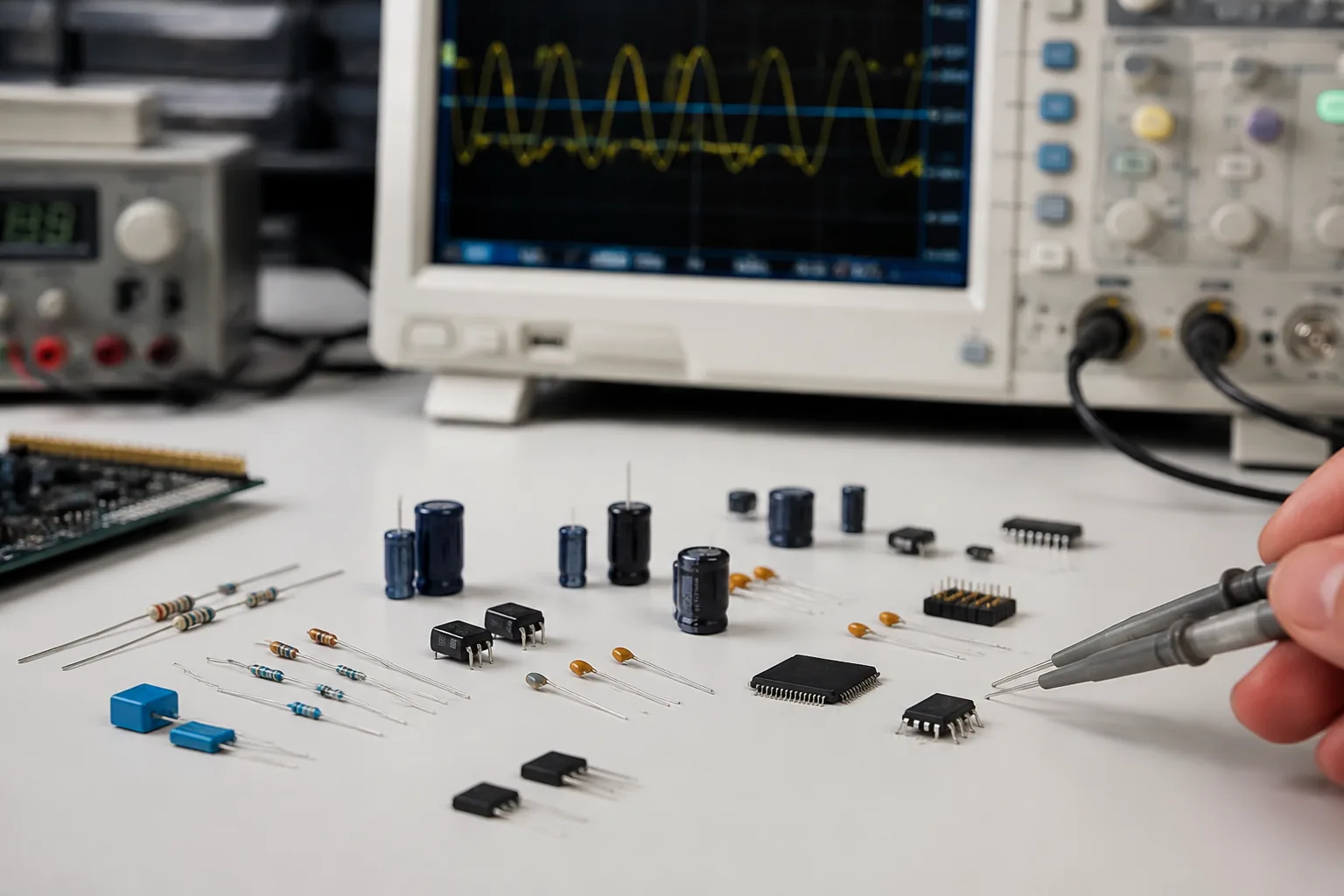
Why Component Testing Sits Before, During and After Production
Component testing is not a single point in the lifecycle — it appears at three stages, and each stage answers a different question:
- Design verification / qualification (up-front) — does the component meet its datasheet and the customer's design-in parameters, under normal and extreme conditions? This is the qualification that releases a new component or a new supplier.
- Production screening / release (during) — does each production lot pass the lot-acceptance and screening tests (burn-in, PIND, hermeticity, electrical test) that move it from raw product to qualified product? The 100 %-screening step ("二筛" in Chinese industry) is what converts a commercial-grade part into a qualified high-reliability part.
- Reliability / life verification (after) — what is the long-term failure rate, and will the component meet its MTBF over the service life? This is the burn-in + steady-state-life + HALT programme that underpins the reliability prediction.
A test report must therefore state which stage it covers — a qualification report, a screening/lot-acceptance report, and a reliability report are different documents.
What Are the Six Test Categories?
The full component-test taxonomy covers six categories, each with its own instrumentation, standards and acceptance criteria:
1. Electrical / functional / parametric testing. Verify the component operates per its datasheet — static (resistance, capacitance, inductance without a functioning signal), dynamic (frequency response, power handling under operating conditions) and parametric (voltage, current, timing against datasheet limits). Instrumentation: multimeter, LCR meter, oscilloscope, signal generator, curve tracer, automated test equipment (ATE) for high-volume parametric screening, in-circuit test (ICT) with bed-of-nails fixtures for PCB-mounted components.
2. Environmental / mechanical stress testing. Subject the component to the temperature, humidity, vibration and shock of its service environment: temperature cycling (−55 °C to +125 °C or higher), steady-state humidity, vibration, mechanical shock, constant acceleration. Standards: MIL-STD-883 / GJB 548C Method 1001–1030, GB/T 4937 (半导体器件机械和气候试验方法).
3. Safety / EMC testing. Verify insulation resistance, dielectric withstand, electrostatic-discharge (ESD) sensitivity, and electromagnetic compatibility — that the component neither emits excessive EMI nor is over-susceptible to it. Standards: IEC 61000-4-x series, MIL-STD-461, FCC. For our EMC-immunity services, see electrostatic discharge immunity testing and surge impulse immunity testing.
4. Life / reliability testing. Accelerate aging to predict service life: burn-in (elevated temperature and voltage to weed out infant-mortality failures), steady-state and intermittent operating life tests (MIL-STD-883 / GJB 548C Method 1005/1006), HALT (highly accelerated life test to find design limits), and MTBF statistical analysis.
5. Counterfeit detection. Verify the part is genuine — visual inspection, X-ray imaging (internal structure, die presence), decapsulation (open the package to inspect the die), electrical test against the marked part, and material analysis. Standards: AS6171 (counterfeit detection, test methods — ACT is the first US lab accredited to AS6171 methods) and AS6081 (counterfeit avoidance, distributors). Critical for aerospace/defence supply chains where a remarked or empty-package counterfeit can kill a mission.
6. Failure analysis. Root-cause investigation of a failed component — X-ray, decapsulation, cross-sectioning, SEM/EDS, electrical characterisation — to determine whether the failure is manufacturing, environmental, design or counterfeit. This is the complementary service to the up-front qualification testing; for our dedicated offering, see electronic component failure analysis.
How Do the Military-Qualification Levels Compare?
For high-reliability applications (aerospace, defence, space, medical, automotive-safety), the MIL-STD / GJB qualification levels define how much screening a part has passed, and the level is what the customer specifies:
| Level | Standard | Description |
|---|---|---|
| JAN (Joint Army-Navy) | MIL-PRF / GJB | Base military qualification — meets standard military requirements |
| JAN-TX | MIL-PRF / GJB | High-reliability — additional screening for critical aerospace/defence |
| JAN-TXV | MIL-PRF / GJB | Extra-high-reliability — stricter screening, space and high-risk |
| JAN-S | MIL-PRF / GJB | Space-grade — the highest level, most extensive testing and screening |
| MIL-PRF (Performance Spec) | MIL-PRF-38535 (IC) / -38534 (hybrid) / -19500 (discrete) | Defines performance criteria the part must meet for qualification |
China's GJB (国军标) military-standard system is built on the MIL-STD framework: GJB 548C-2021《微电子器件试验方法和程序》(replacing GJB 548B-2005, ≈ 95 % adoption of MIL-STD-883) is the microcircuit test-method standard; GJB 7243-2011《军用电子元件筛选技术要求》 is the screening-requirement standard that governs the "二次筛选"(second screening) service offered by Chinese labs. The screening items — burn-in, PIND, hermeticity (fine/gross leak), temperature cycling, mechanical shock, steady-state life, intermittent life — are the GJB 548C method numbers applied to the GJB 7243 screening sequence.
What About the Commercial-Grade Component Standards?
For non-military commercial components, the Chinese framework is the GB/T national and SJ/T industry standard system:
- GB/T 4937 — 半导体器件机械和气候试验方法 (mechanical and climatic test methods for semiconductor devices), the commercial counterpart to the environmental tests in GJB 548C.
- GB/T 9178 / GB/T 14113 / GB/T 2900.66 — terminology standards for ICs, packaging and semiconductor-device electrotechnical terms.
- GB/T 42974-2023 / GB/T 42975-2023 — FLASH memory and driver IC test methods (recent additions, reflecting the move to domestic-IC standards).
- GB/T 43538-2023 / GB/T 43580-2023 — IC metal-package and general IC requirements.
- GB/T 1772-79 — 电子元器件失效率试验方法 (failure-rate test method, historically modelled on MIL-STD).
- GB/T 11499 / GB/T 4023 / GB/T 14028 — discrete-semiconductor-device standards.
- SJ/T 11001-2023 et al. — detailed specifications for fixed aluminium electrolytic capacitors and other passive components.
The commercial grade and the military grade use related but separate test sequences — a commercial GB/T 4937 temperature cycle is not the same as a GJB 548C Method 1010 temperature cycle, and the qualification levels (JAN/JP/S) apply only to the military framework.
Upscreening — When a Commercial Part Must Become a High-Reliability Part
A growing service is upscreening — taking a commercial-grade or industrial-grade part and running the additional MIL-STD/GJB screening on it to qualify it for a high-reliability application, when the military-graded part is unavailable or unaffordable. Upscreening applies wider-temperature burn-in, additional PIND, hermeticity and life tests beyond the original manufacturer's spec, and the part is only qualified for the high-rel application if it passes the full upscreening sequence — a part that fails upscreening cannot be "partially qualified". Upscreening is governed by the same MIL-STD-883 / GJB 548C methods as the original qualification, and the report must document the upscreening sequence applied.
What Belongs on the Report?
A compliant component-test report states the component type, the test category (electrical/environmental/life/counterfeit/FA), the standard and method number (e.g. GJB 548C Method 1015 burn-in; MIL-STD-883 Method 1009 solderability; GB/T 4937 temperature cycle), the test conditions, and the result against the acceptance criterion. For high-reliability qualification it states the qualification level (JAN / TX / TXV / S) claimed and verified. For counterfeit detection it states the AS6171 / AS6081 method and the authenticity verdict. Conflating the stages — e.g. reporting a screening result as a qualification — is a common error.
FAQ
What is the difference between electronic component testing and electronic component failure analysis?
Testing qualifies or screens the component up-front (does it meet spec, will it survive?) using the six test categories. Failure analysis investigates a component after it has failed (why did it break?) using X-ray, decapsulation, cross-section, SEM/EDS. Testing prevents failures; FA explains them. They are complementary services.
What is "upscreening", and when is it needed?
Upscreening takes a commercial/industrial-grade part and applies additional MIL-STD/GJB screening (wider-temperature burn-in, PIND, hermeticity, life) to qualify it for a high-reliability application when the military-graded part is unavailable. The part is qualified only if it passes the full upscreening sequence; a part that fails cannot be partially qualified.
What are the JAN / TX / TXV / S qualification levels?
They are the MIL-STD military-qualification levels of increasing reliability: JAN (base military), JAN-TX (high-reliability, additional screening), JAN-TXV (extra-high-reliability, space/high-risk), JAN-S (space-grade, the most extensive testing). China's GJB system mirrors these. The level is what the high-rel customer specifies on the purchase order.
Which standards govern electronic component testing in China?
The military side uses GJB 548C-2021《微电子器件试验方法和程序》(≈ MIL-STD-883) and GJB 7243-2011《军用电子元件筛选技术要求》 for screening. The commercial side uses GB/T 4937 (mechanical and climatic test methods for semiconductor devices), plus the IC and discrete-device GB/T and SJ/T families. Counterfeit detection uses AS6171 / AS6081.
Why is temperature cycling typically −55 °C to +125 °C?
Because that range covers the worst-case storage and operating extremes for military/aerospace components (the MIL-STD-883 / GJB 548C Method 1010 default), accelerating the CTE-mismatch fatigue that causes die, wire-bond and solder-joint failures. Commercial-grade components may use a narrower range per GB/T 4937, matched to their declared operating environment.
Our Testing Capabilities
As an ISO/IEC 17025-accredited third-party laboratory, Beijing ZKGX Research provides electronic component testing across the six categories and both the military and commercial frameworks:
- Electrical / functional / parametric — static, dynamic and parametric testing by multimeter, LCR meter, oscilloscope, curve tracer, ATE and ICT for resistors, capacitors, inductors, diodes, transistors and ICs.
- Environmental / mechanical — temperature cycling (−55 °C to +125 °C and higher), steady-state humidity, vibration, mechanical shock, constant acceleration, to MIL-STD-883 / GJB 548C Methods 1001–1030 and GB/T 4937.
- Safety / EMC — insulation resistance, dielectric withstand, ESD sensitivity (IEC 61000-4-2), EMC (IEC 61000-4-x, MIL-STD-461) — see also our ESD immunity and surge immunity services.
- Life / reliability — burn-in (GJB 548C Method 1015), steady-state and intermittent operating life (1005/1006), HALT, MTBF analysis.
- Counterfeit detection — visual, X-ray, decapsulation, electrical test, material analysis, to AS6171 / AS6081.
- Failure analysis — X-ray, decapsulation, cross-section, SEM/EDS, electrical characterisation, as the complementary service to up-front testing — see electronic component failure analysis.
- Upscreening — commercial-to-high-rel qualification by additional GJB 548C / MIL-STD-883 screening, with the full upscreening sequence documented.
Sample types include passive components (R/C/L), discrete semiconductors, integrated circuits, hybrid microcircuits, and PCB-mounted assemblies. If you have a specific component type, qualification level (JAN/TX/TXV/S, GB/T commercial), application (aerospace / defence / medical / automotive / industrial), or standard (GJB / MIL-STD / MIL-PRF / GB/T / SJ/T / AS6171), contact the laboratory to confirm the exact test set and reporting format befOre testing.