What Does "Ellagic Acid Testing" Mean in a Laboratory?
Ellagic acid (EA, CAS 476-66-4, C₁₄H₆O₈, MW 302.19) is a naturally occurring polyphenolic lactone — a hydrolysable-tannin degradation product formed by the lactonisation of hexahydroxydiphenic acid (HHDP). It is the bioactive behind pomegranate, strawberry, raspberry, blackberry, walnut and Terminalia chebula, studied for antioxidant, anti-inflammatory, anticancer and skin-whitening activity. Because it appears as both a free acid and as the bound ellagitannin precursor in plant material, and because it is added as a declared active to cosmetics (whitening), health foods and herbal formulations, "ellagic acid testing" in a laboratory is not one assay but three distinct services, each answering a different question on a different matrix: food / plant / health-food content assay (how much EA is in this pomegranate extract?), cosmetic active assay (is the whitening cream at its declared %?), and pharmacopoeia / marker-compound quantification (is the herbal drug standardised to its EA marker?). The methods look related (most end in RP-HPLC with UV/DAD detection at ~254-270 nm), but the sample preparation — and the single biggest analytical problem of ellagic acid — differ by matrix.
Why Ellagic Acid Is the Most Difficult Polyphenol to Quantify
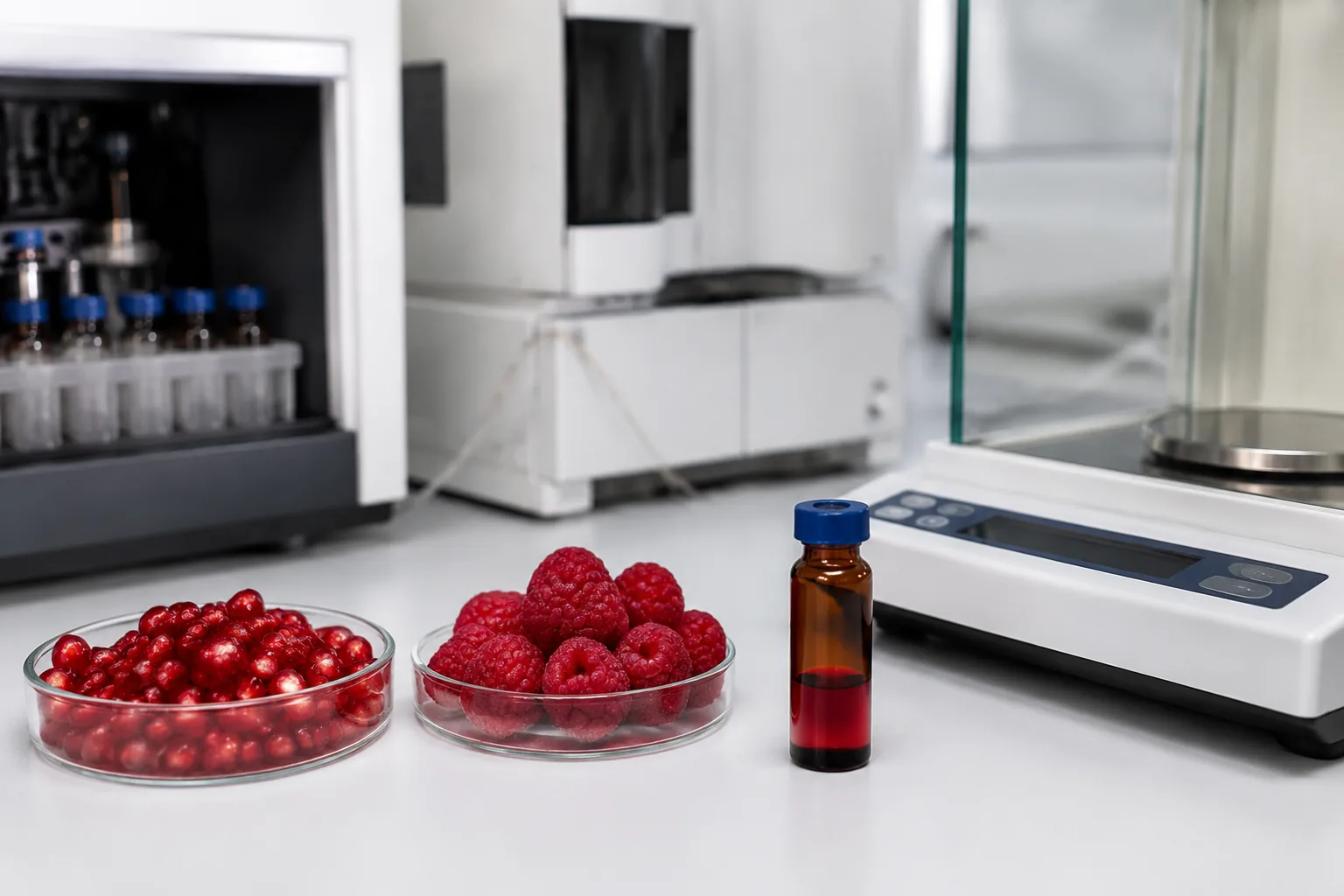
Three properties of ellagic acid make its HPLC quantification uniquely challenging, and a method that ignores them produces falsely low or non-reproducible results:
- Extremely low aqueous and organic solubility — EA is practically insoluble in water, sparingly soluble in methanol and ethanol, and precipitates from solution over time even when initially dissolved. This is the single most cited cause of assay variability.
- High adsorptivity — EA adsorbs strongly onto reversed-phase columns and onto surfaces, causing peak tailing, carryover and quantification drift.
- Free-acid vs ellagitannin bound state — in plant matrices, EA exists both as the free acid (the analyte) and as the sugar-bound ellagitannin precursor (e.g. punicalagin in pomegranate). Without a hydrolysis step to release the bound fraction, the assay measures only the free acid and underreports the total EA content of the material.
The solubility problem has a well-validated technical fix: adding ≥ 2 % w/w dimethylacetamide (DMA) to the EA-containing solution stabilises EA in solution for ≥ 72 h without precipitation (a Japanese patent on guava-leaf extract demonstrated this, with DMA the only solvent in a test panel — methanol, ethanol, DMSO — that kept EA dissolved over time). A modern EA assay method should therefore state how the solubility problem was addressed — DMA stabilisation, heated dissolution, or immediate analysis — or its low recovery may be a sample-preparation artefact rather than a true low content.
What Are the Three Services — and Why Confusing Them Produces Wrong Reports
| Service | Question | Matrix | Standard / method |
|---|---|---|---|
| Food / plant / health-food content assay | How much EA is in this material? | Pomegranate, strawberry, Terminalia chebula, walnut, herbal formulations, health foods | Literature RP-HPLC methods (no dedicated EA GB standard yet); hydrolysis step to release bound ellagitannins; DMA stabilisation |
| Cosmetic active assay | Is the whitening active at its declared %? | Cream, serum, lotion | China QB/T 5295-2018 (美白化妆品中鞣花酸的测定 高效液相色谱法); SPE clean-up |
| Pharma / herbal marker compound | Is the herbal drug standardised to its EA marker? | Terminalia chebula tablets, herbal compound formulations, TCM | RP-HPLC marker-compound assay per ICH validation; EA as one of several markers |
A food method (mg/g) is not a cosmetic method (% w/w); a free-acid-only assay is not a total-EA assay. The report must name the matrix and the standard.
How Is the Food / Plant / Health-Food Content Assay Performed?
For EA in plant materials and health foods, the RP-HPLC method is well-established in the literature, with the ICH-validated Terminalia chebula tablet assay as a representative published method:
- Sample prep — plant material is ground, extracted with methanol (often acidified with 0.1 % formic / orthophosphoric / trifluoroacetic acid), sonicated (10–15 min), and centrifuged; for total EA, an acid hydrolysis step releases the bound ellagitannin fraction before extraction.
- Column — C18 / ODS, 250 × 4.6 mm, 5 µm (Phenomenex, Inertsil, Symmetry Shield RP18, or SIELC Newcrom BH mixed-mode).
- Mobile phase — acetonitrile : 0.01–0.1 % orthophosphoric-acid / formic-acid / TFA water, typically 80:20 or gradient; or methanol : perchloric-acid water on mixed-mode columns.
- Detection — UV / DAD at ~254–270 nm (EA λmax ≈ 254 nm; some methods use 270 nm).
- Quantification — external-standard or internal-standard (coumaric acid) calibration, 20–120 µg/mL range, r² ≥ 0.999.
- Validation (ICH Q2) — recovery 98.96–100.14 %; intraday RSD ~0.06 %, interday RSD ~0.03 %; LOD ~3.74 µg/mL, LOQ ~16.84 µg/mL; robust to ± 3 °C temperature variation; rugged across analysts.
The reported result is EA content in mg/g (or mg per tablet / per dose), against the declared value or the raw-material specification.
How Is the Cosmetic Active Assay Performed?
For whitening cosmetics, EA is the active ingredient typically at 0.1–2 %, and the assay is governed by China's QB/T 5295-2018《美白化妆品中鞣花酸的测定 高效液相色谱法》:
- Scope — water-based, emulsion, cream, gel, wax-based and powder cosmetics.
- Sample prep — methanol-water (1+1) extraction, 10-min sonication, centrifugation; solid-phase extraction (SPE) clean-up to remove matrix interferences that co-elute at the EA retention time.
- HPLC — C18 column, methanol-acidified-water mobile phase, UV/DAD at ~254 nm.
- Result — EA content in % w/w against the declared whitening-active concentration and the regulatory cap.
Because EA is a regulated cosmetic whitening agent (with concentration limits in some jurisdictions), the assay must reach an LOQ appropriate to the declared use level — typically well below 0.01 % w/w — and the SPE clean-up is essential for complex emulsion matrices.
How Is the Pharma / Herbal Marker-Compound Assay Performed?
For herbal drugs standardised to EA as a marker (e.g. Terminalia chebula fruit, pomegranate extract, triphala compound formulations), EA is one of several hydrolysable-tannin markers (alongside chebulinic acid, chebulagic acid, gallic acid), and the assay is part of a multi-marker RP-HPLC fingerprint per ICH Q2 validation:
- Multi-analyte — EA + gallic acid + chebulinic acid + chebulagic acid, often resolved isocratically or by gradient.
- Standardisation — the herbal drug is standardised to a declared EA (or total hydrolysable-tannin) content (commercial Terminalia chebula extracts range 21–50 % total hydrolysable tannins).
- Purpose — quality control of the raw herb, batch-to-batch uniformity, and GLP data for blended formulations.
What Belongs on the Report?
A compliant EA test report states the service, the matrix, the method (column / mobile phase / detection), the LOD/LOQ, whether a hydrolysis step was applied (free-acid-only vs total EA), how the solubility problem was addressed (DMA stabilisation, heated dissolution, immediate analysis), and the result against the applicable limit — mg/g vs raw-material spec (food/herb); % w/w vs label claim and regulatory cap (cosmetic); mg/tablet vs marker spec (pharma). The cardinal error is reporting a free-acid-only number against a total-EA specification, or omitting the solubility control.
For related services, see our Cosmetics testing and Health Food Testing for China SAMR.
FAQ
Why is ellagic acid so difficult to quantify by HPLC?
Three properties: extremely low aqueous and organic solubility (it precipitates from methanol over time), high adsorptivity onto reversed-phase columns (peak tailing, carryover), and the free-acid-vs-ellagitannin bound state in plant matrices. A method must address all three — DMA stabilisation for solubility, column conditioning for adsorptivity, and acid hydrolysis to release the bound fraction — or it underreports EA content.
What is the dimethylacetamide (DMA) stabilisation method?
Adding ≥ 2 % w/w dimethylacetamide to an EA-containing solution stabilises EA in solution for ≥ 72 h without precipitation. DMA was the only solvent in a test panel (vs methanol, ethanol, DMSO) that kept EA dissolved over time on guava-leaf extract. Modern EA assays that use DMA report markedly higher and more reproducible recovery than those that do not address solubility.
What is the difference between free ellagic acid and total ellagic acid?
In plant material, EA exists as the free acid (the analyte) and as the sugar-bound ellagitannin precursor (e.g. punicalagin). An acid-hydrolysis step cleaves the ellagitannin to release additional EA, so the "total EA" result is higher than the "free EA" result. A report must state whether hydrolysis was applied, because comparing a free-acid-only result against a total-EA specification is invalid.
Which Chinese standard covers ellagic acid in cosmetics?
QB/T 5295-2018《美白化妆品中鞣花酸的测定 高效液相色谱法》 — HPLC with DAD detection, applicable to water-based, emulsion, cream, gel, wax-based and powder cosmetics, with SPE clean-up for complex matrices. There is no dedicated EA GB national standard yet; food/herbal EA assays use validated literature RP-HPLC methods.
Can the same HPLC method cover food, cosmetics and herbal-drug matrices?
The chromatography and UV detection are broadly similar (C18, ~254 nm, acidified methanol/acetonitrile), but the sample preparation differs by matrix — methanol extraction + hydrolysis for plant material, SPE clean-up for cosmetic emulsions, multi-marker calibration for herbal drugs. A method validated for one matrix is not automatically valid for another; each requires its own validated method.
Our Testing Capabilities
As an ISO/IEC 17025-accredited third-party laboratory, Beijing ZKGX Research provides ellagic acid testing across the three service families:
- Food / plant / health-food content assay — RP-HPLC with UV/DAD at ~254 nm on pomegranate, strawberry, raspberry, walnut, Terminalia chebula and herbal/health-food formulations, with optional acid hydrolysis to release bound ellagitannins (free-EA or total-EA reporting) and DMA stabilisation to control the solubility problem; validated per ICH Q2 (LOD ~3.74 µg/mL, LOQ ~16.84 µg/mL, recovery 98.96–100.14 %).
- Cosmetic active assay — EA in whitening creams/serums/lotions to QB/T 5295-2018 HPLC with SPE clean-up, against declared % w/w and regulatory cap, with LOQ appropriate to use level.
- Pharma / herbal marker compound — EA as one of several hydrolysable-tannin markers (gallic acid, chebulinic acid, chebulagic acid) in herbal drugs and compound formulations, per ICH-validated multi-marker RP-HPLC.
Sample types include plant materials and extracts, health foods, herbal formulations, TCM tablets, whitening cosmetics, and pharmaceutical-grade EA raw material. If you have a specific matrix, regulatory target (QB/T / GB / ChP / USP / ICH), or reporting requirement (free-EA vs total-EA, mg/g vs % w/w vs mg/tablet), contact the laboratory to confirm the correct method, solubility control, hydrolysis step and reporting format befOre testing.