Table of Contents
- What standards govern heat pump testing?
- How is COP determined under EN 14511?
- How is seasonal performance (SCOP) measured under EN 14825?
- How is domestic hot water performance tested under EN 16147?
- What role do defrosting and auxiliary corrections play?
- How is sound power measured?
- How does the Chinese GB framework differ?
- FAQ
- Our heat pump testing service
What standards govern heat pump testing?
Heat pump testing is governed by a tightly structured family of European standards (the EN 14511 / EN 14825 / EN 16147 / EN 12102 set) that together define every property a heat pump is rated for, plus the national adoptions and certification schemes that translate those ratings into market access. A test report that quotes only one of these standards answers only one of the questions a regulator, a certifier or a customer will ask.
The principal reference standards our laboratory works to are: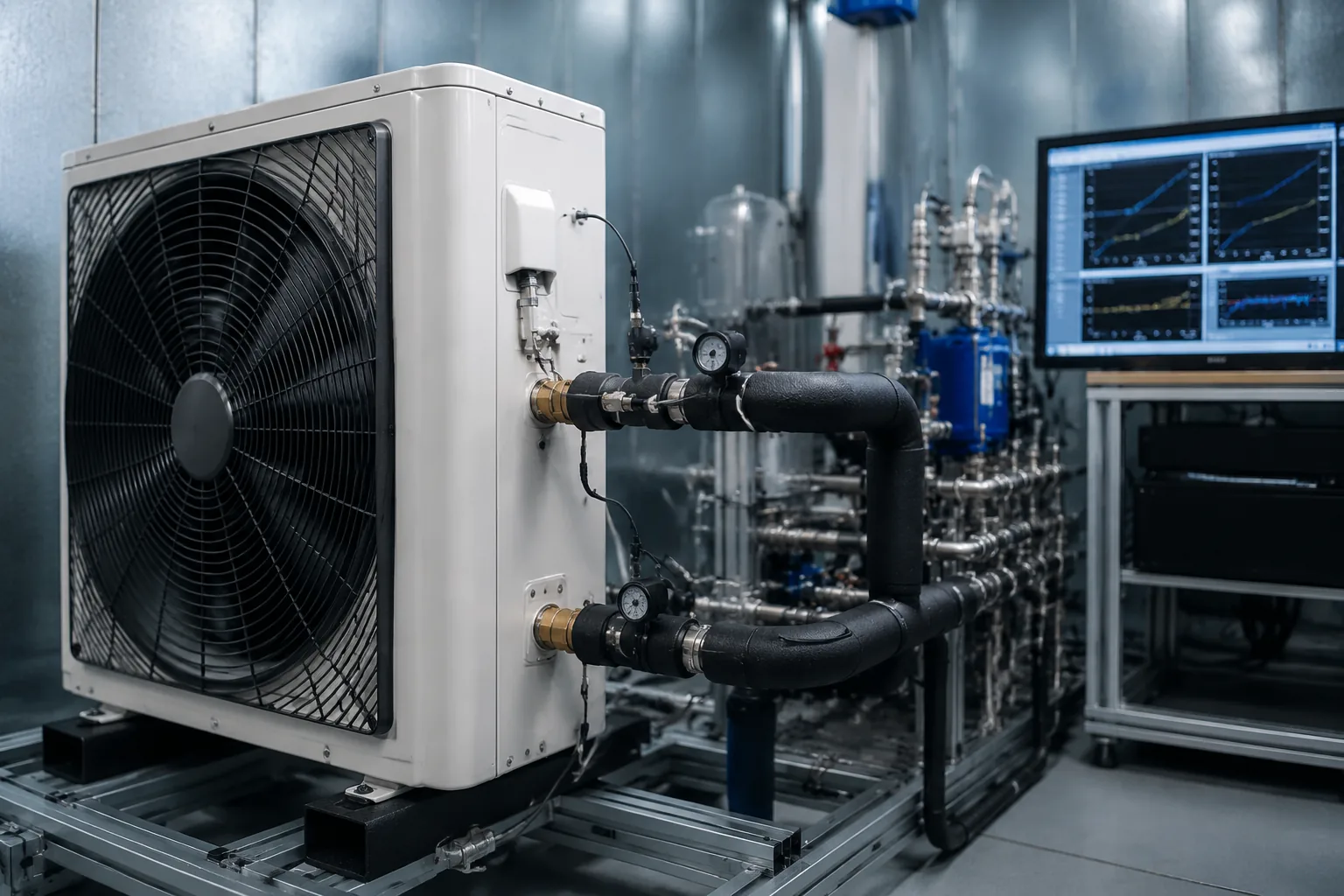
- EN 14511, Air conditioners, liquid chilling packages and heat pumps with electrically driven compressors for space heating and cooling — the foundational product standard, in four parts: Part 1 (terms and definitions), Part 2 (test conditions), Part 3 (test method) and Part 4 (requirements). EN 14511 defines the standardised rating conditions under which the coefficient of performance (COP) is determined and the categories of heat pump (air/water, brine/water, water/water, air/air, direct evaporation). It replaced the earlier EN 255-1+2 in 2011.
- EN 14825, Testing and rating at part load conditions and calculation of seasonal performance — the part-load and seasonal-performance standard. EN 14825 defines the test points A through G at part-load conditions, the climate zones (cold, medium, warm), the degradation coefficient, and the calculation methodology that produces the seasonal coefficient of performance (SCOP). SCOP, not the single-point COP, is the figure the energy labelling and the building-energy-performance regulations use.
- EN 16147, Heat pumps with electrically driven compressors — Testing and rating for domestic hot water — the domestic-hot-water (DHW) performance standard, defining the daily tapping profiles (S through XXL) under which the DHW COP is determined. It replaced the earlier EN 255-3, and unlike the old standard it incorporates the cylinder standing losses over 24 hours into the COP — producing lower but more realistic ratings.
- EN 12102, Determination of the sound power level — the acoustic standard, specifying the Class A method and the reference rating conditions under which the heat pump's sound power (in dBA) is measured for the energy label.
- EN 12309, Testing of gas-fired sorption appliances — the gas-fired absorption and adsorption heat pump standard, with test conditions and the performance metric specific to gas-driven (rather than electrically-driven) heat pumps.
- EN 15879, Testing of direct evaporation heat pumps — the standard for heat pumps in which the refrigerant evaporates directly in a ground-buried pipe, with the test rig placing the evaporator in a brine tank at specified temperatures.
- GB 21455-2019, Minimum allowable values of energy efficiency and energy efficiency grades for room air conditioners (std.samr.gov.cn) — China's mandatory energy-efficiency standard, which covers both fixed-speed and variable-speed room air conditioners and the low-ambient air-source heat pump heater-fan units, using the annual performance factor (APF) as the rating metric.
- GB/T 37480, Low ambient temperature air source heat pump (water chilling) packages — China's recommended standard for air-source heat pump chiller packages designed for low-ambient operation, with the technical requirements and test methods specific to that product category.
- EHPA Quality Label — the European Heat Pump Association's certification scheme, which requires independent testing under EN 14825, EN 14511 and EN 12102 plus the achievement of minimum COP thresholds (3.1 at A2W35 for air/water, 4.3 at B0W35 for brine/water, 5.1 at W10W35 for water/water) and a documentation / service-network requirement.
A common misconception in specifications we receive is that a single "heat pump COP" number characterises the unit. It does not. The COP depends on the rating condition (the heat-source temperature and the heat-sink temperature), and the same unit reports materially different COP values at A7W35, A7W55, A-7W35 and A-7W55. The SCOP, in turn, depends on the climate zone and the application temperature. A conformity project must specify the rating condition, the climate zone and the application before the numbers are meaningful, because comparing two COPs declared at different boundary conditions is the classic error the standards exist to prevent.
How is COP determined under EN 14511?
The COP — the coefficient of performance — is the ratio of useful heat delivered to the electrical energy consumed, measured at a defined steady-state or quasi-steady-state rating condition. It is the fundamental performance metric of a heat pump, and EN 14511 defines both how it is measured and the rating conditions under which it is declared.
The rating condition is the pair of temperatures that defines the test: the heat-source temperature (the temperature of the air, brine or water from which the heat pump extracts heat) and the heat-sink temperature (the temperature of the heating water or air to which the heat pump delivers heat). The standard notation abbreviates these as, for example, A7W35 (outside air at 7 °C, heating water at 35 °C), B0W35 (brine at 0 °C, heating water at 35 °C), or A-7W55 (outside air at -7 °C, heating water at 55 °C). The fundamental thermodynamic relationship is that the COP is higher when the temperature lift between source and sink is smaller — an air/water heat pump at A7W35 has a much higher COP than the same unit at A-7W55 — which is why the rating condition must always be quoted alongside the COP, and why comparing COPs at different rating conditions is meaningless.
EN 14511 defines the rating conditions for each heat-source and heat-sink category:
- Heat-sink (heating-water) outlet temperatures: low temperature 35 °C (W35), medium temperature 45 °C (W45), high temperature 55 °C (W55), very high temperature 65 °C (W65). For water heat transfer, the inlet temperature is set to produce a 5 K temperature difference across the heating side at the nominal standard point.
- Outside-air source temperatures: A12, A7, A2, A-7, A-15.
- Brine source temperatures: B-5, B0, B5.
- Water source temperatures: W10, W15.
- Exhaust-air source: A20.
The COP measurement itself is performed on a calibrated test rig that supplies the heat source at the specified inlet condition and absorbs the delivered heat at the specified outlet condition. The heating capacity is determined by the calorimetric or the enthalpy method (measuring the water-side or air-side heat flow), and the electrical energy input is measured at the heat pump's power supply. The COP is the ratio. The measurement is run at steady state (for the continuous-operation points) or at virtual steady state averaged over a defrost cycle (for the points where the air-source evaporator frosts), and the standard specifies the stabilisation criteria and the measurement duration that make the result reproducible across laboratories.
The pump-and-fan correction is an EN 14511 feature that affects the COP by up to 0.3 and that specifications frequently misunderstand. Some heat pumps integrate the hydraulic circulation pump; others are delivered without one. Without correction, the integrated-pump unit would report a lower COP (because its electrical consumption includes the pump) than the pumpless unit, even if the refrigeration cycles are identical. The standard corrects for this by measuring the hydraulic capacity needed to overcome the device's internal pressure loss, converting it to an equivalent electrical input using a virtual pump/fan efficiency, and adding or subtracting it so that all units are compared on the same basis. The correction makes the COP comparable across the integrated-pump and the pumpless designs, and a report that omits the correction is reporting a COP that is not comparable to a corrected COP from another unit.
How is seasonal performance (SCOP) measured under EN 14825?
The single-point COP at one rating condition is useful for comparison, but it does not describe how the heat pump performs across a heating season — across the range of outdoor temperatures, the part-load fractions and the operating modes the unit actually experiences. EN 14825 defines the seasonal coefficient of performance (SCOP), the metric that the energy labelling and the building regulations use, and the test methodology that produces it.
The SCOP calculation is built on a set of part-load test points (A through G) defined by the standard, each specifying an outdoor temperature, an outlet-water temperature, and a percentage of the design heating load. The test points are:
- A: -7 °C (or -8 °C), corresponding to the high-load end of the heating season.
- B: 2 °C (or 1 °C).
- C: 7 °C (or 6 °C).
- D: 12 °C (or 11 °C), the low-load end.
- E: at the operating-limit temperature (TOL).
- F: at the bivalent temperature (Tbivalent).
- G: -15 °C, only for the colder climate and where TOL is below -20 °C.
At each test point, the declared capacity and the declared COP are reported, and the test laboratory measures a subset of these points to verify the declaration. The EHPA regulation specifies that the declared performance data are considered valid if the measured values deviate by no more than ±5 % (for the Table 2 performance-test conditions) or ±8 % (for the A-through-F seasonal-performance conditions) from the declared values — tolerances that exist because a heat pump's performance varies with the installation and the measurement, and the standard sets the bounds within which the declaration is accepted.
Three further parameters enter the SCOP calculation:
The climate zone. EN 14825 defines three: cold (Tdesign = -22 °C), medium (Tdesign = -10 °C) and warm (Tdesign = +2 °C). The design temperature sets the building's peak heating load, and the load-duration curve that weights the part-load COPs into the SCOP depends on it. A heat pump tested and declared for the average climate produces a different SCOP from the same unit declared for the colder climate, because the weighting of the part-load points differs.
The degradation coefficient (Cdh). When a heat pump operates in on/off cycling mode (rather than continuous modulation), the cycling losses reduce the effective COP below what the steady-state measurement predicts. The degradation coefficient captures this reduction, and EN 14825 sets a default value of Cdh = 0.9 unless the manufacturer declares and tests a different value. The degradation coefficient is the parameter that connects the part-load COP (measured at steady state) to the seasonal COP (experienced in cycling operation), and it is the parameter whose omission produces the optimistic SCOPs that the BRE validation study identified.
The electric power consumptions in non-active modes. The SCOP calculation incorporates the electrical consumption in the off mode (POFF), the standby mode (PSB), the thermostat-off mode (PTO) and the crankcase-heater mode (PCK). These auxiliary consumptions can be a non-trivial fraction of the seasonal energy budget — a heat pump that performs well when running but draws a high crankcase-heater power throughout the off-season has its SCOP reduced by that standby consumption, and the EN 14825 methodology is what captures this.
A critical finding from the published validation literature: the standard EN 14825 testing may overpredict the real-world heat pump performance, because the standard tests are run with the compressor at the fixed speed the manufacturer declares (per clause 11.6.2, which allows the manufacturer to fix the compressor speed), whereas the installed heat pump varies its compressor speed freely. The BRE lab study, which ran EN 14825 tests with the compressor free to vary, found the COP significantly lower than the manufacturer's declared values at all part-load points where the compressor cycled. The implication for a testing laboratory is that the EN 14825 result is a standardised rating, not a field-performance prediction, and the report should make that distinction clear.
How is domestic hot water performance tested under EN 16147?
The space-heating COP and SCOP characterise the heat pump's performance in delivering heat to the building's heating circuit. The domestic-hot-water (DHW) COP characterises its performance in delivering hot water to the cylinder — a different operating mode with a different load profile, a different flow temperature, and a different loss structure. EN 16147 is the standard that defines the DHW test.
The EN 16147 test uses a daily tapping profile — a schedule of hot-water withdrawals of defined volume and energy spread across a 24-hour day — to simulate realistic domestic hot-water use. The standard defines a series of profiles from S (2.1 kWh/day) through XXL (24.53 kWh/day), each representing a different household size and use pattern. The test rig draws off hot water according to the profile, the heat pump reheats the cylinder, and the COP is the useful heat delivered to the drawn-off water divided by the total electrical energy consumed by the heat pump over the 24-hour period.
Three features of the EN 16147 test distinguish it from the older EN 255-3 it replaced and make the DHW COP more realistic:
The cylinder standing losses are incorporated. Unlike the old standard, EN 16147 includes the heat lost from the cylinder over the 24-hour period in the COP calculation — the heat the heat pump must produce to maintain the cylinder temperature against the standing losses is part of the energy consumed, and it reduces the reported COP. This is why the EN 16147 COP values are lower than the EN 255-3 values for the same heat pump: the new standard does not let the cylinder losses disappear from the rating.
The cold-water inlet temperature is fixed at 10 °C. This standardisation makes the test reproducible across laboratories and seasons, and it sets the temperature lift the heat pump must achieve. The test also stipulates a minimum achieved water temperature for each withdrawal; if the heat pump cannot reach it, a direct electrical heater cuts in, and the electrical consumption of that heater is part of the test result.
The test typically uses the largest applicable tapping profile. Because the storage losses are relatively constant, the COP increases with the quantity of water drawn — the standing losses are a smaller fraction of the total useful heat at the larger draw. The standard therefore reports the COP at the profile that best matches the device's intended use, and the laboratory confirms the profile selection with the manufacturer befOre testing.
The published validation literature reports DHW COP values for air-source heat pumps with environmental air as the heat source (A15) typically in the region of 2.3 to 2.7 — materially lower than the space-heating COP at the same outdoor temperature, because the DHW flow temperature is higher (the cylinder is heated to 50-60 °C) and the cylinder losses are incorporated. The DHW COP is the figure that determines the hot-water running cost, and it is the figure the building-energy-performance regulations increasingly require to be declared alongside the space-heating SCOP.
What role do defrosting and auxiliary corrections play?
Two corrections that the EN 14511 / EN 14825 methodology applies — the defrost correction for air-source heat pumps, and the pump/fan correction discussed above — deserve explicit treatment because they affect the declared COP by amounts that change the comparison between units, and because specifications frequently misunderstand them.
Defrost correction. Air-source heat pumps frost at source temperatures below A7 (the evaporator collects ice from the humid outdoor air), and they must periodically reverse the cycle to defrost — briefly drawing heat from the building's heating circuit to melt the ice off the outdoor coil. The defrost cycle consumes energy and interrupts the heat delivery, and the EN 14511 test methodology accounts for this by running the test over a four-hour period at the rating condition and averaging the COP across one or more complete defrost cycles. The humidity of the inlet air is specified for each temperature level because the frost rate and the defrost frequency depend on it. The COP reduction through defrosting is in the region of 0.3 to 1.0, depending on the efficiency of the defrost algorithm — a heat pump with a well-tuned defrost cycle loses less performance than one with a crude cycle, and the test captures the difference. Above A7, air-source heat pumps typically run frost-free and the defrost correction does not apply.
Pump and fan correction. As described in the COP section, the correction normalises the electrical consumption for the integrated-pump versus the pumpless designs, affecting the COP by up to 0.3. The correction is mandatory under EN 14511 for the COP to be comparable across designs, and a report that omits it is reporting a COP whose comparability to other units is questionable.
These two corrections are the reason the declared COP under the standard can differ from a "raw" COP measured without them, and they are the reason the standard exists — to define the corrections that make the ratings comparable. A laboratory that reports the uncorrected COP and the corrected COP separately gives the customer both numbers; a laboratory that reports only one without specifying which leaves the result open to the comparison error the standard was written to prevent.
How is sound power measured?
The sound power level is the acoustic metric reported on the heat pump's energy label and the figure architects, specifiers and planning authorities use in product selection and in noise-impact assessment. EN 12102 defines the measurement.
The measurement uses the Class A method (the reverberant-room or free-field method that produces the sound-power level in decibels A-weighted, dBA), at a reference rating condition defined as the highest temperature application for which the unit is being granted. The reference condition is chosen at the high-temperature application because that is typically the loudest operating point — the compressor and the fan run harder at the higher load.
The standard distinguishes the sound power radiated by different surfaces of the heat pump, because the installation determines which surface matters:
- Outdoor side casing (LWo) — the sound radiated by the outdoor unit's casing, the figure that matters for an outdoor installation's impact on neighbours.
- Discharge duct or duct termination (LWdo) — the sound radiated through the discharge path, for indoor-installed package units delivered without or with duct connections.
- Indoor side casing (LWi) — the sound radiated by the indoor unit's casing, relevant for split units where the compressor is part of the indoor unit.
For units that have defrost cycles at the reference test condition, the acoustic test is performed with humidity control of the air inlet so that no cycling operation occurs during the test — the sound measurement is run at steady state, because the cyclic operation would produce a non-representative time-varying sound profile.
The sound power is the figure that the energy label carries and the figure that the planning process references, and a heat pump that passes the COP and SCOP thresholds but exceeds the sound-power expectation for the installation site will be rejected on noise grounds. The acoustic test is therefore not a footnote to the performance testing — it is a distinct qualification that the EN 12102 measurement delivers.
How does the Chinese GB framework differ?
The Chinese heat-pump framework differs structurally from the European one, and a project scoped to the European standards does not automatically satisfy the Chinese regulator. The differences matter because the Chinese market is the largest heat-pump market in the world, and a heat pump intended for both markets must be tested against both framework sets.
The principal Chinese standards are:
- GB 21455-2019, Minimum allowable values of energy efficiency and energy efficiency grades for room air conditioners — the mandatory energy-efficiency standard. The 2019 edition consolidated two earlier standards (GB 12021.3-2010 for fixed-speed units and GB 21455-2013 for variable-speed units) into a single document covering both. It applies to air-cooled, fully-hermetic-compressor room air conditioners with rated cooling capacity up to 14 kW, climate type T1, and — importantly — to the low-ambient air-source heat pump heater-fan units (低环境温度空气源热泵热风机) that have become a major product category in northern Chinese coal-to-electricity conversions. The rating metric is the annual performance factor (APF), not the European SCOP, and the standard sets both the minimum energy-efficiency limit (the market-access floor) and the energy-efficiency grades (the labelling tiers).
- GB/T 37480, Low ambient temperature air source heat pump (water chilling) packages — the recommended standard for the air-source heat pump chiller packages designed for low-ambient operation (the hydronic counterpart to the heater-fan units). It specifies the technical requirements and the test methods for the chiller-package product category.
Three structural differences from the European framework affect a Chinese-market project:
The rating metric is APF, not SCOP. APF (the annual performance factor) aggregates the heating-season and the cooling-season performance into a single annual figure, reflecting the reality that most Chinese room air conditioners are reversible (heat in winter, cool in summer). SCOP, by contrast, is a heating-season-only figure. A heat pump tested and rated under EN 14825 produces an SCOP; the same heat pump tested under GB 21455 produces an APF; the two are not directly comparable, and the report must name which metric it reports.
The mandatory-versus-recommended distinction matters for market access. GB 21455 is mandatory — a heat pump that does not meet the minimum energy-efficiency limit cannot be sold in China. GB/T 37480 is recommended — it defines the technical baseline for the low-ambient chiller package, but the mandatory floor is set by GB 21455 (for the heater-fan category) and by the separate chiller energy-efficiency standards (for the commercial chiller category). A Chinese-market project must confirm which mandatory standard applies to the product category before testing, because the minimum-efficiency limit differs across the categories.
The low-ambient operation is a specific Chinese focus. The northern Chinese coal-to-electricity programme has driven the development of heat pumps that must deliver useful heat at ambient temperatures down to -20 °C and below — a performance regime that the European average-climate EN 14825 testing does not exercise (the European cold climate sets Tdesign at -22 °C, but the bulk of the European market tests at the average climate). GB/T 37480 and the heater-fan provisions of GB 21455 address this low-ambient regime directly, with test points and performance requirements specific to it. A heat pump intended for northern China must be tested at the low-ambient conditions the Chinese standards specify, and a report that tests only at the European rating points does not answer the Chinese regulator's question.
A cross-market project therefore tests the heat pump against both the EN framework (for the European market and the EHPA label) and the GB framework (for the Chinese market), with the report explicitly naming the standard, the metric and the rating condition for each declared value. We confirm the target markets and the product category before quoting, because the test scope and the cost are driven by the combined requirement set.
FAQ
Which standard should my heat pump be tested to?
It depends on the product type, the target market and the application. For the European market, EN 14511 (COP at rating conditions), EN 14825 (SCOP at part load), EN 16147 (DHW performance) and EN 12102 (sound power) form the core set, with EN 12309 for gas-driven units and EN 15879 for direct-evaporation units. For the Chinese market, GB 21455-2019 (mandatory, APF) and GB/T 37480 (low-ambient chiller packages) apply, with the metric and the minimum-efficiency limit differing from the European framework. For the EHPA Quality Label, the EN testing plus the minimum-COP thresholds (3.1 / 4.3 / 5.1 at the category-specific rating point) apply. We confirm the product type and target market before quoting.
What is the difference between COP and SCOP?
COP is the coefficient of performance at a single rating condition (a defined source temperature and sink temperature). SCOP is the seasonal coefficient of performance — the weighted average of the part-load COPs across the heating season, calculated under EN 14825 from the A-through-G test points, the climate zone, the degradation coefficient and the non-active-mode power consumptions. COP is the comparison metric; SCOP is the regulatory and labelling metric. Both must be quoted with their rating conditions or climate zones to be meaningful.
Why does my heat pump perform worse in the field than its declared SCOP?
Several reasons. The EN 14825 test runs at the compressor speed the manufacturer declares (clause 11.6.2 allows the manufacturer to fix the speed), whereas the installed unit varies its compressor speed freely — and the free-varying operation produces cycling losses the fixed-speed test does not capture. The defrost cycles, the cylinder standing losses (for DHW), the auxiliary standby consumption and the installation-specific losses (long pipe runs, undersized cylinders, poor hydraulic integration) all reduce the field performance below the declared SCOP. The validation literature has documented this gap systematically, and the EN 14825 result is best understood as a standardised rating for comparison, not a field-performance guarantee.
What tapping profile is used for the DHW test?
EN 16147 defines profiles from S (2.1 kWh/day) through XXL (24.53 kWh/day), representing different household sizes. The test is typically run at the largest applicable profile because the COP increases with the draw (the cylinder standing losses are a smaller fraction at the larger draw). We confirm the profile with the manufacturer before testing, and the report names the profile and the cold-water inlet temperature (10 °C) alongside the COP.
Do you test to the EHPA Quality Label requirements?
Yes. The EHPA label requires the EN 14511 / EN 14825 / EN 12102 testing plus the achievement of the minimum COP at the category-specific rating point (3.1 at A2W35 for air/water, 4.3 at B0W35 for brine/water, 5.1 at W10W35 for water/water). The label also requires the documentation in the language of the country of sale and the service-network availability, which are outside the laboratory's scope but which the test report supports. We confirm the label scope before quoting.
Our heat pump testing service
Our laboratory provides heat pump testing across the full standard stack — EN 14511 for the COP at rating conditions, EN 14825 for the part-load and SCOP, EN 16147 for the DHW performance, EN 12102 for the sound power, EN 12309 for gas-driven units, EN 15879 for direct-evaporation units, GB 21455-2019 and GB/T 37480 for the Chinese market, and the EHPA Quality Label testing regime. Each project begins with a scoping step that confirms the product type (air/water, brine/water, water/water, air/air, direct evaporation, gas-driven), the target market, the application (space heating, DHW, combination) and the corresponding standard set, so the report you receive answers the question your regulator, your certifier or your customer will actually ask.
We measure the COP at the EN 14511 rating conditions with the pump/fan correction; the SCOP at the EN 14825 part-load test points A through G with the degradation coefficient and the non-active-mode power consumptions; the DHW COP under the EN 16147 tapping profiles with the cylinder losses incorporated; the sound power under EN 12102 Class A at the reference rating condition; and the defrost-corrected performance at the air-source rating points below A7. For the Chinese market we test under GB 21455 (APF, mandatory) and GB/T 37480 (low-ambient chiller packages). For the EHPA label we run the full test regime and confirm the minimum-COP threshold. Reports are issued with the standard, the rating condition, the metric, the measured value, the declared value, the tolerance and the conformity conclusion explicitly stated, with the test-point table and the SCOP calculation included, in a format suitable for energy-labelling submission, EHPA label application, regulatory conformity or customer qualification.
To start a project, send us the heat pump type and capacity, the refrigerant, the target market, the application (space heating, DHW, combination), the applicable standard if known (or let us confirm it), and whether the project is energy-labelling conformity, EHPA label application, Chinese market access or field-performance validation. We will return a project scope, test-rig requirement, schedule and quotation, and begin testing on your confirmation.