Lysine testing is the laboratory determination of the concentration of lysine (赖氨酸, Lys, K) — an essential amino acid that the human body and monogastric animals cannot synthesize and must obtain from food or feed — in food, feed, and feed additives. The test is governed by a matrix-specific GB framework: food under GB 5009.124-2016 (Determination of Amino Acids in Foods), feed under GB/T 18246-2019 (Determination of Amino Acids in Feed), and the feed-additive product L-lysine monohydrochloride under GB 34466-2017 (Feed Additive — L-Lysine Monohydrochloride). The defining analytical principle is the hydrolysis-then-chromatography pipeline: lysine in food and feed is almost entirely protein-bound (not free), so it must first be acid-hydrolysed from the protein before chromatographic measurement — a step that distinguishes amino-acid analysis from the direct-extraction analysis used for most other analytes.
Why Lysine Matters — the Limiting Amino Acid
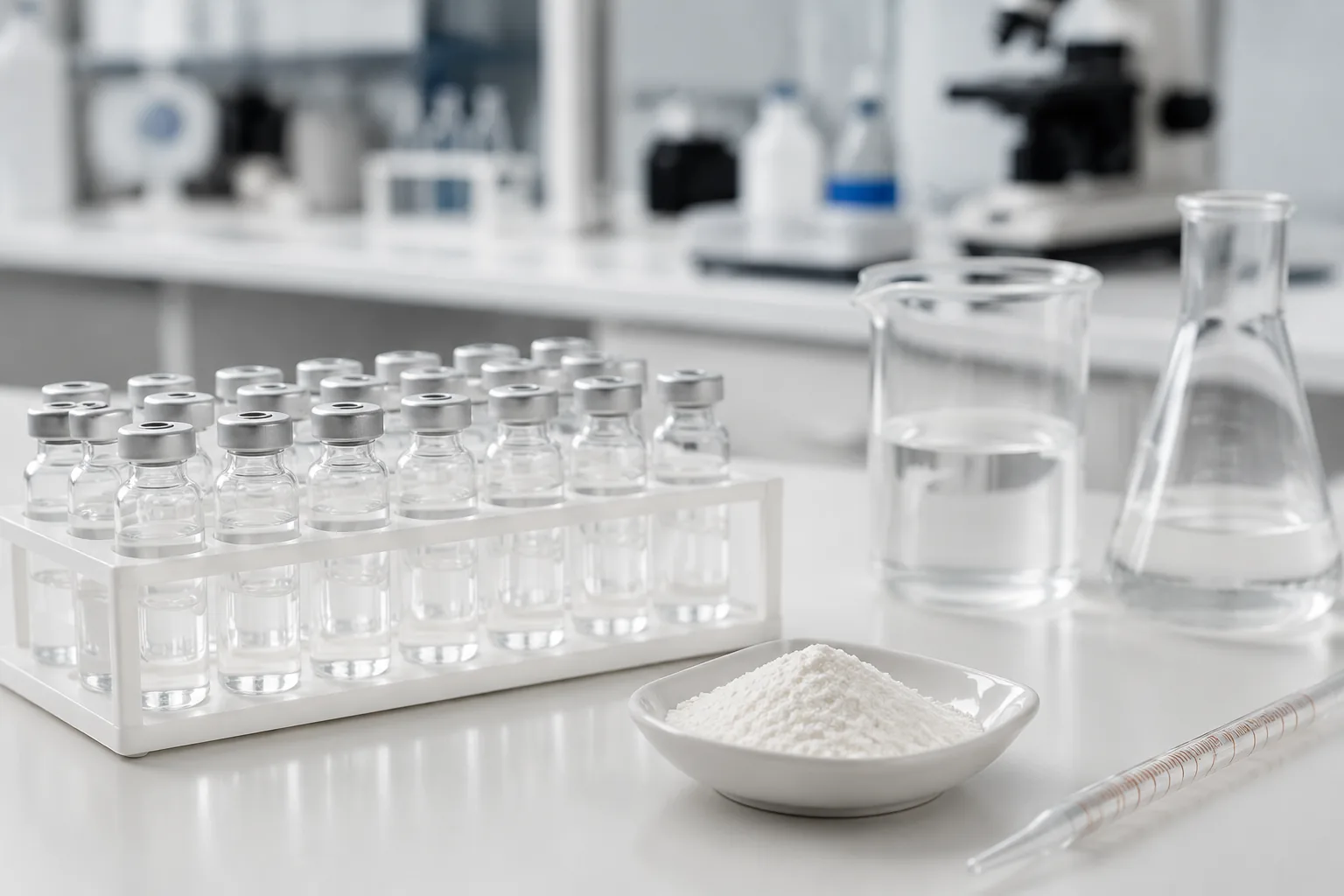
Lysine is the first limiting amino acid in cereal-based human diets and in swine/poultry feed. "Limiting" means it is present in the lowest quantity relative to the animal's requirement — the protein quality of wheat, rice, and corn is constrained not by their total protein but by their lysine deficiency. Supplementation with synthetic L-lysine (added as the hydrochloride salt to feed, or as a fortificant to food) directly raises the biological value of the protein. This is why lysine is the highest-volume amino acid produced industrially (millions of tonnes per year) and why its accurate measurement in both the food/feed matrix and the additive product is a critical compliance test.
The Matrix-Specific GB Framework
Lysine is governed by different standards depending on the product category:
| Matrix | Standard | Method |
|---|---|---|
| Food (including infant formula, nutritional products) | GB 5009.124-2016 — Determination of Amino Acids in Foods | Amino-acid analyzer (ion-exchange chromatography + ninhydrin post-column derivatization) |
| Feed (raw materials, compound, concentrate, premix) | GB/T 18246-2019 — Determination of Amino Acids in Feed | Four methods: acid hydrolysis, oxidative hydrolysis, alkaline hydrolysis (Trp), acid extraction (free amino acids) |
| Feed additive (L-lysine HCl product) | GB 34466-2017 — Feed Additive — L-Lysine Monohydrochloride | Product specification: purity, specific rotation, loss on drying, chloride, heavy metals |
A report must name the matrix and the applicable standard, because the sample preparation, the hydrolysis method, and the reporting basis differ.
The Hydrolysis-Then-Chromatography Principle
The defining analytical challenge of lysine testing — and one the search results do not explain — is that lysine in food and feed is almost entirely protein-bound, not free. To measure it, the peptide bonds must first be cleaved by hydrolysis, releasing the individual amino acids for chromatographic separation.
The standard acid hydrolysis:
- Sample preparation — the food/feed sample is homogenized.
- Acid hydrolysis — the sample is hydrolysed in 6 mol/L hydrochloric acid at 110 °C for 22–24 hours (conventional) or under microwave acceleration. This cleaves all peptide bonds, releasing lysine (and all other amino acids except tryptophan, which is destroyed by acid — Trp needs separate alkaline hydrolysis).
- Chromatographic separation — the hydrolysate is analyzed by ion-exchange chromatography (the amino-acid analyzer) with ninhydrin post-column derivatization — ninhydrin reacts with each amino acid after chromatographic separation, producing a coloured derivative detected at 570 nm (primary amines) and 440 nm (proline/imino acids). Lysine elutes at its characteristic retention time and is quantified against a calibration standard.
Total Lysine vs Free (Added) Lysine
A distinction that GB/T 18246 makes explicit and that matters for feed-additive compliance:
- Total lysine (acid hydrolysis) — measures all lysine, both the protein-bound native lysine and any added free lysine supplement. This is the nutritional-availability parameter.
- Free lysine (acid extraction, no hydrolysis) — measures only the lysine that is added as a supplement and is not protein-bound. Extracted with dilute acid without hydrolysis. This is the additive-content verification parameter for compound feed and premixes.
A feed-additive verification report measures free lysine (did the declared amount of supplement actually get added?); a nutritional-quality report measures total lysine (what is the actual nutritional value of this feed?).
The Feed-Additive Product: GB 34466-2017
GB 34466-2017 (Feed Additive — L-Lysine Monohydrochloride, 饲料添加剂 L-赖氨酸盐酸盐) is the product standard for the synthetic L-lysine HCl additive. It specifies the product specification:
- Content (purity) — L-lysine HCl content ≥ 98.5 %.
- Specific rotation — optical purity verification (the biologically active L-form).
- Loss on drying — moisture control.
- Chloride content — consistent with the HCl salt.
- Heavy metals / arsenic — purity from contamination.
A complete additive-product report cites GB 34466-2017 and verifies these specification parameters.
The Analytical Methods: Amino-Acid Analyzer vs HPLC
Two chromatographic platforms are used for lysine:
- Amino-acid analyzer (ion-exchange chromatography + ninhydrin) — the GB 5009.124 and GB/T 18246 reference method. Cation-exchange resin separates amino acids by charge and hydrophobicity, ninhydrin post-column derivatization produces coloured products detected at 570/440 nm. This is the dedicated-amino-acid platform; it resolves all 17 protein amino acids in a single run. It is the standard for nutritional labelling and feed-quality compliance.
- HPLC with pre-column derivatization (OPA/FMOC) — the alternative platform used in many labs. Amino acids are derivatized before injection (OPA for primary amines, FMOC for secondary), then separated by reversed-phase HPLC with fluorescence detection. Faster and more sensitive than the amino-acid analyzer but less standardized.
The amino-acid analyzer is the GB reference; HPLC-OPA/FMOC is the practical alternative.
The Infant-Formula and Special-Food Dimension
For infant formula (GB 10765/10767) and special-medical-purpose foods, lysine is a mandatory labelled nutrient — the product label must declare the lysine content per 100 g/serving, and the declared value must be verified by GB 5009.124. Because infant formula is often the sole nutrition source for infants, the lysine content must meet the minimum specified by the product standard, and a compliance test verifies both that the minimum is met and that the label declaration is accurate.
Our Testing Capabilities
Beijing ZKGX Research conducts lysine testing across the matrix-specific GB framework:
- Food (GB 5009.124-2016): total amino acids (including lysine) by amino-acid analyzer (ion-exchange + ninhydrin) after acid hydrolysis, for nutritional labelling and infant-formula compliance.
- Feed (GB/T 18246-2019): total lysine (acid hydrolysis) and free lysine (acid extraction, no hydrolysis) by amino-acid analyzer, for compound feed, concentrate, premix, and feed raw materials.
- Feed additive (GB 34466-2017): L-lysine HCl product specification — content (≥98.5 %), specific rotation, loss on drying, chloride, heavy metals/arsenic.
- Alternative method: HPLC with OPA/FMOC pre-column derivatization and fluorescence detection for faster screening.
- Sample types: infant formula, special-medical-purpose foods, cereals, dairy, compound feed, feed additives (L-lysine HCl), and premixes.
- Deliverable: a test report stating the matrix, the standard applied, the hydrolysis method (total vs free lysine), the measured value (g/100 g or %), and pass/fail against the applicable product specification or label declaration.
If you have a food, feed, or feed-additive sample requiring lysine verification, contact our testing team to scope the matrix, the applicable GB standard, and whether total or free lysine is the required measurement.
Frequently Asked Questions
What standard governns lysine testing?
It depends on the matrix. Food is under GB 5009.124-2016 (Determination of Amino Acids in Foods). Feed is under GB/T 18246-2019 (Determination of Amino Acids in Feed). The feed-additive product L-lysine HCl is under GB 34466-2017 (Feed Additive — L-Lysine Monohydrochloride). Each standard specifies a different sample preparation and reporting basis.
Why must lysine be hydrolysed befOre testing?
Because in food and feed, lysine is almost entirely protein-bound (part of the protein chain, not free). The peptide bonds must be cleaved by acid hydrolysis (6 mol/L HCl, 110 °C, 22–24 h) to release the individual amino acids for chromatographic measurement. This hydrolysis step is unique to amino-acid analysis — most other analytes (vitamins, minerals) are extracted directly without breaking the protein.
What is the difference between total lysine and free lysine?
Total lysine (acid hydrolysis) measures all lysine — both protein-bound native lysine and added free lysine supplement — and is the nutritional-availability parameter. Free lysine (acid extraction, no hydrolysis) measures only the added supplement not bound in protein, and is the feed-additive verification parameter (did the declared supplement actually get added?). GB/T 18246 provides both methods.
What method is used to measure lysine?
The GB reference method is the amino-acid analyzer (cation-exchange chromatography + ninhydrin post-column derivatization, detected at 570 nm for primary amines). Lysine elutes at its characteristic retention time and is quantified against a calibration standard. HPLC with OPA/FMOC pre-column derivatization and fluorescence detection is the practical alternative.
What is GB 34466-2017?
GB 34466-2017 (Feed Additive — L-Lysine Monohydrochloride) is the product standard for the synthetic L-lysine HCl additive. It specifies the product specification: content ≥ 98.5 %, specific rotation (optical purity), loss on drying, chloride content, and heavy-metals/arsenic purity limits. It is the compliance standard for the additive product itself, not for feed or food containing lysine.