Table of Contents
- What is pectin testing?
- The standard stack: FAO JECFA, USP FCC, EP, GB 25533, GB 2760
- Pectin identity: INS 440, the E 440(i)/(ii) split, and CAS 9000-69-5
- Galacturonic acid: the ≥ 65 % specification and its titrimetric determination
- Degree of esterification (DE) and the HM/LM split at 50 %
- Degree of amidation (DA): the E 440(ii) vs E 440(i) distinction
- Gel strength: SAG, Bloom, and the USDA method
- Purity tests: residual solvents, SO₂, heavy metals, ash, nitrogen
- Identification test: the pectate lyase UV method and the alcohol-precipitation test
- The spectrophotometric copper pectate alternative (Wang 2021)
- GB 2760 usage scope and the "GMP" allowance
- FAQ
- Our pectin testing capabilities
What is pectin testing?
Pectin testing is the measurement and validation of the identity, composition, purity, and functional performance of pectin — the high-molecular-weight polysaccharide of partially methyl-esterified polygalacturonic acid extracted from citrus peel or apple pomace — when used as a food additive (INS 440 / E 440), a gelling agent, thickener, stabiliser, and emulsifier in jams, jellies, dairy products, confectionery, and pharmaceutical preparations. The output of a pectin test is a dossier of results covering the galacturonic acid content (the compositional purity, ≥ 65 %), the degree of esterification (DE, which determines whether the pectin is High Methoxyl HM or Low Methoxyl LM), the degree of amidation (DA, which distinguishes E 440(i) from E 440(ii)), the gel strength (the functional performance), and the purity tests — residual solvents (methanol, ethanol, isopropanol ≤ 1 %), sulphur dioxide (≤ 50 mg/kg), lead (≤ 5 mg/kg), acid-insoluble ash (≤ 1 %), total insolubles (≤ 3 %), nitrogen (≤ 2.5 %), and loss on drying (≤ 12 %).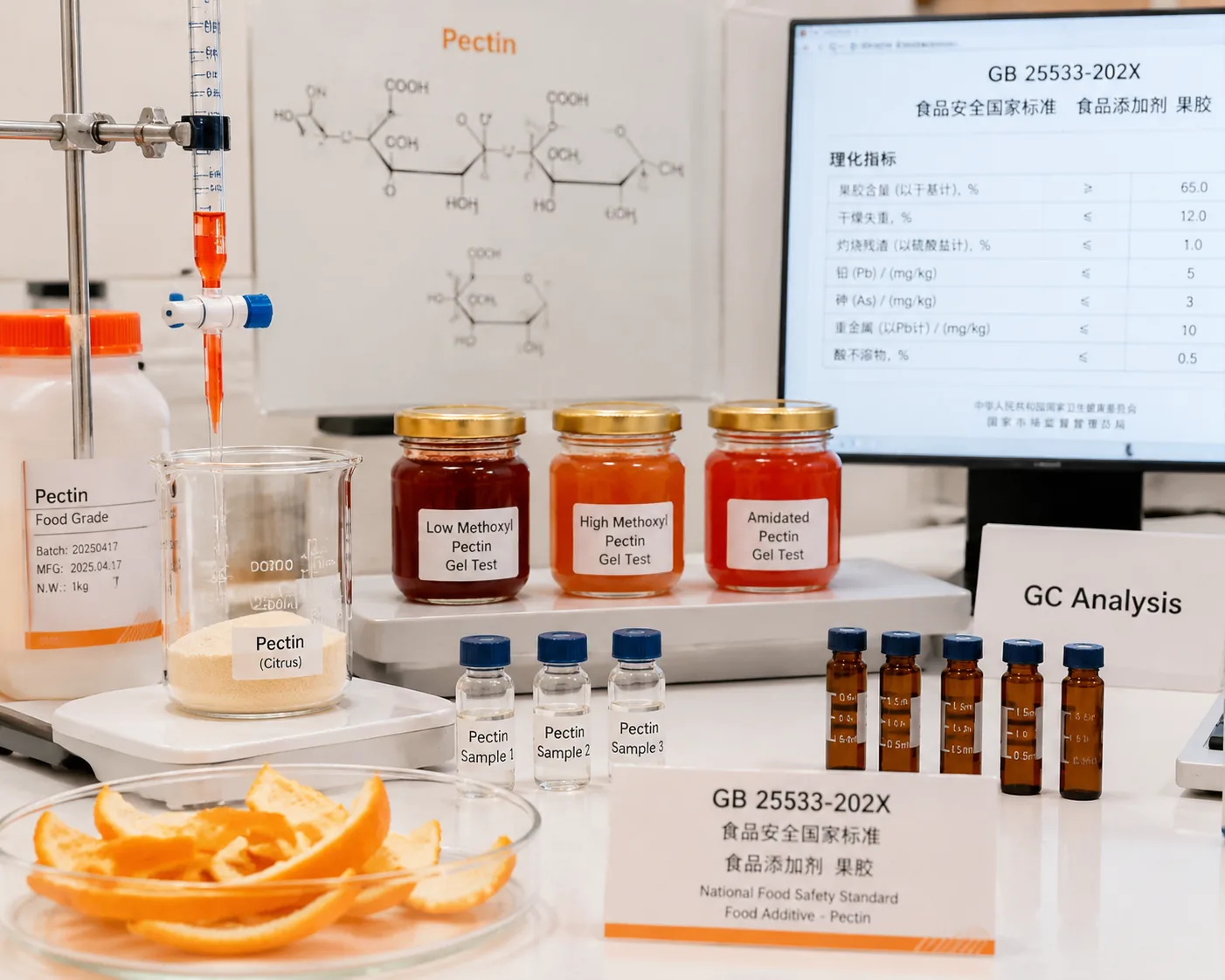
Pectin is the single most important gelling agent in the food industry, with a global market exceeding USD 1 billion and major producers (CP Kelco, Cargill, Herbstreith & Fox, Yantai Andre Pectin, Naturex) supplying the jam, dairy, beverage, and confectionery sectors. The standards governing pectin testing span the FAO JECFA Pectins monograph (the international reference specification, prepared at the 68th JECFA in 2007), the USP Food Chemicals Codex (FCC) Pectins monograph, the European Pharmacopoeia Pectin monograph, the ISO standards for galacturonic acid and degree of esterification, and the Chinese GB 25533-2010 National food safety Standard for Food Additive — Pectin (with its revision under public consultation as of 2025). A pectin product placed on the Chinese market must satisfy GB 25533-2010 (or its 2025 revision when adopted), with its usage scope and limits further regulated by GB 2760 National Food Safety Standard for the Use of Food Additives; on the US market, the FCC monograph; on the EU market, the E 440 specification under Regulation (EU) No 231/2012.
The standard stack: FAO JECFA, USP FCC, EP, GB 25533, GB 2760
A complete pectin testing project draws on a stack of international, US, EU, and Chinese standards.
| Family | Standard | Scope |
|---|---|---|
| FAO JECFA Pectins (2007, 68th JECFA) | INS 440 monograph | The international reference specification — galacturonic acid, DE, DA, residual solvents, SO₂, Pb, ash, nitrogen, LOD; group ADI "not specified" since 1981 |
| USP FCC Pectins (Food Chemicals Codex) | US food-chemical specification | US equivalent of the JECFA monograph; used by FDA as the food-additive specification reference |
| EP Pectin monograph | European Pharmacopoeia | Pharmaceutical-grade pectin (oral and topical) |
| GB 25533-2010 | National Food Safety Standard — Food Additive — Pectin | Chinese national standard for food-additive pectin; revising (2025 draft adds As requirement, updated methods) |
| GB 2760-2024 | National Food Safety Standard — Use of Food Additives | Chinese usage scope — pectin permitted in most food categories at GMP ("按生产需要适量使用") |
| ISO 18482 | Pectins — Determination of molecular weight | Size-exclusion chromatography method |
| ISO 1709 | (older reference) Pectin — general methods | Used for historical comparison |
| ICH Q3D | Elemental impurities | Heavy-metal leaching from pectin into drug product (for pharmaceutical use) |
The single most consequential fact for a Chinese manufacturer is that GB 25533-2010 is the NMPA/SAMR-mandated specification for food-additive pectin, and the 2025 revision under public consultation will tighten the requirements (adding arsenic, updating the galacturonic acid and residual-solvent methods). A pectin product placed on the Chinese market must satisfy GB 25533-2010, and its usage is regulated by GB 2760 (generally "按生产需要适量使用" — GMP, no specific numerical limit in most food categories).
Pectin identity: INS 440, the E 440(i)/(ii) split, and CAS 9000-69-5
Pectin is identified internationally by three coordinated reference numbers:
| Identifier | Value | What it specifies |
|---|---|---|
| INS / E number | 440 | The international numbering system for food additives; pectin |
| E 440(i) | Non-amidated pectin | The standard citrus or apple pectin, with the methyl ester intact |
| E 440(ii) | Amidated pectin | A sub-type in which a portion of the methyl esters has been converted to primary amides by treatment with ammonia under alkaline conditions |
| CAS number | 9000-69-5 | The Chemical Abstracts Service identifier for pectin |
The E 440(i) / E 440(ii) split is the most important regulatory distinction in pectin chemistry. Amidated pectin (E 440(ii)) gels at lower sugar and calcium concentrations than non-amidated pectin, and is preferred for low-sugar jams and for dairy stabilisation; the degree of amidation (DA) is regulated to ≤ 25 % of total carboxyl groups per the FAO JECFA monograph. The two sub-types share the CAS number 9000-69-5 and the INS 440 designation; the regulatory distinction is functional (gel behaviour) and structural (amide content), not compositional.
Galacturonic acid: the ≥ 65 % specification and its titrimetric determination
The single most important compositional specification for pectin is the galacturonic acid content — the fraction of the polysaccharide that is the galacturonic acid monomer (with methyl-ester and amide substitutions). The galacturonic acid content is the compositional purity of the pectin, and the FAO JECFA / FCC / GB 25533 specification sets a floor of ≥ 65 %, calculated on the ash-free and dried basis.
The determination is titrimetric (the classical method, FAO JECFA / GB 25533):
- Wash the pectin with HCl-60 % ethanol to remove free acids and sugars; dry and weigh.
- Dissolve the washed pectin in water; titrate with 0.1 mol/L NaOH to the phenolphthalein endpoint (initial titre V₁ — the free carboxyl groups).
- Saponify the methyl esters with 0.5 mol/L NaOH for 15 min; back-titrate with 0.1 mol/L NaOH (saponification titre V₂ — the esterified carboxyl groups).
- (Amidated pectin) Distil the amide under alkaline conditions into a receiving flask; titrate (amide titre, B − S).
- (Acetyl ester) Distil the acetyl with Clark's solution; titrate (acetyl titre, A − A₀).
- Calculate the galacturonic acid: mg GA = 19.41 × [V₁ + V₂ + (B − S) − (A − A₀)].
The galacturonic acid result is reported as a mass fraction on the ash-free, dried basis; a pectin with galacturonic acid < 65 % fails the specification and may not be sold as food-additive pectin.
Degree of esterification (DE) and the HM/LM split at 50 %
The degree of esterification (DE) is the fraction of the galacturonic-acid carboxyl groups that carry a methyl ester, expressed as a percentage of total carboxyl groups. DE is calculated from the same titration that gives the galacturonic acid:
DE = 100 × V₂ / [V₁ + V₂ + (B − S) − (A − A₀)]
DE is the single most important functional parameter of pectin, because it determines the gelling mechanism:
| Pectin type | DE range | Gelling mechanism | Typical application |
|---|---|---|---|
| High Methoxyl (HM) | DE > 50 % | Gels with high sugar (> 55 % soluble solids) and low pH (< 3.5) | Traditional jams, jellies, marmalades, fruit confectionery |
| Low Methoxyl (LM) | DE < 50 % | Gels with calcium (cross-linking the carboxylate groups), low sugar, broad pH range | Low-sugar jams, dairy desserts, heat-reversible gels |
| Amidated LM (E 440(ii)) | DE < 50 %, DA ≤ 25 % | Gels with calcium at lower calcium concentrations; more tolerant of variable conditions | Low-sugar jams, stabilised dairy, cold-set gels |
The HM / LM split at DE = 50 % is the operational classification used by every food manufacturer selecting a pectin for a given application. A pectin's DE is therefore reported on every commercial product data sheet (typically as DE 60-75 % for a slow-set HM citrus pectin; DE 30-35 % for an LM citrus pectin; DA 18-22 % for an amidated LM pectin).
Degree of amidation (DA): the E 440(ii) vs E 440(i) distinction
The degree of amidation (DA) is the fraction of the galacturonic-acid carboxyl groups that has been converted from methyl ester to primary amide by treatment with ammonia. DA is calculated from the amide titre (B − S) in the same titration that gives the galacturonic acid and DE:
DA = 100 × (B − S) / [V₁ + V₂ + (B − S) − (A − A₀)]
The FAO JECFA / FCC / GB 25533 specification caps the DA at ≤ 25 % of total carboxyl groups. A pectin with DA = 0 is E 440(i); a pectin with DA > 0 (and DE < 50 %) is E 440(ii). The DA controls the calcium sensitivity and the gel-formation behaviour of the pectin: a higher DA gives a slower, more-tolerant calcium set, which is why amidated LM pectin is preferred for low-sugar jams and for dairy stabilisation where the calcium concentration is variable.
Gel strength: SAG, the USDA method, and the internal-reference method
The functional test that ties the compositional parameters (DE, DA, galacturonic acid) to the commercial value of the pectin is the gel strength, measured in a standardised jam or jelly formulation. The gel strength is the single most-quoted commercial specification after the DE.
| Method | Standard | Formulation | Result |
|---|---|---|---|
| SAG (Sagging) method | IFTP / USDA | A standard 65 % soluble-solids jam at pH 2.4-2.5; the gel is allowed to set in a glass; the gel is demoulded and the percentage sag (deformation) after 2 min is measured | Grade = 100 × (1 − sag) × (sucrose / pectin ratio); commercial pectin grades 100-300 |
| Bloom method | (Adapted from gelatin) | A gel in a standard jar; a Bloom plunger penetrates the gel and the force is measured | Bloom strength (g), more common in pharmaceutical-grade pectin |
| Texture-analyser TPA | Internal method | Same SAG formulation; the gel's modulus and yield stress measured on a texture analyser (Stable Micro Systems TA.XT, or equivalent) | Used for rapid internal QC; needs cross-reference to SAG |
The USDA SAG method is the historical commercial standard, still used by the major producers for grade declaration; the grade is the sucrose-to-pectin ratio at which the pectin gives a standardised gel (65 % soluble solids, pH 2.4) with 23.5 % sag (a "jelly grade 100" is a pectin that gives the standard gel at 100 parts sucrose to 1 part pectin). The gel strength measurement requires a controlled test environment (water bath at 25 °C, controlled-solids jam formulation, controlled-pH buffer) and is the most operator-sensitive of the pectin tests; a laboratory serving commercial pectin QC must be able to reproduce the USDA method.
Purity tests: residual solvents, SO₂, heavy metals, ash, nitrogen
The FAO JECFA / FCC / GB 25533 purity tests cap the contaminants that arise from the pectin extraction process (which uses methanol, ethanol, or isopropanol as the precipitating solvent) and from the raw material (citrus peel may carry SO₂ from pre-treatment, heavy metals from soil, nitrogen from protein residue).
| Test | Limit (FAO JECFA / GB 25533) | Method |
|---|---|---|
| Loss on drying | ≤ 12 % (105 °C, 2 h) | Gravimetric |
| Sulphur dioxide | ≤ 50 mg/kg | Reflux in methanol-HCl; the released SO₂ is distilled into H₂O₂ and titrated with 0.01 mol/L NaOH |
| Residual solvents | ≤ 1 % total of methanol, ethanol, and isopropanol (singly or in combination) | Headspace GC with 2-butanol internal standard; sample heated at 70 °C, syringe at 80 °C |
| Acid-insoluble ash | ≤ 1 % | Ash at 800 °C; dissolve in HCl; filter; weigh residue |
| Total insolubles | ≤ 3 % | Dissolve in NaOH-EDTA at 100 °C; filter through glass-fibre; weigh residue |
| Nitrogen | ≤ 2.5 % after washing with acid and ethanol | Kjeldahl (the protein-bound nitrogen that survives the extraction) |
| Lead | ≤ 5 mg/kg | AAS or ICP-AES/ICP-MS |
| Arsenic (GB 25533-2025 draft) | Per Chinese revision | ICP-MS |
| Degree of amidation | ≤ 25 % | Titration as above |
The residual-solvent test (headspace GC) is the most commonly failed purity test for pectin: a pectin that has been insufficiently dried after the alcohol precipitation will report > 1 % total methanol/ethanol/isopropanol, failing the specification. The SO₂ test is critical for citrus pectin, where the raw peel may have been treated with sulphite as a preservative.
Identification test: the pectate lyase UV method and the alcohol-precipitation test
Two identification tests are used to confirm that the sample is pectin (and not another gum or polysaccharide):
Pectate lyase UV method (FAO JECFA / GB 25533) — Dissolve the sample at pH 12 (NaOH) to de-esterify, then re-adjust to pH 7.0. Add pectate lyase, which cleaves the α-1,4-galacturonan backbone by β-elimination, producing a 4,5-unsaturated product that absorbs at 235 nm. Measure the absorbance at 0 and 10 min; the change (A₁₀ − A₀) should be > 0.023. Other gums show essentially no change, which is what distinguishes pectin from them.
Alcohol-precipitation test (qualitative, used in wine and fruit-juice labs) — Filter the sample, mix with acidified 95 % ethanol at pH 3; if pectin is present, a whitish precipitate or floating flocculent mass forms within 10 min. The test is qualitative and is used in wine-making (Enartis, Laffort protocols) to verify that the pectinase enzyme has finished de-pectinising the must before clarification or filtration.
The spectrophotometric copper pectate alternative (Wang 2021)
A more recent alternative to the classical titrimetric galacturonic acid method is the spectrophotometric copper pectate method (Wang et al., Polymers 2021, 13, 2847), which offers improved repeatability and accuracy for high-throughput laboratories. In this method:
- React the pectin solution with a copper salt; the copper displaces the sodium/potassium counter-ions and forms insoluble copper pectate.
- Centrifuge to remove the copper pectate.
- Measure the residual copper in the supernatant by UV-Vis spectrophotometry (with a colour reagent), and back-calculate the copper that has bound to the pectin.
- Convert the bound copper to galacturonic acid by stoichiometry.
The method's reported relative standard deviation is 2.09 % across commercial and plant-extracted pectins, comparable to the classical titrimetric method, with the advantage that it eliminates the weighing step and the associated error. The method has not yet been incorporated into the FAO JECFA or GB 25533 monograph but is increasingly cited in academic and industrial literature as a rapid QC alternative.
GB 2760 usage scope and the "GMP" allowance
In China, the use of pectin as a food additive is regulated by GB 2760 National Food Safety Standard for the Use of Food Additives. Pectin is permitted in a wide range of food categories, with the majority of the categories set to "按生产需要适量使用" (GMP — Good Manufacturing Practice, use as needed) rather than a specific numerical limit:
| Food category (representative) | GB 2760 limit |
|---|---|
| Fermented milk (01.02.01) | GMP |
| Cream and whipping cream (01.04) | GMP |
| Fruit jams, jellies, marmalades (04.01.02.05) | GMP |
| Confectionery (05.02) | GMP |
| Bakery (07.0) | GMP |
| Sauces and dressings (12.0) | GMP |
| Fruit and vegetable juices (14.02.01) | GMP |
| Infant formula (13.01) | Specific limit per the infant-formula standard |
The "GMP" allowance means that pectin may be used at the level needed to achieve the desired gelling, thickening, or stabilising effect, with the upper bound set by the principle that the additive should not be used to deceive the consumer or to mask inferior ingredients. For infant formula, pectin is permitted with specific numerical limits set by the separate infant-formula standard.
FAQ
What is the difference between E 440(i) and E 440(ii)?
E 440(i) is non-amidated pectin (the methyl ester intact); E 440(ii) is amidated pectin (a portion of the methyl esters converted to amides, DA ≤ 25 %). Amidated pectin gels with calcium at lower concentrations and is preferred for low-sugar jams and dairy stabilisation.
What is the galacturonic acid specification, and why does it matter?
The galacturonic acid content must be ≥ 65 % on the ash-free, dried basis per FAO JECFA / FCC / GB 25533. Galacturonic acid is the compositional purity of the pectin — the fraction of the polysaccharide that is the galacturonic acid monomer. A pectin with galacturonic acid < 65 % is either not pure pectin or has been over-diluted with standardising sugars.
What is the DE = 50 % threshold?
The Degree of Esterification (DE) splits pectin into High Methoxyl (HM, DE > 50 %) which gels with high sugar and low pH, and Low Methoxyl (LM, DE < 50 %) which gels with calcium. The 50 % DE threshold is the operational classification used by every food manufacturer to select a pectin for a given application.
What residual solvents are limited in pectin, and why?
Methanol, ethanol, and isopropanol are the precipitating solvents used in the commercial pectin extraction; the specification caps the total residual solvent at ≤ 1 %. Headspace GC with 2-butanol internal standard is the method. The limit ensures that the solvent residues from the extraction are sufficiently removed by the downstream drying.
Does GB 25533-2010 differ from the FAO JECFA Pectins monograph?
GB 25533-2010 is broadly harmonised with the FAO JECFA monograph on galacturonic acid, DE, DA, residual solvents, SO₂, Pb, ash, and nitrogen. The 2025 revision under public consultation adds an arsenic requirement (with ICP-MS method) and updates the galacturonic acid and residual-solvent methods, bringing the Chinese standard closer to the current international practice.
Our pectin testing capabilities
Beijing ZKGX Research (ISO/IEC 17025 accredited, CMA- and CNAS-accredited testing laboratory) provides complete pectin testing against the FAO JECFA, USP FCC, EP, and Chinese GB 25533 / GB 2760 standard stack:
- GB 25533-2010 food-additive pectin — full conformance: galacturonic acid ≥ 65 %, DE, DA ≤ 25 %, loss on drying ≤ 12 %, SO₂ ≤ 50 mg/kg, residual solvents ≤ 1 %, acid-insoluble ash ≤ 1 %, total insolubles ≤ 3 %, nitrogen ≤ 2.5 %, lead ≤ 5 mg/kg.
- FAO JECFA Pectins (68th JECFA, 2007) — full specification; identification by pectate lyase UV (ΔA₂₃₅ > 0.023); purity battery; group ADI "not specified".
- USP Food Chemicals Codex (FCC) Pectins — US food-chemicals-codex monograph for FDA-market conformity.
- EP Pectin monograph — pharmaceutical-grade pectin for oral and topical formulations.
- Galacturonic acid titration — the classical wash/saponify/back-titrate method (V₁, V₂, B−S, A−A₀).
- Degree of esterification (DE) and degree of amidation (DA) — from the same titration; HM (DE > 50 %) / LM (DE < 50 %) classification; E 440(i) vs E 440(ii) declaration.
- Gel strength — USDA SAG method (65 % soluble solids, pH 2.4, % sag, grade) and texture-analyser TPA; commercial grade 100-300.
- Residual solvents — headspace GC with 2-butanol internal standard; methanol, ethanol, isopropanol individually and total ≤ 1 %.
- Sulphur dioxide — reflux / distillation into H₂O₂ / titration with 0.01 mol/L NaOH; ≤ 50 mg/kg.
- Heavy metals — Pb by AAS or ICP-MS (≤ 5 mg/kg); As per GB 25533-2025 draft by ICP-MS.
- Identification — pectate lyase UV method; qualitative alcohol-precipitation test for wine and fruit-juice applications.
- GB 2760 usage-scope verification — confirmation that the intended food-category usage is permitted and the level is within the GB 2760 allowance (GMP for most categories; specific limit for infant formula).
Suitable sample matrices include: commercial pectin powder (citrus, apple, sugar-beet); amidated pectin (E 440(ii)); pectin-standardised blends with sucrose, glucose, or buffer salts; pectin in fruit jams, jellies, marmalades; pectin in dairy desserts and fermented milk; pectin in confectionery and bakery; pectin in fruit juices and beverages; pectin in pharmaceutical oral and topical formulations. Each project is delivered with a full data report (test protocol, instrument calibration, raw titration and GC data, statistical analysis, identification-test evidence, classification conclusion per the applicable standard) in English and/or Chinese, with CMA/CNAS stamping. Contact Beijing ZKGX Research to scope the pectin test battery applicable to your product and target market.