What is Plastic Film Testing?
Plastic film testing is the systematic evaluation of physical, mechanical, optical, and thermal properties of plastic films to ensure they meet specific performance standards for their intended applications. These tests measure critical characteristics including tensile strength, tear resistance, barrier properties, optical clarity, and thermal stability under controlled conditions.
The testing process follows established international standards such as ASTM (American Society for Testing and Materials) and ISO (International Organization for Standardization), which provide standardized methodologies for consistent and accurate results. Quality control through comprehensive film testing ensures that plastic films perform reliably across diverse industries including food packaging, medical devices, agricultural applications, and industrial manufacturing.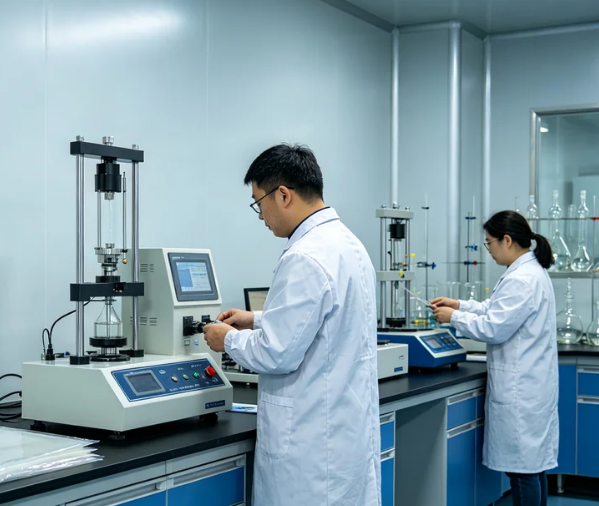
Why Plastic Film Testing Matters
Plastic film testing serves as a critical quality assurance mechanism that directly impacts product safety, regulatory compliance, and manufacturing efficiency. Without rigorous testing protocols, films may fail during use, leading to product loss, safety hazards, and costly recalls.
Testing enables manufacturers to:
Ensure Product Safety: Films used in medical and food packaging must meet strict biocompatibility and migration standards to prevent contamination and health risks.
Maintain Consistency: Systematic testing identifies variations in film properties during production, allowing for immediate corrections before materials reach the market.
Meet Regulatory Requirements: Industries such as pharmaceuticals and food packaging operate under strict regulatory frameworks that mandate specific testing protocols and performance thresholds.
Optimize Material Performance: Testing data guides material selection and formulation improvements, helping manufacturers develop films with enhanced durability, barrier properties, or sustainability features.
Reduce Costs: Early detection of quality issues prevents expensive downstream problems, including product returns, customer complaints, and brand damage.
Key Mechanical Properties Tested in Plastic Films
Tensile Strength Testing
Tensile strength testing measures a film's ability to withstand stretching forces without breaking. This fundamental test evaluates the maximum force a film can endure before failure, along with its elongation characteristics and elastic modulus.
Testing Standard: ASTM D882 and ISO 527-3
Methodology: A film specimen is clamped in a universal testing machine and elongated at a constant rate. The equipment records force and elongation data until the specimen breaks, providing measurements of tensile strength (maximum stress), elongation at break (percentage of stretch), and elastic modulus (stiffness).
Applications: Tensile data determines whether films can withstand mechanical stresses during packaging operations, transportation, and end-use scenarios. High tensile strength is essential for heavy-duty packaging and industrial applications where films experience significant pulling forces.
Tear Resistance Testing
Tear resistance measures the force required to propagate an existing tear through the film material. This property directly affects a film's durability during handling and its ability to maintain integrity when damaged.
Testing Standards:
-
ASTM D1004 (Graves tear test) - measures tear initiation resistance
-
ASTM D1922 (Elmendorf tear test) - measures tear propagation resistance
-
ISO 6383 Part 2 - standardized tear resistance methodology
Methodology: The Elmendorf test uses a pendulum mechanism where a notched specimen is mounted between two grips. When released, the pendulum tears through the specimen, and the force required to propagate the tear is measured.
Key Considerations: Tear resistance often differs between machine direction (MD) and transverse direction (TD) due to molecular orientation during film production. Testing both directions provides complete performance characterization.
Puncture and Impact Resistance Testing
These tests evaluate a film's ability to withstand penetration by sharp objects and sudden impact forces, critical for protective packaging applications.
Testing Standards:
-
ASTM D1709 - Impact resistance by free-falling dart method
-
ASTM F1306 - Slow rate penetration test
-
ISO 7765-2 - Free-falling dart method
Free-Falling Dart Test Methodology: A hemispherical dart of specified weight is dropped onto a clamped film specimen. The staircase method determines the impact failure mass by systematically adjusting the dart weight based on whether the previous test resulted in failure or non-failure.
Applications: Puncture resistance testing is essential for films used in packaging products with sharp edges, heavy items, or applications requiring protection during transport and storage.
Friction and Blocking Testing
Friction testing evaluates how plastic films interact with themselves and other surfaces during handling, processing, and use.
Testing Standards:
-
ASTM D1894 - Coefficient of friction
-
ISO 8295 - Friction coefficients determination
-
ISO 11502 - Blocking resistance
Coefficient of Friction (COF): Measures both static friction (force required to initiate movement) and kinetic friction (force required to maintain movement). Low COF values facilitate smooth film feeding in automated packaging equipment.
Blocking Resistance: Evaluates the tendency of film layers to adhere to each other under pressure, which can cause processing difficulties and material waste.
Barrier Properties Testing
Barrier testing measures a plastic film's ability to prevent transmission of gases, moisture, and other substances. These properties are critical for maintaining product freshness, extending shelf life, and protecting sensitive contents.
Oxygen Transmission Rate (OTR)
Testing Standard: ASTM D3985, ISO 15105-2
Methodology: The test measures the volume of oxygen that passes through a film specimen per unit area per unit time under controlled temperature and humidity conditions. Coulometric sensors detect oxygen molecules that permeate through the film.
Applications: OTR testing is essential for food packaging where oxygen exposure causes spoilage, pharmaceutical packaging requiring controlled atmospheres, and electronic components sensitive to oxidation.
Water Vapor Transmission Rate (WVTR)
Testing Standards: ASTM F1249, ASTM E96, ISO 15106-2
Methodology: Modulated infrared sensors detect water vapor molecules that permeate through the film specimen. The test reports transmission rates in grams per square meter per day (g/m²/day).
Applications: WVTR determines a film's moisture barrier effectiveness for products requiring dry conditions, including pharmaceuticals, dried foods, and moisture-sensitive electronics.
Importance of Barrier Properties
Barrier performance directly correlates with:
Shelf Life Extension: Lower transmission rates maintain product quality over extended periods, reducing waste and improving distribution efficiency.
Product Protection: Effective barriers prevent contamination, oxidation, and moisture damage that compromise product integrity.
Regulatory Compliance: Many food and pharmaceutical applications have specific barrier requirements mandated by regulatory agencies.
Optical Properties Testing
Optical properties determine a film's visual characteristics, affecting both aesthetic appeal and functional performance in applications requiring visibility or light control.
Haze and Clarity Testing
Testing Standard: ASTM D1003
Methodology: Haze meters measure the percentage of transmitted light that scatters when passing through the film. High haze values indicate reduced clarity, while low values indicate clear, transparent films.
Applications: Clear films allow consumers to view packaged products, while specific haze levels can provide privacy or diffuse light in architectural applications.
Gloss Measurement
Testing Standard: ASTM D2457
Methodology: Gloss meters measure the amount of light reflected from the film surface at specific angles (typically 20°, 60°, and 85°). Higher gloss values indicate shinier surfaces.
Applications: Gloss affects visual appeal and perceived quality. High-gloss films are preferred for premium packaging, while matte finishes serve applications requiring reduced glare.
Color Measurement
Methodology: Spectrophotometers measure color in the CIE Lab* color space, providing quantitative values for lightness (L*), red-green axis (a*), and blue-yellow axis (b*).
Applications: Color consistency is critical for brand identity and quality perception. Testing ensures batch-to-batch uniformity and compliance with color specifications.
Thermal Properties and Heat seal testing
Heat Seal Strength
Testing Standard: ASTM F88
Methodology: The test measures the force required to peel apart a heat-sealed joint. Specimens are sealed under controlled conditions of temperature, pressure, and dwell time, then tested to determine seal integrity.
Applications: Heat seal strength determines whether packaging can maintain hermetic seals during storage, transport, and handling. Insufficient seal strength leads to product contamination and package failure.
Hot Tack Strength
Testing Standard: ASTM F1921
Methodology: Hot tack measures seal strength immediately after formation, before the seal cools to room temperature. This property is critical for vertical form-fill-seal packaging operations where product weight stresses the seal while still hot.
Applications: High hot tack strength allows faster packaging line speeds and prevents seal failure when heavy products are dropped into bags immediately after sealing.
Shrinkage and Dimensional Stability
Testing Standard: ISO 11501
Methodology: Films are heated under controlled conditions, and dimensional changes are measured. Shrinkage tension can also be determined by measuring the force generated when the film shrinks while constrained.
Applications: Shrink films require specific shrinkage properties for proper package conformation. Conversely, dimensional stability is essential for applications where films must maintain precise dimensions during temperature variations.
Thickness Measurement
Accurate thickness measurement is fundamental to film quality control, affecting mechanical properties, barrier performance, and material cost.
Testing Standards
ASTM D6988: Guide for determining thickness of plastic film test specimens
ISO 4593: Plastics film and sheeting - determination of thickness
Measurement Considerations
Pressure Foot Specifications: For thin films (≤ 0.025 mm), maximum pressure of 70 kPa (10 psi) is recommended. For stiffer films, pressure ranges of 160-185 kPa (23-27 psi) are appropriate.
Foot Diameter: Standards recommend diameters between 3.2-12.7 mm for plastic films. Larger diameters can be difficult to calibrate and maintain cleanliness.
Measurement Points: Multiple measurements across the film width and length identify thickness variations that could affect performance.
Importance of Thickness Uniformity
Consistent Performance: Thickness variations create weak points that fail under stress or provide inadequate barrier protection.
Material Efficiency: Uniform thickness optimizes material usage, reducing waste while maintaining required performance levels.
Processing Reliability: Consistent thickness ensures reliable performance in automated packaging equipment and sealing operations.
Advanced Testing Methods
Fourier-Transform Infrared Spectroscopy (FTIR)
Application: FTIR analyzes the molecular composition of plastic films, identifying polymer types and additives. This technique detects contaminants, verifies material composition, and ensures compliance with specifications.
Differential Scanning Calorimetry (DSC)
Application: DSC measures thermal transitions including melting points, crystallization temperatures, and glass transition temperatures. This data informs processing parameters and predicts thermal performance in applications.
Surface Energy Testing
Application: Contact angle measurements determine surface energy, affecting printability, coating adhesion, and bonding performance. Surface treatments such as corona or plasma discharge modify surface energy for improved functionality.
Dynamic Mechanical Analysis (DMA)
Application: DMA evaluates mechanical behavior across temperature and frequency ranges, providing insights into viscoelastic properties and temperature-dependent performance characteristics.
Testing for Recycled and Sustainable Films
Quality Control for Recycled Materials
Testing films made from recycled materials requires comprehensive evaluation to ensure performance equivalence with virgin materials.
Key Testing Parameters:
-
Gel count and defect analysis for material purity
-
Mechanical property comparison with virgin material baselines
-
Migration testing for food contact applications
-
Non-Intentionally Added Substances (NIAS) studies
Sustainability Focus: Increasing demand for biodegradable, compostable, and recyclable films drives testing innovations to validate environmental claims while maintaining performance standards.
Industry-Specific Testing Requirements
Food Packaging Industry
Critical Tests: OTR, WVTR, seal strength, migration testing, food contact compliance
Standards: FDA regulations, EU food contact materials directives, global food safety standards
Applications: Barrier films for fresh produce, vacuum packaging for meats, modified atmosphere packaging for extended shelf life
Medical Device Industry
Critical Tests: Biocompatibility (ISO 10993), sterility maintenance, barrier properties, extractables and leachables
Standards: USP standards, ISO 11607 for sterile barrier systems
Applications: Sterile packaging, medical device pouches, pharmaceutical blister packs
Industrial Applications
Critical Tests: Tear resistance, puncture resistance, UV stability, chemical resistance
Applications: Construction films, agricultural films, protective coverings, industrial packaging
Automotive Industry
Critical Tests: Thermal stability, chemical resistance, durability testing
Applications: Protective films for components, interior trim films, paint protection films
Selecting the Right Testing Protocol
Factors to Consider
Application Requirements: Match testing parameters to end-use conditions and performance expectations.
Regulatory Compliance: Identify applicable standards and regulations for the target industry and market.
Material Type: Consider polymer type, thickness, and construction (single-layer, multi-layer, coated).
Processing Conditions: Evaluate how manufacturing processes affect film properties and select relevant tests.
Quality Objectives: Determine acceptable performance thresholds and testing frequency for production control.
Testing Service Capabilities
When selecting testing laboratories, evaluate:
-
Accreditation and certification status
-
Range of testing capabilities and equipment
-
Experience with specific material types and applications
-
Turnaround time and reporting quality
-
Ability to provide interpretation and recommendations
Benefits of Comprehensive Testing Programs
Quality Assurance
Systematic testing programs ensure consistent product quality, reducing defect rates and customer complaints.
Process Optimization
Testing data identifies opportunities to improve manufacturing efficiency, reduce material usage, and enhance product performance.
Innovation Support
Advanced testing methods enable development of new materials with enhanced properties, supporting product differentiation and market expansion.
Risk Mitigation
Thorough testing prevents quality failures that result in product recalls, liability issues, and brand damage.
Cost Reduction
Early detection of quality issues and optimization of material formulations reduce production costs and waste.
Future Trends in Plastic Film Testing
Automation and Digital Integration
Advanced testing systems incorporate automated specimen handling, digital data acquisition, and real-time monitoring for improved efficiency and accuracy.
Artificial Intelligence Applications
Machine learning algorithms analyze testing data to predict performance, identify anomalies, and optimize processing parameters.
Sustainability Testing
Growing emphasis on circular economy principles drives development of testing methods for recycled content validation, biodegradability assessment, and environmental impact measurement.
Multi-Property Testing Systems
Integrated testing platforms enable simultaneous measurement of multiple properties, reducing testing time while maintaining accuracy.
Comprehensive plastic film testing ensures product quality, regulatory compliance, and optimal performance across diverse applications. Partnering with accredited testing laboratories and implementing systematic testing protocols enables manufacturers to deliver reliable, high-quality film products that meet demanding industry requirements.