What Are Fire-Resistant Expansion Seals and Why Testing Matters {#what-are-fire-resistant-expansion-seals}
Fire-resistant expansion seals are specially designed systems installed in building expansion joints—gaps between walls, floors, and ceilings that accommodate thermal expansion, wind sway, and seismic movement—to prevent the spread of fire and hot gases between building compartments. When an expansion joint occurs in a fire-rated floor or wall, the seal system filling that joint must maintain the same fire resistance rating as the surrounding assembly.
A 2-hour rated floor assembly with an expansion joint requires a seal system also rated for 2 hours. Without properly tested fire-resistant expansion seals, a building's passive fire protection system has a built-in weakness: flames, toxic gases, and heat travel through unprotected joints, bypassing fire-rated barriers entirely. In high-rise buildings, hospitals, schools, and industrial facilities, a single seal failure can lead to loss of life, catastrophic property damage, and business interruption.
Testing validates that fire-resistant expansion seals perform under controlled furnace conditions that simulate real fire events. Accredited agencies—UL (Underwriters Laboratories), Intertek Warnock-Hersey, and European notified bodies—conduct these tests to confirm that the seal system maintains integrity and insulation for the rated duration.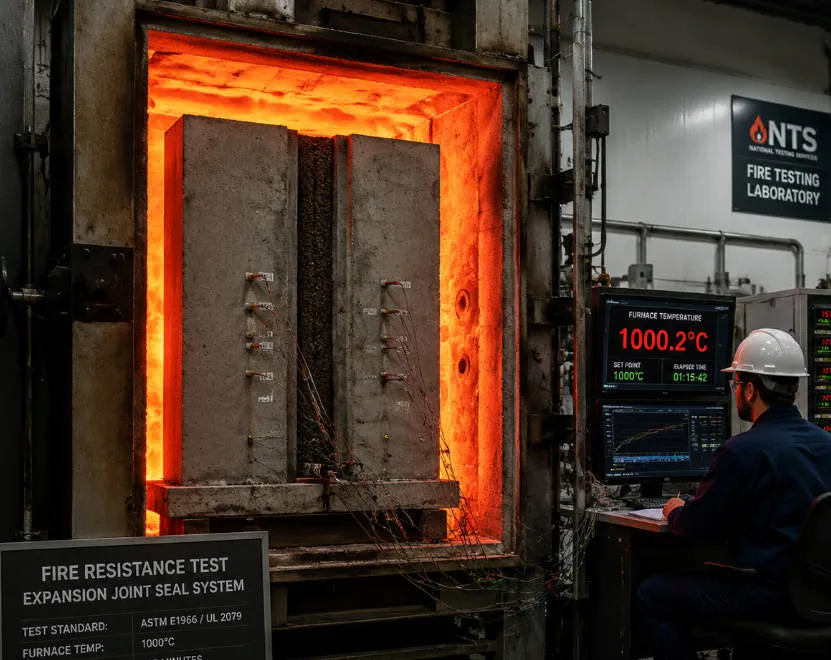
Key Testing Standards for Fire-Resistant Expansion Joint Seals {#key-testing-standards}
Fire-resistant expansion seal testing falls under multiple international standards depending on geography and application. The table below maps each standard to its scope and classification system.
|
Standard |
Scope |
Classification |
Primary Region |
Test Focus |
|---|---|---|---|---|
|
UL 2079 |
Expansion joint systems |
Hourly ratings (1H, 2H, 3H, 4H) |
North America |
Full system performance including movement |
|
ASTM E1966 |
Fire tests of building joint systems |
Hourly ratings per ASTM E119 |
North America |
Joint assembly fire endurance |
|
EN 1366-4 |
Linear joint seals fire resistance |
EI 30 to EI 240 |
Europe |
Integrity + Insulation |
|
EN 13501-2 |
Classification of fire resistance |
EI classes |
Europe |
Classification framework |
|
ISO 24472 |
Fire sealant performance in expansion joints |
Performance criteria |
International |
Sealant material evaluation |
|
BS 476-20 |
Fire resistance of building elements |
Integrity + Insulation |
UK (legacy) |
Superseded by EN 1366 but still used |
|
EAD 350141-00-1106 |
Linear joints and gap seals |
CE marking |
Europe |
Product assessment for CE |
|
AS 1530.4 |
Fire resistance of building elements |
Integrity + Insulation |
Australia |
Similar to EN 1366 |
|
Certifire |
Certification scheme for fire products |
Third-party certification |
Middle East |
Product conformity |
Selecting the governing standard: For North American projects, UL 2079 is the primary standard. For European projects, EN 1366-4 testing with EN 13501-2 classification applies. Australian projects use AS 1530.4. International projects may specify ISO 24472 or accept multiple certifications.
UL 2079 Testing: The North American Benchmark {#ul-2079-testing}
UL 2079 is the definitive North American test standard for fire-rated expansion joint systems. It goes beyond testing just the sealant material—it evaluates the complete system including substrates, accessories, movement capability, and thermal transfer.
What UL 2079 Evaluates
UL 2079 testing provides prescriptive systems that evaluate:
-
Sidewall composition: What materials the joint sidewalls are made of (concrete, masonry, steel stud with gypsum board)
-
Sidewall depth: Minimum depth required for the rated assembly
-
Fire endurance duration: 1-hour, 2-hour, 3-hour, or 4-hour ratings
-
Movement capability: The joint's ability to accommodate expansion and contraction while maintaining fire resistance
-
Thermal transfer evaluation: Heat transmission through the seal to the unexposed side
-
Hose stream test: Impact and thermal shock resistance after fire exposure (for some assemblies)
Three Properties That Determine UL 2079 Compliance
Fire-rated expansion joints rely on three primary properties to pass UL 2079:
-
Product formula: The base material composition and any fire-retardant impregnation. Intumescent coatings that expand when exposed to heat, ceramic fibers, and mineral wool each behave differently under furnace conditions.
-
Compression ratio: How much the uncompressed seal system is compressed at the mean joint size. Pre-compressed expansion joints depend on this compression for stability—they do not use invasive anchoring. The compression ratio directly affects gap-filling capability during movement cycles.
-
System depth: How deep the expansion joint seal extends into the joint cavity. Greater depth typically provides longer burn endurance because fire must penetrate more material to compromise the seal.
UL 2079 vs. Non-Fire-Rated Expansion Joints
Non-fire-rated pre-compressed expansion joints retain inherent fire-resistant properties due to their dense foam construction, but they have not been subjected to the full UL 2079 testing protocol. Only systems that have passed UL 2079 at an accredited laboratory (UL, Intertek Warnock-Hersey) carry a legitimate fire rating for code compliance.
EN 1366-4 and EN 13501-2: The European Framework {#en-1366-4-testing}
European fire-resistant expansion seal testing follows a two-part framework: EN 1366-4 defines the test method, and EN 13501-2 defines the classification.
EN 1366-4: Test Method for Linear Joint Seals
EN 1366-4 is the most relevant European standard for fire resistance testing of linear joint seals. The test procedure:
-
The joint seal assembly—including substrate, sealant material, and any backer rods or accessories—is mounted in a test frame.
-
The frame is attached to a vertical or horizontal test furnace.
-
The furnace temperature is raised according to the standard time-temperature curve (ISO 834): reaching approximately 590°C at 10 minutes, 945°C at 60 minutes, and 1,153°C at 240 minutes.
-
Thermocouples on the unexposed side monitor temperature rise.
-
Cotton pads and gap gauges check for integrity failures (flame passage, hot gas leakage).
EN 13501-2: Classification
Test results from EN 1366-4 are classified under EN 13501-2 using the EI system:
-
E (Integrity): The seal prevents passage of flames and hot gases.
-
I (Insulation): The unexposed side temperature rise stays below 180°C above ambient.
Classification examples: EI 30, EI 60, EI 90, EI 120, EI 180, EI 240 (numbers indicate minutes of performance).
EAD 350141-00-1106: CE Marking
The European Assessment Document (EAD) 350141-00-1106 supersedes the older ETAG 026 for linear joints and gap seals. Products tested under this EAD can achieve CE marking and a Declaration of Performance (DoP), required for placing fire-stopping products on the European market.
ISO 24472: Fire Sealant Performance Evaluation {#iso-24472-testing}
ISO 24472 is the international standard for evaluating fire sealant performance specifically in building expansion joints. It provides a framework for testing that complements regional standards.
ISO 24472 Testing Protocol
The standard requires evaluating sealants under conditions simulating actual building fires:
-
Sample preparation: Fire sealant samples are prepared per the standard's specifications, including substrate type and joint dimensions.
-
Controlled ignition: A defined ignition source simulates a real fire event at the joint.
-
Temperature measurement: Thermocouples and infrared cameras monitor temperature changes on both exposed and unexposed sides throughout the test.
-
Visual inspection: Trained observers record sealant performance—any cracking, debonding, intumescence behavior, or flame-through events.
-
Post-test analysis: Results are analyzed for flame spread prevention and structural integrity maintenance.
Non-Compliance Consequences
Failure to comply with ISO 24472 carries serious risks:
-
Liability for damages: Building owners and contractors may be held liable for fire-related losses.
-
Fines and penalties: Regulatory non-compliance results in significant financial penalties.
-
Reputation damage: A single fire protection failure can irreparably harm a company's reputation.
Three Methods for Achieving Fire-Rated Expansion Joints {#three-methods}
Three primary seal technologies achieve fire ratings in expansion joints, each suited to different joint sizes and movement requirements.
|
Method |
Joint Size |
Movement Capability |
Installation |
Key Features |
|---|---|---|---|---|
|
Pre-compressed seals with intumescent coating |
Up to 6 inches |
Up to 50% compression and extension |
Horizontal/vertical; behind cover plate |
Watertight seal, customizable silicone face, no invasive anchoring |
|
Ceramic fiber blanket fire barriers |
Up to 32 inches |
Excellent range of motion |
Horizontal/vertical; requires cover plate |
Handles large joints, superior insulation |
|
Mineral wool fire barriers |
Up to 4 inches |
Limited movement |
Typically floor assemblies |
Dense insulating barrier, excellent fire and sound resistance |
Pre-Compressed Seals with Intumescent Coating
The latest advancement in fire-rated expansion joint technology. Pre-compressed seals with integrated intumescent coating are designed for joints measuring 6 inches or less. The intumescent coating expands when exposed to heat, filling any gaps created by joint movement during a fire. These systems accommodate up to 50% movement in both compression and extension, can be installed in horizontal or vertical applications, and provide a watertight seal. The silicone face can be colored to match the project aesthetic.
Ceramic Fiber Blanket Fire Barriers
Ceramic fiber blankets achieve fire ratings for larger joints—up to 32 inches. The blankets are draped or compressed into the joint cavity and typically require a metal cover plate. They provide excellent insulation and fire resistance with a wide range of motion capability, making them suitable for large structural joints in commercial buildings.
Mineral Wool Fire Barriers
Mineral wool products are compressed into smaller joints (typically 4 inches or less) and covered with a sealant to form a fire barrier. Common in floor assemblies, mineral wool provides a dense, insulating barrier that does not expand but offers excellent fire resistance and soundproofing. It is often paired with pre-compressed foam in hybrid systems—mineral wool for fire and sound insulation, foam for environmental sealing and traffic-rated surfaces.
Fire Resistance Classification: Integrity (E) and Insulation (I) {#integrity-insulation}
Most fire resistance tests evaluate two parameters that determine the seal's classification:
Integrity (E)
Integrity is the seal's ability to prevent the passage of flames and hot gases from the fire-exposed side to the unexposed side. Failure occurs when:
-
Sustained flaming appears on the unexposed side for more than 10 seconds
-
A cotton pad applied to the unexposed side ignites
-
A 25 mm gap gauge can penetrate through a crack or opening
-
A 6 mm gap gauge can penetrate and move freely along the seal length
Insulation (I)
Insulation is the seal's ability to limit temperature rise on the unexposed side. Failure occurs when:
-
The average unexposed side temperature rises more than 140°C above initial ambient
-
Any single thermocouple reading exceeds 180°C above initial ambient
Combined Classification: EI
Products are classified by both criteria simultaneously. An EI 120 rating means the seal maintained both integrity and insulation for 120 minutes under the standard time-temperature curve.
|
Classification |
Fire Endurance |
Typical Application |
|---|---|---|
|
EI 30 |
30 minutes |
Light compartmentation |
|
EI 60 |
1 hour |
Standard wall separations |
|
EI 90 |
1.5 hours |
Enhanced compartmentation |
|
EI 120 |
2 hours |
Floor assemblies, shaft walls |
|
EI 180 |
3 hours |
High-risk occupancies |
|
EI 240 |
4 hours |
Special structural requirements |
Reaction to Fire vs. Resistance to Fire: Understanding the Difference {#reaction-vs-resistance}
These two concepts are frequently confused but fundamentally different:
|
Aspect |
Reaction to Fire |
Resistance to Fire |
|---|---|---|
|
What it measures |
How a material contributes to fire development and spread |
How a building element prevents fire passage from one side to another |
|
Test subject |
Single material or product (e.g., sealant, wall covering) |
Complete system or building section (wall including joints and penetrations) |
|
Classification (Europe) |
EN 13501-1 (Euro classes A1 through F) |
EN 13501-2 (EI classes) |
|
Key parameters |
Ignitability, flame spread, heat release, smoke production |
Integrity (E) and Insulation (I) |
EN 13501-1 Euro Classifications
|
Euro Class |
Requirement |
Examples |
|---|---|---|
|
A1 |
No contribution to fire |
Stone, concrete, glass, most metals |
|
A2 |
Insignificant contribution to fire |
Similar to A1 with small organic compound content |
|
B |
No flame spread; very limited fire contribution |
Gypsum boards with thin covering, fire-rated sealants |
|
C |
Very limited flame spread |
Gypsum boards with thicker coverings |
|
D |
Limited flame spread |
Wood and wooden products |
|
E |
Acceptable reaction for small flame exposure |
Many plastic products |
|
F |
Not passing A1-E requirements |
Unclassified materials |
Test Procedure: From Furnace to Classification {#test-procedure}
The fire resistance test for expansion joint seals follows a standardized procedure:
1. Specimen Construction
The test specimen replicates the actual installation:
-
Substrates match the approved system (concrete, masonry, steel stud with gypsum)
-
Joint width set to the maximum rated dimension
-
Seal installed per manufacturer instructions
-
Movement capability demonstrated before furnace exposure
2. Furnace Exposure
The specimen is mounted on a test furnace:
-
Furnace temperature follows the standard time-temperature curve (ISO 834 / ASTM E119)
-
Temperature at 10 min: ~590°C; 30 min: ~821°C; 60 min: ~945°C; 120 min: ~1,049°C; 240 min: ~1,153°C
3. Monitoring During Test
-
Thermocouples on the unexposed side record temperature continuously
-
Visual observation through furnace viewport and unexposed side
-
Cotton pad test at intervals to detect hot gases
-
Gap gauge test to detect integrity breaches
4. Termination Criteria
The test terminates when:
-
Integrity failure (flame-through, gap gauge penetration, cotton pad ignition)
-
Insulation failure (temperature exceeds limits)
-
The target duration is reached successfully
5. Classification
Results are classified according to the applicable standard (EI class for EN, hourly rating for UL). The classification specifies:
-
Fire resistance duration
-
Joint type (floor, wall, head-of-wall)
-
Movement capability
-
Maximum joint width
-
Approved substrate types
Common Test Failures and Corrective Actions {#common-failures}
|
Failure Mode |
Cause |
Detection Method |
Corrective Action |
|---|---|---|---|
|
Integrity failure (flame-through) |
Insufficient seal depth or material density |
Visual observation, cotton pad ignition |
Increase seal depth or use higher-density material |
|
Integrity failure (gap opening) |
Joint movement exceeds seal capability |
Gap gauge penetration |
Use seal with higher movement rating |
|
Insulation failure (temperature rise) |
Insufficient thermal insulation |
Thermocouple reading exceeds 180°C |
Add insulation layer or increase material thickness |
|
Seal debonding from substrate |
Inadequate adhesion under thermal stress |
Visual inspection of seal edge |
Improve surface preparation or use primer |
|
Intumescent coating failure |
Coating does not expand sufficiently |
Post-test visual analysis |
Adjust coating formulation or thickness |
|
Compression loss during fire |
Foam core loses structural integrity |
Seal gap measurement during test |
Increase compression ratio or use denser core material |
|
Cover plate failure |
Metal cover plate distorts or detaches |
Visual observation |
Upgrade cover plate gauge or attachment method |
Summary {#summary}
Fire-resistant expansion seal testing validates that the most vulnerable points in a building's fire-rated assemblies—expansion joints—will perform when fire strikes. Three standards dominate: UL 2079 (North America) evaluates complete joint systems including movement, substrate, and thermal transfer; EN 1366-4 with EN 13501-2 (Europe) classifies seals by Integrity (E) and Insulation (I) performance from EI 30 to EI 240; and ISO 24472 provides an international framework for sealant material evaluation. Three seal technologies serve different needs: pre-compressed intumescent seals for joints up to 6 inches with 50% movement, ceramic fiber blankets for large joints up to 32 inches, and mineral wool barriers for small joints with limited movement. The key test parameters—integrity (no flame or hot gas passage) and insulation (temperature rise below 180°C on the unexposed side)—determine the fire rating. A properly tested, correctly installed fire-resistant expansion seal is the difference between a fire contained to its compartment and a fire that spreads unchecked through a building's hidden infrastructure.
FAQ {#faq}
What is the primary test standard for fire-rated expansion joints in North America? UL 2079 is the primary standard. It evaluates the complete expansion joint system including substrate composition, sidewall depth, fire endurance duration, movement capability, and thermal transfer. Products must be tested at an accredited agency such as UL or Intertek Warnock-Hersey.
What do EI ratings mean for expansion joint seals? E stands for Integrity (preventing flame and hot gas passage) and I stands for Insulation (limiting temperature rise on the unexposed side to below 180°C). EI 120 means both criteria were met for 120 minutes. Ratings range from EI 30 to EI 240.
Are fire-rated and non-fire-rated expansion joint sealants different? Yes. Fire-rated sealants have passed rigorous testing (UL 2079, EN 1366-4) as part of a complete system. Non-fire-rated pre-compressed joints may have inherent fire-resistant properties from their dense construction but have not been tested or certified for fire endurance.
How often should fire-rated expansion joint seals be inspected? Regular inspection is recommended as part of the building's fire protection maintenance program. Seal lifespan depends on exposure to weather, movement cycles, and UV radiation. Replace when cracking, debonding, compression loss, or physical damage is observed.
Can mineral wool and pre-compressed foam seals be used together? Yes. Hybrid systems leverage the strengths of both materials: mineral wool provides enhanced fire and sound insulation, while pre-compressed foam provides environmental sealing and can sustain pedestrian and vehicular traffic. This combination is common where depth restrictions prohibit mineral wool-only solutions.
What is the difference between reaction to fire and resistance to fire? Reaction to fire (EN 13501-1) measures how a single material contributes to fire development—its ignitability, flame spread, and smoke production. Resistance to fire (EN 13501-2) measures how a complete building element prevents fire passage from one compartment to another—its integrity and insulation over time.
Can I install fire-rated expansion joint seals myself? Professional installation by experienced contractors is strongly recommended. Improper installation—wrong compression ratio, inadequate depth, incorrect substrate preparation—results in a non-compliant system that may fail during a fire even though the product itself passed testing.
References {#references}
-
UL 2079. Standard for Tests for Fire Resistance of Building Joint Systems. Underwriters Laboratories.
-
ASTM E1966. Standard Test Method for Fire-Resistant Joint Systems. ASTM International.
-
EN 1366-4:2023. Fire Resistance Tests for Service Installations — Part 4: Linear Joint Seals. European Committee for Standardization.
-
EN 13501-2:2023. Fire Classification of Construction Products and Building Elements — Part 2: Classification Using Data from Fire Resistance Tests. CEN.
-
ISO 24472:2023. Fire Safety — Fire Sealants in Building Expansion Joints — Performance Evaluation. International Organization for Standardization.
-
ISO 834-1:1999. Fire-Resistance Tests — Elements of Building Construction — Part 1: General Requirements. ISO.
-
BS 476-20:1987. Fire Tests on Building Materials and Structures — Part 20: Method for Determination of the Fire Resistance of Elements of Construction. BSI.
-
EAD 350141-00-1106. Fire Stopping and Fire Sealing Products — Linear Joints and Gap Seals. European Organisation for Technical Assessment.
-
AS 1530.4:2014. Methods for Fire Tests on Building Materials, Components and Structures — Part 4: Fire Resistance Test. Standards Australia.
-
EN 13501-1:2018. Fire Classification of Construction Products and Building Elements — Part 1: Classification Using Data from Reaction to Fire Tests. CEN.
-
NFPA 80. Standard for fire doors and Other Opening Protectives. National Fire Protection Association.
-
ASTM E119. Standard Test Methods for Fire Tests of Building Construction and Materials. ASTM International.