Table of Contents
- What is povidone testing?
- The standard stack: USP, EP, GB, FAO JECFA
- K-value: the molecular-weight grade system (K-15, K-30, K-90)
- Assay: nitrogen content by Kjeldahl (11.5–12.8 %)
- Residual solvents: 2-pyrrolidone, formic acid, and the ICH Q3C framework
- Hydrazine: the genotoxic-impurity limit test
- Aldehydes and peroxides: the oxidation-degradation markers
- Loss on drying, sulfated ash, and heavy metals
- Water-insoluble substances and the clarity test
- Povidone vs crospovidone vs copovidone: the family
- FAQ
- Our povidone testing capabilities
What is povidone testing?
Povidone testing is the measurement and validation of the identity, molecular-weight grade, assay (nitrogen content), residual impurities, and physical properties of povidone (polyvinylpyrrolidone, PVP, CAS 9003-39-8, INS 1201 / E1201) — the water-soluble synthetic polymer used as a pharmaceutical excipient (binder, film-former, suspending agent, tablet disintegrant matrix), a food additive (clarifying agent, stabiliser, tableting aid), a cosmetic ingredient (hair-spray fixative, toothpaste binder), and a blood-plasma expander (the historical use that established the biocompatibility). The output of a povidone test is a dossier covering the K-value (the molecular-weight grade: K-15, K-30, K-90), the assay (nitrogen content 11.5–12.8 % by Kjeldahl), the residual impurities (2-pyrrolidone ≤ 0.2 %, formic acid ≤ 0.2 %, hydrazine ≤ 1 ppm, aldehydes ≤ 0.05 %, peroxides ≤ 400 ppm), and the physical properties (loss on drying ≤ 5 %, sulfated ash ≤ 0.1 %, heavy metals ≤ 10 ppm, water-insoluble substances ≤ 0.1 %).
Povidone (PVP) is produced by the free-radical polymerisation of N-vinylpyrrolidone (NVP) in water or isopropanol, using a hydrogen peroxide / amine initiator or an azo initiator. The degree of polymerisation is controlled by the initiator concentration and the reaction temperature, producing grades from K-12 (lowest molecular weight, ~2,500 Da) through K-15, K-25, K-30, K-60, to K-90 (highest, ~1,300,000 Da). The "K" designation is the Fikentscher K-value — a viscosity-derived molecular-weight index defined in the USP, EP, and FAO JECFA monographs and measured by capillary viscometry of a dilute aqueous solution. The K-value is the single most important commercial specification of povidone — it determines the binding strength (tablet), the film-forming (coating), the suspending (liquid formulation), and the viscosity of the final product.
The standards governing povidone testing span the USP Povidone monograph (the US pharmacopeial reference), the EP 01/2011:0691 Povidone monograph (the European pharmacopeial reference, harmonised with USP under the PDG), the FAO JECFA Polyvinylpyrrolidone monograph (INS 1201, the international food-additive specification), the Chinese GB 31630-2014 National food safety Standard for Food Additive — Polyvinylpyrrolidone (the Chinese food-additive product standard), and the BASF Kollidon technical literature (the world's largest povidone manufacturer, whose product grades define the industry standard). A povidone placed on the US pharmaceutical market must satisfy the USP monograph; on the EU market, the EP monograph; on the Chinese food market, GB 31630; on the international food market, the FAO JECFA specification.
The standard stack: USP, EP, GB, FAO JECFA
A complete povidone testing project draws on a stack of pharmacopeial and food-additive standards.
| Family | Standard | Scope |
|---|---|---|
| USP Povidone | Povidone monograph (USP-NF) | The US pharmacopeial reference; assay (nitrogen 11.5–12.8 %), K-value, residual solvents, hydrazine, aldehydes, peroxides, water-insoluble, LOD, sulfated ash, heavy metals |
| USP <467> | Residual Solvents | The USP general chapter governing the residual-solvent limits, applied to povidone (2-pyrrolidone, formic acid) |
| USP <232> / <233> | Elemental Impurities — Limits / Procedures | The USP elemental-impurities framework, replacing the older heavy-metals <231> |
| EP 01/2011:0691 | Povidone (European Pharmacopoeia) | The European pharmacopeial monograph; harmonised with USP under the PDG (Pharmacopeial Discussion Group) |
| EP 01/2008:1544 | Povidone, water-free | The anhydrous form |
| FAO JECFA | Polyvinylpyrrolidone (INS 1201, Compendium of Food Additive Specifications, Vol. 4) | The international food-additive specification; ADI "not specified" since 1983 (27th JECFA); the K-value, nitrogen, residual monomer, hydrazine, sulfated ash |
| GB 31630-2014 | 《食品安全国家标准 食品添加剂 聚乙烯吡咯烷酮》 | The Chinese national food-additive standard for PVP; assay (nitrogen), K-value, residual NVP, hydrazine, heavy metals |
| GB 2760-2024 | Use of Food Additives | The Chinese usage scope — PVP permitted in specified food categories (beer clarification, beverage stabiliser) at GMP |
| ICH Q3C(R9) | Impurities: Guideline for Residual Solvents | The international residual-solvent framework; 2-pyrrolidone not listed in Q3C (handled as a monograph-specific limit) |
| ICH S9 | Genotoxic and Carcinogenic Impurities (cross-reference) | The genotoxic-impurity framework relevant to the hydrazine limit |
| BASF Kollidon | Technical literature (Kollidon K-12, K-17, K-25, K-30, K-90; Kollidon CL crospovidone; Kollidon VA64 copovidone) | The industry reference; BASF is the world's largest povidone manufacturer |
The single most consequential fact for a Chinese manufacturer is that GB 31630-2014 is the Chinese national food-additive standard for PVP, with the usage scope regulated by GB 2760-2024 (PVP is permitted in beer clarification and as a beverage stabiliser at GMP). For pharmaceutical use in China, the Chinese Pharmacopoeia Povidone monograph (通则) applies, equivalent to the USP / EP monograph.
K-value: the molecular-weight grade system (K-15, K-30, K-90)
The K-value (the Fikentscher K-value) is the viscosity-derived molecular-weight index that defines the grade of povidone. It is the single most-cited specification on a povidone data sheet and the single most important test in the povidone monograph.
Definition — The Fikentscher K-value is derived from the relative viscosity of a dilute aqueous solution of the povidone, using the Fikentscher equation (developed in the 1930s for cellulose derivatives, adapted for PVP):
log(Z) = [ (75 K₀²) / (1 + 1.5 K₀ · c) + K₀ ] · c
where Z is the relative viscosity (η_rel = flow time of solution / flow time of solvent), c is the concentration in g/100 mL, and K₀ = 10⁻³ × K-value. The K-value is solved iteratively from the measured relative viscosity and the known concentration.
USP / EP / FAO JECFA procedure:
- Prepare a solution of the povidone in water at a concentration chosen by the K-value grade (typically 1 % for K-90, 5 % for K-30, 10 % for K-15).
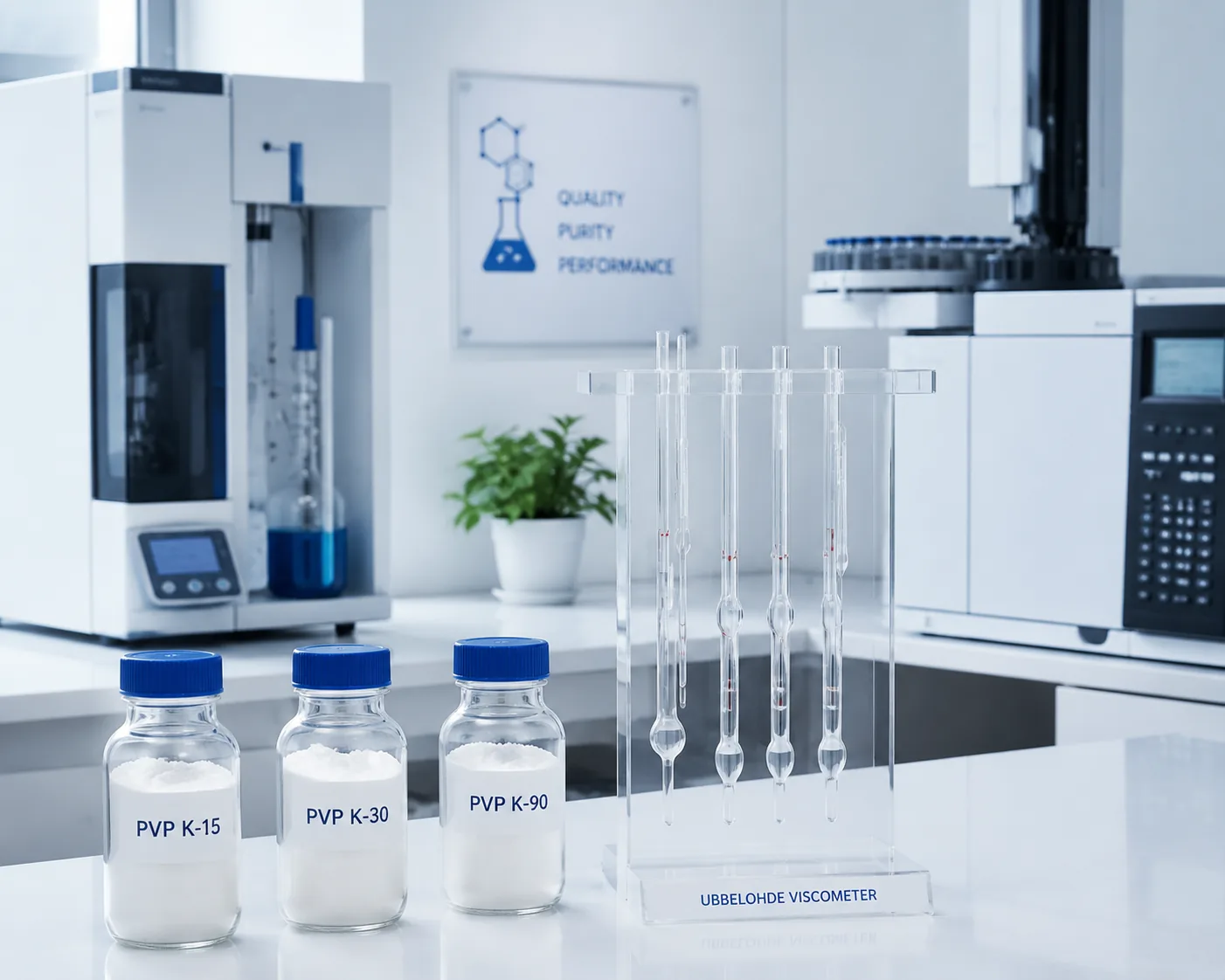
- Measure the relative viscosity Z using an Ubbelohde capillary viscometer at 25 ± 0.1 °C.
- Calculate the K-value by the Fikentscher equation.
K-value grades and their molecular weights:
| K-value grade | Approximate Mw (Da) | Typical application |
|---|---|---|
| K-12 | 2,500–3,400 | Low-viscosity binder; blood-plasma expander (historical) |
| K-15 | 7,000–9,000 | Binder, suspending agent; the "Kollidon 17 PF" low-endotoxin grade for parenteral |
| K-17 / K-25 | 10,000–32,000 | Intermediate grades |
| K-30 | 40,000–55,000 | The workhorse — tablet binder, film-former, the most widely used grade |
| K-60 | 350,000–450,000 | High-viscosity suspending; thickener |
| K-90 | 1,000,000–1,500,000 | High-viscosity film-former; hair-spray fixative; hydrophilic matrix |
Acceptance — The USP monograph requires the K-value to be within ± 2 of the labelled value (e.g. K-29–32 for a K-30 product; K-88–96 for a K-90 product). A povidone whose K-value is outside this range is non-conforming and must be re-blended to grade.
Assay: nitrogen content by Kjeldahl (11.5–12.8 %)
The assay of povidone is defined as the nitrogen content, determined by the Kjeldahl method (the classical wet-digestion + steam-distillation + titration method for total organic nitrogen). The nitrogen content of pure PVP is 12.6 % (the theoretical value for the –CH₂–CH(N(C=O)CH₂CH₂CH₂)– repeat unit, C₆H₉NO, MW 111.14, N% = 14.01/111.14 × 100 = 12.6 %). The USP monograph specifies NLT 11.5 % and NMT 12.8 % nitrogen (on the anhydrous basis) — the tolerance accommodates the moisture, the residual monomer, and the minor chain-end groups that shift the measured nitrogen slightly from the theoretical.
Procedure (USP / EP Kjeldahl):
- Digest ~0.1 g of povidone with sulfuric acid + copper sulfate catalyst + potassium sulfate at 400 °C until clear.
- Steam-distil the ammonium sulfate into a boric-acid receiver.
- Titrate with 0.1 N HCl.
- Calculate: N% = (V_HCl × N_HCl × 14.01) / (W_sample × 10).
The nitrogen assay is the basis of the povidone identity — a non-PVP polymer would have a different nitrogen content (or no nitrogen at all). The nitrogen content, combined with the K-value, fully characterises the povidone grade.
Residual solvents: 2-pyrrolidone, formic acid, and the ICH Q3C framework
The povidone polymerisation leaves residual amounts of the monomer (N-vinylpyrrolidone, NVP), the depolymerisation product (2-pyrrolidone), and the initiator decomposition product (formic acid, from the hydrogen peroxide / amine initiator). These are the process-related impurities limited by the USP / EP / FAO JECFA monographs.
| Impurity | USP / EP / FAO JECFA limit | Method |
|---|---|---|
| 2-Pyrrolidone (the residual monomer / depolymerisation product) | ≤ 0.2 % (USP); ≤ 0.5 % (FAO JECFA, as "unsaturated compounds" by titration with perchloric acid) | GC (headspace) of a sample solution against a 2-pyrrolidone standard; or the perchloric-acid titration of the residual NVP |
| Formic acid (from the hydrogen peroxide / amine initiator) | ≤ 0.2 % | Ion chromatography or the acid-base titration of a sample solution |
| N-Vinylpyrrolidone (NVP) (the residual monomer) | Per USP <467> residual-solvent limits (NVP is treated as a reactive unsaturated monomer) | GC with an FID or MS detector |
| Water content (Karl Fischer) | Per the grade (typically ≤ 5 % LOD; the anhydrous grade ≤ 0.5 % by KF) | Karl Fischer titration |
The 2-pyrrolidone is the most-cited residual impurity in povidone QC — it is the open-chain ring-opening product of the NVP hydrolysis and the dominant process-related impurity. The USP limit of 0.2 % is the tighter of the international limits; the FAO JECFA monograph's "unsaturated compounds" test (the perchloric-acid titration) is an older, less-specific method that captures both the NVP and any other basic impurity.
Hydrazine: the genotoxic-impurity limit test
Hydrazine (N₂H₄) is a genotoxic carcinogen (IARC Group 2B) that can be present in povidone as a trace impurity from the polymerisation initiator or from the decomposition of the azo initiator. The USP / EP monographs limit hydrazine to ≤ 1 ppm (1 µg/g) in povidone — one of the tightest impurity limits in any pharmacopeial monograph.
Method — The classical method (USP / EP) is the dimethylaminobenzaldehyde (DMAB) colorimetric method: hydrazine reacts with DMAB to form a yellow p-dimethylaminobenzaldehyde hydrazone, measured by UV-Vis at 456 nm. The modern method is LC-MS/MS with an isotope-labelled hydrazine internal standard — more sensitive and more specific than the DMAB method.
The hydrazine limit has been progressively tightened (from the older 5 ppm to the current 1 ppm) as the analytical methods have improved and as the ICH M7 framework on genotoxic impurities has raised the awareness of the genotoxic impurity control. The 1 ppm limit corresponds to a daily intake well below the ICH M7 TTC of 1.5 µg/day for a genotoxic impurity (a 1 g daily dose of povidone × 1 ppm = 1 µg hydrazine — at the TTC itself).
Aldehydes and peroxides: the oxidation-degradation markers
Povidone is susceptible to oxidative degradation under heat, light, and oxygen, producing aldehydes (the formaldehyde from the backbone oxidation) and peroxides (the hydroperoxide from the chain radical formation). These degradation products affect the stability of the povidone-containing formulation (the aldehydes can react with the active ingredient; the peroxides can oxidise the active ingredient) and are therefore limited by the monograph.
| Impurity | USP / EP limit | Method |
|---|---|---|
| Aldehydes (as formaldehyde) | ≤ 0.05 % | Colorimetric — the formaldehyde reacts with Nash reagent (acetylacetone + ammonium acetate) to form a yellow lutidine derivative, measured at 412 nm |
| Peroxides (as H₂O₂) | ≤ 400 ppm (0.04 %) | Iodometric — the peroxide liberates iodine from potassium iodide, measured at 350 nm or titrated with sodium thiosulphate |
The aldehyde and peroxide tests are the povidone-equivalent of the "oxidation induction time" of a polymer — they verify that the povidone has not degraded during storage. A high peroxide value in a received povidone batch indicates improper storage (heat, light, or prolonged shelf life) and the batch should be rejected for pharmaceutical use.
Loss on drying, sulfated ash, and heavy metals
The physical-purity tests of the povidone monograph:
| Test | USP / EP limit | Method |
|---|---|---|
| Loss on drying (LOD) | ≤ 5.0 % (at 105 °C to constant weight); the anhydrous grade ≤ 0.5 % | Gravimetric |
| Water content (Karl Fischer) | Per the grade (the Kollidon 30 anhydrous grade ≤ 0.5 %) | Karl Fischer titration |
| Sulfated ash (residue on ignition) | ≤ 0.1 % (USP); ≤ 0.02 % (the low-ash Kollidon VA64 copovidone) | Ignition with H₂SO₄ at 600 °C |
| Heavy metals (as Pb) | ≤ 10 ppm | ICP-MS (USP <233>); the older USP <231> was deleted in 2018 |
| pH (2 % aqueous solution) | 3.0–7.0 (USP); 4.0–7.0 (EP) | pH meter |
The sulfated ash at ≤ 0.1 % is a tight limit that verifies the inorganic-residue control (the polymerisation catalyst, the neutralisation salts, the process water minerals). A high sulfated ash indicates poor process control or a low-grade raw material.
Water-insoluble substances and the clarity test
| Test | USP / EP limit | Method |
|---|---|---|
| Water-insoluble substances | ≤ 0.1 % (USP); ≤ 0.5 % (FAO JECFA, as "insoluble matter") | Dissolve in water, filter through a 0.45 µm membrane, weigh the residue |
| Clarity of solution | The 5 % aqueous solution must be clear, not more opalescent than the reference suspension | Visual comparison against the EP reference suspension |
The water-insoluble substances test verifies that the povidone is fully water-soluble (the cross-linked fraction, the gel particles, the insoluble contaminants are excluded). A povidone with > 0.1 % water-insoluble substances would form a cloudy solution and would be unsuitable for the liquid-formulation applications.
Povidone vs crospovidone vs copovidone: the family
The "povidone family" includes three distinct products with different polymer structures, different monograph tests, and different applications.
| Product | Structure | Monograph | Application |
|---|---|---|---|
| Povidone (PVP) | Linear polyvinylpyrrolidone, water-soluble | USP Povidone / EP 0691 / GB 31630 / FAO JECFA INS 1201 | Binder, film-former, suspending agent, blood-plasma expander (historical) |
| Crospovidone (cross-linked PVP, PVPP) | Cross-linked polyvinylpyrrolidone, water-insoluble | USP Crospovidone / EP 0892 | Tablet disintegrant (swells in water but does not dissolve); beer / wine clarification (the "Polyclar" grade that adsorbs polyphenols) |
| Copovidone (PVP-VA, Kollidon VA64) | Copolymer of N-vinylpyrrolidone and vinyl acetate (60:40) | USP Copovidone / EP 2062 | Tablet film-coating (the VA gives the moisture barrier), solvent-borne film-former, hot-melt extrusion matrix |
The three products share the pyrrolidone chemistry but differ critically in their water-solubility (povidone soluble; crospovidone insoluble; copovidone soluble) and in their regulatory status (povidone is INS 1201 food-additive permitted; crospovidone is INS 1202; copovidone is pharmaceutical-only). A povidone test report must identify which product is being tested, because the monographs, the acceptance limits, and the applications are different.
FAQ
What is the K-value of povidone and why is it important?
The K-value (Fikentscher K-value) is a viscosity-derived molecular-weight index that defines the grade of povidone — K-12 (lowest Mw ~2,500 Da) through K-30 (the workhorse, Mw ~50,000 Da) to K-90 (highest, Mw ~1,300,000 Da). It is determined by capillary viscometry of a dilute aqueous solution and the Fikentscher equation. The K-value determines the binding strength, the film-forming, and the viscosity of the final product; it is the single most-cited specification on a povidone data sheet.
What is the USP assay for povidone and what is the acceptance?
The USP assay for povidone is the nitrogen content, determined by the Kjeldahl method. The acceptance is NLT 11.5 % and NMT 12.8 % nitrogen on the anhydrous basis (the theoretical nitrogen of pure PVP is 12.6 %). The nitrogen assay is the basis of the povidone identity — a non-PVP polymer would have a different nitrogen content.
What are the most critical residual impurities in povidone?
The four critical residual impurities are 2-pyrrolidone (≤ 0.2 %, the depolymerisation product), hydrazine (≤ 1 ppm, the genotoxic impurity from the initiator), aldehydes (≤ 0.05 % as formaldehyde), and peroxides (≤ 400 ppm as H₂O₂). The hydrazine limit is the tightest, reflecting the ICH M7 genotoxic-impurity framework.
What is the difference between povidone and crospovidone?
Povidone is the linear water-soluble polyvinylpyrrolidone, used as a binder and film-former (USP Povidone monograph, INS 1201). Crospovidone is the cross-linked water-insoluble polyvinylpyrrolidone, used as a tablet disintegrant and as a beer / wine polyphenol adsorbent (USP Crospovidone monograph, INS 1202). The two share the pyrrolidone chemistry but have different solubility, different monographs, and different applications.
Is povidone permitted as a food additive in China?
Yes. GB 31630-2014 is the Chinese national food-additive standard for polyvinylpyrrolidone (PVP, INS 1201), and GB 2760-2024 permits PVP in specified food categories (beer clarification, beverage stabiliser) at GMP ("按生产需要适量使用"). For pharmaceutical use in China, the Chinese Pharmacopoeia Povidone monograph applies.
Our povidone testing capabilities
Beijing ZKGX Research (ISO/IEC 17025 accredited, CMA- and CNAS-accredited testing laboratory) provides complete povidone testing across the USP, EP, GB, and FAO JECFA standard stack:
- USP Povidone monograph — full conformance: assay (nitrogen 11.5–12.8 % by Kjeldahl), K-value (Fikentscher by capillary viscometry), residual 2-pyrrolidone ≤ 0.2 %, formic acid ≤ 0.2 %, hydrazine ≤ 1 ppm, aldehydes ≤ 0.05 %, peroxides ≤ 400 ppm, LOD ≤ 5 %, sulfated ash ≤ 0.1 %, heavy metals ≤ 10 ppm (ICP-MS per USP <233>), water-insoluble ≤ 0.1 %, pH.
- EP 01/2011:0691 Povidone monograph — harmonised with USP under the PDG.
- FAO JECFA Polyvinylpyrrolidone (INS 1201) monograph — full specification for the food-additive market.
- GB 31630-2014 Chinese food-additive PVP — assay, K-value, residual monomer, hydrazine, heavy metals; GB 2760-2024 usage-scope verification.
- K-value determination — the Fikentscher K-value by capillary viscometry (Ubbelohde) at 25 °C; the full grade range (K-12 through K-90); acceptance ± 2 of the labelled K.
- Nitrogen assay — the Kjeldahl method (digestion, steam distillation, titration); 11.5–12.8 % acceptance.
- Residual impurities — 2-pyrrolidone by GC-headspace; NVP by GC-FID; formic acid by ion chromatography; per the USP <467> framework.
- Hydrazine — DMAB colorimetric at 456 nm; or LC-MS/MS with isotope-labelled internal standard for the 1 ppm limit.
- Aldehydes — Nash reagent (acetylacetone / ammonium acetate) colorimetric at 412 nm; ≤ 0.05 % as formaldehyde.
- Peroxides — iodometric at 350 nm or sodium-thiosulphate titration; ≤ 400 ppm as H₂O₂.
- Heavy metals — ICP-MS per USP <232> / <233>; Pb, As, Cd, Hg, Co, V, Ni per the ICH Q3D framework.
- Physical tests — LOD, sulfated ash, water-insoluble, clarity, pH, Karl Fischer water content.
- Crospovidone (USP Crospovidone / EP 0892) and copovidone (USP Copovidone / EP 2062) — the companion monograph tests for the cross-linked and copolymer grades.
Suitable sample matrices include: pharmaceutical-grade povidone (K-12 through K-90); food-additive-grade PVP; the anhydrous (low-moisture) grades; the low-endotoxin parenteral grades (Kollidon 17 PF); crospovidone (PVPP); copovidone (Kollidon VA64). Each project is delivered with a full data report (test protocol, instrument calibration, raw Kjeldahl / viscometry / GC / LC-MS data, statistical analysis, identification-test evidence, classification conclusion per the applicable standard) in English and/or Chinese, with CMA/CNAS stamping. Contact Beijing ZKGX Research to scope the povidone test applicable to your product and target market.