What Is Shower Testing?
Shower testing encompasses two distinct evaluation processes: emergency safety shower testing for workplace compliance and product quality testing for shower manufacturing standards. Both ensure showers perform reliably when needed—whether protecting workers from chemical exposure or providing daily bathing functionality.
Emergency safety shower testing verifies that emergency eyewash stations and drench showers meet ANSI Z358.1 standards, delivering adequate water flow, proper temperature, and correct spray patterns to decontaminate personnel exposed to hazardous materials.
Product quality testing evaluates shower heads and fixtures against manufacturing standards, assessing appearance, mechanical strength, sealing performance, flow characteristics, and durability under various operating conditions.
Why Are Emergency Shower Tests Critical for Workplace Safety?
The first 10-15 seconds after chemical exposure are critical. Delaying treatment, even for a few seconds, can contribute to serious injury, permanent damage, or death. Emergency showers and eyewash stations provide immediate on-the-spot decontamination.
Critical Applications
Chemical Exposure Scenarios
- Corrosive chemicals – Acids and bases causing immediate tissue damage
- Toxic substances – Materials absorbed through skin contact
- Irritants – Compounds causing eye and skin irritation
- Flammable liquids – Solvents that may ignite on clothing
Industrial Settings Requiring Emergency Showers
- Battery charging areas
- Chemical laboratories
- Spraying and coating operations
- Dipping and plating processes
- Product dispensing areas
- High dust environments
Consequences of Inadequate Testing
Safety Failures
- Insufficient water flow fails to adequately flush contaminants
- Improper temperature causes hypothermia or scalding during extended rinsing
- Incorrect spray pattern misses critical body areas
- Delayed activation extends exposure time
Regulatory Consequences
- OSHA citations and fines
- ANSI non-compliance violations
- Increased liability exposure
- Failed safety audits
What Are the ANSI Z358.1 Requirements?
ANSI Z358.1-2014 establishes the American national standard for emergency eyewash and shower equipment, specifying design, performance, installation, and maintenance requirements.
Emergency Shower Specifications
Flow Rate Requirements
- Minimum flow: 75.7 liters/minute (20 gallons/minute)
- Duration: Minimum 15 minutes continuous operation
- Spray pattern: At least 50.8 cm (20 inches) diameter at 152.4 cm (60 inches) from floor
Installation Dimensions
- Shower head height: 208.3-243.8 cm (82-96 inches) from floor
- Actuator height: Maximum 173.3 cm (69 inches) from floor
- Unobstructed area: 86.4 cm (34 inches) diameter minimum
Performance Requirements
- Activation time: Less than 1 second
- Stay-on feature: Must remain operational without continuous hand pressure
- Valve operation: Turns off intentionally, not automatically
Eyewash Station Specifications
Flow Rate Requirements
- Eyewash stations: Minimum 1.5 liters/minute (0.4 gallons/minute)
- Eye/face wash stations: Minimum 11.4 liters/minute (3.0 gallons/minute)
- Duration: Minimum 15 minutes continuous flow
Installation Dimensions
- Nozzle height: 83.8-134.6 cm (33-53 inches) from floor
- Distance from wall: Minimum 15.3 cm (6 inches)
- Nozzle protection: Covers must remove automatically during activation
Performance Requirements
- Simultaneous flow: Both eyes flushed at once
- Gentle velocity: Flow must not injure eyes
- Hands-free operation: User can hold eyelids open while flushing
How to Test Emergency Shower Flow Rate?
Flow rate testing verifies that emergency showers deliver adequate water volume to effectively flush contaminants from the body.
Required Equipment
- Collection container: Large trash can on wheels with 10-gallon (37.9L) increment marks
- Sleeve or shroud: Covers shower head to minimize spray dispersion
- Stopwatch: For timing water collection
- Flow calculation: Volume collected ÷ time = flow rate
Testing Procedure
Step 1: Preparation
- Position collection container below shower head
- Ensure container drain is closed
- Elevate container sleeve to enclose shower head
- Lock container wheels in place
Step 2: Water Collection
- Pull shower handle to activate water flow
- Allow water to run for exactly 15 seconds
- Push handle to stop water flow
- Record volume of water collected
Step 3: Flow Rate Calculation
- 15-second test volume: Minimum 18.9 liters (5 gallons) required
- Extrapolated flow rate: Multiply 15-second volume by 4 for liters/minute
- Compliance threshold: 75.7 liters/minute (20 gallons/minute) minimum
Step 4: Documentation
- Record test date and tester initials
- Note flow rate and pass/fail status
- Attach test tag to shower unit
- Report deficiencies immediately
Interpreting Results
| 15-Second Volume | Flow Rate (L/min) | Status |
|---|---|---|
| <18.9 L | <75.7 L/min | FAIL – Insufficient flow |
| 18.9-28.4 L | 75.7-113.6 L/min | PASS – Adequate flow |
| >28.4 L | >113.6 L/min | CAUTION – May be excessive |
What Temperature Should Safety Shower Water Be?
Water temperature critically affects user compliance and safety during emergency decontamination. ANSI Z358.1 specifies "tepid" water temperature requirements.
Temperature Requirements
ANSI Standard Range
- Minimum temperature: 16°C (60°F)
- Maximum temperature: 38°C (100°F)
- Optimal range: 20-25°C (68-77°F)
Why Temperature Matters
Cold Water Risks (<16°C / 60°F)
- Hypothermia during extended flushing (15+ minutes)
- User discomfort causing premature cessation of rinsing
- Shock response in already-injured persons
- Reduced effectiveness as users shorten exposure time
Hot Water Risks (>38°C / 100°F)
- Scalding injuries to damaged skin
- Enhanced chemical interaction – heat accelerates some chemical reactions
- Increased absorption – heat can increase skin permeability
- Additional tissue damage compounding original injury
Temperature Testing Procedure
Equipment
- Non-mercury thermometer
- Small collection container
- Protective sleeve
Procedure
- Activate shower and allow flow to stabilize
- Collect small water sample from sleeve outlet
- Measure temperature immediately
- Record reading on test documentation
- Verify within 16-38°C range
Temperature Control Solutions
For Cold Climates
- Install heated plumbing systems
- Use thermostatic tempering valves
- Provide heated enclosures for outdoor units
For Hot Climates
- Install tempering valves
- Shade outdoor units
- Use cooling systems where necessary
How Often Should Emergency Showers Be Inspected?
Regular inspection and maintenance ensures emergency equipment functions reliably when needed.
Inspection Frequency Requirements
Weekly Activations
- Purpose: Clear sediment, verify operation, prevent stagnation
- Duration: Run water for 3-5 seconds minimum
- Documentation: Record date, tester, and observations
- Personnel: Designate responsible person for each area
Annual Comprehensive Testing
- Purpose: Full compliance verification per ANSI Z358.1
- Scope: Complete flow rate, temperature, and pattern testing
- Documentation: Detailed test records and certification
- Repairs: Immediate correction of deficiencies
Inspection Checklist
Weekly Visual Inspection
- ✓ Unit accessible and unobstructed
- ✓ Signage visible and legible
- ✓ Protective covers in place (eyewash)
- ✓ No visible damage or leaks
- ✓ Valves operate smoothly
Weekly Functional Test
- ✓ Water flows immediately upon activation
- ✓ Flow continues hands-free
- ✓ No unusual odors or discoloration
- ✓ Adequate pressure observed
- ✓ Valve shuts off completely
Annual Compliance Testing
- ✓ Flow rate meets ANSI requirements
- ✓ Water temperature within tepid range
- ✓ Spray pattern correct dimensions
- ✓ Installation heights compliant
- ✓ All components functional
Documentation Requirements
Test Records Must Include
- Date and time of test
- Tester identification
- Flow rate measurements
- Temperature readings
- Pass/fail determination
- Corrective actions taken
- Next test due date
What Are Shower Product Quality Testing Standards?
Shower product testing evaluates manufactured shower heads and fixtures against quality and performance standards to ensure durability, functionality, and safety.
Testing Categories
Physical Testing
- Appearance and surface quality
- Dimensional accuracy
- Mechanical strength
- Installation compatibility
Performance Testing
- Flow rate and spray pattern
- Sealing and leakage resistance
- Temperature resistance
- Pressure handling capability
Durability Testing
- Life cycle testing
- Thermal cycling resistance
- Coating adhesion
- Fatigue resistance
Applicable Standards
International Standards
- ASME A112.18.1 – Plumbing fixture fittings
- ASSE 1016 – Shower valves
- CSA B125 – Plumbing fittings
Performance Requirements
- Flow rates within specified limits
- No leakage under pressure
- Durable finishes and coatings
- Safe operation under all conditions
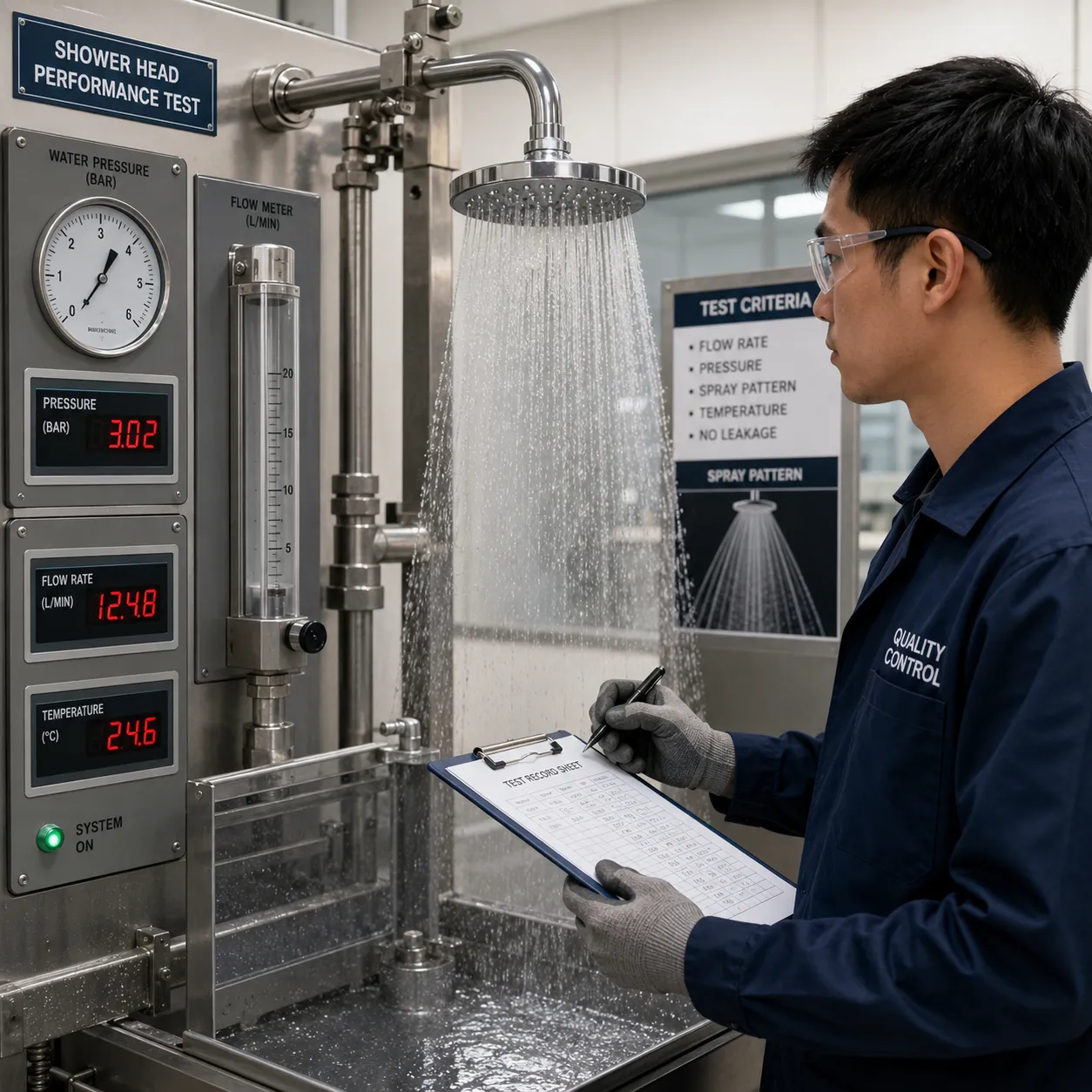
How to Test Shower Head Performance?
Shower head performance testing evaluates water delivery characteristics, ensuring adequate flow and appropriate spray patterns.
Flow Rate Testing
Test Conditions
- Water temperature: <30°C
- Dynamic pressure: 0.10 MPa ± 0.02 MPa
- Pressure stabilization: 1 minute before measurement
Test Procedure
- Install shower head on test apparatus
- Adjust dynamic pressure to 0.10 MPa
- Allow 1 minute stabilization
- Measure flow rate with calibrated meter
- Repeat 3 times, calculate average
Flow Rate Limits
| Shower Type | Maximum Flow Rate |
|---|---|
| Hand-held shower | ≤7.5 L/min |
| Fixed shower head | ≤9.0 L/min |
Spray Pattern Evaluation
Pattern Requirements
- Uniform water distribution
- No excessive concentration in any area
- Appropriate spray angle
- Comfortable spray force
Spray Force Testing
- Handheld showers: Average spray force ≥0.85 N
- Multiple patterns: Test all spray settings
- Measurement: Use force meter at standard distance
Function Switching Test
For Multi-Function Shower Heads
- Test cycles: 10,000 switching cycles
- Test pressure: 0.25 MPa ± 0.02 MPa
- Switching force: Maximum 45 N or 1.7 N·m
- Accessibility: ≤22 N for disabled-accessible units
What Are the Appearance Inspection Criteria?
Visual inspection identifies surface defects that affect aesthetics, functionality, or safety.
Inspection Conditions
Lighting Requirements
- Illumination: 300 lx ± 20 lx
- Viewing distance: 600 mm ± 50 mm
- Light type: Diffuse, non-glare
Surface Quality Standards
Metal Castings
- No shrinkage cavities
- No blisters or bubbles
- No cracks or fractures
- No porosity visible
- No adhering molding sand in internal cavities
Plastic Components
- No ripples or flow marks
- No scratches or abrasions
- No modification damage
- Uniform color and texture
Electroplated Surfaces
- No unplated areas after installation
- Bright, even finish
- No peeling or flaking
- No blistering
- Complete coverage
Safety Requirements
Sharp Edge Inspection
- All user-contactable surfaces must be smooth
- No sharp corners or edges
- No burrs or rough spots
- No projections that could cause injury
Accessibility Compliance
- Reach ranges appropriate for all users
- Controls operable with limited grip strength
- Clear floor space maintained
How to Conduct Shower Sealing Performance Tests?
Sealing tests verify that shower components maintain water integrity under various conditions.
Static Sealing Test
Test Conditions
- Water temperature: 70°C ± 2°C
- Test pressures: 0.05 MPa and 0.50 MPa
- Duration: 5 minutes ± 10 seconds each pressure
Procedure
- Connect shower to water supply
- Set water temperature to 70°C
- Apply 0.05 MPa pressure for 5 minutes
- Inspect all connections for leakage
- Repeat at 0.50 MPa pressure
- Record any water seepage
Acceptance Criteria
- No visible leakage at any connection
- No water seepage between components
- All seals remain intact
Dynamic Sealing Test
Test Conditions
- Hot water: 70°C ± 2°C
- Cold water: 20°C ± 2°C
- Supply pressure: 0.30 MPa ± 0.02 MPa
- Cycles: 300 complete cycles
Procedure
- Supply cold water for 2 minutes
- Switch to hot water for 2 minutes
- Repeat for 300 cycles
- Inspect for leakage throughout test
Acceptance Criteria
- No leaks at any point
- No cracks or permanent deformation
- All functions remain operational
Pressure Cycling Test
Purpose: Evaluate sealing under pressure variations
Test Parameters
- Low pressure: 0.10 MPa ± 0.02 MPa
- High pressure: 0.50 MPa ± 0.02 MPa
- Cycles: As specified by standard
- Temperature: 42°C ± 2°C
Emergency Shower Installation Requirements
Proper installation ensures emergency equipment functions correctly and remains accessible during emergencies.
Location Requirements
Accessibility Standards
- Maximum travel distance: 10 seconds from hazard
- Average walking distance: 16-17 meters (55 feet) in 10 seconds
- Unobstructed path: No doorways, partitions, or machinery between hazard and unit
- Same floor level: No stairs between workstation and equipment
Placement Guidelines
- As close to hazard as practical
- In normal traffic pattern for visibility
- Near emergency exit when possible
- Away from electrical hazards
- Protected from freezing (outdoor units)
Installation Dimensions
Emergency Showers
- Shower head: 208-244 cm (82-96 inches) from floor
- Actuator handle: Maximum 173 cm (69 inches) from floor
- Unobstructed diameter: 86 cm (34 inches) minimum
- Spray pattern center: 41 cm (16 inches) from obstructions
Eyewash Stations
- Nozzle height: 84-135 cm (33-53 inches) from floor
- Distance from wall: Minimum 15 cm (6 inches)
- Basin clearance: Adequate for user's head
Environmental Considerations
Lighting
- Well-lit location
- Visible signage
- Emergency lighting backup
Drainage
- Adequate floor drainage
- Containment for hazardous runoff
- Compliance with waste disposal regulations
Protection
- Freeze protection for outdoor units
- Corrosion protection in chemical areas
- Impact protection in high-traffic zones
Best Practices for Shower Testing Programs
Establish Comprehensive Programs
Documentation Systems
- Maintain test records for all units
- Track inspection schedules
- Document corrective actions
- Archive historical data
Training Requirements
- Train designated inspectors
- Educate all workers on equipment location
- Practice emergency procedures
- Review proper usage techniques
Maintenance Protocols
Preventive Maintenance
- Replace worn components proactively
- Keep spare parts inventory
- Schedule regular servicing
- Address issues before failure
Corrective Actions
- Immediate repair of failed units
- Tag non-functional equipment "DO NOT USE"
- Notify affected personnel
- Document all repairs
Quality Assurance
Audit Programs
- Regular compliance audits
- Third-party inspections
- Management reviews
- Continuous improvement initiatives
Performance Monitoring
- Track test results over time
- Identify recurring issues
- Analyze failure patterns
- Implement systematic solutions
Bottom Line
Shower testing—both emergency safety equipment and product quality—ensures reliable performance when it matters most. Emergency shower testing protects workers from chemical exposure consequences, while product quality testing ensures consumer satisfaction and safety.
Implement systematic testing programs aligned with ANSI Z358.1 for emergency equipment and applicable manufacturing standards for shower products. Regular inspection, proper documentation, and immediate corrective action maintain compliance and protect lives.