Table of Contents
- What Is the Difference Between Skin Corrosion and Skin Irritation?
- Which GHS Categories Govern Skin Corrosion and Irritation?
- How Does In Vitro RhE Testing Replace the Draize Rabbit Test?
- What Are the Exact Viability Thresholds in OECD TG 431 for Corrosion?
- What Is the 50% Decision Point in OECD TG 439 for Irritation?
- When Should You Use the Top-Down Versus Bottom-Up Testing Strategy?
- Which Chinese National Standards Apply to Dermal Corrosion and Irritation?
- How Are Medical Devices Evaluated for Skin Irritation?
- How Does pH Screening Fit Into the Testing Decision Tree?
- FAQ
What Is the Difference Between Skin Corrosion and Skin Irritation?
Skin corrosion produces irreversible damage — visible necrosis extending through the epidermis into the dermis after up to 4 hours of exposure — whereas skin irritation produces reversible damage. This reversibility distinction is the single criterion that separates UN GHS Category 1 (corrosive) from Category 2 (irritant), and it dictates which test method enters the decision tree first.
Corrosive reactions manifest as ulcers, bleeding, bloody scabs, and by the end of the 14-day observation period, discoloration from blanching, alopecia, and scarring. Irritant reactions resolve within the same observation window. Because the biological endpoints differ in severity rather than mechanism, validated in vitro methods can distinguish the two using the same reconstructed human epidermis (RhE) tissue model, simply by varying exposure time and reading viability at different cut-offs.
Read more on the GHS classification framework or the RhE test principle.
Which GHS Categories Govern Skin Corrosion and Irritation?
The UN Globally Harmonized System splits dermal hazards into one irritant category and three corrosive sub-categories, aligned with transport packing groups. The sub-categorization is defined by exposure time and observation window, not by chemistry:
| GHS Category | Exposure | Onset / Observation | Transport Packing Group |
|---|---|---|---|
| 1A | ≤ 3 min | visible destruction within ≤ 1 h | I |
| 1B | > 3 min ≤ 1 h | visible destruction within ≤ 14 d | II |
| 1C | > 1 h ≤ 4 h | visible destruction within ≤ 14 d | III |
| 2 (Irritant) | up to 4 h | mean erythema/eschar or edema ≥ 2.3 and ≤ 4.0 in ≥ 2 of 3 animals at 24/48/72 h | — |
A Category 1 corrosive substance is automatically also classified as an irritant — corrosion is the more severe end of the same hazard spectrum. This hierarchy is what makes the Top-Down testing strategy statistically efficient: confirming corrosion simultaneously resolves irritation.
How Does In Vitro RhE Testing Replace the Draize Rabbit Test?
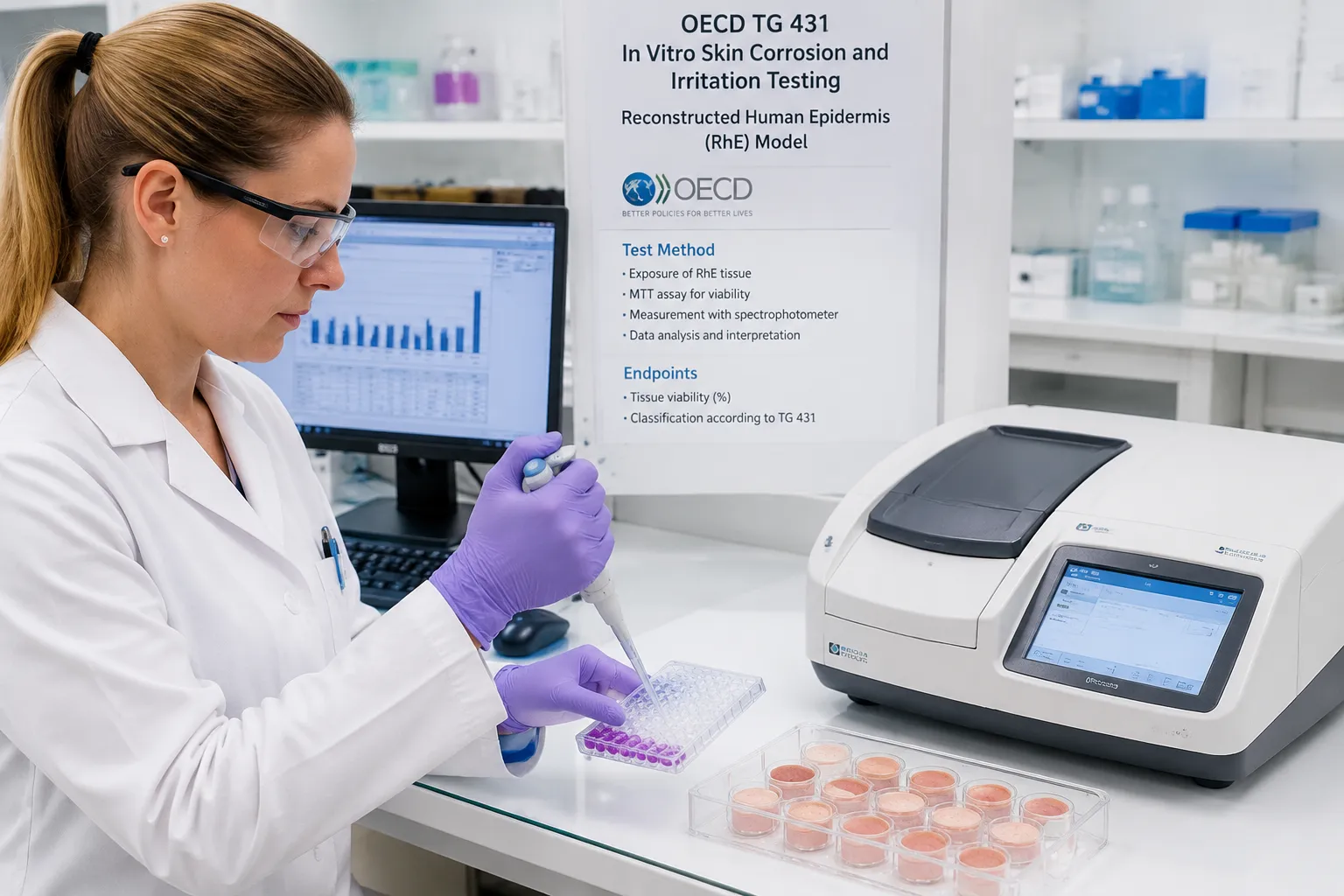
The traditional in vivo method, OECD TG 404 (the Draize rabbit test), has been largely replaced by validated reconstructed human epidermis (RhE) methods under OECD TG 431 (corrosion) and OECD TG 439 (irritation). The RhE model is a three-dimensional construct of living human keratinocytes cultured to form a multi-layered epidermis with a functional stratum corneum — it mimics the biochemical and physiological barrier properties of real human upper skin.
The readout is cell viability measured by the MTT assay: mitochondrial succinate dehydrogenase in viable cells reduces the yellow MTT dye to a purple formazan precipitate. After topical application of the test substance and a defined exposure period, the formazan is extracted and quantified spectrophotometrically. Viability is expressed as a percentage of the concurrent negative control (set to 100%). Because corrosion and irritation differ by severity, the same tissue model distinguishes them through different exposure times and different viability cut-offs.
Two pre-tests are mandatory before running the assay: substances that directly reduce MTT (false viability increase) and strongly colored substances (optical interference) must be screened out first, or the viability reading is invalid.
What Are the Exact Viability Thresholds in OECD TG 431 for Corrosion?
OECD TG 431 classifies corrosion using viability measured at two exposure windows — 3 minutes and 1 hour — against defined cut-offs. These are the authoritative decision points:
| Exposure Time | Cell Viability (vs. negative control) | Classification |
|---|---|---|
| 3 min | < 50% | Category 1A (severe corrosion) |
| 3 min | ≥ 50% | not Cat 1A; proceed to 1 h reading |
| 1 h | < 15% | Category 1 (corrosive — typically 1B or 1C) |
| 1 h | ≥ 35% | Non-corrosive (No Category) |
| 1 h | 15–35% (borderline) | inconclusive — follow-up testing required |
The 35% viability threshold at 1 hour is the critical cut-off that confirms a non-corrosive classification, while the 3-minute reading below 50% isolates the most aggressive Category 1A corrosives. The 15–35% borderline band is not a result in itself; it forces additional testing rather than forcing a classification — a deliberate conservatism built into the guideline to avoid false negatives at the corrosion/irritation boundary.
What Is the 50% Decision Point in OECD TG 439 for Irritation?
OECD TG 439 uses a single viability threshold after a 20-minute exposure and 42-hour post-incubation:
| Mean Tissue Viability (relative to negative control) | Classification |
|---|---|
| > 50% | Non-Irritant (No Category) |
| ≤ 50% | Irritant (UN GHS Category 2) |
This is a binary decision: one number, one cut-off. A result at or below 50% flags the substance as a Category 2 irritant and may indicate potential corrosivity, in which case OECD TG 431 follow-up is warranted. The 50% point is the strongest single differentiator in the dermal testing arsenal because EURL ECVAM validation studies confirmed it reliably separates irritant-but-non-corrosive chemicals from non-irritants.
When Should You Use the Top-Down Versus Bottom-Up Testing Strategy?
The tiered in vitro strategy, formalized in OECD GD 203, runs RhE corrosion and irritation tests in a sequence chosen by the expected hazard severity. The two approaches converge on the same classification but spend test runs efficiently:
Bottom-Up strategy — start with the irritation test (TG 439). If viability is > 50%, the substance is non-irritant and, by extension, non-corrosive — testing stops. This is optimal for mild chemicals and for surfactant-containing cosmetic formulations, where corrosion is unlikely. Validation studies reported that the majority of known non-irritants were correctly classified in vitro via this path, avoiding any corrosion test entirely.
Top-Down strategy — start with the corrosion test (TG 431). If the substance is corrosive, it is automatically also an irritant, so no separate irritation test is needed. This is the correct entry point when existing data (pH extremes, structure–activity relationships, or known analogues) suggest likely corrosivity. Validation studies reported that known in vivo corrosives were consistently identified as corrosive — and therefore irritant — through this single-test path.
The decision hinge: when in vivo data or physicochemical signals point toward severe hazard, go top-down; when the substance is expected to be mild, go bottom-up. Misapplying the strategy costs test runs but rarely misclassifies — validation studies noted that some irritants were over-classified as corrosive by the top-down path (false-positive corrosion), whereas the bottom-up path placed them correctly as irritants only.
Which Chinese National Standards Apply to Dermal Corrosion and Irritation?
Chinese national standards mirror the OECD framework with direct methodological correspondence, allowing a single sample to satisfy both domestic and international regulatory submissions:
| Chinese Standard | Scope | OECD Correspondence |
|---|---|---|
| GB/T 27830-2011 (化学品 体外皮肤腐蚀 人体皮肤模型试验方法) | in vitro skin corrosion using human skin model | OECD TG 431 |
| GB 21604 (化学品 急性皮肤刺激性/腐蚀性试验方法) | acute dermal irritation/corrosion, in vivo | OECD TG 404 |
GB/T 27830-2011 adopts the RhE model principle: terms and definitions, test principle, procedure, and data/reporting requirements align with OECD TG 431, so a test run under GB/T 27830-2011 produces data acceptable under the OECD guideline and vice versa. GB 21604 retains the traditional in vivo method for contexts where animal-test data are still required, but for chemical registration under REACH-equivalent regimes, GB/T 27830-2011 (in vitro) is the preferred route.
How Are Medical Devices Evaluated for Skin Irritation?
Medical devices follow a distinct pathway because the test article is typically a material or extract rather than a neat chemical. The procedure chains two ISO standards:
- ISO 10993-12 — sample preparation: the device material is extracted in polar (e.g., saline) and non-polar (e.g., sesame oil) vehicles under standardized conditions (e.g., 37 °C for 72 h or 50 °C for 72 h), producing test extracts.
- RhE model exposure + MTT viability — the extracts are applied to a reconstructed human epidermis model (e.g., SkinEthic™ RHE), and viability is read by MTT. An extract that reduces viability below the irritation threshold flags the device material as a skin irritant.
This in vitro approach replaces the historical intracutaneous reactivity test in rabbits for many device categories, removing the need for in vivo endpoints entirely for many device types. The medical-device standard landscape also includes a dedicated industry standard for in vitro skin irritation of medical devices using the RhE model, specifying applicability to device extracts.
How Does pH Screening Fit Into the Testing Decision Tree?
pH is a physicochemical screen, not a test, but it carries enough predictive weight to force a classification without any biological assay under specific conditions. Per OSHA HCS 2012 and EU CLP:
- pH ≤ 2 or pH ≥ 11.5, especially when combined with extreme acid/alkali reserve (buffering capacity), indicates strong local effects and the substance is considered leading to skin corrosion (Category 1) at ≥ 1% in a mixture.
- If acid/alkali reserve analysis suggests the mixture will not be corrosive despite the extreme pH, further testing is required to confirm — the pH signal alone is not overridden without evidence.
pH screening is therefore the first gate in the tiered evaluation: it can short-circuit the decision tree by assigning Category 1 directly, or it can trigger RhE testing when the buffering data conflict with the pH reading.
FAQ
Can one RhE test result serve both corrosion and irritation classification?
Yes, but only through the Top-Down path. A Category 1 corrosive result under OECD TG 431 automatically places the substance as an irritant as well, so no separate TG 439 run is needed. A non-corrosive result, however, still requires a TG 439 irritation test to determine Cat 2 vs. No Category.
What happens if viability falls in the 15–35% borderline band in TG 431?
The result is inconclusive for sub-categorization. The guideline requires follow-up testing rather than forcing a classification, to avoid false negatives at the corrosion/irritation boundary. Typically a TG 439 irritation test resolves the classification.
Do colored or MTT-reducing substances invalidate the assay?
They can, which is why two pre-tests are mandatory. A substance that directly reduces MTT inflates apparent viability, and a strongly colored substance interferes with the spectrophotometric readout. Both must be screened before the main assay, or a corrective control run is required.
Is the in vivo Draize test (OECD TG 404) still accepted?
It remains the reference method but is largely superseded by in vitro RhE methods (TG 431/439) for regulatory submissions in the EU and for cosmetic ingredients, where animal testing is banned. GB 21604 preserves the in vivo method for specific domestic contexts where animal data are still requested.
How are mixtures classified when additivity does not apply?
For acids (pH ≤ 2), bases (pH ≥ 11.5), inorganic salts, aldehydes, phenols, and surfactants, the additivity formula fails. OSHA HCS 2012 provides a separate concentration table: e.g., an acid with pH ≤ 2 at ≥ 1% classifies the mixture as Category 1 directly.
What is the minimum information needed befOre testing?
Existing human data, animal experience, structurally related compound data, pH with buffering capacity, and any ex vivo/in vitro data should be reviewed first. This weight-of-evidence step, per OECD TG 404's tiered approach, can be sufficient to classify without new testing.
Our Skin Corrosion and Irritation Testing Capabilities
Beijing ZKGX Research Institute delivers the full in vitro dermal corrosion and irritation testing portfolio described above as accredited third-party services. Our testing follows the validated RhE method framework and applies both the Top-Down and Bottom-Up tiered strategies to match each sample's expected hazard profile.
Standards Our Testing Covers
| Test Endpoint | Method Reference |
|---|---|
| In vitro skin corrosion (RhE model) | OECD TG 431 / GB/T 27830-2011 |
| In vitro skin irritation (RhE model) | OECD TG 439 |
| In vivo acute dermal irritation/corrosion | OECD TG 404 / GB 21604 |
| Integrated testing & assessment strategy | OECD GD 203 |
| Medical device skin irritation (extract method) | ISO 10993-10 / ISO 10993-12 |
What We Can Test
- Chemicals & raw materials — GHS classification (Category 1A/1B/1C/2) for REACH, EU CLP, and China GHS submissions
- Cosmetics & personal care ingredients — animal-free safety assessment supporting product registration
- Mixtures & formulations — including surfactants, acids/bases, and multi-component products where additivity or pH rules apply
- Medical devices — extract-based irritation evaluation per the ISO 10993 series
Sample Types We Accept
Solids, liquids, gels, pastes, creams, and device extracts in polar/non-polar vehicles. The RhE model's topical application route accommodates most physical forms that contact human skin.
Get a Testing Quote
If you need a skin corrosion or irritation classification for a chemical, cosmetic, or device, our team will confirm the applicable standard, sample requirements, and a quotation. Contact Beijing ZKGX Research Institute to start.
Note: This article references authoritative standards including OECD TG 431, OECD TG 439, GB/T 27830-2011, GB 21604, and OSHA HCS 2012. Verify specific thresholds against the current adopted versions of each guideline before regulatory submission.