Toothpaste testing encompasses a comprehensive range of evaluation methods used to verify the safety, efficacy, and quality of toothpaste products for oral hygiene applications. These testing procedures are critical for ensuring that toothpastes effectively clean teeth, prevent dental caries, and do not pose health risks from contaminants or excessive abrasivity.
This comprehensive guide covers all major toothpaste testing methodologies, from heavy metal contamination analysis to abrasivity evaluation. You'll learn how to measure fluoride content, assess cleaning efficacy, evaluate safety parameters, and ensure compliance with regulatory standards.
What you'll learn in this guide:
- Heavy metal testing (lead, arsenic, mercury, cadmium)
- Abrasivity testing (RDA and REA methods)
- Fluoride content analysis
- Cleaning efficacy and plaque removal
- Whitening performance evaluation
- Safety and toxicity testing
- Microbiological testing
- Regulatory standards and compliance
Importance of Toothpaste Testing
Testing toothpaste serves critical functions for consumer safety, product efficacy, and regulatory compliance.
Key benefits of toothpaste testing:
Consumer safety: Testing identifies harmful contaminants like heavy metals that can cause serious health effects, especially in children, including cognitive damage, kidney disease, and cancer.
Efficacy verification: Testing confirms that toothpaste delivers claimed benefits such as cavity prevention, tartar control, sensitivity relief, and whitening.
Abrasion control: Abrasivity testing ensures toothpaste cleans effectively without causing excessive wear to tooth enamel or dentine.
Regulatory compliance: Certified testing provides documentation required by FDA, ADA, and international regulatory agencies for market access and product claims.
Quality consistency: Regular testing ensures manufacturing consistency and identifies variations that could affect safety or performance.
Environmental protection: Heavy metal testing prevents environmental contamination from personal care products entering water systems.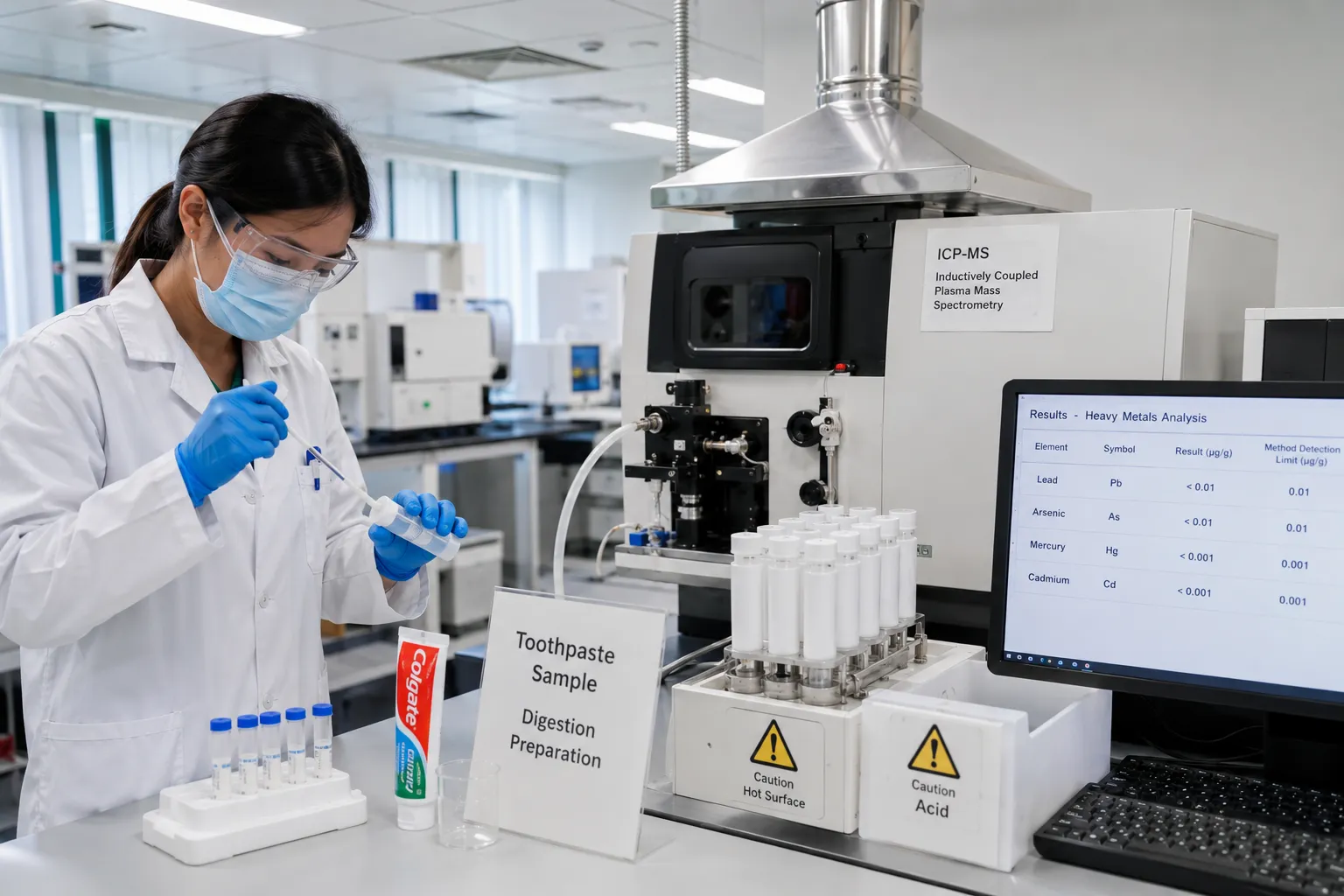
Heavy Metal Testing
Contaminants of Concern
Lead (Pb):
- No safe level of exposure exists, especially for children
- Causes irreversible cognitive and developmental damage
- Contributes to kidney damage and heart disease in adults
- Carcinogenic properties
- Found in approximately 90% of tested toothpastes
Arsenic (As):
- Highly toxic metalloid
- Causes cellular alterations and skin cancer
- Neurological impairment
- Found in approximately 65% of tested toothpastes
Mercury (Hg):
- Causes oxidative stress and cellular damage
- Neurological toxicity
- Environmental persistence
- Found in approximately 50% of tested toothpastes
Cadmium (Cd):
- Multi-tissue carcinogen affecting lungs, kidneys, pancreas
- Bioaccumulates in the body
- Found in approximately 33% of tested toothpastes
Sources of Contamination
Bentonite clay:
- Used for cleaning properties
- Can be contaminated with lead and arsenic depending on source
- Highest contamination levels found in clay-heavy formulas
- Geographic source affects contamination level
Hydroxyapatite:
- Often sourced from cow bones
- Added for remineralization claims
- Can introduce lead and cadmium
- Source purification critical
Calcium carbonate:
- Gentle abrasive for stain removal
- Can carry measurable lead
- Quality varies by source
Other ingredients:
- Titanium dioxide
- Flavoring compounds
- Color additives
- All potential contamination routes
Testing Methods for Heavy Metals
inductively coupled plasma mass spectrometry (ICP-MS):
- Most sensitive and accurate method
- Detects multiple metals simultaneously
- Detection limits: typically 0.1-1 ppb
- Used by accredited laboratories
Atomic Absorption Spectroscopy (AAS):
- Flame or graphite furnace methods
- Good sensitivity for individual metals
- Lower cost than ICP-MS
- Widely available
X-ray Fluorescence (XRF):
- Non-destructive screening method
- Portable instruments available
- Lower sensitivity than laboratory methods
- Useful for initial screening
Regulatory Limits
FDA limits (United States):
- Fluoride-free toothpaste: 10,000 ppb lead
- Fluoride toothpaste: 20,000 ppb lead
- No specific limits for arsenic, mercury, or cadmium
- Critics consider limits outdated and insufficiently protective
Washington State limits:
- Lead: 1,000 ppb (recently enacted)
- More protective than federal standards
- Several products have exceeded this limit
California limits:
- Baby food lead limit: 6 ppb
- Most toothpastes exceed baby food limits
- No specific toothpaste limits
International variations:
- EU: Generally more stringent
- Canada: Health Canada guidelines
- Australia: TGA requirements
Sample Preparation
Acid digestion:
- Microwave-assisted digestion
- Nitric acid or mixed acid solutions
- Complete dissolution of sample
- Dilution to appropriate concentration
Quality control:
- Certified reference materials
- Method blanks
- Spike recovery samples
- Duplicate analyses
Abrasivity Testing
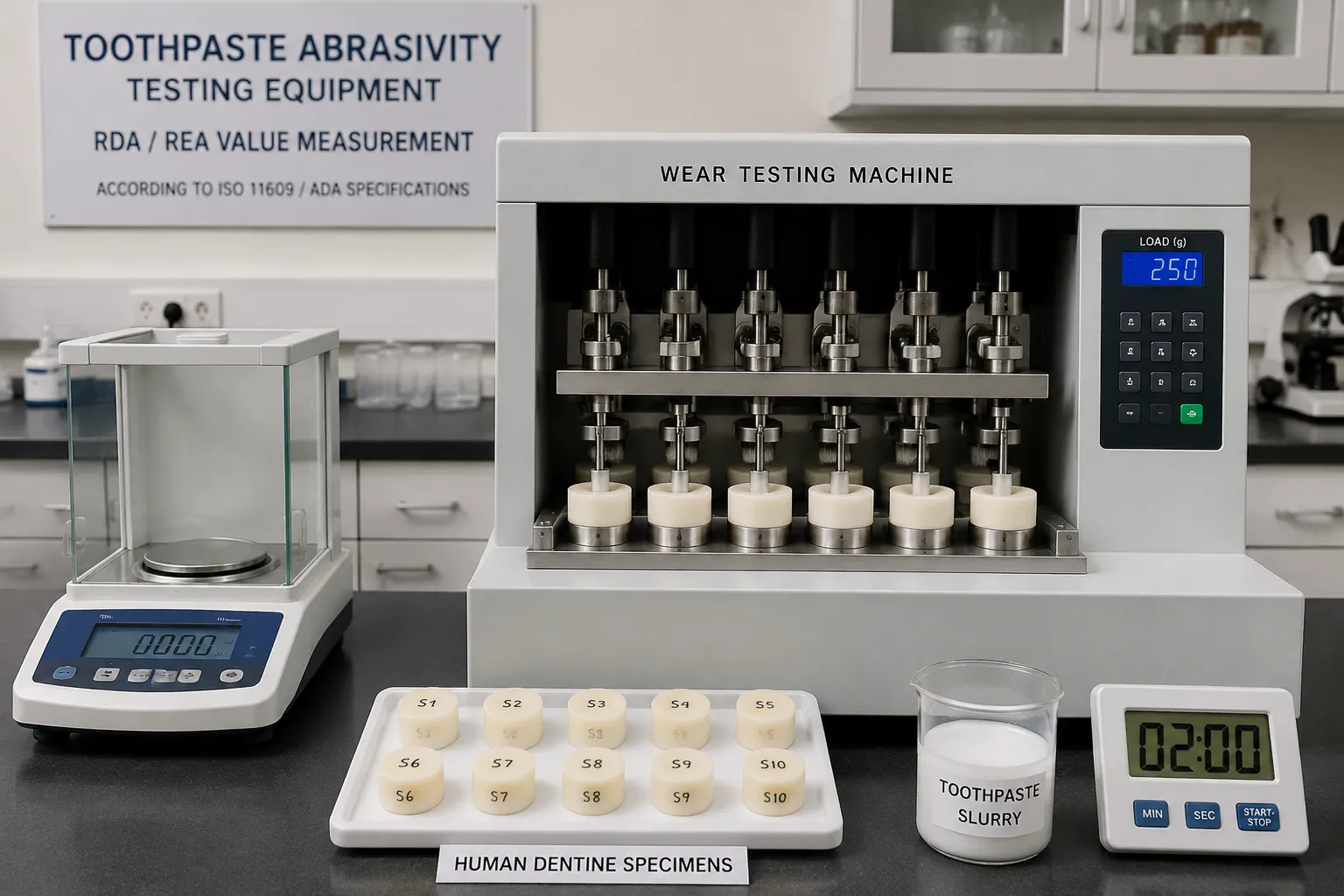
Relative Dentine Abrasivity (RDA)
Purpose: Measure toothpaste abrasiveness to dentine (softer than enamel)
Test method:
- Prepare human or bovine dentine specimens
- Apply toothpaste slurry with standardized brushing
- Measure dentine wear after brushing
- Compare to reference standard
- Calculate RDA value
Reference standard:
- Calcium pyrophosphate assigned RDA = 10
- All values relative to this standard
Classification:
- Low abrasivity: RDA < 70
- Medium abrasivity: RDA 70-100
- High abrasivity: RDA 100-150
- Very high abrasivity: RDA > 150
Clinical significance:
- Lower RDA recommended for sensitive teeth
- Higher RDA for stain removal
- Balance between cleaning and wear
- ADA recommends RDA < 250
Relative Enamel Abrasivity (REA)
Purpose: Measure abrasiveness to tooth enamel
Test method:
- Similar to RDA but uses enamel specimens
- Enamel is harder than dentine
- Less affected by abrasives
- Important for long-term wear assessment
Typical values:
- Generally lower than RDA values
- Range: 2-15 for most toothpastes
- Higher values indicate more enamel wear potential
Factors Affecting Abrasivity
Abrasive particles:
- Silica (most common)
- Calcium carbonate
- Alumina
- Dicalcium phosphate
Particle characteristics:
- Size: typically 5-40 microns
- Shape: spherical vs. angular
- Hardness: affects cleaning and wear
- Concentration in formula
Other factors:
- Fluoride compounds can affect abrasivity
- Surfactants influence cleaning
- Viscosity affects particle contact
- pH can affect substrate hardness
Fluoride Testing
Total Fluoride Analysis
Ion-selective electrode method:
- Direct measurement of fluoride ion
- TISAB buffer to release bound fluoride
- Calibration with fluoride standards
- Rapid and accurate
Ion chromatography:
- Separates and quantifies fluoride
- Can measure other anons simultaneously
- Higher sensitivity
- More complex method
Fluoride Types in Toothpaste
Sodium fluoride (NaF):
- Most common form
- Good stability
- Typical concentration: 1,000-1,500 ppm F
Sodium monofluorophosphate (Na2PO3F):
- Requires enzymatic hydrolysis to release F-
- Slightly less effective than NaF
- Compatible with calcium abrasives
Stannous fluoride (SnF2):
- Provides additional antimicrobial benefits
- Less stable than NaF
- Can cause staining
- Typical concentration: 1,000 ppm F
Fluoride Efficacy Testing
In vitro demineralization/remineralization:
- pH cycling models
- Measure enamel hardness changes
- Assess caries prevention potential
- Compare to non-fluoride controls
Clinical correlation:
- Fluoride concentration correlates with caries reduction
- 1,000 ppm F minimum for efficacy
- Higher concentrations for prescription products
Cleaning Efficacy Testing
Pellicle Cleaning Ratio (PCR)
Purpose: Measure ability to remove acquired pellicle (stain-attractive film)
Test method:
- Create standardized stain on enamel specimens
- Stain solution: tea, coffee, red wine, casein
- Brush specimens in standardized machine
- Measure remaining stain
- Calculate cleaning ratio
Typical values:
- Higher PCR = better cleaning
- Range: 30-110 for commercial toothpastes
- Influenced by abrasivity and surfactants
Plaque Removal Assessment
In vitro methods:
- Artificial plaque substrates
- Standardized brushing simulation
- Gravimetric or visual measurement
- Comparisons between formulations
Clinical studies:
- Plaque indices (Silness-Löe, Turesky)
- Controlled brushing studies
- Professional and supervised brushing
- Real-world efficacy data
Whitening Performance Testing
Shade Guide Measurement
VITA Bleachedguide:
- Industry standard shade guide
- Extended range for bleached teeth
- Before and after comparison
- Quantifies shade changes
Test protocol:
- Create stained enamel specimens
- Brush for standardized period (e.g., 1 week equivalent)
- Measure shade before and after
- Calculate shade change
Typical results:
- 0.5-1 shade: minimal whitening
- 1-2 shades: moderate whitening
- 2-3+ shades: significant whitening
Surface Stain Removal
Methods:
- Spectrophotometric measurement
- Colorimetry (Lab* values)
- Visual assessment by calibrated examiners
- Image analysis
Factors affecting whitening:
- Abrasivity (mechanical removal)
- Chemical agents (peroxide, enzymes)
- Cleaning efficiency
- Application time
Microbiological Testing
Preservative Efficacy
Challenge testing:
- Inoculate product with specified microorganisms
- Monitor survival over time
- Verify preservative system effectiveness
- Required for product stability
Test organisms:
- Bacteria: Pseudomonas, Staphylococcus, E. coli
- Yeast: Candida albicans
- Mold: Aspergillus niger
Microbial Limits Testing
Total aerobic count:
- Determines total bacterial load
- Must meet specified limits
- Typically < 100-1,000 CFU/g
Absence of pathogens:
- No Pseudomonas aeruginosa
- No Staphylococcus aureus
- No Candida albicans
- No E. coli
Safety and Toxicity Testing
Cytotoxicity testing
In vitro methods:
- Cell culture exposure to extracts
- MTT or similar viability assays
- ISO 10993-5 guidelines
- Required for new ingredients
Acceptance criteria:
- Cell viability > 70% typically acceptable
- No evidence of cytotoxicity
- Dose-response evaluation
Irritation and Sensitization
Mucosal irritation:
- Hamster cheek pouch model
- Human repeated insult patch test (HRIPT)
- Oral mucosal irritation assessment
Sensitization potential:
- Guinea pig maximization test
- Local lymph node assay
- Human patch testing
Fluoride Toxicity
Acute toxicity:
- Calculate fluoride dose per use
- Assess risk of accidental ingestion
- Child-resistant packaging requirements
- Warning label requirements
Chronic exposure:
- Dental fluorosis risk (children)
- Skeletal fluorosis (extreme exposure)
- Safe use instructions
Quality Control Testing
Physical Properties
pH measurement:
- Typical range: 5.5-9.0
- Affects enamel and fluoride stability
- Must be consistent batch-to-batch
Viscosity/rheology:
- Affects dispensing and use
- Must remain stable over shelf life
- Temperature effects assessment
Particle size distribution:
- Abrasive particle size
- Affects abrasivity and texture
- Laser diffraction or microscopy
Stability Testing
Accelerated stability:
- Elevated temperature (40°C)
- Elevated humidity (75% RH)
- Monitor over 3-6 months
- Predict shelf life
Real-time stability:
- Room temperature storage
- Monitor over claimed shelf life
- Verify accelerated predictions
Parameters monitored:
- Appearance and color
- pH
- Fluoride content
- Microbiological quality
- Rheology
Regulatory Requirements
FDA Requirements (United States)
Monograph compliance:
- Fluoride dentifrice monograph
- Active ingredient specifications
- Labeling requirements
- Warning statements
Heavy metal limits:
- Lead: 10,000-20,000 ppb depending on fluoride
- Mercury, arsenic, cadmium: no specific limits
- Industry self-regulation common
Good Manufacturing Practice:
- 21 CFR 211 requirements
- Quality control procedures
- Documentation requirements
- Batch release testing
ADA Seal of Acceptance
Requirements:
- Clinical studies for efficacy claims
- Safety documentation
- Fluoride content verification (for cavity protection claims)
- RDA < 250
- Quality control procedures
Review process:
- Council on Scientific Affairs evaluation
- Independent expert review
- Ongoing compliance monitoring
- Periodic re-evaluation
International Standards
ISO standards:
- ISO 11609: Dentifrices - requirements and test methods
- ISO 14569: Abrasivity testing methods
- ISO 10271: corrosion testing
EU requirements:
- Cosmetic Regulation (EC) No 1223/2009
- Heavy metal limits (Annex II)
- Safety assessment requirements
- CPNP notification
Testing Laboratory Requirements
Accreditation
ISO 17025:
- General requirements for testing laboratories
- Technical competence
- Quality management system
- Traceability of measurements
GLP compliance:
- Good Laboratory Practice
- Required for regulatory submissions
- Documentation and data integrity
- Quality assurance oversight
Method Validation
Parameters validated:
- Accuracy (recovery)
- Precision (repeatability, reproducibility)
- Specificity
- Linearity
- Detection and quantitation limits
- Robustness
Quality Assurance
Quality control samples:
- Certified reference materials
- Method blanks
- Spike samples
- Duplicate analyses
Proficiency testing:
- Inter-laboratory comparisons
- External quality assessment
- Ongoing competence verification
Frequently Asked Questions
Why are heavy metals found in toothpaste?
Heavy metals contaminate toothpaste through raw materials like bentonite clay, hydroxyapatite, and calcium carbonate. These ingredients can carry lead, arsenic, mercury, and cadmium depending on their geographic source and processing. Contamination is typically unintentional but widespread.
What is RDA and why does it matter?
RDA (Relative Dentine Abrasivity) measures how abrasive toothpaste is to the softer dentine layer of teeth. Higher RDA values indicate more abrasiveness, which cleans better but can cause wear over time. Most dentists recommend RDA below 100 for daily use, and ADA requires RDA below 250 for their Seal.
How is fluoride content tested in toothpaste?
Fluoride is tested using ion-selective electrodes or ion chromatography. The sample is prepared with a buffer (TISAB) to release bound fluoride, then measured against calibration standards. Total fluoride must meet label claims and regulatory limits (typically 1,000-1,500 ppm).
What are safe limits for lead in toothpaste?
FDA limits are 10,000 ppb for fluoride-free and 20,000 ppb for fluoride toothpaste. However, no level of lead exposure is considered safe, especially for children. Washington State recently set a 1,000 ppb limit, and many health advocates argue for even lower limits.
How do manufacturers test whitening claims?
Whitening is tested using stained enamel specimens brushed for standardized periods. Shade is measured using guides like VITA Bleachedguide before and after brushing. Products can claim specific shade improvements based on these controlled tests.
What microbiological testing is required?
Toothpaste must undergo preservative efficacy testing (challenge testing) and microbial limits testing. Products must demonstrate they can prevent microbial growth during use and meet limits for total aerobic count and absence of specified pathogens.
How often should toothpaste be tested?
Testing occurs at multiple stages: incoming raw materials, in-process checks, final product release, and stability monitoring. Heavy metal testing should occur on each batch or at defined intervals. Stability testing continues throughout shelf life.
What is the difference between RDA and REA?
RDA (Relative Dentine Abrasivity) measures wear on dentine, which is softer and more susceptible to abrasion. REA (Relative Enamel Abrasivity) measures wear on harder enamel. RDA is the industry standard because dentine wear is more clinically relevant for most patients.
Conclusion
Toothpaste testing provides the essential foundation for oral care product safety, efficacy, and quality. Comprehensive testing programs that include heavy metal analysis, abrasivity evaluation, fluoride verification, and cleaning efficacy assessment enable manufacturers to deliver products that are safe, effective, and compliant with regulatory requirements.
Understanding testing methods, maintaining rigorous quality control, and achieving appropriate certifications ensures that toothpastes provide reliable oral health benefits without posing health risks from contamination or excessive abrasivity. The investment in proper testing pays dividends through enhanced consumer safety, regulatory compliance, and product performance.
Key takeaways:
- Heavy metal testing is critical as 90% of toothpastes contain detectable lead
- RDA testing ensures effective cleaning without excessive wear
- Fluoride analysis verifies cavity prevention efficacy
- Cleaning efficacy testing validates stain removal claims
- Regulatory limits vary significantly between jurisdictions
- Quality control testing ensures batch-to-batch consistency
- Stability testing verifies shelf life claims
- Accredited laboratories provide reliable, defensible results
The commitment to rigorous toothpaste testing demonstrates manufacturer dedication to consumer safety, product quality, and regulatory compliance in this essential daily oral hygiene product.
Note: This article provides general guidance on toothpaste testing methods. Always consult relevant standards (ISO, FDA monographs), manufacturer specifications, and regulatory requirements for detailed testing procedures and acceptance criteria. Reference authoritative sources including FDA, ADA Council on Scientific Affairs, and ISO for current standards and best practices.