Table of Contents
- Why Is Infant Pacifier Testing Necessary?
- What Physical and Mechanical Tests Are Required?
- What Are the CPSIA Chemical Limits (Lead, Phthalates)?
- How Are N-Nitrosamines Tested (ASTM F1313)?
- How Is Bisphenol A Migration Tested and Why Does It Matter?
- How Do US, European, and Chinese Standards Compare?
- What Does a Complete Pacifier Test Program Include?
- FAQ
- Our Infant Pacifier safety testing Capabilities
Why Is Infant Pacifier Testing Necessary?
Infant pacifier testing exists because a pacifier is placed in the mouth of a baby who cannot report a defect — so every possible failure mode (choking, suffocation, chemical ingestion) must be found by laboratory testing before the product reaches the market. A pacifier consists of a nipple intended for sucking, a guard or shield at the base that prevents the whole pacifier from being drawn into the child's mouth, and usually a handle or ring. Each of those components can fail in a way that harms an infant: the shield can be too small and allow swallowing, the nipple can tear off and become a choking hazard, and the plastic can leach endocrine-disrupting chemicals into the baby's saliva.
The regulatory driver in the United States is the CPSC pacifier regulation, 16 CFR Part 1511, backed by the Consumer Product Safety Improvement Act (CPSIA). Since 2014 the CPSC has received multiple reports involving pacifiers — including choking, bitten-off pieces, and fingers caught in small holes — with at least one fatality. Testing to the mandatory standards is how a manufacturer proves, via a Children's Product Certificate issued on the basis of accredited third-party laboratory testing, that the product will stay in one piece and will not poison the child who sucks on it. An untested or non-compliant pacifier is not a quality issue — it is a recall and liability issue.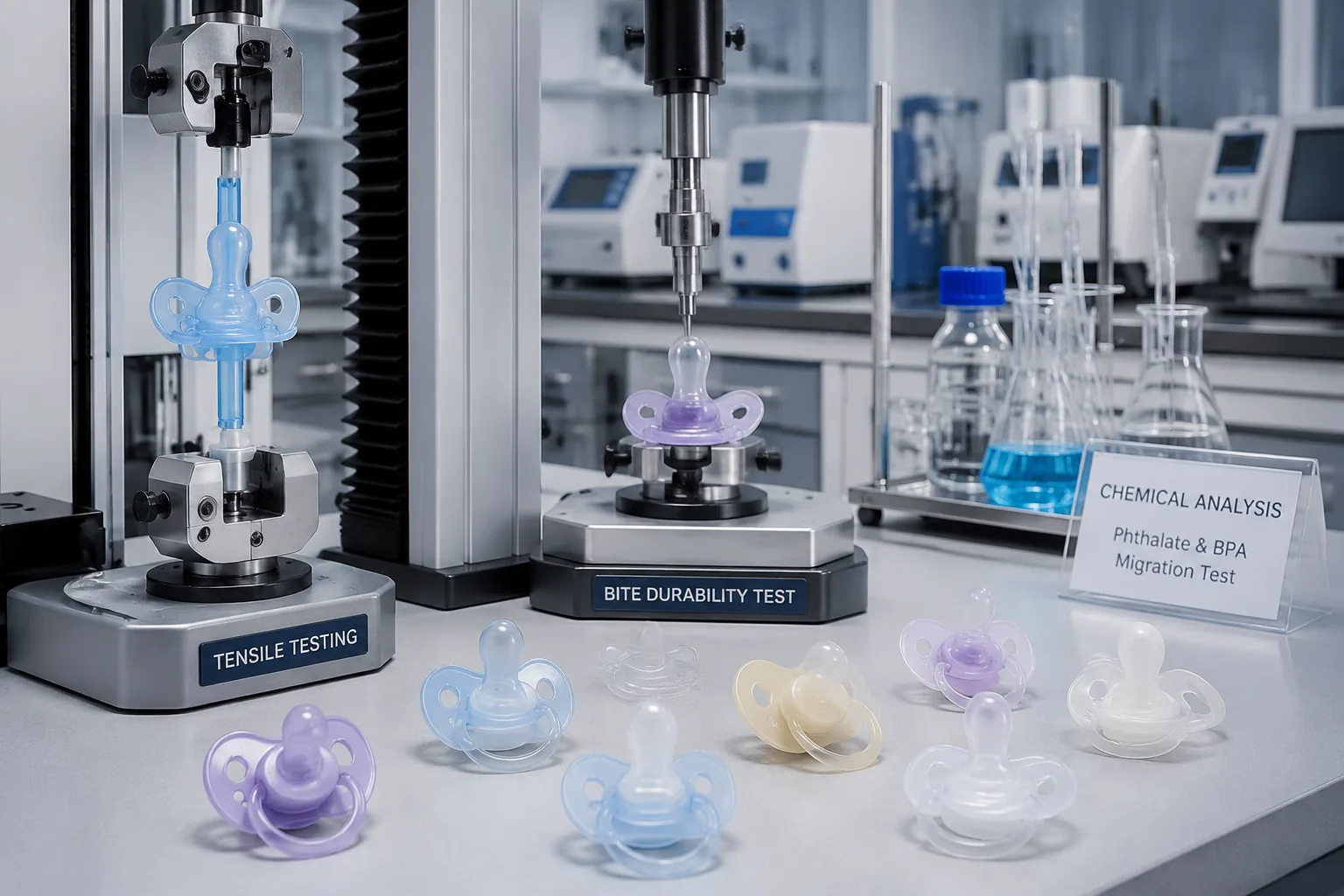
What Physical and Mechanical Tests Are Required?
The physical and mechanical test battery simulates the realistic use and foreseeable abuse an infant will subject the pacifier to. The principal tests, drawn from 16 CFR Part 1511, ASTM F963, EN 1400, and GB 28482, are:
| Test | What It Prevents | Standard Reference |
|---|---|---|
| Shield integrity & ventilation | Whole-pacifier swallowing; suffocation from blocked airway | 16 CFR 1511 / EN 1400 / GB 28482 |
| Protrusion limitation (impact) | Pacifier forced into the mouth if baby falls on face | 16 CFR 1511 |
| Structural integrity (tensile) | Nipple or handle tearing off → choking | 16 CFR 1511 / ASTM F963 |
| Bite/tear durability | Nipple failure from repeated biting | GB 28482 §6.5 / EN 1400 |
| Abuse testing (pull/twist/drop) | Small-parts detachment under rough handling | 16 CFR 1500.51 / 1500.52 / ASTM F963 |
The shield test is the most safety-critical: the shield must be large enough that the pacifier cannot enter the infant's mouth and block the throat, and it must have ventilation holes so that if the pacifier does seat against the face the child can still breathe. The protrusion test guards against the scenario where a baby falls face-down onto the pacifier — the protruding handle or ring must not drive the nipple dangerously far into the mouth. The structural-integrity and abuse tests apply defined tensile and torsional loads (and defined drop conditions) and then check that no small part has detached, because a detached nipple or fragment is the classic small-parts choking hazard.
A pacifier must stay in one piece after all of these tests. Any detachment of a component that fits entirely within the small-parts cylinder (16 CFR Part 1501) is a failure.
What Are the CPSIA Chemical Limits (Lead, Phthalates)?
Beyond physical safety, the CPSIA imposes strict chemical-content limits on the accessible materials of a pacifier. These are the binding thresholds a third-party laboratory must verify:
| Substance | Limit | Basis |
|---|---|---|
| Lead in surface coatings (paint) | ≤ 0.009% (90 ppm) | 16 CFR Part 1303 |
| Total lead in accessible components | ≤ 100 ppm (0.01%) | CPSIA §101 |
| 8 specified phthalates (DEHP, DBP, BBP, DINP, DIBP, DPENP, DHEXP, DCHP) | ≤ 0.1% each, in plasticized components | CPSIA §108 |
The lead limits protect against neurodevelopmental harm — there is no safe blood-lead level in infants. The phthalate limits target endocrine disruption: the eight listed phthalates are restricted because they interfere with hormone signaling during sensitive developmental windows, and infants ingest them by mouthing the plasticized components. Testing for total lead is done by digesting the accessible material and quantifying lead (typically by ICP-OES or ICP-MS); phthalate testing extracts the plasticizer and quantifies each compound by GC-MS. A pacifier lot cannot be certified — and cannot carry a valid Children's Product Certificate — until these chemical results are on file from a CPSC-accepted laboratory.
How Are N-Nitrosamines Tested (ASTM F1313)?
N-nitrosamines are volatile carcinogenic compounds that can form in the vulcanization of rubber nipples. They are regulated under ASTM F1313 (Standard Specification for Volatile N-Nitrosamines in Rubber Baby Pacifier Nipples), referenced by ASTM F963 §4.20. The standard sets upper limits on specific nitrosamines in the rubber nipple material — the regulated nitrosamines include N-nitrosodimethylamine (NDMA) and N-nitrosodiethylamine (NDEA), among others, each with a low-ppb ceiling.
The test method extracts the volatile nitrosamines from the rubber and quantifies them, typically by gas chromatography with a thermal-energy-analyzer or mass-spectrometric detector. The reason for the tight limit is direct: the infant sucks on the nipple for extended periods, and nitrosamines migrating from the rubber into the baby's saliva are ingested. Because nitrosamines are proven animal carcinogens and probable human carcinogens, the exposure pathway is considered unacceptable above the specified ceiling, and a rubber nipple exceeding it fails the ASTM F1313 requirement and therefore the pacifier regulation.
The Chinese standard GB 28482-2012 goes further: it requires testing for both N-nitrosamines and N-nitrosatable substances (precursors that can convert to nitrosamines in the body), covering a broader chemical-risk surface than the US rubber-nipple-only scope.
How Is Bisphenol A Migration Tested and Why Does It Matter?
Bisphenol A (BPA) is an endocrine-disrupting compound used in polycarbonate plastics and epoxy resins, associated with metabolic, reproductive, and neurodevelopmental disorders. Infants and toddlers are especially vulnerable because their detoxification capacity is immature and exposure occurs during sensitive developmental stages. While BPA is banned in infant feeding bottles in the European Union, its use in pacifiers has remained less uniformly regulated — and a 2026 peer-reviewed study found that "BPA-free" labeling is not a reliable guarantee of safety.
The study (Herwanger et al., Environmental Science and Pollution Research, 2026, DOI: 10.1007/s11356-026-37444-1) analyzed seven commercially available pacifiers by dissecting them into shield and teat components, cutting the materials into fragments, and measuring BPA migration into a simulant using validated high-performance liquid chromatography with fluorescence detection (HPLC-FLD). The findings:
| Measurement | Range |
|---|---|
| BPA in eluate | Below LOQ up to 288 µg/L |
| Total BPA release per pacifier | 33 to 26,536 ng |
| Highest migration | Observed in a product labeled "BPA-free" |
Assessed against the European food safety Authority's revised 2023 tolerable daily intake (TDI) of 0.2 ng/kg body weight/day — a 20,000-fold tightening from the former 2015 TDI of 4 µg/kg bw/day — even the lowest total migration exceeded the new TDI in a worst-case exposure scenario. The practical implication for pacifier testing is that BPA migration must be measured, not inferred from a "BPA-free" label, and the method of choice is HPLC-FLD (or GC-MS) on migrated extracts. The result reclassifies pacifiers as a relevant early-life source of BPA exposure and underlines the case for harmonized regulation analogous to the existing bans on BPA in feeding bottles and toys.
How Do US, European, and Chinese Standards Compare?
Pacifier safety is governed by three regional frameworks that overlap in scope but differ in structure and in the strictness of certain chemical requirements:
| Region | Primary Standard | Scope | Distinctive Requirement |
|---|---|---|---|
| United States | 16 CFR Part 1511 + ASTM F963 + ASTM F1313 + CPSIA | Physical/mechanical + chemical (lead, phthalates, nitrosamines) | CPSC-accepted third-party testing + Children's Product Certificate; 8 phthalates |
| European Union | EN 1400:2013+A2:2018 | General safety + mechanical + chemical (single consolidated doc) | CE marking; General Product Safety Directive compliance |
| China | GB 28482-2012 (mandatory) | Modified-adopted from EN 1400 | Stricter on phthalates (6, ≤0.1% each material) and N-nitrosamines / N-nitrosatables |
The most important cross-regional difference is that GB 28482-2012 is stricter on chemical safety than the EN 1400 it was modeled on. China added explicit phthalate-content requirements and test methods (6 phthalates ≤0.1% per material, by GB/T 22048 GC-MS) and added release limits for both N-nitrosamines and N-nitrosatable substances — closing gaps the original EN 1400:2002 left open. A globally marketed pacifier therefore cannot assume one regional pass transfers to another: a lot qualified for the EU must still be tested to CPSIA chemistry for the US, and to GB 28482's tighter plasticizer and nitrosamine rules for China. A complete third-party test program runs all three.
What Does a Complete Pacifier Test Program Include?
Bringing the physical, mechanical, and chemical requirements together, a complete third-party pacifier test program covers the following test groups:
| Test Group | Tests | Method Basis |
|---|---|---|
| Physical / mechanical | Shield size & ventilation, protrusion/impact, tensile (nipple & handle), bite/tear durability, abuse (pull/twist/drop), small-parts | 16 CFR 1511 / ASTM F963 / EN 1400 / GB 28482 |
| Heavy metals | Total lead (accessible), specific-element migration (Sb, As, Ba, Cd, Cr, Pb, Hg, Se) | CPSIA / EN 71-3 style / GB 28482 |
| Phthalates | DEHP, DBP, BBP, DINP, DIBP, DPENP, DHEXP, DCHP (US); 6 phthalates (CN) | CPSIA §108 / GB/T 22048 (GC-MS) |
| N-Nitrosamines | Volatile N-nitrosamines in rubber nipples; N-nitrosamines + N-nitrosatables (CN) | ASTM F1313 / GB 28482 |
| BPA migration | BPA migrating into simulant from shield & teat | HPLC-FLD / GC-MS |
| VOCs & formaldehyde | Volatile organic compounds, formaldehyde release | EN 1400 / GB 28482 |
| Labeling | Strangulation warning, tracking label, age guidance | 16 CFR 1511 / CPSIA / EN 1400 |
A lot that passes all applicable groups earns its regional certifications: a Children's Product Certificate (US), CE conformity (EU), and GB 28482 compliance (China). The test report is the evidence a regulator or retailer requests in a recall audit or a marketplace listing review — which is why Consumer Reports' finding of non-compliant pacifiers on major marketplaces is traced back to sellers who could not produce these test reports.
FAQ
Can a pacifier be sold in the US without third-party testing?
No. Pacifiers are children's products under the CPSIA and must be tested by a CPSC-accepted, accredited third-party laboratory for compliance with 16 CFR Part 1511, ASTM F963 (including the ASTM F1313 nitrosamine requirement), and the CPSIA chemical limits. The manufacturer or importer must then issue a Children's Product Certificate based on that testing.
What phthalates are banned in pacifiers, and at what level?
In the US, the CPSIA restricts eight phthalates — DEHP, DBP, BBP, DINP, DIBP, DPENP, DHEXP, and DCHP — each to no more than 0.1% in plasticized components. China's GB 28482-2012 restricts six phthalates at the same 0.1%-per-material ceiling (tested by GB/T 22048, GC-MS).
Is a "BPA-free" label a guarantee of safety?
No. A 2026 peer-reviewed study (Herwanger et al.) found that the highest BPA migration among tested pacifiers came from a product labeled "BPA-free." BPA migration must be measured by HPLC-FLD or GC-MS on migrated extracts, not inferred from a voluntary label.
What is the difference between EN 1400 and GB 28482?
GB 28482-2012 (China, mandatory) was modified-adopted from EN 1400 (Europe) but adds stricter requirements for phthalates (6, ≤0.1% per material) and for both N-nitrosamines and N-nitrosatable substances. A pacifier that passes EN 1400 must still be tested to GB 28482's tighter chemical rules for the Chinese market.
Why are N-nitrosamines regulated in rubber pacifier nipples?
N-nitrosamines are volatile carcinogens that can form during rubber vulcanization and migrate into the infant's saliva during sucking. ASTM F1313 sets low-ppb ceilings for specific nitrosamines (including NDMA and NDEA) in rubber nipples; the exposure pathway — prolonged mouthing by an infant — makes even small concentrations unacceptable.
What happens if a pacifier fails the shield or protrusion test?
It cannot be certified or sold. A shield that is too small risks whole-pacifier ingestion and airway blockage; a protrusion that fails the impact test risks the nipple being driven into the throat if the baby falls on the pacifier. Both are core requirements of 16 CFR Part 1511, EN 1400, and GB 28482, and any failure is a recall-level defect.
Our Infant Pacifier Safety Testing Capabilities
Beijing ZKGX Research Institute provides third-party safety testing for infant pacifiers and soothers. Our testing follows the validated US (16 CFR 1511 / ASTM F963 / F1313 / CPSIA), European (EN 1400), and Chinese (GB 28482-2012) frameworks, applied to each product's target markets.
Standards / Methods Our Testing Covers
| Test Endpoint | Method Reference |
|---|---|
| Pacifier physical/mechanical safety | 16 CFR Part 1511 / ASTM F963 |
| Volatile N-nitrosamines (rubber nipples) | ASTM F1313 |
| Lead (coatings & total) and phthalates | CPSIA / 16 CFR Part 1303 |
| Soother general safety (EU) | EN 1400:2013+A2:2018 |
| Soother safety (China, mandatory) | GB 28482-2012 |
| Phthalate content (GC-MS) | GB/T 22048 |
| BPA migration (HPLC-FLD / GC-MS) | Validated in-house methods |
| Heavy-element migration | EN 71-3 style / GB 28482 |
What We Can Test
- Complete pacifiers / soothers — full physical, mechanical, and chemical test program for US, EU, or CN market certification
- Rubber & silicone nipples — nitrosamine (ASTM F1313 / GB 28482) and N-nitrosatable substance release
- Plasticized shields, handles & components — phthalate content (CPSIA / GB 28482) and lead content
- Polycarbonate / resin components — BPA migration into simulant (HPLC-FLD / GC-MS)
Sample Types We Accept
Finished pacifier units (nipple + shield + handle), and dissected component samples (shield, teat, handle) for component-specific chemical migration testing. Migration tests use defined food/saliva simulants per the method standard.
Get a Testing Quote
If you need to certify a pacifier for the US (Children's Product Certificate), EU (CE / EN 1400), or Chinese (GB 28482) market — or to investigate a BPA or phthalate concern — our team will confirm the applicable standard, sample requirements, and a quotation. Contact Beijing ZKGX Research Institute to start.