Table of Contents
- Why Is Lithium Bromide Testing Necessary?
- What Does a LiBr Analysis Panel Measure?
- What Are the Normal Operating Ranges for LiBr Solution?
- How Is LiBr Concentration Measured (Hydrometer, Titration, Conductivity)?
- What Is the Conductivity Method and Its Empirical Formula?
- How Are Impurities and Purity Tested (ICP, Ion Chromatography)?
- Which Chinese Standard Governs LiBr Solution (HG/T 2822)?
- How Do Corrosion Inhibitors Work and Why Test Them?
- FAQ
- Our Lithium Bromide Solution Testing Capabilities
Why Is Lithium Bromide Testing Necessary?
Lithium bromide (LiBr) is the working fluid — the absorbent — in water/LiBr absorption chillers, and its chemistry directly determines whether the chiller runs efficiently or fails through crystallization, corrosion, or vacuum loss. A LiBr/water absorption chiller uses the affinity of aqueous LiBr for water vapor to drive the refrigeration cycle: in the generator, heat drives water vapor out of the solution; in the absorber, the concentrated solution re-absorbs the vapor. The concentration, purity, and inhibitor balance of that solution set the cycle's coefficient of performance (COP), the crystallization margin, and the corrosion rate of the internal steel and copper — so testing the solution is the only way to detect chemical drift before it becomes a mechanical failure.
The failures that testing prevents are concrete and expensive. Crystallization — salt precipitating out of a too-concentrated or too-cold solution — blocks solution passages and stops the chiller, requiring emergency intervention. Corrosion, accelerated when inhibitor levels fall and pH drifts acidic, attacks tubes, pumps, and piping and can cause leaks that breach the vacuum on which the cycle depends. Even moderate contamination reduces COP, raising energy consumption and destabilizing performance. Testing catches these conditions early, when correction is a chemical adjustment rather than a component replacement.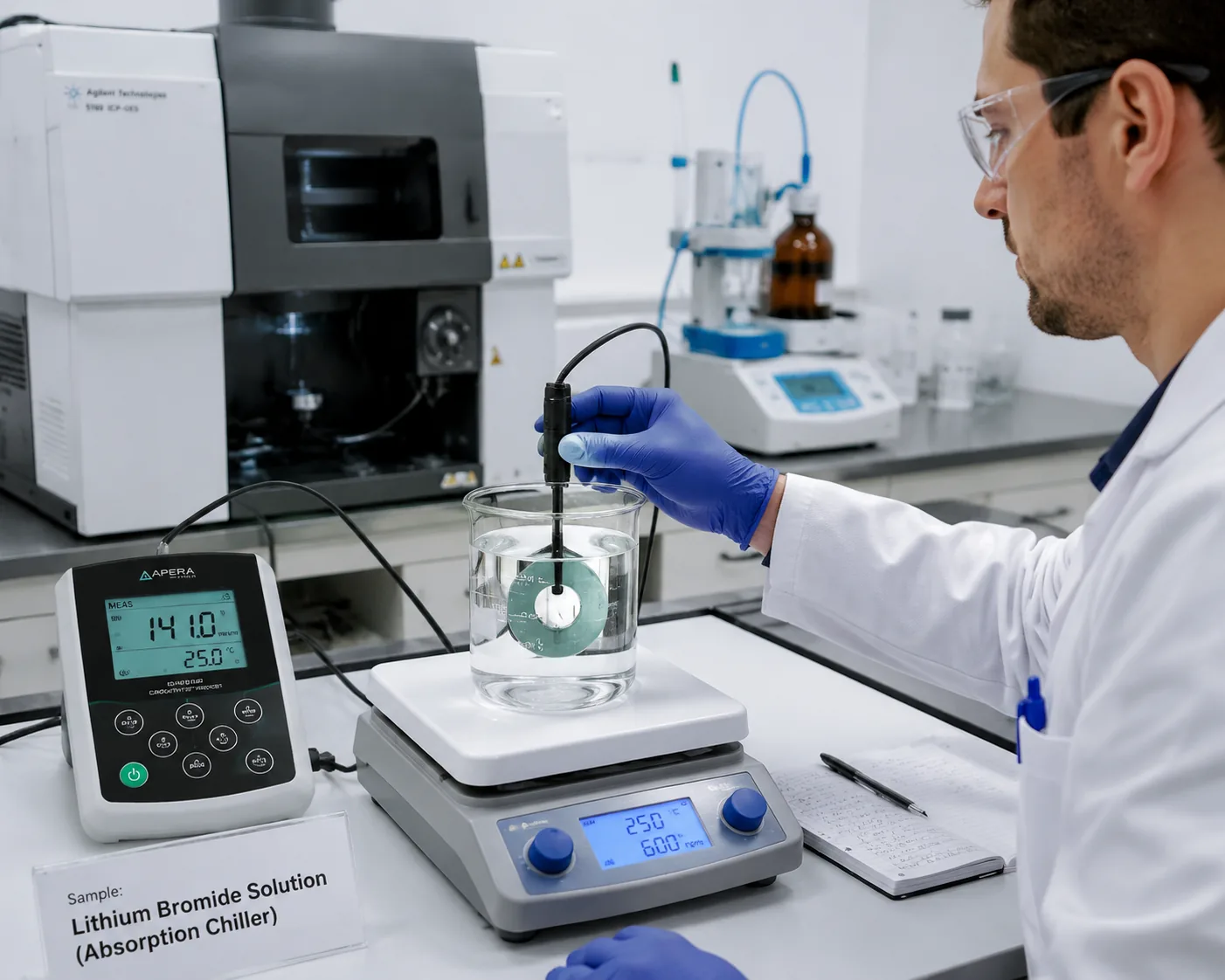
What Does a LiBr Analysis Panel Measure?
A complete LiBr diagnostic panel — as specified by commercial analysis services and OEM service procedures (e.g., the York/Johnson Controls LiBr sample-testing protocol) — measures six parameters that together diagnose the solution's operational health:
| Test | What It Diagnoses |
|---|---|
| Specific gravity / % LiBr | Solution strength — the chiller's operational charge concentration |
| Alkalinity / pH | Air leakage into the chiller; acidity drives metal corrosion |
| Dissolved copper | Copper-tube corrosion (a leak precursor) |
| Dissolved iron / suspended solids | Steel-interior corrosion; degree of internal fouling |
| Lithium molybdate (or chromate) | Corrosion-inhibitor residual strength |
| Octanol (surfactant) residual | Absorption-enhancer presence; affects heat/mass transfer |
Each parameter maps to a specific failure mode: falling % LiBr means the charge is diluted; rising dissolved metals mean active corrosion; depleted inhibitor means the protective passivation film is failing; low pH means air ingress. A diagnostic report that pairs the raw values with the failure-mode interpretation is what separates a laboratory readout from an actionable maintenance decision.
What Are the Normal Operating Ranges for LiBr Solution?
The LiBr solution in a healthy absorption chiller operates within defined chemical windows. Drift outside these ranges triggers the failure modes above:
| Parameter | Normal Range | Out-of-Range Consequence |
|---|---|---|
| LiBr concentration | 50–60% by mass (up to ~65% at the generator) | Too high → crystallization; too low → reduced capacity/COP |
| pH / alkalinity | 9.5–10.5 (alkaline) | Below range → accelerated carbon-steel corrosion |
| Lithium chromate inhibitor | 0.1–0.3% by mass | Below range → loss of passivation film, pitting |
| Lithium molybdate inhibitor | 0.01–0.04% by mass | Below range → anodic corrosion sites activate |
| Octanol surfactant | Surface tension reduced to ~40–50 mN/m | Absent → lower absorption efficiency, higher energy use |
The concentration window is the most critical and the most temperature-dependent. LiBr solubility rises with temperature, so a 60% solution that is stable at the hot generator can crystallize at the cooler absorber/throttling-valve region where temperature is lowest and concentration is highest — which is where crystallization blockages characteristically occur. This coupling of concentration and temperature is why concentration must be monitored against the solution's crystallization curve, not read as a single number.
How Is LiBr Concentration Measured (Hydrometer, Titration, Conductivity)?
Three established methods determine LiBr concentration, each trading off accuracy against convenience:
| Method | Principle | Accuracy | Constraint |
|---|---|---|---|
| Hydrometer (specific gravity) | Density scales with LiBr mass fraction | Good, established | Requires extracted sample; temperature-corrected reading |
| Silver nitrate titration | AgNO₃ precipitates bromide; endpoint gives Br⁻ content | ±0.5% | Time-consuming; laboratory extraction and manipulation |
| Electrical conductivity | Conductivity correlates with concentration at known temperature | Real-time, in-situ | Valid only within the calibrated concentration/temperature band |
The hydrometer and titration methods are accurate but require drawing a sample and laboratory work, so they give a snapshot rather than continuous monitoring. The conductivity method is the modern alternative: a submerged toroidal sensor measures conductivity and temperature in real time, and concentration is computed from the reading — no sampling required. The trade-off is that the conductivity-to-concentration relationship is non-linear and breaks down near the crystallization boundary, so the method's validity range must be respected.
What Is the Conductivity Method and Its Empirical Formula?
The conductivity method was characterized in detail by Osta-Omar and Micallef (University of Malta, 2017), who measured the electrical conductivity of aqueous LiBr across the operating concentration (45–65% by mass) and temperature (25–95 °C) ranges using a submerged toroidal sensor. Their regression analysis produced an empirical correlation valid for the 45–60% concentration band:
C = (0.236 × T − EC + 343.9) / 34.09
where C is the LiBr mass concentration (%), T is the solution temperature (°C), and EC is the electrical conductivity (mS/cm). Valid for 45% ≤ C ≤ 60% and 25 °C ≤ T ≤ 95 °C. The regression's p-values for both variables (3.85×10⁻²² for temperature, 7.89×10⁻⁵⁷ for concentration) confirm both are statistically significant predictors.
The method's key operational finding concerns the crystallization onset at 65% concentration: as the 65% solution cools toward 40 °C, conductivity drops sharply from ~78 mS/cm to ~51 mS/cm — a discontinuity that directly signals salt crystallization. This makes the conductivity sensor a useful crystallization-warning device: a sudden unexplained conductivity drop at the throttling-valve/absorber region signals that the solution has crossed its saturation boundary and is precipitating salt, before flow blockage occurs.
The formula's limitation is the band it cannot cover. Above 60% concentration, the relationship between conductivity and concentration becomes non-monotonic because crystallization changes the ion population, so the correlation is invalid there. For the high-concentration generator region, the hydrometer or titration method remains necessary.
How Are Impurities and Purity Tested (ICP, Ion Chromatography)?
Beyond the operational-solution parameters, LiBr as a chemical product has purity specifications — relevant when qualifying a new charge, a recycled lot, or a high-purity grade. Current industry purity requirements range from 99.0% to 99.9% depending on application, with impurity tolerances (LiCl, NaBr, heavy metals) generally at low ppm levels. The methods used:
| Method | Detects | Sensitivity | Note |
|---|---|---|---|
| Argentometric titration | Bromide content (quantitative) | ~±0.5% | Industry standard for bulk assay |
| UV spectrophotometry | Bromide ion absorbance at 220–230 nm | Rapid | Interference from overlapping-spectrum contaminants |
| Ion chromatography (IC) | LiBr + common impurities simultaneously | Detection limit ~0.1 ppm | Comprehensive purity assessment |
| ICP-OES / ICP-MS | Trace metallic contaminants | Parts-per-billion level | Capital-intensive; for high-purity qualification |
The technical challenge common to all is chloride interference: bromide and chloride are chemically similar, so chloride in the sample can bias titration and spectrophotometry results unless a separation step or correction factor is applied. ICP and ion chromatography resolve this by separating species physically before detection. Another recurring difficulty is LiBr's hygroscopic nature — it absorbs atmospheric moisture readily, so sample handling must control humidity to avoid concentration errors during weighing and preparation.
Which Chinese Standard Governs LiBr Solution (HG/T 2822)?
The Chinese chemical-industry standard HG/T 2822-2022 (Lithium Bromide Solution for Refrigeration Machines, implemented April 2023) governs the technical requirements for LiBr solution used in absorption refrigeration. It supersedes the 2012 and 2005 editions and specifies the product's concentration, inhibitor content, pH, and impurity limits.
The standard's scope aligns with what a solution-analysis panel measures — it defines what a compliant charge must contain, and routine analysis verifies the in-service solution continues to meet those parameters as it ages. Key reference values drawn from the standard and industry practice: LiBr relative molecular mass 86.84, typical operating concentration 50–60%, pH maintained alkaline at 9.5–10.5 to control corrosion, and inhibitor mass fractions as specified (chromate 0.1–0.3%, or the molybdate alternative at 0.01–0.04%). A LiBr solution qualified to HG/T 2822-2022 is the baseline for the Chinese market; ongoing analysis then tracks how the in-service solution drifts from that baseline.
How Do Corrosion Inhibitors Work and Why Test Them?
Corrosion in a LiBr chiller is electrochemical: the LiBr electrolyte, in contact with carbon-steel and copper internals, drives anodic dissolution of the metal. Inhibitors interrupt that process by forming a passivation film on the metal surface that blocks the anodic or cathodic reaction sites. Testing the inhibitor residual is therefOre testing whether the corrosion protection is still intact.
| Inhibitor | Mechanism | Typical Mass Fraction | Status |
|---|---|---|---|
| Lithium chromate (Li₂CrO₄) | Forms passivation film; promotes stable oxide layer | 0.1–0.3% | Traditional, widely used; hexavalent-chromium environmental concern |
| Lithium molybdate (Li₂MoO₄) | Anodic inhibitor; passivates at low dosage | 0.01–0.04% | Environmental-friendly alternative |
| Proprietary (e.g., Advaguard 750) | OEM-specific advanced formulation | Per OEM spec | Marketed for longer solution life; requires OEM-qualified lab |
The critical point is that inhibitor depletes over time — it is consumed forming the passivation film and can be lost through leakage or dilution. When the residual falls below its effective threshold, the passivation film breaks down locally and pitting corrosion begins, often at welds or heat-affected zones. This is why the dissolved-copper and dissolved-iron tests are run alongside the inhibitor test: a low inhibitor residual combined with rising dissolved metals is the unmistakable signature of active corrosion, and the correction is inhibitor re-dosing plus pH adjustment, not a metal repair. Proprietary inhibitors like Advaguard 750 (used by Johnson Controls/York) require an OEM-qualified laboratory that holds the specific specification ranges — a generic lab cannot interpret the result against the OEM's acceptance criteria.
FAQ
How often should LiBr solution be tested?
Per industry guidance, 24/7 industrial operations and high-risk/fluctuating-condition systems should be tested every 6 months; commercial and seasonal systems every 12 months. Regular testing catches chemical drift before it causes crystallization, corrosion, or COP loss.
What is the most accurate method to measure LiBr concentration?
Silver nitrate titration (argentometric) is the established quantitative method with ~±0.5% precision, but it requires sample extraction and laboratory work. The conductivity method enables real-time in-situ monitoring via the Osta-Omar/Micallef empirical formula, but is valid only for the 45–60% concentration / 25–95 °C range; above 60%, the relationship breaks down.
Why does LiBr solution crystallize, and where?
Crystallization occurs when concentration exceeds the temperature-dependent solubility limit. It characteristically happens in the weak-solution line between the throttling valve and the absorber — the point where temperature is lowest and concentration is highest. A 65% solution begins crystallizing near 40 °C; monitoring concentration against the crystallization curve at that location prevents blockage.
What pH should LiBr solution be maintained at?
LiBr solution should be maintained alkaline, at pH 9.5–10.5. An acidic drift accelerates carbon-steel corrosion directly; the alkaline environment supports the inhibitor's passivation film. A falling pH also indicates air leakage into the chiller (carbon dioxide absorption), which itself is a fault to correct.
What is the difference between chromate and molybdate inhibitors?
Lithium chromate (0.1–0.3%) is the traditional, highly effective inhibitor but carries hexavalent-chromium environmental and handling concerns. Lithium molybdate (0.01–0.04%) is the environmental-friendly alternative — effective at far lower dosage as an anodic inhibitor. Both form passivation films; the choice depends on the operator's environmental requirements and the OEM specification.
Can recycled or processed LiBr solution be reused?
Yes. Research programs (e.g., the ILK Dresden lithium-cycle project) have developed separation and processing methods to recover LiBr from spent solutions, with corrosion testing of the processed solution validating reuse. The processed solution must still meet the concentration, inhibitor, and purity requirements of HG/T 2822-2022 (or the equivalent OEM spec) before being returned to service.
Our Lithium Bromide Solution Testing Capabilities
Beijing ZKGX Research Institute provides third-party chemical analysis of LiBr solution for absorption chillers and of LiBr as a chemical product. Our testing follows the validated analytical methods and the HG/T 2822-2022 specification, applied to each sample's service condition.
Standards / Methods Our Testing Covers
| Test Endpoint | Method Reference |
|---|---|
| LiBr solution for refrigeration machines | HG/T 2822-2022 |
| Concentration (specific gravity / titration) | Hydrometer / argentometric titration |
| Concentration (in-situ, conductivity) | Toroidal conductivity + empirical correlation |
| pH / alkalinity | Potentiometric / titrimetric |
| Dissolved copper & iron, suspended solids | ICP-OES / ICP-MS |
| Corrosion-inhibitor residual (molybdate / chromate) | UV spectrophotometry / ion chromatography |
| Purity & trace impurities (LiCl, NaBr, heavy metals) | Ion chromatography / ICP-OES |
What We Can Test
- In-service LiBr solution from operating chillers — full diagnostic panel (concentration, pH, dissolved metals, inhibitor, octanol) with failure-mode interpretation
- New and recycled LiBr product — purity qualification to 99.0–99.9% with ppm-level impurity screening
- Corrosion-inhibitor residuals — lithium molybdate, lithium chromate, and OEM proprietary types
- Crystallization-risk assessment — concentration mapped against the temperature-dependent solubility curve
Sample Types We Accept
Drawn solution samples in sealed, humidity-controlled containers (LiBr is hygroscopic — sample handling controls moisture). Concentration, inhibitor, and purity tests run on the as-received charge; conductivity correlation analysis available on request.
Get a Testing Quote
If you need to diagnose an operating absorption chiller's solution, qualify a new or recycled LiBr charge, or assess crystallization and corrosion risk, our team will confirm the applicable method, sample requirements, and a quotation. Contact Beijing ZKGX Research Institute to start.