Table of Contents
- Why Is Magnesium Alloy corrosion testing Necessary?
- What Are the Main Corrosion Forms in Magnesium Alloys?
- How Is Salt spray testing Performed (ASTM B117 / ISO 9227)?
- How Does Immersion Testing Measure Corrosion Rate (ASTM G31)?
- What Is the Hydrogen Evolution Method Unique to Magnesium?
- Which Electrochemical Methods Are Used (EIS / PDP / LPR)?
- How Do Alloying Elements Affect Corrosion Behavior?
- Which Chinese National Standards Apply?
- FAQ
- Our Magnesium Alloy Corrosion Testing Capabilities
Why Is Magnesium Alloy Corrosion Testing Necessary?
Magnesium is the lightest structural metal — roughly two-thirds the density of aluminum — but its reactivity makes it highly susceptible to corrosion, which is the single biggest barrier to its wider use in automotive, aerospace, and electronics. Corrosion testing quantifies how a specific alloy or component degrades under defined conditions, so engineers can select the right alloy grade, judge whether a surface treatment is effective, and predict service life.
The practical need is direct: a magnesium gearbox housing, steering-wheel frame, or laptop chassis must survive years of humid, salty, or polluted environments without structural failure. Corrosion testing provides the data that separates an alloy fit for service from one that will pit, crack, or dissolve prematurely. Because magnesium's corrosion behavior is strongly governed by alloy composition and microstructure — not just its bulk chemistry — each alloy and heat-treatment condition must be evaluated on its own.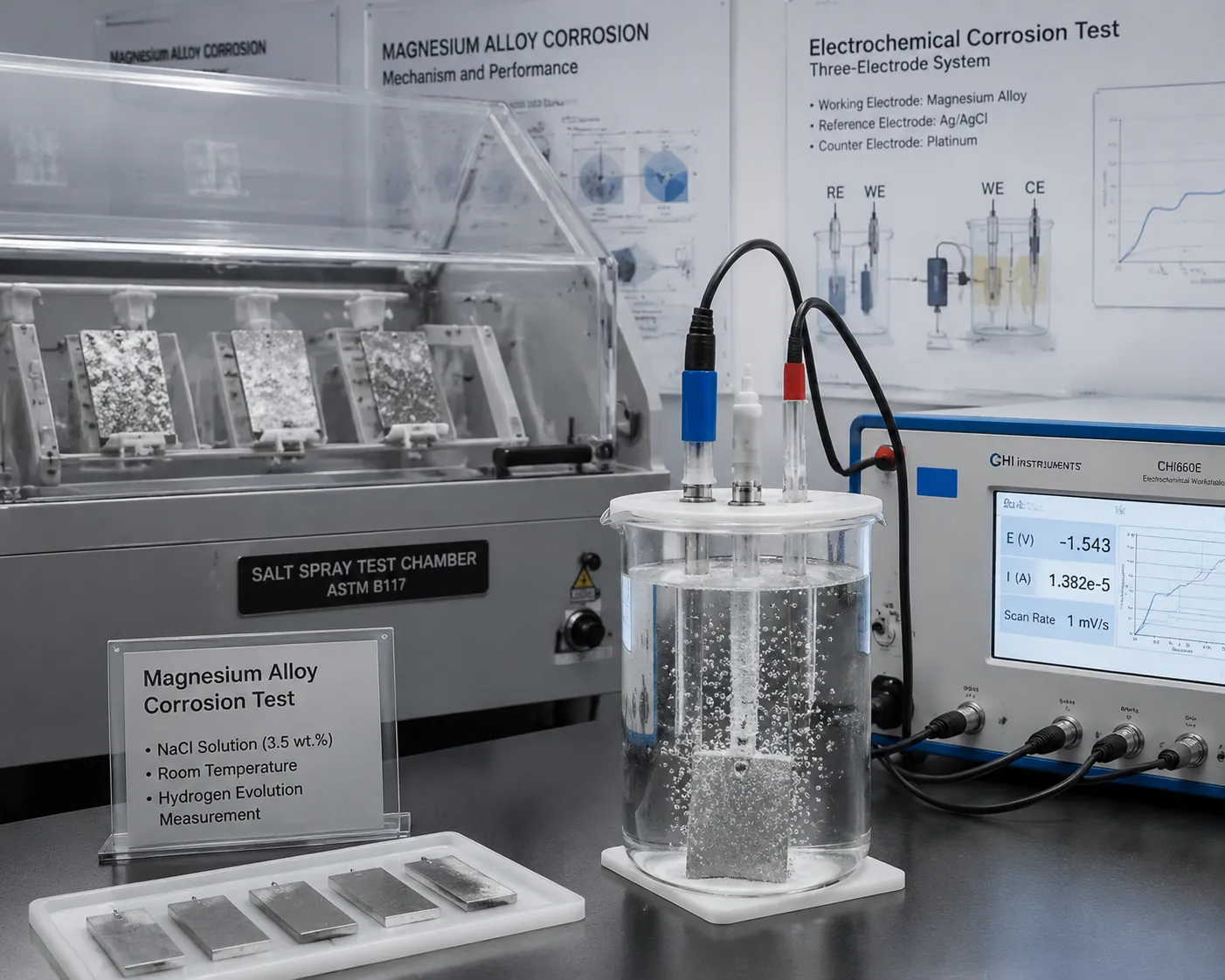
What Are the Main Corrosion Forms in Magnesium Alloys?
Magnesium alloys suffer several distinct corrosion morphologies, and testing must be designed to reveal the relevant one for the application:
| Corrosion Form | Characteristic | Typical Trigger |
|---|---|---|
| Galvanic corrosion | Magnesium (the most active structural metal) acts as the anode and dissolves when coupled to steel, aluminum, or copper fasteners | Dissimilar-metal contact |
| Pitting corrosion | Localized breakdown of the hydroxide film, producing deep cavities | Chloride ions in neutral or saline media |
| Filiform corrosion | Thread-like filaments spreading under a coating | Humidity + coating defects |
| Intergranular corrosion | Attack along grain boundaries, often linked to second-phase particles | Impurity segregation (Fe, Ni, Cu) |
A peculiarity of magnesium is the negative difference effect (NDE): when anodically polarized, hydrogen evolution increases rather than decreases, contradicting normal electrochemical expectation. This means standard electrochemical interpretation must be adjusted for magnesium — a subtlety that the most rigorous test programs account for.
How Is Salt Spray Testing Performed (ASTM B117 / ISO 9227)?
ASTM B117 and its international equivalent ISO 9227 define the benchmark accelerated corrosion test — the neutral salt spray (NSS). It exposes the sample to a continuous atomized salt fog under tightly controlled conditions:
| Parameter | Requirement (NSS) |
|---|---|
| Exposure-zone temperature | 35 °C ± 1.7 °C |
| Relative humidity | ~95–100% (saturated fog) |
| Salt solution | 5% NaCl (sodium chloride) |
| Solution pH (atomized at 35 °C) | 6.5–7.2 |
| Fog collection rate | 1.0–2.0 mL per 80 cm² per hour |
| Test cycle | Continuous, uninterrupted spray |
The test duration is set by the specification or the parties — common durations for magnesium alloys range from 24 to 1000 hours, depending on whether the sample is bare, coated, or treated. Two more severe variants exist: AASS (acetic acid salt spray, pH ~3.1–3.3) and CASS (copper-accelerated acetic acid, adding CuCl₂ for the harshest accelerated corrosion). After exposure, the specimen is evaluated by the rating method in ASTM G46 (pitting) or ISO 10289 / GB/T 6461 (corrosion-area rating), following the cleaning procedure in ASTM G1.
How Does Immersion Testing Measure Corrosion Rate (ASTM G31)?
ASTM G31 is the standard laboratory immersion test that quantifies corrosion rate by mass loss — the most direct measurement of how fast the alloy dissolves. The specimen is fully immersed in a defined electrolyte (commonly 3.5% NaCl, simulating seawater) for a set period, then cleaned per ASTM G1 and weighed.
The corrosion rate is calculated from the mass loss using the standard formula:
Corrosion rate = (K × ΔW) / (A × T × D)
where ΔW is the mass loss (g), A is the exposed area (cm²), T is the exposure time (hours), D is the alloy density (~1.74–1.81 g/cm³ for magnesium alloys), and K is a constant that sets the output unit (K = 8.76 × 10⁴ gives mm/year). The result is expressed as a uniform corrosion rate in mm/year, which allows direct comparison between alloys, heat treatments, and surface conditions.
Immersion testing is favored for its simplicity and directness, but it captures only average corrosion — it does not distinguish localized pitting from uniform dissolution, which is why it is often paired with electrochemical methods and surface profilometry.
What Is the Hydrogen Evolution Method Unique to Magnesium?
Because the cathodic half-reaction of magnesium corrosion generates hydrogen gas, the hydrogen evolution (H₂ collection) method is a magnesium-specific technique for in-situ corrosion-rate measurement:
Mg + 2H₂O → Mg(OH)₂ + H₂↑
The volume of hydrogen gas evolved is collected (commonly with a burette inverted over the sample) and converted to a corrosion rate. The method has two advantages over mass-loss testing: it is non-destructive and continuous — the corrosion rate is recorded in real time throughout the immersion, rather than only as a single end-point value. This makes it especially valuable for studying how the rate changes as the surface film forms, breaks down, or self-heals.
The H₂ method is particularly useful for revealing the negative difference effect: because anodically polarized magnesium evolves more hydrogen than expected, the collected-gas data expose behavior that electrochemical current readings alone would misrepresent. Researchers in the field treat hydrogen collection and mass loss as complementary — when the two methods agree, the corrosion rate is well constrained.
Which Electrochemical Methods Are Used (EIS / PDP / LPR)?
Electrochemical methods probe the corrosion mechanism and kinetics in real time using a potentiostat and a three-electrode cell (working electrode = sample, reference = saturated calomel or Ag/AgCl, counter = platinum):
| Method | Output | What It Reveals |
|---|---|---|
| EIS (Electrochemical Impedance Spectroscopy) | Charge-transfer resistance (Rct), film resistance | Protective quality of the surface film; mechanistic detail |
| PDP (Potentiodynamic Polarization) | Corrosion current density (icorr), corrosion potential (Ecorr), Tafel slopes | Instantaneous corrosion rate; anodic/cathodic reaction kinetics |
| LPR (Linear Polarization Resistance) | Polarization resistance (Rp) | Continuous, rapid corrosion-rate monitoring |
These methods give an instantaneous picture — they tell you how fast corrosion is happening right now — whereas mass-loss and hydrogen methods give an integrated rate over the whole exposure. A complete characterization usually combines both: electrochemistry to understand the mechanism and short-term kinetics, plus mass loss / hydrogen collection to validate the long-term rate. The key caveat is the negative difference effect, which means the anodic Tafel extrapolation must be interpreted cautiously for magnesium.
How Do Alloying Elements Affect Corrosion Behavior?
Corrosion resistance in magnesium alloys is governed strongly by composition — which is why chemical specification alone does not predict performance, and testing of the actual alloy is required:
- Aluminum (in AZ-series alloys like AZ91, AZ31): higher Al content generally improves corrosion resistance, partly through the formation of a protective layered double hydroxide (LDH) carbonate film in atmospheric conditions — though this benefit is weaker in full immersion.
- Manganese: binds harmful impurities (iron) into harmless intermetallics, raising the tolerance limit and improving resistance.
- Rare earths (RE): elements like Nd, Ce, Y refine the microstructure and can reduce the galvanic driving force of second-phase particles.
- Iron, nickel, copper (impurities): even at low concentrations, these accelerate corrosion dramatically by acting as efficient cathodic sites; their tolerance limits are tight and well-documented.
This composition-dependence is why corrosion testing is performed on the specific alloy and temper, not inferred from the nominal Mg content.
Which Chinese National Standards Apply?
Chinese standards mirror the international framework, allowing one sample to satisfy both domestic and global submissions:
| International Standard | Chinese Equivalent | Scope |
|---|---|---|
| ASTM B117 / ISO 9227 | GB/T 10125-2021 | Salt spray testing (NSS / AASS / CASS) |
| ISO 10289 | GB/T 6461-2002 | Rating of corrosion-corroded specimens |
| ASTM G31, G1 | (Used directly — no equivalent GB/T) | Immersion testing & specimen cleaning |
| — | GB/T 2423.17 | Salt spray for electronic/electrical products |
GB/T 10125-2021 specifies the same three salt-spray variants (neutral NSS, acetic-acid AASS, copper-accelerated CASS) with parameters aligned to ISO 9227. A magnesium-alloy specimen (e.g., AZ31B) is typically placed at a defined angle (commonly 20–30° from vertical) and exposed per the selected variant, then rated against GB/T 6461. The immersion and electrochemical methods (ASTM G31/G1, EIS/PDP/LPR) are applied directly without a Chinese national-standard equivalent.
FAQ
What is the difference between NSS, AASS, and CASS salt spray?
NSS (neutral salt spray, pH 6.5–7.2) is the baseline test used for most metals and coatings. AASS adds acetic acid to drop the pH to ~3.1–3.3, accelerating corrosion for decorative coatings. CASS adds copper(II) chloride on top of AASS for the most aggressive accelerated corrosion, used for high-performance decorative finishes like those on automotive trim.
Can salt spray test results predict real service life?
Only approximately. Salt spray is an accelerated, comparative test — it ranks materials and coatings against each other under identical harsh conditions, but the correlation to real-world service life is not linear. Field exposure and the application's actual environment (humidity, pollutants, temperature cycles) must factor into any service-life prediction.
Why is magnesium so prone to galvanic corrosion?
Magnesium is the most electrochemically active structural metal, so in any metal couple (Mg + steel, Mg + aluminum, Mg + copper) it is always the anode and dissolves to protect the other metal. This makes fastener selection and isolation critical in any magnesium assembly — testing must evaluate the joint, not just the bulk alloy.
How are electrochemical corrosion rate and mass-loss rate compared?
They should agree when the corrosion is uniform and well-behaved. Electrochemistry gives an instantaneous rate from the corrosion current density (via Faraday's law), while mass loss integrates the rate over the whole exposure. Discrepancies often indicate localized corrosion (pitting) or the negative difference effect, where hydrogen evolution distorts the electrochemical reading.
Does adding rare-earth elements always improve magnesium corrosion resistance?
Not always — the effect depends on which rare earth, how much, and the resulting microstructure. Some RE additions refine second-phase particles and reduce micro-galvanic coupling, improving resistance; others can form new cathodic phases that accelerate attack. The specific alloy must be tested, as composition alone does not guarantee performance.
Is a coated magnesium alloy exempt from corrosion testing?
No. Coatings delay corrosion, but defects, scratches, and edges expose the underlying magnesium, which then corrodes rapidly — often filiform or under-film corrosion. Coated samples are tested by the same methods (salt spray, immersion), and the rating focuses on coating integrity and any under-film attack.
Our Magnesium Alloy Corrosion Testing Capabilities
Beijing ZKGX Research Institute provides third-party corrosion-performance testing for magnesium alloys and components. Our testing follows the validated ASTM, ISO, and GB/T methods, applied to each sample's alloy grade, temper, and surface condition.
Standards Our Testing Covers
| Test Endpoint | Method Reference |
|---|---|
| Neutral / acetic / copper-accelerated salt spray | ASTM B117 / ISO 9227 / GB/T 10125 |
| Laboratory immersion corrosion (mass-loss rate) | ASTM G31 |
| Specimen preparation, cleaning & evaluation | ASTM G1 |
| Pitting assessment | ASTM G46 |
| Corrosion-area rating | ISO 10289 / GB/T 6461 |
| Electronic-product salt spray | GB/T 2423.17 |
| Electrochemical corrosion (EIS / PDP / LPR) | ASTM G106 / ASTM G5 |
What We Can Test
- Cast and wrought magnesium alloys — AZ-series (AZ91, AZ31), AM-series (AM50, AM60), and rare-earth-containing grades
- Coated and surface-treated components — anodized (MAO/PEO), conversion-coated, painted, and plated samples
- Assemblies and joints — galvanic-couple testing of magnesium fastened to dissimilar metals
- Automotive and electronic components — housings, brackets, and structural parts
Sample Types We Accept
Flat coupons, machined specimens, and finished components. Electrochemical testing uses standard working-electrode geometries; salt-spray and immersion testing accommodate components of varying shape, placed at the standard angle.
Get a Testing Quote
If you need corrosion-performance data for a magnesium alloy or component, our team will confirm the applicable standard, sample requirements, and a quotation. Contact Beijing ZKGX Research Institute to start.