What Standards Apply to Paper Products Testing?
Paper products testing in China is segmented by end use, and each category maps to a distinct national standard with its own technical indicator table. The four product families and their governing standards are:
| Category | Products | Governing standard |
|---|---|---|
| Household / sanitary paper | Toilet paper, tissue, kitchen roll, wet wipes | GB/T 20810 (toilet paper), GB/T 20808 (facial tissue), GB/T 27728 (wet wipes) |
| Food-contact paper | Paper cups, bowls, food wrapping, carton board | GB 4806.8-2022 (food-contact paper and board) |
| Corrugated packaging | Cartons, corrugated fibreboard | GB/T 6544, with test methods in GB/T 6545 (burst) and GB/T 6546 (edge crush) |
| Disposable hygiene | Sanitary pads, diapers, masks | GB/T 8939, GB/T 28004, with microbiology under GB 15979 |
Food-contact paper is the one category governed by a mandatory GB standard (GB 4806.8 is a food-safety national standard, not a recommended GB/T), which means a non-conforming test result is a regulatory violation, not just a quality dispute. Knowing whether your product sits under a GB or a GB/T up front decides whether the report feeds a compliance filing or a commercial QC argument.
How Is Food-Contact Paper Tested Under GB 4806.8-2022?
GB 4806.8-2022 — National food safety Standard for Food Contact Paper and Board Materials and Products — is the binding standard for paper cups, takeout boxes, wrapping paper, waxed paper, silicone-coated paper, and pulp-moulded trays. Its technical requirements split into three layers.
Sensory: the material must be normal in colour, smell, and surface, with no off-odour, no visible foreign matter, and no coating delamination after immersion testing.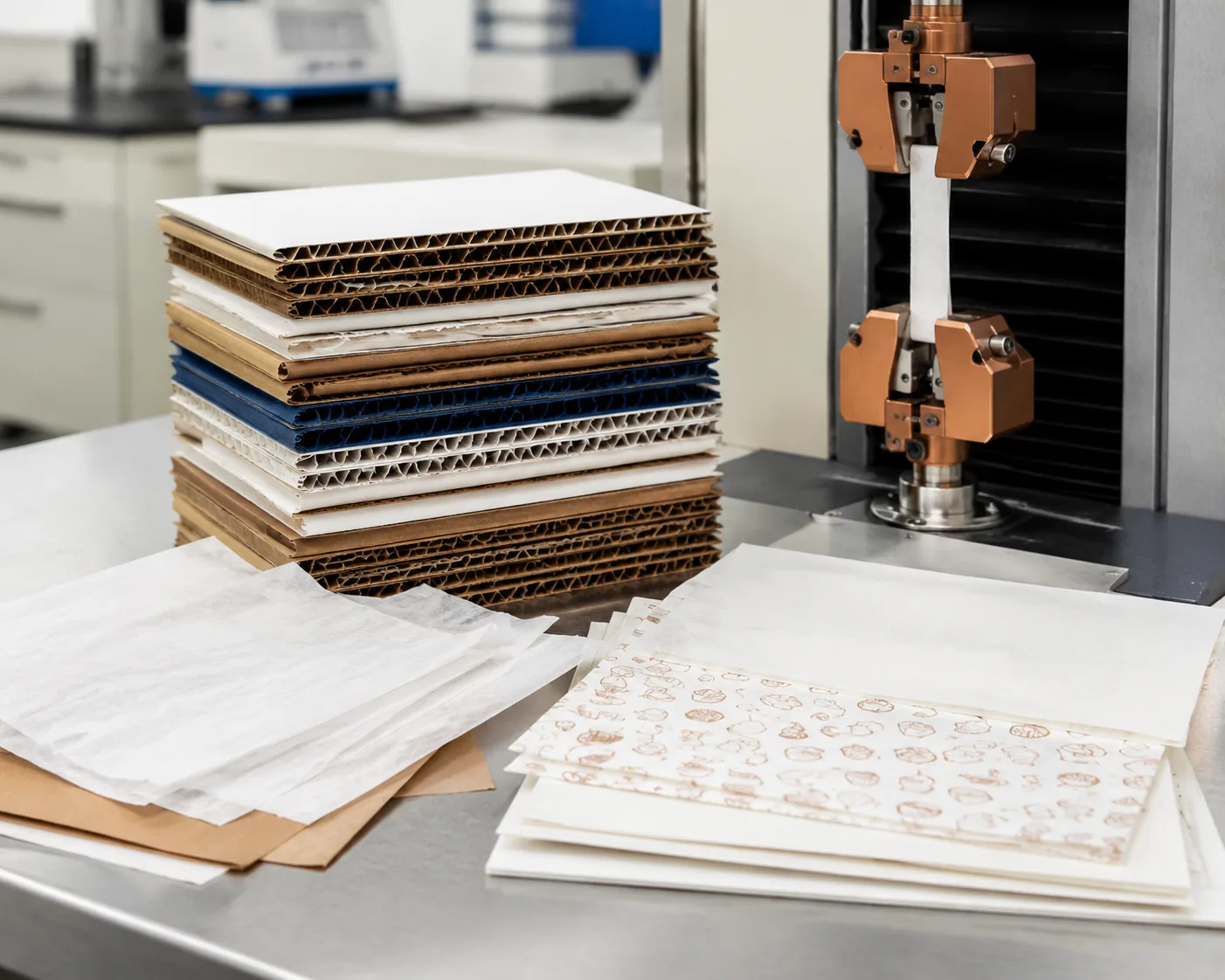
Migration limits (the core chemical test set):
- Heavy metals (as Pb) — overall migration limit applied; lead residue must not exceed 3.0 mg/kg, arsenic 1.0 mg/kg.
- Specific migration of regulated elements — Pb, Cd, Cr, Hg, and organotin are measured per GB 31604.49 into 4 % acetic acid and other food simulants.
- Total migration (overall migration) into 4 % acetic acid, 10 % / 20 % / 50 % ethanol, and vegetable oil — each must stay below 10 mg/dm².
- Potassium permanganate consumption — an indicator of oxidisable organic leachables.
- Styrene / 4-methylstyrene specific migration — for coated or laminated paper, the styrene SML is 6 mg/kg (per GB 9685 additive use standard).
Fluorescent substances: tested under UV at 254 nm and 365 nm per GB 31604.47 — the requirement is non-detectable. This catches optical brighteners and residual fluorescent whitening agents, which are a routine reason food-contact paper fails supervision sampling.
A complete GB 4806.8 report lists every simulant used, the test temperature/time regime, and the measured value against each SML. A report that only shows "pass" without the simulant matrix is not defensible in a market-supervision review.
What Are the Key Physical Tests for Household Paper?
Household paper (toilet paper, facial tissue, kitchen towel) under GB/T 20810-2018 is graded into three quality tiers — 优等品 (premium), 一等品 (first grade), 合格品 (qualified) — and the threshold tables are product- and grammage-specific. The indicators that actually drive a pass/fail:
Tensile index (抗张指数): for virgin-pulp toilet paper, premium grade cross-direction tensile index is set around 2.30 N·m/g, first grade around 1.50 N·m/g. Wet tensile strength (longitudinal) must reach ≥ 20 N/m for grammage ≥ 18 g/m² (≥ 14 N/m for lower grammage). Test methods: GB/T 12914 (constant-rate-of-extension) and GB/T 24328.3.
Absorbency (横向吸液高度): the capillary rise height in a fixed time — a direct measure of how fast the sheet picks up liquid. Low values flag poor converting or over-refined pulp.
Brightness (D65 亮度): set with both an upper and lower bound — too low reads as grey, too high raises a fluorescent-whitener suspicion that pulls the sheet back into the GB 4806.8 fluorescent-substance trap.
Microbiology: tested per GB 15979 — aerobic bacterial count, coliforms, Staphylococcus aureus, Streptococcus haemolyticus, Pseudomonas aeruginosa. These are the items most cited in provincial supervision sampling failures, not the tensile numbers.
Softness (柔软度): GB/T 20810-2018 revised the softness method; it is measured on a handle-ometer type instrument in mN, with thresholds tied to ply count and grammage band.
The pattern: a household-paper report without the microbiology block is incomplete even if every physical number passes, because hygiene indicators are what market-supervision authorities actually enforce.
How Is Corrugated Packaging Board Tested?
Corrugated fibreboard under GB/T 6544-2008 is graded by both flute type (单瓦楞 single-wall, 双瓦楞 double-wall, 三瓦楞 triple-wall) and quality grade (优等品 / 合格品). The three load-bearing tests:
Edge crush test (ECT, 边压强度) — measured per GB/T 6546, reported in kN/m. This is the single best predictor of stacking strength — a carton that fails ECT will collapse in a warehouse stack. Minimum thresholds rise with wall count: a triple-wall board carries a far higher ECT floor than a single-wall board of the same grade.
Burst strength (耐破强度) — measured per GB/T 6545, reported in kPa. Burst is the legacy Mullen test; it correlates with resistance to blunt impact and internal pressure, and remains a contractual requirement for many export cartons.
adhesive strength (粘合强度) — the peel force between liner and flute. GB/T 6544 sets ≥ 600 N/m for premium grade and ≥ 400 N/m for qualified grade. A low adhesive strength is the defect that produces "delaminated" cartons that look intact on the outside but have lost structural integrity.
Puncture resistance (戳穿强度) — measures resistance to a sharp probe, relevant for cartons shipping pointed or heavy contents.
For corrugated boxes (not just the board), GB/T 6543 adds the box compression test (BCT) — a full-carton crush to a deformation or load limit — which combines ECT, board grade, and box geometry into a single number buyers actually care about.
What Mechanical Tests Cover Paper and Plastic Packaging?
For combined paper/plastic packaging (laminated pouches, coated kraft, courier bags), the mechanical test set overlaps with plastic-film methods. The key standards and what they prove:
- TAPPI T494 / ASTM D882 — tensile strength and elongation of paper / thin plastic film. The specimen is a rectangular strip; a jaw break (failure at the grip) is only acceptable if results match mid-gauge breaks.
- TAPPI T456 — wet tensile strength of paper. The specimen is soaked before pulling; comparing wet vs dry tensile gives a percent strength retention that flags fibre-bonding problems.
- ASTM F1306 — puncture resistance of thin flexible barriers (probe penetration). Simulates a fork or staple piercing a pouch.
- ASTM D1894 / ISO 8295 — coefficient of friction (static and kinetic). A COF out of spec is why filled bags slide off pallets or jam on form-fill-seal lines.
- ASTM D1876 — T-peel of adhesive seals. The seal peel strength is what stops a pouch bursting in transit.
The methodological subtlety across these is specimen gripping. Paper and thin film concentrate stress at the jaw face; pneumatic side-action grips with line-contact or smooth faces, plus a video extensometer (so the specimen bears no extra weight), are the configuration that produces valid breaks in the gauge length rather than at the grip.
How Are Sustainability and Recyclability Claims Verified?
Sustainability testing for paper packaging has two distinct purposes — proving the package breaks down (compostability), and proving it can re-enter the fibre stream (recyclability). These are not the same test.
Compostability — for a paper package to carry a compostable claim, the framework is EN 13432 or ISO 14855, covering: disintegration (≥ 90 % fragmentates to < 2 mm in 12 weeks under industrial composting), biodegradation (≥ 90 % of the organic carbon converts to CO₂ in 6 months), ecotoxicity (germination and plant growth on the composted residue), and heavy-metal content of the packaging itself. A paper board passes these only if its coatings, inks, and adhesives are also compostable — a waxed or PE-coated cup will fail disintegration.
Recyclability / repulpability — the test is whether the fibre can be recovered in a standard repulping process. The relevant methods assess fibre yield after pulping, screenability (adhesives and coatings cause "stickies" that jam recycling screens), and the strength of the paper made from the recovered furnish. This is where silicone-coated release papers and wet-strength-treated tissues fail — they cannot be repulped economically.
A laboratory report supporting a "recyclable" claim without a repulpability test is a greenwashing exposure waiting to happen. The test for can it be broken down and the test for can the fibre be recovered answer different questions.
Our Testing Capabilities
Beijing ZKGX Research provides paper products testing across household, food-contact, and corrugated-packaging categories, against the GB / GB/T and ISO frameworks above.
Food-contact paper (GB 4806.8-2022):
- Overall migration into 4 % acetic acid, ethanol, vegetable oil
- Specific migration of Pb, Cd, Cr, Hg, organotin (GB 31604.49)
- Fluorescent substances at 254 / 365 nm (GB 31604.47)
- Potassium permanganate consumption, formaldehyde, styrene / 4-methylstyrene SML
Household paper (GB/T 20810 / 20808):
- Tensile index, wet tensile strength (GB/T 12914, GB/T 24328.3)
- Brightness, softness, absorbency, dusting rate
- Microbiology per GB 15979 (aerobic count, coliforms, pathogens)
Corrugated board and boxes (GB/T 6544 / 6543):
- Edge crush (GB/T 6546), burst (GB/T 6545), puncture, adhesive peel
- Full box compression test to deformation / load limit
Mechanical and barrier properties: tensile and peel per ASTM D882 / D1876, COF per ASTM D1894, puncture per ASTM F1306, WVTR (ASTM E96) and OTR (ASTM D3985) for barrier-coated papers.
If you need a GB/T 20810 or GB 4806.8 report for market-supervision response, product registration, or incoming inspection — contact our laboratory with the product type, applicable standard, and intended market, and we will scope the test plan.
FAQ
What is the difference between GB and GB/T for paper products?
A GB standard (e.g. GB 4806.8, GB 20810-2006) is mandatory — non-conformance is a regulatory violation. A GB/T standard (e.g. GB/T 20810-2018, GB/T 6544) is recommended — non-conformance is a quality / commercial issue, not a legal one. Note that GB 20810 was downgraded to GB/T 20810 in the 2018 revision, so a product that was once subject to mandatory thresholds is now on a recommended basis for its physical properties. The microbiology block, however, still routes through the mandatory GB 15979.
Which test most often causes food-contact paper to fail?
Fluorescent substances. The GB 31604.47 test at 254 / 365 nm catches optical brighteners and fluorescent whitening agents that manufacturers add to make the sheet look brighter. The requirement is non-detectable — any positive reading fails. It is one of the most cited items in provincial supervision sampling of paper cups and wrapping paper.
Is burst strength or edge crush more important for a corrugated carton?
For stacking and warehouse storage, edge crush (ECT) is the better predictor — it directly models the carton's resistance to top-down load. Burst (Mullen) is better for resistance to impact and rough handling. Many export contracts specify both; if only one can be tested, ECT is the more decision-relevant for cartons that will be palletised.
Can one report cover both GB/T 6544 board and GB/T 6543 boxes?
No — they are separate scopes. GB/T 6544 covers the corrugated board material (ECT, burst, adhesive, puncture of the flat board). GB/T 6543 covers the finished carton (box compression, joint shear, drop test, dimensional check). A board that passes GB/T 6544 can still fail box compression in GB/T 6543 if the converting (scoring, gluing, joint) is poor. Buy the report that matches what you are actually shipping.
Do paper straws and pulp-moulded trays fall under GB 4806.8?
Yes. GB 4806.8-2022 explicitly includes pulp-moulded products. Paper straws are food-contact paper articles and are tested under the same migration and fluorescent-substance regime as paper cups. The high wet-strength resins and glues used in straws are a frequent source of formaldehyde or specific-migration non-conformance — a paper straw is not automatically a "clean" test result just because it is paper.