Rolling Bearing testing is the set of laboratory methods that verify a bearing's dynamic load rating (C), basic rating life (L10), and running vibration quality against ISO 281, ISO 15242, ANSI/ABMA Std 9 and 11, and ASTM D4170 before the bearing enters service. It combines three tiers — vibration acceptance, fretting-wear bench testing, and endurance life testing — to confirm that a production bearing actually matches the rating printed in its catalog.
What Standards Govern Rolling Bearing Testing?
Rolling bearing testing is split across calculation standards (which define the rating) and measurement standards (which verify it). They are not interchangeable, and the confusion between them is the most common source of disputes over a bearing's claimed life.
- ISO 281:2007 (Rolling bearings — Dynamic load ratings and rating life) defines the basic dynamic load rating C, the basic rating life L10 (the life that 90 % of a population reaches), and the modified rating life with a fatigue limit. It is built on the 1947 Lundberg–Palmgren fatigue theory. Outside the U.S. this is the universal calculation basis for bearing life; inside the U.S. the equivalents are ANSI/ABMA Std 9 (ball bearings) and ANSI/ABMA Std 11 (roller bearings), harmonized with ISO 281.
- ISO/TS 16281 (Methods for calculating the modified reference rating life) supplements ISO 281 by accounting for clearances, load distribution, and tilting — used when the operating conditions deviate from the ideal catalog assumptions.
- ISO 15242-1 to -4 (Measuring methods for vibration) defines how a finished bearing's running vibration is measured and accepted — Part 1 fundamentals, Part 2 radial ball bearings, Part 3 tapered roller bearings, Part 4 cylindrical roller bearings.
- ASTM D4170 (Standard Test Method for Fretting Wear Protection of Rolling Bearing Lubricants Greases) and ASTM D7594 (SRV fretting test) verify the grease that protects the bearing from false-brinelling damage.
- DIN 51819-1/-2/-3 define the FE8 rig used to qualify lubricants in a rolling-bearing contact.
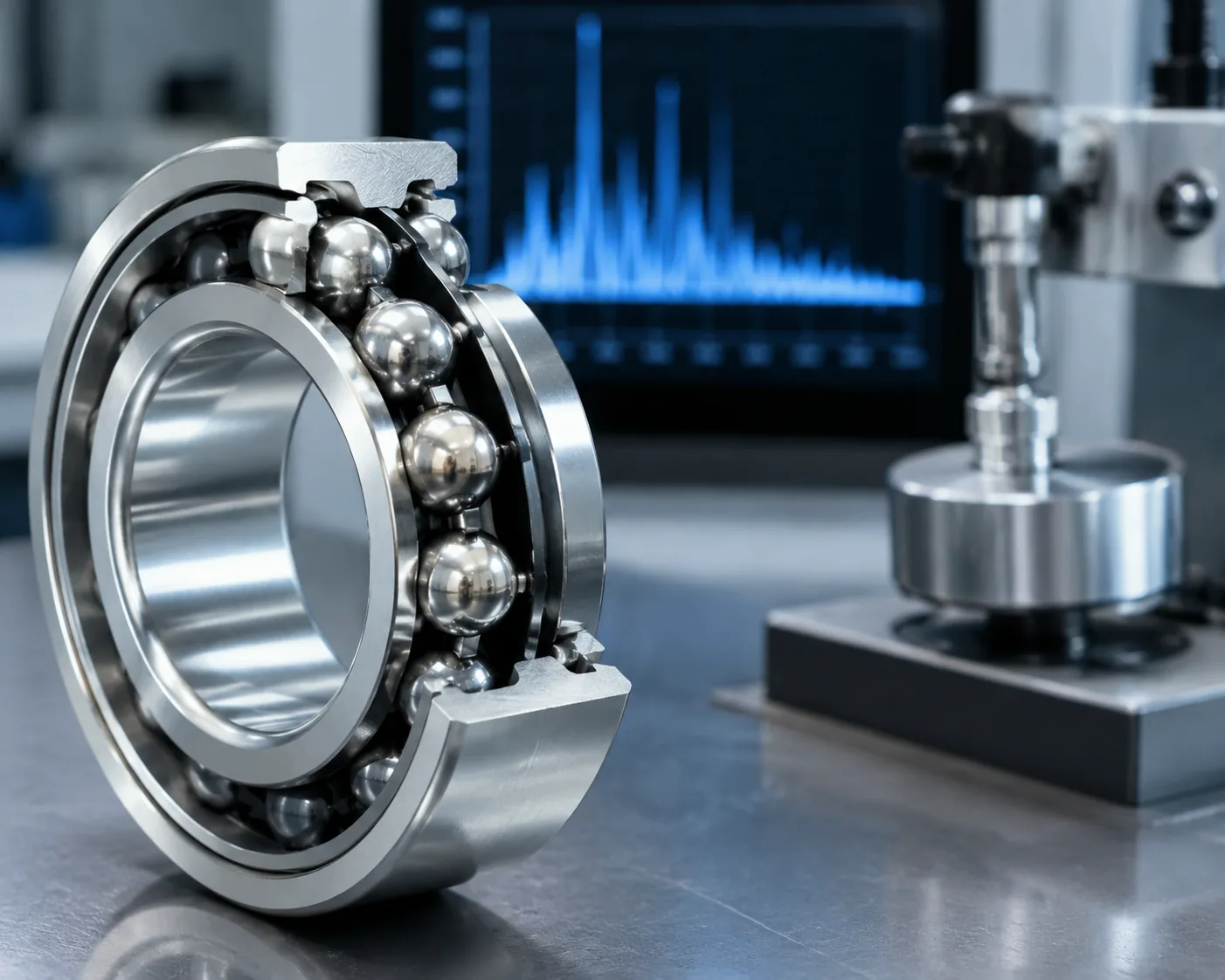
The critical fact that almost no SERP source states plainly: ISO 281 defines how to calculate L10, but no ISO or ABMA standard defines how to verify L10 by endurance testing. Bearing endurance testing for the verification of dynamic load ratings is explicitly not part of ISO or any other standard. Manufacturers therefore quote ISO 281 ratings to describe their products, but only a minority of well-established companies actually verify those ratings on dedicated endurance rigs. This is the gap that independent acceptance testing exists to close.
How Is Bearing Vibration Quality Measured to ISO 15242?
Vibration acceptance is the first-tier test — it is applied to every finished bearing, non-destructively, before any life test. The principle is that a bearing with defective raceways, balls, or cage generates characteristic vibration signatures as it rotates under a defined radial or axial load at a defined speed.
ISO 15242-1:2015 specifies the fundamentals: the bearing is mounted on a precision spindle, loaded (radially for radial bearings, axially for thrust bearings), rotated at a specified speed, and the vibration is picked up by a transducer contacting the stationary ring. The signal is split into low (50–300 Hz), medium (300–1800 Hz), and high (1800–10000 Hz) frequency bands, and reported as velocity in μm/s RMS in each band. The band limits matter because different defects show up in different bands: cage and out-of-round problems sit in the low band; inner- and outer-race waviness in the mid band; ball/surface defects in the high band.
ISO 15242 itself defines the measurement method and lets the acceptance thresholds be agreed between manufacturer and purchaser; the type-specific parts (-2, -3, -4) carry the vibration limit values and the V-class grading. Acceptance is a matter of agreed thresholds, not an absolute universal pass line.
For fault diagnosis rather than acceptance, the frequency-domain method is dominant. A defective bearing generates energy at four characteristic defect frequencies that are functions of geometry and shaft speed:
- BPFO (ball pass frequency, outer race) — a defect on the outer raceway.
- BPFI (ball pass frequency, inner race) — a defect on the inner raceway, sideband-modulated by shaft rotation.
- BSF (ball spin frequency) — a defect on the rolling element itself.
- FTF (fundamental train frequency) — a cage defect.
A two-channel FFT analyzer resolves these peaks in the spectrum, which is why vibration acceptance (ISO 15242) and vibration diagnostics (BPFO/BPFI/BSF/FTF) share the same instrumentation but answer different questions: the first asks "does this bearing pass?", the second asks "what is wrong with it?".
How Is the L10 Fatigue Life Calculated Under ISO 281?
ISO 281 expresses the basic rating life for 90 % survival as:
L10 = (C / P)^p (in millions of revolutions)
where C is the basic dynamic load rating, P is the equivalent dynamic bearing load, and the exponent p = 3 for ball bearings and 10/3 for roller bearings. The modified life adds the factor αISO (or αSLF), which adjusts for lubrication (the κ viscosity ratio), contamination (ηc), and the fatigue load limit Pu.
The fatigue load limit Pu is the bearing load under which the maximum contact stress just reaches the fatigue stress limit of the bearing steel. ISO 281 fixes this fatigue stress limit at a maximum Hertzian contact pressure of approximately 1500 MPa for "commonly used, high-quality hardened bearing steel … manufactured in accordance with good manufacturing practices." For bearings with a mean diameter above 100 mm the standard reduces this limit by (100/dm)^0.5 (ball) or (100/dm)^0.3 (roller), reflecting that large bearings suffer from lower manufacturing accuracy and less effective ingot kneading.
The disputed point — and the reason buyers test rather than trust catalog values — is that ISO 281 defines "high-quality bearing steel" qualitatively, with no quantitative measure of bearing quality. A manufacturer can apply ISO 281 performance parameters to bearings whose steel, heat treatment, and geometry do not actually meet the "good manufacturing practices" assumption. The catalog L10 is therefore a calculated number; the verified L10 requires endurance testing that no standard mandates.
What Is the Fafnir Fretting Wear Test (ASTM D4170)?
Bearings that oscillate through small angles or stand still under vibration do not fail by classical rolling-contact fatigue — they fail by false brinelling (standstill marks) and fretting corrosion. ISO 281, which is built on fatigue theory, does not predict this damage mode at all, so application-oriented wear tests are required.
ASTM D4170 — the "Fafnir wear test," introduced in 1982 and based on Hudson and Morton's work at the Fafnir Bearing Company — is the standardized method. A thrust ball bearing (type 06×65; inner bore 16 mm, outer 35.69 mm, 9 balls of 7.142 mm) is run under fixed conditions:
- Load: 2450 N (max. Hertzian contact pressure ≈ 1.87 GPa; Cdyn/P ≈ 7.9), or 4450 N (≈ 2.28 GPa; Cdyn/P ≈ 4.3) for a higher-severity variant.
- Frequency: 30 Hz, oscillation angle: ±6° (amplitude ratio x/2b ≈ 5.5), duration: 22 h.
After the run the bearing is inspected and the mass loss of the raceways is weighed. By the classic acceptance rule, mass losses below 5 mg are acceptable; modern high-performance greases target 2 mg or even 1 mg. ASTM D4170 is listed in the current NLGI High-Performance Multiuse (HPM) specification — HPM-LL (long life) and HPM-HL (high load) — as a release test for lubricating greases, and is particularly important for wind-turbine blade bearings and aerospace oscillating bearings.
Because the Fafnir test has relatively high scatter, the U.S. aerospace industry pushed through ASTM D7594 in 2016 as an alternative "true" fretting test on the SRV tribometer: pure sliding, point contact, 100 N load, 0.3 mm amplitude, 50 Hz, 80 °C. The two tests are not interchangeable — good results in one do not guarantee good results in the other, because the amplitude ratio (x/2b) differs by more than a factor of ten.
What Do the FE8 and SRV Test Rigs Measure?
For grease and bearing-material interaction at the European end of the industry, the FE8 rig (standardized by DIN 51819-1/-2/-3) is the reference. It runs an axial cylindrical roller thrust bearing (type 81212) under controlled load, speed, temperature, and lubrication to qualify how a grease protects the bearing from wear and fatigue over a sustained run. The FE8 produces different failure modes — surface-initiated fatigue versus sub-surface fatigue — depending on lubricant chemistry and the tribo-layer that forms, which is why it is used both for grease release and for bearing-material research. The FE9 rig (DIN 51819-1) is the higher-temperature/higher-speed sibling used to assess wear-protection properties of lubricants.
These rigs answer the question that ISO 281 cannot: not "what is the calculated life?" but "what life does this specific grease + this specific bearing actually give under these specific conditions?".
How Are Bearing Steel and Lubricants Verified?
The calculation in ISO 281 rests on the assumption of "high-quality hardened bearing steel." Whether a bearing actually meets that assumption is a materials question — and this is where chemical and metallurgical testing enters the picture, because no rig result is meaningful if the steel itself is not what the rating assumes.
- Non-metallic inclusion cleanliness — bearing fatigue life is governed by oxide and sulfide inclusions that act as sub-surface fatigue origins. Cleanliness is rated to GB/T 10561 / ISO 4967 / ASTM E45 (method A, worst-field, or method JK ratings I–VIII). High-purity bearing steel for demanding service is held to tight inclusion limits.
- Hardness — through-hardened bearing steel (e.g. GCr15 / 100Cr6) is verified to GB/T 230.1 (Rockwell HRC) or GB/T 4340 (Vickers HV); case-carburized bearings (tapered roller, mast guide) receive a microhardness traverse through the case.
- Microstructure and retained austenite — the tempered martensite structure and the retained-austenite content (which affects dimensional stability under load) are checked metallographically; excessive retained austenite can transform in service and change the raceway geometry.
- Surface and fracture analysis — a prematurely failed bearing is examined by SEM fractography to distinguish fatigue spalling, fretting wear, overload brinelling, and corrosion, because the failure mode determines whether the cause is material, lubrication, mounting, or contamination.
- Chemical composition — bearing-steel composition (C, Cr, Mn, Si, plus residual P, S, Ti, Al, O) is verified by spark OES (GB/T 11261 for carbon, etc.), since oxygen and titanium levels correlate with inclusion content and hence with fatigue life.
- Lubricant analysis — the grease or oil is characterized for consistency (cone penetration, NLGI grade), dropping point, base-oil viscosity, anti-wear/extreme-pressure additive content, and copper-strip corrosiveness (GB/T 5096 / ASTM D130), because the lubricant is the second load-bearing element in the contact.
This metallurgical and chemical verification is the bridge between the catalog rating (ISO 281) and the real bearing: it confirms — or refutes — the "high-quality steel, good manufacturing practice" assumption on which the entire L10 calculation depends.
When Does Bearing Testing Make Sense?
Testing pays for itself when the bearing is on a critical, expensive, or hard-to-repair machine. Catalog data is sufficient for the majority of applications because it describes estimated performance, but real performance strays from catalog values for reasons of operating load, tolerance, mounting, and lubrication. Testing is justified when the equipment must be reliable, when in-service repair is difficult or impossible, when failure could cause injury or death, when certification or warranty requires it, or when comparing a new supplier against a validated baseline. In every one of these cases the question is the same: does this specific bearing, from this specific supplier, actually meet the rating it claims?
Frequently Asked Questions
What standard governs rolling bearing life calculation?
ISO 281:2007 defines the basic dynamic load rating C and the basic rating life L10 = (C/P)^p, where p = 3 for ball bearings and 10/3 for roller bearings. In the U.S. the equivalents are ANSI/ABMA Std 9 (ball) and Std 11 (roller), harmonized with ISO 281. ISO/TS 16281 adds the modified reference life for non-ideal operating conditions.
Is the L10 life calculated or measured?
Calculated. ISO 281 defines how to calculate L10; no ISO or ABMA standard defines how to verify it by endurance testing. A catalog L10 is a calculated number, and only endurance rig testing on a statistically meaningful sample can verify it — which is why independent acceptance testing exists.
What does ISO 15242 measure?
ISO 15242-1 to -4 measure the running vibration of a finished bearing, reported as velocity in μm/s RMS across low (50–300 Hz), medium (300–1800 Hz), and high (1800–10000 Hz) frequency bands. Vibration acceptance thresholds are agreed between manufacturer and purchaser; the type-specific parts (-2/-3/-4) carry the limit values.
What is the Fafnir wear test (ASTM D4170)?
A thrust ball bearing is oscillated at ±6°, 30 Hz, for 22 h under 2450 N (≈ 1.87 GPa) or 4450 N (≈ 2.28 GPa), then the raceway mass loss is weighed. Losses below 5 mg are acceptable; modern high-performance greases target 2 mg or less. It is a release test in the NLGI HPM specification and is used for wind-turbine blade bearings and aerospace oscillating bearings.
What does bearing "false brinelling" mean?
False brinelling (standstill marks) is wear that occurs when a bearing oscillates through a very small angle or vibrates while stationary, so the rolling elements repeatedly load the same arc of the raceway without completing a full revolution. It is a fretting mechanism, not classical rolling-contact fatigue, and it is not predicted by ISO 281 — it requires ASTM D4170 or ASTM D7594 testing.
Our Testing Capabilities
Beijing ZKGX Research (ISO/IEC 17025 testing laboratory) provides the materials and lubricant verification that supports rolling bearing qualification. Where ISO 281, ISO 15242, and ASTM D4170 define the mechanical side, we verify the steel, heat treatment, and lubricant on which those ratings depend:
- Bearing-steel cleanliness (non-metallic inclusions) to GB/T 10561 / ISO 4967 / ASTM E45 — the inclusion rating that governs fatigue origin.
- Hardness to GB/T 230.1 (Rockwell HRC) and GB/T 4340 (Vickers HV), including case-depth traverses on carburized bearings.
- Metallographic microstructure and retained austenite for dimensional-stability assessment.
- Fracture and surface analysis (SEM fractography) of failed bearings — distinguishing fatigue spalling, fretting, overload brinelling, and corrosion to identify the root cause.
- Chemical composition of bearing steel (GCr15 / 100Cr6 and equivalents) by spark OES.
- Lubricant (grease and oil) analysis — consistency, dropping point, base-oil viscosity, additive content, and copper-strip corrosiveness (GB/T 5096 / ASTM D130).
If you have a bearing batch to qualify, a premature failure to diagnose, or a bearing steel / lubricant to verify against its catalog rating, contact our testing team to scope the applicable standards, sample requirements, and acceptance criteria.