What Does "Rope Ladder Testing" Mean in a Marine Context?
When a laboratory or class surveyor tests a marine rope ladder, the subject is almost always a pilot ladder — the rope-and-hardwood ladder a maritime pilot climbs to board a ship at sea. It is governed by SOLAS Chapter V, Regulation 23 and built to ISO 799-1:2019 (Ships and marine technology — Pilot ladders — Part 1: Design and specification). A related but distinct product, the embarkation ladder used to board survival craft, falls under ISO 5489:2024. "Rope ladder testing" therefore resolves to a tightly defined set of ISO and SOLAS-mandated tests, not a generic textile examination. Pilot ladders are listed on a vessel's Cargo Ship Safety Equipment Certificate, so every ladder must carry a valid certificate and be tested at the intervals the standard prescribes. The testing framework divides cleanly into three layers: prototype type-approval tests, in-service periodic strength tests, and onboard crew inspections.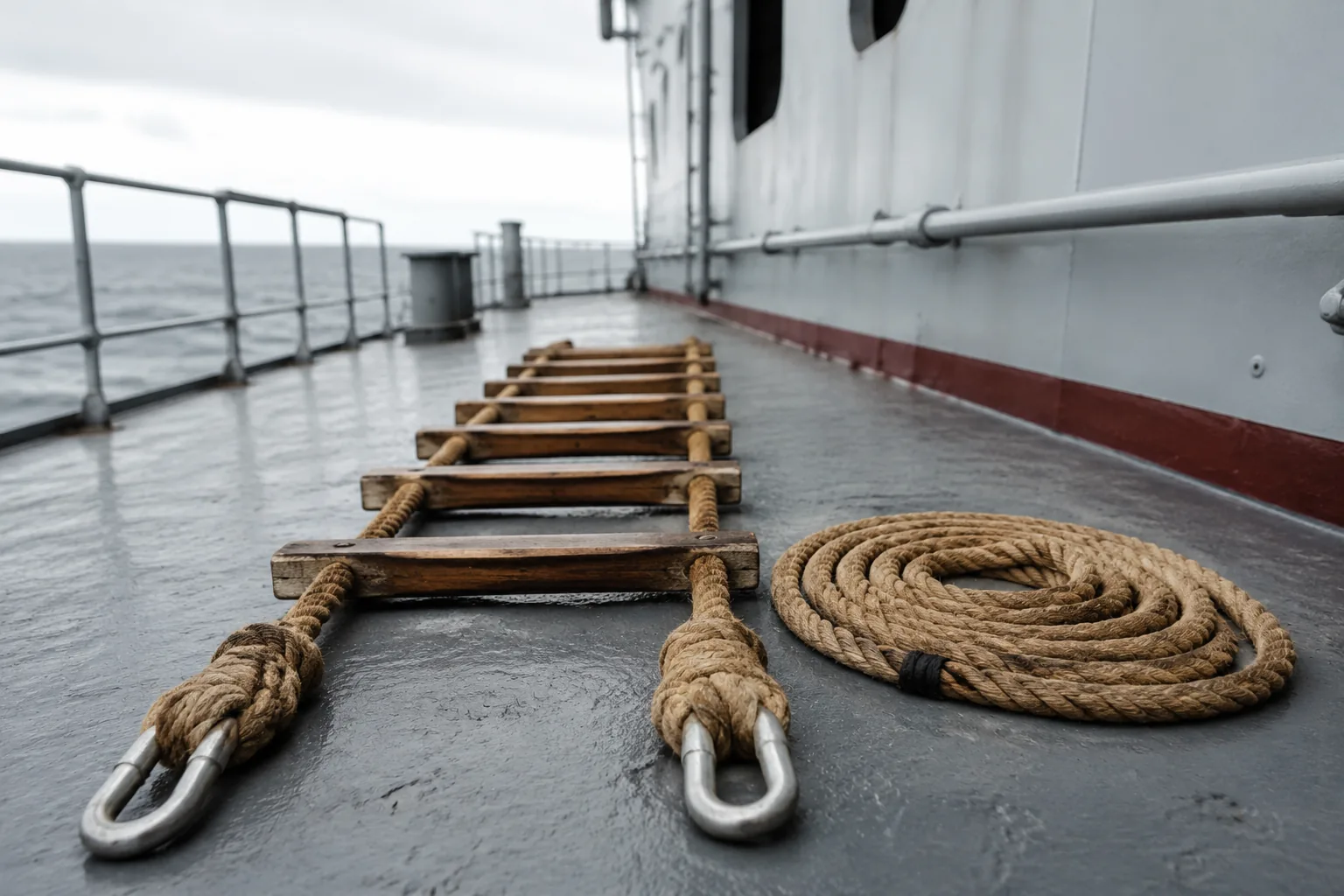
What Are the Four Prototype Tests in ISO 799-1:2019 Table 2?
The decisive tests live in Table 2 of ISO 799-1:2019, and this is where most public guidance stops at "do the strength test." The standard actually specifies four separate prototype tests, each with its own load, duration and pass/fail criterion. These must be run on a fully assembled ladder and on representative steps; any part permanently deformed in testing may not go into service.
1. Step flexibility test. A step is placed on supports at the points where the side ropes pass through, and a static load of 3.0 kN is applied uniformly over a 100 mm-wide contact area at the centre for at least one minute. For a step limited to use as one of the four lowest steps in the ladder, the load is reduced to 1.4 kN. Pass criterion: centre deflection must not exceed 25 mm under load, and there must be no residual deflection after the load is removed, with a maximum of 60 s to recover.
2. Step friction test. A reference block of clean oak (115 mm × 480 mm, with 3 mm-wide, 3 mm-deep grooves 15 mm apart) is used as a benchmark. A metal block of 1.5–3.0 kg with a leather shoe-sole face is placed on the step, one edge is raised, and the angle at which the block begins to slide is recorded. The test is run dry and wet for each step material. Pass criterion: the slide angle on the pilot-ladder step must be greater than or equal to the angle on the oak reference, in both conditions — the ladder step must be no more slippery than grooved oak.
3. Step surface durability test. A 380 N loaded metal block is slid back and forth across the step for 1 500 cycles, after which the step friction test is repeated on the worn surface in dry and wet conditions. Pass criterion: the post-wear slide angles must still meet or beat the reference. This is the test that exposes steps that are merely coated for grip and will become slippery in service.
4. Ladder and step attachment strength test. The fully assembled ladder is suspended vertically or laid out flat with the top end secured by its own attachments, and a static load of 8.8 kN is applied — widely distributed over the bottom step for at least one minute — so the load passes evenly through the step attachment fittings into the side ropes. The procedure is then repeated at five different steps. Pass criterion: steps must not break or crack; the attachment between any step and a side rope must not loosen or break; and the side ropes must show no observable damage, elongation, or permanent deformation after the load is removed. This is the single most-cited test, and it is the one re-run in service.
What Load and Materials Are Specified for the Side Ropes and Seizing?
The ladder cannot pass the 8.8 kN attachment test unless its components meet upstream material specs in Clause 4. These numbers are what a test house checks when verifying a ladder is genuine, not counterfeit:
- Side ropes: two uncovered ropes per side, not less than 18 mm in diameter, continuous with no joints, each with a breaking strength of at least 24 kN. Standard rope is mildew-resistant Grade 1 manila to ISO 1181:2004, or spun thermoset polyester with a contrasting polypropylene core. Alternative ropes are permitted if they meet the same breaking strength, resist elongation under load comparably, and survive the same weathering assessment.
- Securing ropes: where used, must have a breaking strength of at least 48 kN and be fitted with a thimble — double the side-rope figure, because both securing ropes together carry the load.
- Seizing: three-ply tarred marline with a minimum breaking strength of 800 N and minimum diameter 4 mm, or an equivalent. The preferred method of securing steps is seizing per IMO Resolution A.1045(27) §2.2.3; mechanical crimping and "8-shaped" clamps are flagged as weak links that can damage ropes through sharp edges and are the subject of incident investigations.
- Plastic components (chocks, replacement parts) must retain at least 30% of original tensile strength and 80% of original impact strength after a one-year outdoor weathering test.
- Steps: hardwood (ash, oak, beech, teak or equivalent) in one piece, free of knots, not painted, varnished or coated (coatings hide the grain and alter the friction coefficient — a classic counterfeit tell). Step spacing is 330 mm ± 20 mm, with a maximum of two replacement steps per ladder.
For the wider rope-product background shared with these materials, see our Safety rope testing and Steel wire rope testing capabilities.
How Often Must an In-Service Ladder Be Strength-Tested?
The in-service retest rule is the one that catches operators. ISO 799-1:2019 §10.4 (cross-referenced in ISO 799-2:2021 §6.6) states: each ladder shall be subjected to the ladder and step attachment strength test in Table 2 at intervals of not more than 30 months. A ladder that fails must be rebuilt by the original manufacturer (or an authorised party) under §10.3, or scrapped. Key clarifications that come up repeatedly in port-state inspections:
- The 30-month clock runs from the date of manufacture, not from first use — the same way flares and medicines are dated.
- Port authorities enforce this hard. Port Hedland Local Marine Notice 14/25 (effective 2 October 2025) states that a pilot ladder more than 30 months from manufacture is unacceptable unless it carries a valid ladder-and-step attachment strength test certificate. Australia (AMSA) applies the same 30-month rule to vessels calling at Australian ports.
- Manropes have their own, shorter clock: replacement at 12 months from manufacture (28–32 mm diameter, Grade 1 manila only), regardless of how little they were used.
- The strength test must be performed by the manufacturer, or a facility approved by the manufacturer, the Flag State, or a Classification Society — crew cannot self-certify it, and crew repairs beyond step replacement are not permitted.
What Is the Difference Between a Pilot Ladder Test and an Embarkation Ladder Test?
Pilot ladders (ISO 799-1) and embarkation ladders (ISO 5489:2024) are both rope ladders, but they serve different SOLAS chapters and are tested against different criteria. Confusing them on a certificate is a deficiency.
- Pilot ladder — ISO 799-1:2019, SOLAS V/23. Carries a living pilot transferring at sea; optimised for repeated live use, side ropes ≥ 18 mm / 24 kN, hardwood steps, the four Table 2 prototype tests above, 30-month retest.
- Embarkation ladder — ISO 5489:2024, SOLAS Chapter III (life-saving). Used to board survival craft from the ship's deck; designed for emergency descent to the waterline rather than daily personnel transfer, with its own dimension and strength requirements.
A test report should always name the product type and the standard on its face. The two ladder types share construction principles (rope, steps, seizing) but a pilot ladder's certificate does not cover an embarkation ladder, and vice versa.
How Is a Counterfeit or Sub-Standard Ladder Detected in Testing?
The market is widely reported to be flooded with counterfeit ladders carrying forged certificates, and testing is the definitive detection method. The Paris MoU's 2023 focused inspection campaign on pilot transfer arrangements found that identification of ladders and record-keeping of surveys and repairs were missing — so the first test is always document reconciliation: the ID plate serial number, ladder length and construction must match the certificate. From the materials side, a laboratory checks for:
- Painted, varnished or dyed steps — counterfeits are often dyed dark to mimic heat treatment; ISO 799-1:2019 forbids any coating that hides the natural grain or changes the friction coefficient. The step friction test will fail these.
- Under-spec ropes — measure diameter (≥ 18 mm) and verify breaking strength (≥ 24 kN) by pull test. Ropes below spec will fail the 8.8 kN attachment test.
- Mechanical clamps instead of seizing — flagged in Nautical Institute MARS 2023 reports as causing rope damage within six months; detected visually and by inspection of the rope under the clamp.
- Excessive replacement steps — more than two replacement steps (or one replacement spreader step) means the ladder must be rebuilt (§10.2), not patched.
FAQ
Can the ship's crew perform the 30-month strength test themselves?
No. ISO 799-1:2019 §10.4 and port notices require the test to be carried out by the manufacturer or a facility approved by the manufacturer, the Flag State, or a Classification Society. Crew may perform pre-use, post-use and quarterly visual inspections, and may replace up to two steps per the manufacturer's instructions, but the load test and side-rope repairs are outside the crew's scope.
What is the pass load for the ladder and step attachment strength test?
A static load of 8.8 kN applied to the bottom step for at least one minute, then repeated at five different steps. The ladder passes only if no step breaks or cracks, no step-to-rope attachment loosens, and the side ropes show no observable permanent deformation after the load is removed.
Does the 30-month age start from delivery on board or from manufacture?
From the date of manufacture, which is marked on the ladder's ID plate. Port-state authorities such as AMSA and Port Hedland count from manufacture, consistent with how flares and medicines are dated. A ladder sitting unused in a locker still ages.
Why is seizing preferred over mechanical crimping for step attachment?
IMO Resolution A.1045(27) §2.2.3 names seizing as the preferred method. Nautical Institute MARS reporting and incident investigations indicate mechanical clamps and "8-shaped" clamps can move, lose grip, and damage ropes through sharp edges — sometimes within six months of service — making them a contributing factor in pilot-ladder incidents.
Is an embarkation ladder tested the same way as a pilot ladder?
No. Embarkation ladders are tested to ISO 5489:2024 under SOLAS Chapter III (life-saving), with their own dimension and strength requirements suited to emergency descent to survival craft. The pilot-ladder-specific ISO 799-1:2019 Table 2 tests apply only to pilot ladders; the two standards and certificates are not interchangeable.
Our Testing Capabilities
As an ISO/IEC 17025-accredited third-party laboratory, Beijing ZKGX Research provides pilot ladder and rope-ladder testing aligned to ISO 799-1:2019 and IMO Resolution A.1045(27):
- Table 2 prototype tests: step flexibility (3.0 kN / 1.4 kN load, ≤ 25 mm deflection), step friction (dry and wet vs. oak reference), step surface durability (1 500 wear cycles), and the ladder and step attachment strength test (8.8 kN static load, five steps).
- In-service 30-month strength retest per ISO 799-1:2019 §10.4, with test marking and documentation for port-state and flag-state acceptance.
- Component verification: side-rope diameter and breaking strength (≥ 18 mm / ≥ 24 kN), securing rope (≥ 48 kN), seizing material (≥ 800 N), plastic-component weathering retention (≥ 30% tensile / ≥ 80% impact).
- Counterfeit and conformity screening: step coating/grain inspection against §5, ID-plate-to-certificate reconciliation, replacement-step counting, rope integrity under mechanical clamps.
Sample types include new pilot ladders for type approval, in-service ladders due for the 30-month retest, and ladders flagged in port-state inspections. If you have a specific standard, flag-state requirement or port-state deficiency to resolve, contact the laboratory to confirm the exact test set and turnaround.