Table of Contents
- Why Is Sanitary Ware Testing Necessary?
- What Products Are Covered by Sanitary Ware Testing?
- How Are Tap and Mixer Leakage and Pressure Resistance Tested?
- What Hydraulic Performance and Thermostatic Tests Apply?
- How Are Mechanical Endurance and Water Hammer Tested?
- What Chemical Safety and Heavy-Metal Leaching Tests Apply?
- Which Standards Govern Sanitary Ware (EN, GB, ASME, AS/NZS)?
- FAQ
- Our Sanitary Ware Testing Capabilities
Why Is Sanitary Ware Testing Necessary?
Sanitary ware testing verifies that plumbing fixtures — the water closets, basins, taps, mixers, and valves that a building's occupants use every day — will hold pressure without leaking, mix water to a safe temperature without scalding, and survive their service life without failing. A sanitary fixture is a pressure vessel, a wear item, and a safety device all at once: it carries mains water pressure continuously, its moving parts cycle thousands of times a year, and in the case of a thermostatic mixer it is the last line of defense against a scalding injury. Testing to the relevant product standard before market entry is how the manufacturer proves the fixture meets all three demands.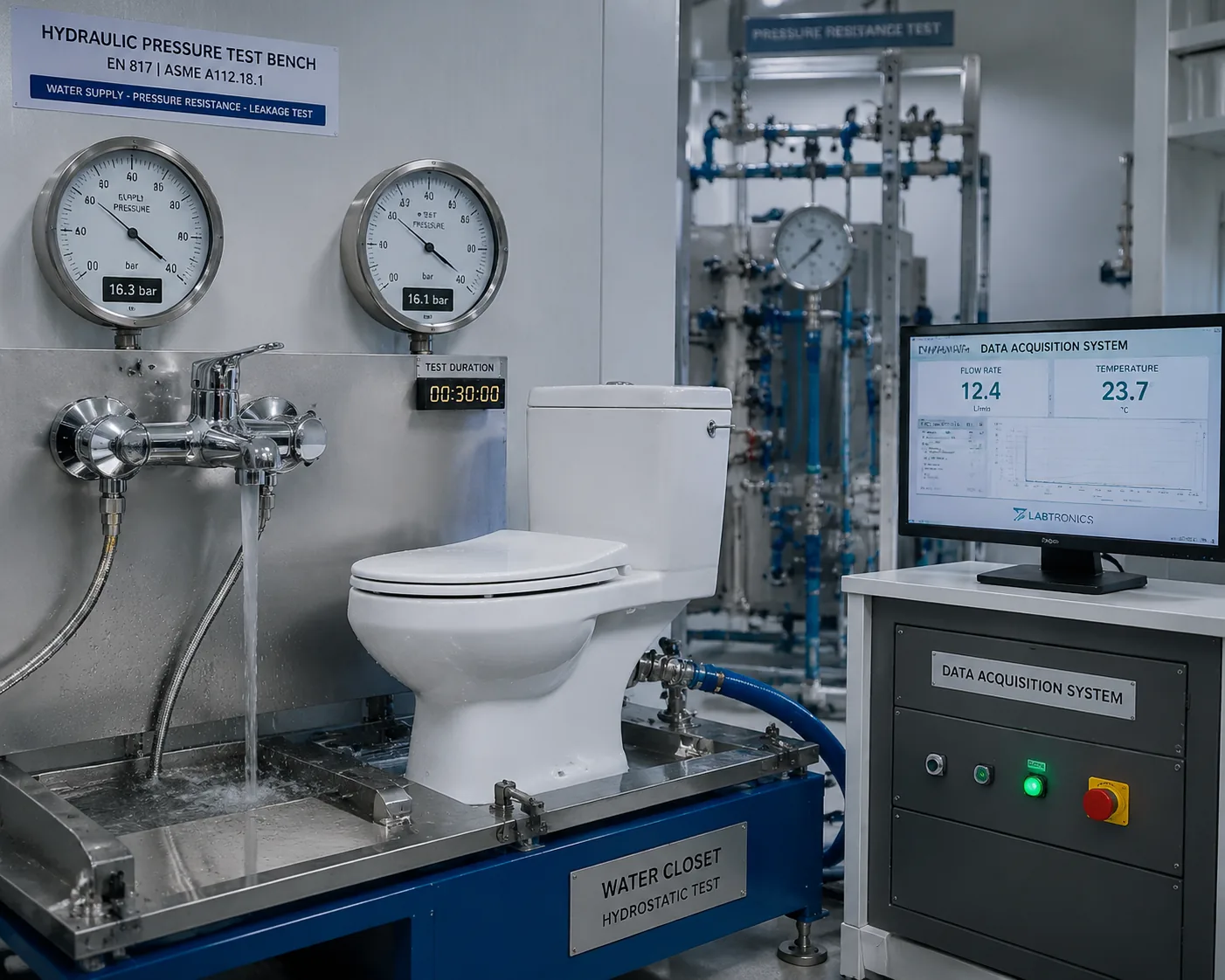
The regulatory driver is mandatory certification in most markets. In Europe, products used in sanitary facilities must satisfy the Building Regulations' functional requirements, and a SINTEF-type approval (or national equivalent) requires a documented testing procedure at an ISO/IEC 17025-accredited laboratory. In China, ceramic sanitary ware must meet GB 6952. In North America, ASME A112 series standards apply. A fixture that has not passed these tests cannot be legally placed on the market in its target region — and a fixture that passes once but is later structurally modified must be re-tested, because the modification invalidates the original certificate. The test report is the evidence a regulator, a certifier, and a specifier require.
What Products Are Covered by Sanitary Ware Testing?
Sanitary ware testing spans the full range of fixtures and fittings installed in a plumbing system:
| Product Category | Examples |
|---|---|
| Water closets (WCs) | WC pans with integral trap, close-coupled suites, one-piece WCs, WC seats & covers, bidets |
| Taps and mixers | Single taps, combination taps, mechanical mixing valves, thermostatic mixing valves |
| Urinals | Wall-hung, stall-type, with integral or separate trap |
| Ceramic ware | Wash basins, sinks, bath tubs, shower trays |
| Shower components | Shower seats, grab bars, shower valves |
| Valves | Flush valves, float valves, flexible connecting hose valves |
Each product category carries its own product standard (e.g., EN 997 for WC pans, EN 817 for mixing valves, EN 14055 for urinals) defining the constructional, dimensional, and performance requirements the product must meet. A complete test program identifies the relevant standard for each product in the range and runs the test suite each standard specifies.
How Are Tap and Mixer Leakage and Pressure Resistance Tested?
Leakage and pressure-resistance testing are the two foundational hydraulic tests for taps and mixers — they verify the valve body holds water pressure without leaking (leakage test) and without deforming (pressure-resistance test). Both are run upstream and downstream of the shut-off valve (obturator), because a tap has two distinct pressure boundaries: the supply side (upstream of the closed valve) and the outlet side (downstream).
| Test | Upstream Pressure (EN) | Downstream Pressure (EN) | Pass Criterion |
|---|---|---|---|
| Leakage | 16 bar | 4 bar | No leakage from the valve |
| Pressure resistance | ~25 bar | 4 bar | No mechanical deformation of the valve body (incidental leakage not counted) |
For the upstream leakage test, the shutter is closed and static water pressure is applied to the tap supplies; for the downstream test, the valve is open, pressure is applied to the supplies, and the outlet is plugged. Leakage tests can be run in cold water. The pressure-resistance test uses a higher upstream pressure (~25 bar) specifically to stress the valve body mechanically; the pass criterion is the absence of permanent deformation — any water that weeps during this overpressure is not a validation failure, because the test is checking structural integrity, not seal tightness.
What Hydraulic Performance and Thermostatic Tests Apply?
Beyond holding pressure, a tap or mixer must deliver water at the right flow rate and (for mixers and thermostatic valves) at the right temperature. The hydraulic performance test evaluates:
| Criterion | What It Measures |
|---|---|
| Flow characteristics | Flow rate as a function of supply pressure and temperature setting |
| Control sensitivity & accuracy | Smoothness and precision of the mixed-temperature control |
| Self-closing valve delivery | Volume of water per activation; flow-opening delay time |
| Thermostatic stability | Mixed-temperature consistency under varying flow, supply pressure, and supply temperature |
| Anti-scald safety | When cold-water supply is cut off, hot-water flow must stop instantly |
The anti-scald test is the safety-critical thermostatic check. In service, if the cold-water supply fails (a burst cold pipe, a valve closed elsewhere in the building), a thermostatic mixer that continues to deliver hot water will scald the user within seconds. The standard requires that on cold-water failure, the hot-water flow stops instantly — and this has become a priority item for sanitary-fittings certification bodies because the burn-injury consequence is severe and immediate. The thermostatic stability test is the related wear-and-accuracy check: the mixer must hold its set output temperature within a defined tolerance band while the supply pressure, flow rate, and inlet temperatures vary, simulating the real dynamic conditions of a plumbing system in use.
How Are Mechanical Endurance and Water Hammer Tested?
Two tests address the time-dependent failure modes of a tap — the wear that accumulates over thousands of cycles, and the hydraulic shock that each cycle can generate.
Mechanical endurance test. This test cycles all the moving parts — handles, diverters, cartridges — through a large number of actuations to verify reliability against wear. Depending on the standard, the test can be run with or without water supply. After the endurance cycling, the leakage and hydraulic-performance tests are repeated to confirm the tap's quality has not degraded with use — a new tap that leaks after its endurance cycle has failed, even if it was tight at the start.
Mechanical resistance test. A separate, shorter test applies a defined force or torque to the operating handles and diverters to confirm they do not break under abusive operation — overtightening, yanking the diverter, or forcing the handle past its stop.
Water hammer test. This test verifies the valve can shut off flow without generating a destructive pressure spike in the supply piping. It is typically run on self-closing valves (timed taps, electronic valves). The test simulates a long pipe run by supplying a large volume of water, then closes the valve rapidly and analyzes the pressure peak generated by the sudden flow stoppage. The water-hammer phenomenon can burst fittings downstream, so a valve that passes its own pressure-resistance test can still fail this test by transferring a destructive transient to the system.
Alternating pressure test. The tap is subjected to rapid pressure alternations (on the order of 0.1-second cycles) to simulate the water-hammer fatigue imposed by other equipment opening and closing elsewhere in the plumbing network. The test runs for a large number of cycles at room temperature; no bursts or leaks may occur before the cycle count is reached.
What Chemical Safety and Heavy-Metal Leaching Tests Apply?
Because sanitary ware comes into prolonged contact with water that may be consumed or contact skin, chemical safety testing verifies that the fixture does not release harmful substances into the water it carries. The two concerns are heavy-metal leaching from brass and bronze fittings (lead, nickel) and the broader category of Substances of Very High Concern (SVHC) and Substances of Interest (SOI) from polymeric and elastomeric components.
| Concern | Source | Regulatory Driver |
|---|---|---|
| Heavy-metal leaching (Pb, Ni) | Brass / bronze valve bodies, plated surfaces | National drinking-water regulations; EN/ASME extraction tests |
| SVHC | Polymeric seals, hoses, coatings | ECHA (European Chemicals Agency) REACH |
| SOI | Impurities / undesired substances in materials | EDANA / certification body methods |
| PFAS, bisphenols, phthalates, PAHs | Plastic and rubber components | SVHC/SOI analytical methods |
The leaching test fills the fixture (or exposes a defined surface area of its wetted parts) with a specified extractant water for a defined time and temperature, then analyzes the extractate for the regulated metals. Lead and nickel are the most-controlled parameters in brass-fitting leaching, because both are toxic and both are present in traditional brass alloys. A fitting that exceeds the leaching limit cannot be certified for drinking-water service, even if it passes all its hydraulic and mechanical tests.
Which Standards Govern Sanitary Ware (EN, GB, ASME, AS/NZS)?
Sanitary ware is governed by a layered set of product standards, each specific to a product type. A complete test program identifies the relevant standard for each product in the range:
| Product | Europe (EN) | China (GB) | USA (ASME) | Australia/NZ (AS/NZS) |
|---|---|---|---|---|
| WC pans (with integral trap) | EN 997:2018 | GB 6952 | ASME A112.19.2 | AS 1172 |
| Single taps | EN 200 | GB 18145 | ASME A112.18.1 | AS/NZS 3718 |
| Mechanical mixing valves | EN 817 | GB 18145 | ASME A112.18.1 | AS/NZS 3718 |
| Thermostatic mixing valves | EN 1111 / EN 1287 | GB 18145 | ASSE 1070 | AS/NZS 4032 |
| Urinals | EN 14055 | GB 6952 | ASME A112.19.2 | AS 1172 |
| Sanitary ceramics (general) | EN 33 | GB 6952-2015 | ASME A112.19.2 | AS 1976 |
The three regional frameworks are methodologically related but not identical — a WC qualified to EN 997 cannot be assumed to meet ASME A112.19.2 without re-testing, because the flush-volume, rim-wash, and trap-seal test procedures differ. A globally traded sanitary-ware range carries test reports against each target market's standards. Accreditation of the testing laboratory (e.g., ISO/IEC 17025) is the cross-border quality marker: a test report from an accredited lab is accepted by certifiers and regulators in the target market.
FAQ
What pressure must a sanitary tap withstand without leaking?
Under EN standards, a tap must withstand 16 bar upstream and 4 bar downstream of the shut-off valve without any leakage. For the pressure-resistance test, the upstream pressure is raised to approximately 25 bar, and the valve body must show no permanent deformation (incidental leakage during this overpressure is not a failure).
What is the anti-scald test for thermostatic mixers?
The anti-scald test verifies that if the cold-water supply is cut off while the mixer is in use, the hot-water flow stops instantly. This prevents scalding when a cold pipe fails or a valve is closed elsewhere in the system. It is a safety-critical test and a priority item for sanitary-fittings certification.
What is the difference between the leakage test and the pressure-resistance test?
The leakage test checks that the valve holds water pressure without leaking (16 bar upstream / 4 bar downstream, EN). The pressure-resistance test checks that the valve body does not deform under higher pressure (~25 bar upstream); any water that weeps during this test is not counted, because the test evaluates structural integrity, not seal tightness.
Why is the mechanical endurance test run?
Because a tap is a wear item. The endurance test cycles all moving parts through a large number of actuations, then repeats the leakage and hydraulic-performance tests to confirm the tap still meets specification after long use. A tap that leaks after its endurance cycle has failed, even if it was tight at the start.
What chemical tests apply to sanitary ware?
Heavy-metal leaching (lead, nickel) from brass/bronze wetted parts, and SVHC/SOI testing of polymeric and elastomeric components (PFAS, bisphenols, phthalates, PAHs). These verify the fixture does not release harmful substances into the water it carries. Leaching tests are mandatory for drinking-water-service certification.
Which standard applies to ceramic sanitary ware in China?
GB 6952-2015 (Ceramic sanitary ware) governs WC pans, wash basins, sinks, and other ceramic fixtures in China. Taps and mixers are covered by GB 18145. For WCs, the international equivalents are EN 997 (Europe) and ASME A112.19.2 (USA); for taps, EN 200/817/1111 and ASME A112.18.1.
Our Sanitary Ware Testing Capabilities
Beijing ZKGX Research Institute provides third-party performance and safety testing for sanitary ware — water closets, basins, taps, mixers, valves, and ceramic ware. Our testing follows the validated EN, GB, ASME, and AS/NZS frameworks, and our laboratory operates under ISO/IEC 17025 accreditation.
Standards / Methods Our Testing Covers
| Test Endpoint | Method Reference |
|---|---|
| WC pans with integral trap | EN 997 / GB 6952 / ASME A112.19.2 |
| Single taps & mechanical mixers | EN 200 / EN 817 / GB 18145 / ASME A112.18.1 |
| Thermostatic mixing valves | EN 1111 / EN 1287 / ASSE 1070 |
| Urinals | EN 14055 / GB 6952 |
| Leakage & pressure resistance (16/4 bar; 25 bar) | EN 200 / EN 817 |
| Hydraulic performance & anti-scald | EN 1111 / EN 1287 |
| Mechanical endurance & water hammer | EN 817 / EN 1111 |
| Heavy-metal leaching (Pb, Ni) | Drinking-water extraction test |
| SVHC / SOI chemical screening | ECHA REACH / EDANA methods |
What We Can Test
- Water closets and suites — flush performance, trap seal, rim wash, dimensional compliance per EN 997 / GB 6952
- Taps, mixers, and thermostatic valves — leakage, pressure resistance, hydraulic performance, anti-scald, endurance, water hammer, alternating pressure
- Urinals, basins, baths, shower trays — ceramic and stainless-steel product-standard qualification
- Flush valves, float valves, flexible hose valves — pressure, endurance, and flow-performance testing
- Wetted-part chemical safety — heavy-metal leaching and SVHC/SOI screening for drinking-water-contact compliance
Sample Types We Accept
Finished product units (complete taps, WC pans, basins) and component samples (valve cartridges, wetted-metal coupons, polymeric seals) for chemical extraction. Hydraulic tests use calibrated pressure rigs with programmable cycling; leaching tests use defined extractant water per the method standard.
Get a Testing Quote
If you need to certify sanitary ware for the European, Chinese, North American, or Australasian market — or to verify chemical safety for drinking-water contact — our team will confirm the applicable standard, sample requirements, and a quotation. Contact Beijing ZKGX Research Institute to start.