What Does "Shackle Testing" Mean?
A shackle is the load-bearing connecting device at the heart of a rigging assembly — the U-shaped body (bow) and pin that joins a sling to a hook, or multiple slings together. It is the smallest, most generic-looking item in the lift, yet a shackle failure drops the load, so it is treated as a certified, periodically-inspected safety appliance. Shackle testing is the mechanical qualification and periodic verification of the shackle's load-bearing performance, governed in North America by ASME B30.26 (Rigging Hardware) under the OSHA framework, internationally by ISO 2415 (forged shackles for general lifting), and in China by GB/T 25854-2010 (一般起重用 D 形和弓形锻造卸扣, identical adoption of ISO 2415:2004). It covers three things: the factory proof load and breaking-force qualification that certifies a new shackle, the periodic in-service inspection that catches degradation, and the removal-from-service criteria that retire a shackle before it fails. It is distinct from sling testing (the strap/chain/rope itself) and wire-rope testing — here the connector is the subject.
What Are the Shackle Types, and Why Pin Style Drives the Test?
A shackle is defined by two choices — body shape and pin type — and both drive how it may be loaded and therefore how it is tested:
Body shape:
- Anchor / bow shackle — wider, rounded bow; can take multiple sling legs and tolerate some side load. The most general-purpose shape.
- Chain / Dee (D) shackle — narrower, straighter side; optimised for straight in-line pulls. Not recommended for side loading — it twists and deforms.
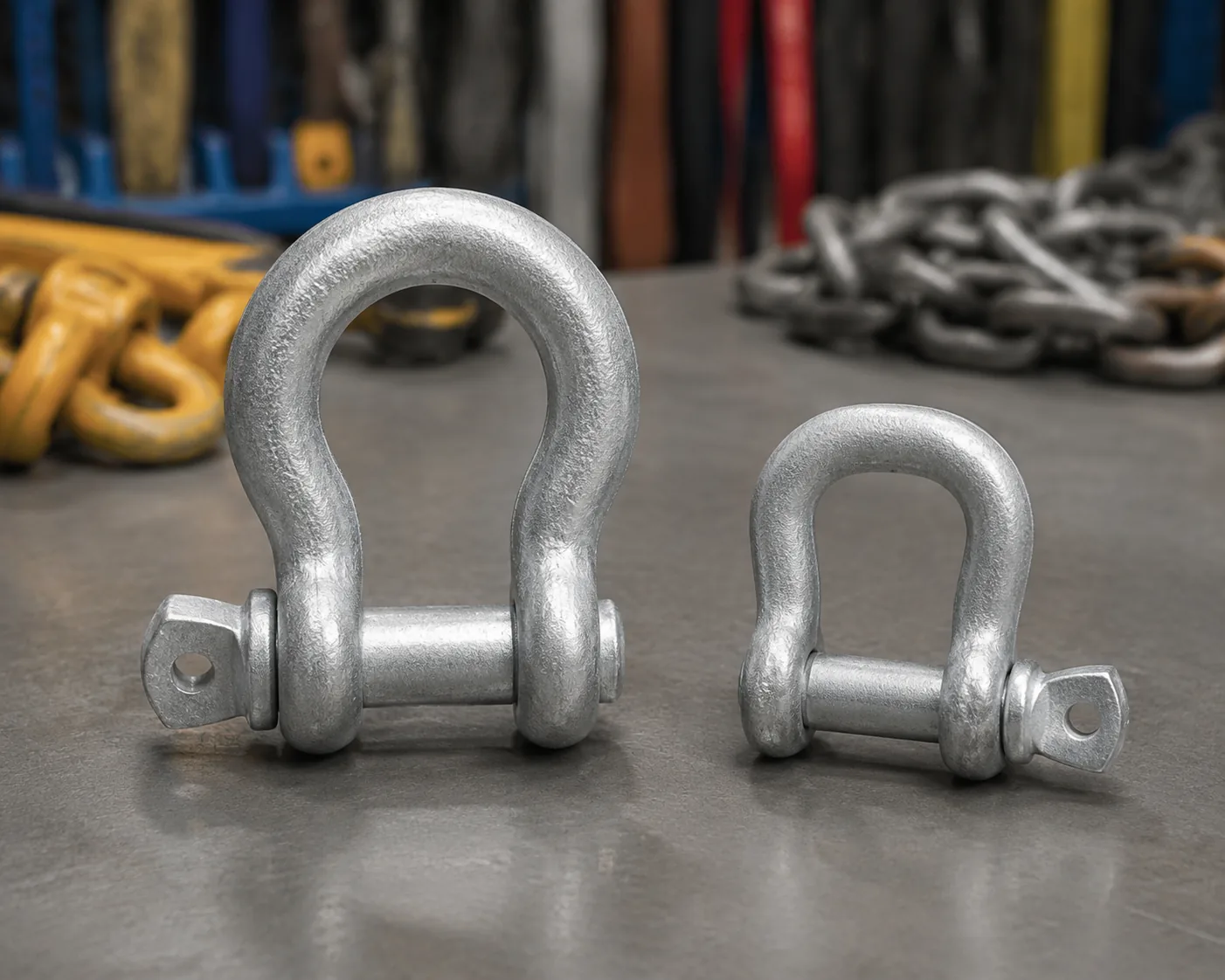
Pin type:
- Screw pin — hand-tightened; for temporary, frequent-attachment use. Must be fully seated (shoulder against the body). Can back out under vibration or side load.
- Bolt-type pin — bolt with nut and cotter/split pin; for semi-permanent or long-term installations where the pin must not move. The most secure against loosening.
- Round pin — plain pin with cotter; for straight in-line pulls only, never for lifting with side load.
The pin type determines both the test (a bolt-type shackle is qualified with the bolt fully engaged and cotter fitted; a screw pin is qualified hand-tight plus the manufacturer's seating) and the in-service risk (a screw pin in a side-loaded, vibrating application can back out and drop the load). A test report that does not name the pin type is incomplete.
How Do Proof Load, Breaking Force and the Design Factor Relate?
Every shackle carries a declared working load limit (WLL), and the test program verifies both a proof load (a non-destructive overload every shackle survives at the factory) and a breaking force (the ultimate load at destruction, which sets the design factor). The design factor — the ratio of minimum breaking force to WLL — is the headline safety number:
| Standard / grade | Design factor | Proof load | Notes |
|---|---|---|---|
| ASME B30.26 / Crosby-type (US) | 6:1 (typical) | ~2× WLL (per manufacturer) | Minimum breaking force = 6 × WLL; the benchmark for domestic lifting shackles |
| GB/T 25854-2010, grade M(4) | 4:1 | ~2× WLL | Minimum breaking force = 4 × WLL; lighter-duty |
| GB/T 25854-2010, grade S(6) | 6:1 | ~2× WLL | Minimum breaking force = 6 × WLL; equivalent to the ASME/Crosby benchmark |
| BS EN 13889, grade 6 | 6:1 | ~2× WLL | European equivalent |
Independent destructive testing of imported 3/16" screw-pin anchor shackles (WLL 1/3 ton = 633 lbf) returned breaking forces of 3672–4717 lbf in-line and 3651–4622 lbf side-loaded — design factors of 5.8–7.5 — confirming that the 6:1 design factor holds for both domestic and imported shackles of this class, with the pin shearing as the dominant in-line failure mode. Two engineering points: the proof load (~2× WLL) is deliberately below the breaking force — the proof proves the shackle survives its service overload without deformation, the breaking test proves the safety margin above it; and the S(6) grade under GB/T 25854 is the equivalent of the ASME B30.26 6:1 shackle, so a grade-S(6) shackle and a Crosby-type shackle of the same WLL are engineered to the same margin.
How Does Side Loading Reduce the Rated Capacity?
A shackle is rated for an in-line load (load along the bow's centreline). Any deviation into side loading increases the stress in the shackle and reduces the allowable WLL. ASME B30.26 prescribes the reductions, and they are large:
| Side-loading angle (from in-line) | Rated-load reduction |
|---|---|
| 0°–5° (in-line) | None |
| 6°–45° | 30 % reduction |
| 46°–90° | 50 % reduction |
| Over 90° | Not recommended; consult manufacturer |
The complementary view is the horizontal-angle stress multiplier when a shackle is used in a multi-leg bridle — the same physics that governs sling-leg tension:
| Horizontal angle | Stress multiplier |
|---|---|
| 90° | 1.000 |
| 60° | 1.155 |
| 45° | 1.414 |
| 30° | 2.000 |
At a 30° horizontal angle the stress in the shackle is double the load weight, so a shackle selected on straight-line WLL is overloaded. This is why a "2-tonne" shackle in a 30° bridle is not a 2-tonne shackle — the configuration, not the stamp, sets the real capacity. Note that a long-standing industry rule-of-thumb (Crosby's "side-load reduces WLL by 50 % at 90°") is confirmed by the destructive data: the side-loaded breaking forces were statistically indistinguishable from the in-line forces, meaning the 50 % reduction is a conservative use-rule that preserves the design factor at the angled stress, not a measured strength loss.
What Are the Inspection Frequencies and Removal Criteria?
ASME B30.26 defines three inspection tiers over a shackle's service life:
- Initial inspection — by a Designated Person before first use, and after any alteration/repair; verifies compliance with B30.26. No written record required.
- Frequent inspection — visual, by the user or Designated Person, each day before each use. Looks for the removal criteria below; no written record required.
- Periodic inspection — complete inspection by a Designated Person, intervals not exceeding 1 year (Normal service = yearly; Severe service = monthly to quarterly; Special service = per Qualified Person). Written record not required, but good practice for audit.
Removal-from-service criteria (ASME B30.26) — any one of these retires the shackle, returnable only by a Qualified Person:
- Missing or illegible identification — manufacturer name/trademark and/or rated load not readable.
- Indications of heat damage — blue/straw discolouration, weld spatter, arc strikes (heat reverses the manufacturing heat-treatment).
- Excessive pitting or corrosion — material loss reduces capacity.
- Bent, twisted, distorted, stretched, elongated, cracked or broken load-bearing components — indicates overload.
- Excessive nicks or gouges — stress raisers.
- ≥ 10 % reduction of original dimension at any point on body or pin — the single most-used measurable retirement criterion.
- Incomplete pin engagement — pin not fully seated.
- Excessive thread damage — pin cannot make full engagement.
- Unauthorised welding or modification — destroys certified integrity.
The 10 % wear rule and the "missing/illegible markings" rule together cover the two most common field retirements: a shackle worn undersize by abrasion, and a shackle whose WLL stamp has corroded off (which makes safe selection impossible). For load-bearing-component cracks not visible to the eye, NDT — magnetic-particle or dye-penetrant testing — is the prescribed detection method.
Soft Shackles (Dyneema) — a Different Failure Mode
A growing share of "shackles" in marine, slackline and light rigging are soft shackles — loops of 12-strand Dyneema/UHMWPE closed with a diamond knot. They are far lighter than steel and do not corrode, but they fail by a completely different mechanism, and their testing reflects this:
- Strength — a soft shackle's theoretical strength is ~4× the line strength (two legs, each doubled), degraded 55–70 % by the knot, giving a real breaking strength of roughly 1.0–1.3× the line strength (independent tests on 1/8" Amsteel returned 1.04–1.10×; claims of 1.8× are optimistic and come from non-marine tow/winch applications).
- Sharp-edge sensitivity — pulling a 3/16" Amsteel soft shackle over a sharp steel edge reduced breaking strength by 28 % (p = 0.014); tri-loading and abrasion showed no significant effect. Soft shackles must be sleeved wherever they contact an edge.
- No proof-load culture — soft shackles are user-tied, not factory-certified, so there is no equivalent of the steel-shackle proof load; the knot must be set (typically to 2000 lbf) before service.
A soft shackle is thus not a drop-in substitute for a certified steel shackle in a regulated lift — it lacks the factory proof-load, the traceable markings and the design-factor framework. It is excellent for its intended marine/sport applications, tested by the methods above.
For the complete rigging cluster, see our lifting sling testing (the strap/chain the shackle connects) and Steel wire rope testing; for failure investigation of failed shackles, Fracture analysis of metals.
FAQ
What is the difference between proof load and breaking force in shackle testing?
Proof load (~2× WLL) is a non-destructive overload every shackle survives at the factory without deformation; breaking force is the load at destruction, which sets the design factor (4:1 for grade M(4), 6:1 for grade S(6) / ASME B30.26). Proof proves service margin; breaking proves the safety factor above it.
How much does side loading reduce a shackle's WLL?
Per ASME B30.26: 30 % reduction at 6°–45° from in-line, 50 % at 46°–90°, and not recommended over 90°. In a multi-leg bridle the horizontal angle also multiplies stress — at 30° horizontal the shackle sees 2× the load weight. The rated WLL applies only to an in-line load.
What is the retirement criterion for shackle wear?
A ≥ 10 % reduction of the original dimension at any point on body or pin. Other ASME B30.26 removal criteria include missing/illegible markings, heat damage, pitting/corrosion, bending/distortion/cracks, nicks/gouges, incomplete pin engagement, thread damage, and unauthorised welding.
Are imported shackles held to the same 6:1 design factor as domestic ones?
Independent destructive testing of imported 3/16" screw-pin anchor shackles returned design factors of 5.8–7.5 (mean ~6.9 in-line, ~6.7 side-loaded), confirming the 6:1 design factor holds. The pin shears in the in-line failure mode; side-loaded failures show broken pins, stripped threads and sheared bells.
Can a soft shackle replace a steel shackle for lifting?
Not as a like-for-like certified substitute. A soft shackle (Dyneema loop with a diamond knot) lacks the factory proof-load, traceable forged markings and design-factor framework of a steel shackle, and its real breaking strength is ~1.0–1.3× the line strength (not the 1.8× sometimes claimed). It is excellent for marine/sport use, tested by sharp-edge and tri-load methods, but it is not a certified lifting shackle.
Our Testing Capabilities
As an ISO/IEC 17025-accredited third-party laboratory, Beijing ZKGX Research provides shackle testing aligned to GB/T 25854-2010, ISO 2415, ASME B30.26, BS EN 13889 and the OSHA rigging framework:
- Proof load (verification load) testing at ~2× WLL per grade, non-destructive, with no-visible-deformation pass criterion.
- Breaking force (destructive) testing with design-factor verification — 4:1 (grade M(4)), 6:1 (grade S(6) / ASME B30.26) — recording failure mode (pin shear, thread strip, bell shear).
- Configuration-specific testing — in-line, side-loaded (6°–45° / 46°–90°), and multi-leg bridle with horizontal-angle stress multipliers applied.
- Periodic inspection and retirement assessment per ASME B30.26 — 10 % dimension reduction, pitting/corrosion, distortion/cracks, thread engagement, heat-damage discolouration, marking legibility.
- NDT for cracks — magnetic-particle and dye-penetrant testing of load-bearing components.
- Soft-shackle characterisation — breaking force vs line strength, sharp-edge strength retention, knot-set verification.
Sample types include bow (anchor) and Dee (chain) shackles, screw-pin / bolt-type / round-pin variants, grade M(4) and S(6), and Dyneema soft shackles. If you have a specific standard (GB / ISO / ASME / EN), grade, WLL, or application, contact the laboratory to confirm the exact test set and reporting format.