Table of Contents
- What standards govern surgical suture testing?
- How is suture diameter measured?
- How is tensile strength tested?
- How is needle attachment strength evaluated?
- How is the needle itself tested?
- What biocompatibility testing is required?
- How do the Chinese YY standards classify sutures?
- FAQ
- Our surgical suture testing service
What standards govern surgical suture testing?
Surgical suture testing is governed by a pharmacopoeial framework (the USP in the United States, the European Pharmacopoeia in Europe, and the Chinese Pharmacopoeia / YY standards in China) that defines the product specifications, overlaid with the ISO 10993 biological-evaluation framework and the application-specific test methods (the needle testing, the corrosion resistance, the bend test). A suture is simultaneously a pharmacopoeial article (governed by the pharmacopoeial monograph) and a medical device (governed by the device regulation and the ISO 10993 biological evaluation), and the conformity project draws from both frameworks.
The principal reference standards our laboratory works to are:
- USP <861>, Sutures — Diameter (USP-NF) — the U.S. pharmacopoeial method for measuring the suture diameter by the pressor-foot gauge, with the acceptance limits per the USP size designation.
- USP <871>, Sutures — Needle Attachment (USP-NF) — the U.S. pharmacopoeial method for testing the needle-attachment strength of the eyeless (swaged) sutures, specifying the force the needle-suture junction must withstand.
- USP <881>, Sutures — Tensile Strength — the U.S. pharmacopoeial method for testing the straight-pull tensile strength, where 10 strands of the specified USP size are pulled to failure and the breaking load must meet the minimum requirement for that size.
- The European Pharmacopoeia (EP) suture monographs — the series of monographs for the sterile catgut (EP 0660), the sterile non-absorbable sutures (EP 0324), the sterile synthetic absorbable braided sutures (EP 0662), and the sterile synthetic absorbable monofilament sutures (EP 0663), each defining the diameter, the breaking-load (minimum breaking load), the needle attachment, and the specific requirements for the suture type.
- ASTM F1874, Standard Test Method for Destructive Testing of Suture Needles — the bend-test method for the suture needles (the straight needle must not break before the 90° bend; the curved needle must not show a permanent set after the test).
- ASTM F1089, Standard Test Method for Corrosion Resistance of Surgical Instruments — the corrosion-resistance test for the suture needles.
- ASTM F3014, Standard Test Method for Needle Penetration Force — the penetration-force test (the piercing resistance must be less than the defined limit, commonly 25 g).
- ISO 10334, Implants for surgery — Malleable wires for use as sutures and other surgical applications — the specification for the stainless-steel suture wires.
- ISO 5832-1, Metallic materials for surgical implants — Part 1: Wrought stainless steel — the material specification for the stainless-steel suture wires and needles.
- ISO 6507-1 / ISO 4545-1 — the Vickers / Knoop hardness test methods for the suture needles.
- ISO 10993 series, Biological evaluation of medical devices — the biological-evaluation framework (Part 1 the evaluation framework, Part 3 genotoxicity / carcinogenicity, Part 4 haemocompatibility, Part 5 cytotoxicity, Part 6 implantation, Part 10 sensitisation / irritation, Part 11 systemic toxicity), applied to the finished, sterilised suture.
A point worth stating plainly because it affects every project: the USP and the EP frameworks are similar but not identical, and they use different numbering systems for the suture sizes. The USP uses the USP size designations (e.g. 2-0, 3-0, 4-0), while the EP uses the metric size designations (the diameter in tenths of a millimetre, e.g. 3, 3.5, 4). A suture tested under the USP monograph satisfies the U.S. FDA submission, and a suture tested under the EP monograph satisfies the European submission, but the two are not interchangeable without the size-conversion verification. We confirm the target market and the pharmacopoeial framework before quoting.
How is suture diameter measured?
The suture diameter is the dimensional property that determines the tensile strength, the knot security, the tissue reaction, and the wound-healing outcome. A larger-diameter suture has the higher tensile strength but produces the greater tissue trauma and the larger wound-track; a smaller-diameter suture is less traumatic but weaker. The diameter measurement confirms the suture matches its labelled size and meets the pharmacopoeial limits.
The diameter is measured under USP <861> (or the equivalent EP method), using the pressor-foot gauge. The method:
- The suture specimen is placed under the pressor foot of the calibrated gauge, which applies the defined pressure to the suture without deforming it.
- The diameter is measured at multiple points along the suture length (commonly four measurements per specimen, distributed along the strand).
- The average diameter and the individual measurements are compared to the pharmacopoeial limits for the labelled USP size.
- The acceptance criterion: no fewer than 20 of the individual measurements must fall within the prescribed range for the labelled size.
A practical point: the diameter measurement is more demanding than it appears, because the braided sutures have the non-uniform diameter along the length (the braid construction produces the slight diameter variation), and the monofilament sutures can have the slight ovality from the extrusion. The pressor-foot gauge must apply the consistent pressure, and the measurement protocol must account for the construction-specific variation. The published research on the suture-diameter standards notes the range from 0.001 mm to 1.299 mm across the USP sizes from 12-0 to 5, and the measurement must resolve the diameter to the defined precision for the pharmacopoeial compliance.
How is tensile strength tested?
The tensile strength — the maximum force the suture withstands before breaking under the straight-pull load — is the defining mechanical property of the suture, and it is the property the surgeon relies on for the wound-closure security. The tensile strength is measured under USP <881> (or the equivalent EP method), using the universal testing machine.
The tensile-strength test procedure:
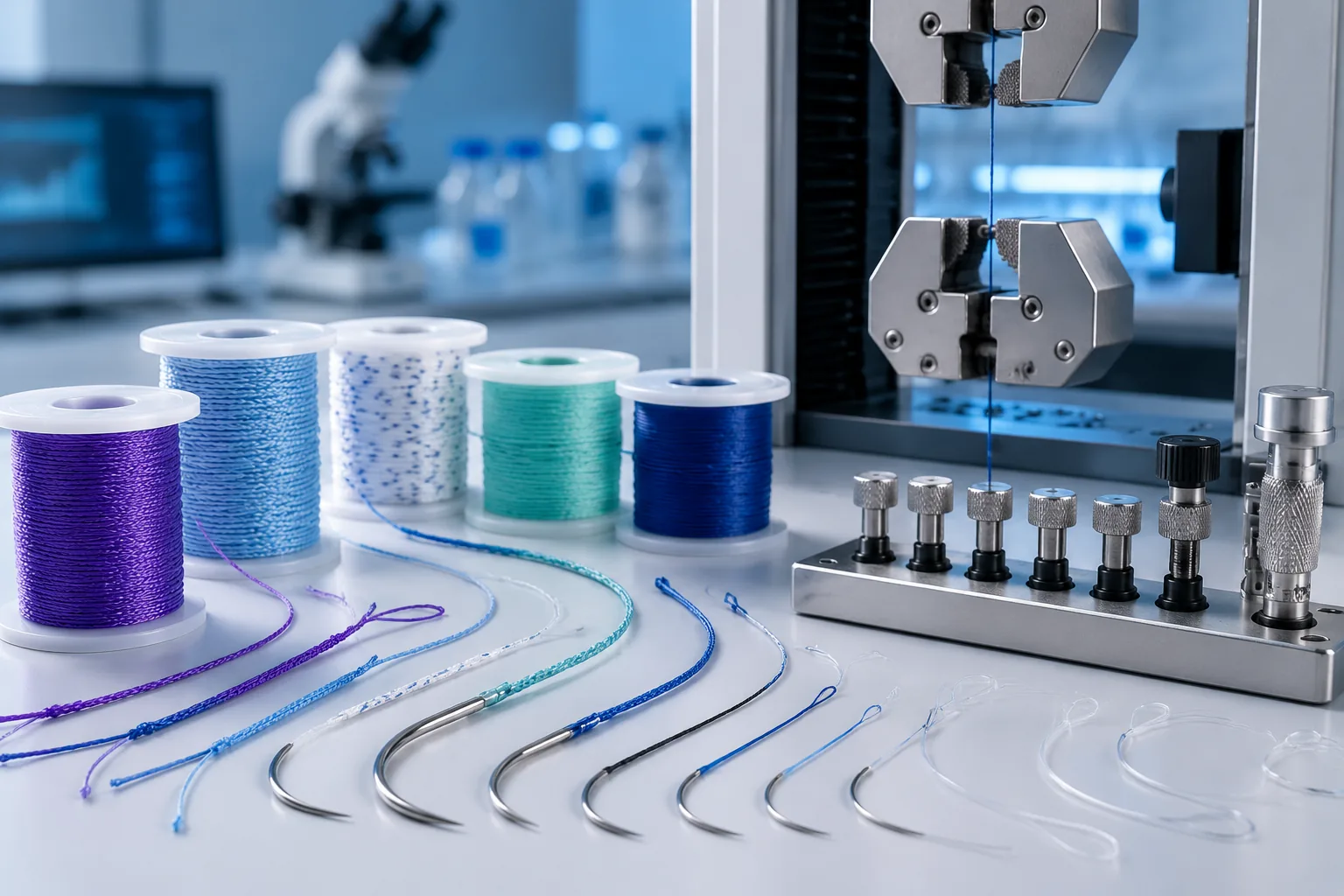
- The suture specimen is clamped in the specialised grips of the universal testing machine (e.g. the Instron 5965), with the defined gauge length (commonly the 5 cm grip-to-grip distance) and the defined crosshead speed (commonly 50 mm/min, per the established protocols).
- The tensile force is applied steadily until the suture fails (the rupture), and the maximum force (the breaking load) is recorded in newtons (N).
- Ten strands of the specified USP size are tested, and the breaking load of each strand must meet the minimum requirement for that size.
The published research data on the six commonly used oral-surgery suture materials (the PGA, the PGLA, the PLA, the PDO, the silk, and the nylon) provides the comparative tensile-strength values:
| Suture material | Mean tensile strength (N) | Standard deviation (N) | Minimum (N) | Maximum (N) |
|---|---|---|---|---|
| PGLA (polyglactin 910) | 38.7 | 3.9 | 31.5 | 44.2 |
| PDO (polydioxanone) | 37.1 | 4.2 | 30.5 | 43.6 |
| Nylon | 36.4 | 4.1 | 29.8 | 41.9 |
| PGA (polyglycolic acid) | 35.2 | 4.6 | 28.1 | 42.9 |
| PLA (polylactic acid) | 34.5 | 5.2 | 26.9 | 40.1 |
| Silk | 32.8 | 4.8 | 25.3 | 39.4 |
The data shows the significant variability (p < 0.001 by the one-way ANOVA) among the suture materials, with the PGLA and the PDO exhibiting the highest tensile strength and the silk the lowest. The clinical implication: the higher-tensile-strength materials (the PGLA, the PDO) are preferred for the high-tension areas and the deep-tissue layers, while the lower-tensile-strength materials (the silk) are suitable for the superficial closures and the delicate tissues.
A point worth noting about the tensile-strength test: the knot-pull tensile strength (the strength of the suture with a standard knot tied) is the alternative measurement that better simulates the in-vivo condition — the suture in the clinical use is always knotted, and the knot reduces the effective strength. The USP and the EP specify the straight-pull tensile strength as the pharmacopoeial standard, but the knot-pull tensile strength is the measurement that predicts the clinical performance more accurately. A complete suture-testing project reports both the straight-pull and the knot-pull tensile strengths, because the two answer different questions and both matter for the clinical-use qualification.
How is needle attachment strength evaluated?
The needle attachment strength is the property that determines whether the suture stays attached to the needle during the tissue passage — the failure mode that produces the lost needle in the wound, the retained foreign body, and the surgical complication. The needle attachment is tested under USP <871> (or the equivalent EP method).
The needle-attachment test procedure:
- The suture-with-needle specimen is clamped in the grips of the universal testing machine — the needle in one grip, the suture in the other — with the defined geometry.
- The tensile force is applied to pull the suture away from the needle, and the force at which the suture detaches from the needle (the needle-attachment failure) is recorded.
- The acceptance criterion: the needle attachment must withstand the defined minimum force for the suture size, as specified in the pharmacopoeial monograph.
The needle attachment is the test that catches the swaging defect — the improperly crimped swage that will release the suture during the tissue passage. The swaging process (the permanent attachment of the suture to the needle end by the mechanical crimping) is the manufacturing step that determines the attachment strength, and the needle-attachment test is the quality-control check that verifies the swaging. A suture that passes the tensile-strength test (the straight-pull suture strength) can still fail the needle-attachment test (the swaging is the weak link), and the two tests must both pass for the suture to be clinically qualified.
The eyed-needle sutures (the suture threaded through the needle eye, rather than swaged) are tested differently — the eyed-needle attachment is governed by the friction and the geometry of the eye, and the test protocol accounts for this. The modern surgical sutures are predominantly the swaged (eyeless) type, and the needle-attachment test is primarily applied to the swaged sutures.
How is the needle itself tested?
The suture needle — the surgical instrument that carries the suture through the tissue — has its own set of test requirements, distinct from the suture-thread testing. The needle is tested for the surface quality, the sharpness, the hardness, the corrosion resistance, and the bend resistance, under the defined standards.
The surface quality (the smoothness, the cleanliness, the sharpness of the point, the cleanliness of the swage) is tested by the visual inspection — the needle surface must be smooth and free from dents, the grinding marks and the polishing dirt must be absent, the point must be sharp, and the swage must be clean and properly formed. The visual test is the first-line quality check.
The hardness is tested by the Vickers hardness test (ISO 6507-1) or the Knoop hardness test (ISO 4545-1), because the needle must be hard enough to maintain the point sharpness and to resist the deformation during the tissue passage, but not so hard that it becomes brittle and fractures. The hardness specification depends on the needle type (the taper, the cutting, the reverse cutting, the spatula) and the application.
The corrosion resistance is tested under ASTM F1089 or ISO 13402, because the needle must resist the corrosion from the body fluids and the sterilisation. The stainless-steel needles must meet the ISO 5832-1 material specification (the wrought stainless steel for the surgical implants), and the corrosion-resistance test verifies that the finished needle maintains the material's corrosion resistance after the manufacturing (the grinding, the polishing, the heat treatment).
The bend resistance (the resistance to breakage and deformation) is tested under ASTM F1874, with the defined acceptance criteria: the straight suture needle must not break before the 90° initial bend is achieved (if it breaks, it is too hard); the curved suture needle must not show a permanent set after the test (if it deforms permanently, it is too soft). The bend test is the test that qualifies the needle's heat treatment — the balance between the hardness (too hard → brittle fracture) and the ductility (too soft → permanent deformation).
The needle penetration force is tested under ASTM F3014, because the needle must penetrate the tissue with the minimum force to avoid the excessive tissue trauma. The piercing resistance (the force required to push the needle through the defined test membrane) must be less than the defined limit (commonly 25 g), and the penetration-force test is the one that qualifies the needle sharpness quantitatively.
What biocompatibility testing is required?
The surgical suture is a tissue-contact medical device (the external-communicating tissue / tissue-bone contact, the prolonged or the permanent contact duration), and the ISO 10993 biological evaluation is required for the finished, sterilised suture. The biological-evaluation endpoints, drawn from the SFDA guidance and the ISO 10993-1 framework, include:
Cytotoxicity (ISO 10993-5 / GB/T 16886.5) — the in-vitro test that confirms the suture material or its extract is not toxic to the cultured cells, with the 70 % cell-viability threshold. The cytotoxicity is the screening test that gates the downstream biological evaluation.
Sensitisation (ISO 10993-10) — the test that confirms the suture material does not provoke the allergic sensitisation.
Irritation / intracutaneous reactivity (ISO 10993-10) — the test that confirms the suture material does not irritate the skin, the eye, or the mucous membrane. The test is route-appropriate (the skin, the eye, the mucosa) and duration-appropriate.
Acute systemic toxicity (ISO 10993-11) — the test for the harmful effects of the single or the multiple exposures during the period less than 24 hours, applicable where the contact allows the potential absorption of the toxic leachables.
Sub-acute / sub-chronic toxicity (ISO 10993-11) — the test for the repeated-exposure effects over the longer period.
Haemocompatibility (ISO 10993-4) — the haemolysis test (the degree of the red-cell lysis and the haemoglobin release caused by the suture material or its extract in vitro), applicable for the suture types that contact the blood.
Genotoxicity (ISO 10993-3) — the battery of the in-vitro tests (the gene-mutation, the chromosomal-aberration, the DNA-damage assays) that assess the genotoxic potential.
Implantation effects (ISO 10993-6) — the local pathological effects (the gross and the microscopic) on the living tissue at the implant site, appropriate to the intended application and the contact duration. The implantation test is particularly relevant for the absorbable sutures, whose degradation products must not provoke the adverse local tissue reaction.
Carcinogenicity (ISO 10993-3) — the test for the carcinogenic potential, applicable where the contact duration or the material warrants the assessment.
The biocompatibility testing is performed on the finished, sterilised suture, in the form it will be used clinically. The test articles (the suture specimens) are sterilised by the final production process, and the biological-evaluation report documents the materials, the nature and the duration of the body contact, the addressed endpoints, and the scientific data or the test results that demonstrate the biocompatibility. For the absorbable sutures, the biological evaluation includes the degradation-product assessment, because the resorption produces the degradation products whose biocompatibility must be confirmed independently of the intact suture.
How do the Chinese YY standards classify sutures?
The Chinese framework for the surgical-suture testing uses two mandatory national standards, distinguished by the absorbability:
-
YY 0167-2020, 非吸收性外科缝线 (Non-absorbable surgical sutures) (NMPA) — the mandatory Chinese standard for the non-absorbable surgical sutures, covering the classification, the requirements, the test methods, the type testing, the labelling, the instructions, the packaging, the transport, the storage, and the expiry. YY 0167-2020 applies to the non-absorbable sutures made of the natural materials (silk), the synthetic fibres (polypropylene, polyamide, polyethylene terephthalate, PVDF), and the stainless-steel wire, in the monofilament and the multifilament constructions, with and without needles. The 2024 amendment to YY 0167-2020 has been issued, and the current edition must be confirmed at the project scoping.
-
YY 1116-2020, 可吸收性外科缝线 (Absorbable surgical sutures) (std.samr.gov.cn) — the mandatory Chinese standard for the absorbable surgical sutures, covering the classification, the requirements, the test methods, the type testing, and the full product specification. YY 1116-2020 applies to the absorbable sutures (the synthetic absorbable braided and monofilament, the catgut), with and without needles.
A point worth noting: both YY 0167 and YY 1116 carry the mandatory YY prefix (not the recommended YY/T), reflecting the regulatory status of the surgical sutures as the critical medical devices whose conformity to the standard is legally required, not merely recommended. A suture marketed in China must comply with the applicable YY standard, and the NMPA registration requires the YY test report.
The Chinese biological-evaluation requirement for the sutures follows the GB/T 16886 series (the Chinese adoption of the ISO 10993), with the absorbable-suture registration technical guideline specifying the required biocompatibility endpoints. The test scope is driven by the suture type (absorbable / non-absorbable, with / without needle), the contact duration, and the nature of the body contact.
The Chinese Pharmacopoeia also carries the suture monographs (the sterile catgut, the sterile non-absorbable sutures, the sterile synthetic absorbable braided sutures, the sterile synthetic absorbable monofilament sutures), aligned with the EP monographs. The pharmacopoeial monograph and the YY standard work together — the monograph defines the pharmacopoeial quality requirements (the diameter, the breaking load, the needle attachment), and the YY standard defines the device-specific requirements (the biocompatibility, the sterilisation, the packaging, the labelling, the shelf life). A complete Chinese-market project tests against both.
FAQ
Which standard should my suture be tested to?
It depends on the target market and the suture type. For the U.S. market, the USP <861> diameter, <871> needle attachment, and <881> tensile strength, with the ISO 10993 biocompatibility. For the European market, the EP suture monographs (0660 catgut, 0324 non-absorbable, 0662 synthetic absorbable braided, 0663 synthetic absorbable monofilament). For the Chinese market, YY 0167-2020 (non-absorbable) or YY 1116-2020 (absorbable), with the GB/T 16886 biocompatibility. We confirm the target market and the suture type before quoting.
What is the difference between absorbable and non-absorbable suture testing?
The absorbable sutures require the additional resorption-profile testing (the in-vitro or the in-vivo degradation monitoring that characterises the rate and the mechanism of the absorption) and the degradation-product biocompatibility, because the absorbable sutures break down in the body and the degradation products must be confirmed as biocompatible. The non-absorbable sutures do not require the resorption testing, but they may require the longer-term implantation testing (the chronic local-tissue-response assessment) because they remain in the body indefinitely. The pharmacopoeial monographs and the YY standards differ for the two categories, and the test scope is driven by the absorbability.
How is the knot-pull tensile strength different from the straight-pull?
The straight-pull tensile strength (USP <881>) measures the force to break the suture pulled straight — the maximum force the material itself can withstand. The knot-pull tensile strength measures the force to break the suture with a standard knot tied — the maximum force the knotted suture can withstand. The knot reduces the effective strength (typically by 30 to 50 %), and the knot-pull strength is the measurement that better predicts the clinical performance because the suture is always knotted in use. A complete testing project reports both.
What needle tests are required?
The surface quality (visual), the hardness (Vickers / Knoop, ISO 6507-1 / 4545-1), the corrosion resistance (ASTM F1089 / ISO 13402), the bend resistance (ASTM F1874), and the penetration force (ASTM F3014, < 25 g). The needle is a surgical instrument with its own set of requirements, distinct from the suture thread, and the needle tests qualify the needle's ability to penetrate the tissue without breaking, deforming, or corroding.
How is the shelf life of the suture determined?
The shelf life is determined by the real-time ageing and / or the accelerated ageing testing, which verifies that the suture maintains the tensile strength, the needle attachment, the sterility, and the packaging integrity over the declared shelf life. The accelerated ageing uses the elevated temperature (commonly 50 to 60 °C) to simulate the real-time ageing in the shorter test duration, and the Arrhenius-equation-based calculation converts the accelerated-ageing time to the real-time-equivalent. The shelf-life testing is the final qualification before the suture is released to the market.
Our surgical suture testing service
Our laboratory provides surgical suture testing across the full standard stack — the USP <861> / <871> / <881> pharmacopoeial methods, the EP suture monographs, the YY 0167-2020 (non-absorbable) and YY 1116-2020 (absorbable) Chinese standards, the ASTM needle tests (F1874 bend, F1089 corrosion, F3014 penetration), the ISO 10334 stainless-steel-wire specification, and the ISO 10993 / GB/T 16886 biocompatibility framework. Each project begins with a scoping step that confirms the suture type (absorbable / non-absorbable, monofilament / braided, the material, with / without needle), the target market, the regulatory pathway, and the applicable standard set, so the report you receive answers the question your regulator, your surgeon or your quality system will actually ask.
We measure the suture diameter by the USP <861> pressor-foot gauge; the tensile strength by the USP <881> straight-pull and the knot-pull methods on the universal testing machine; the needle attachment by the USP <871>; the needle hardness by the Vickers / Knoop methods; the needle corrosion resistance by the ASTM F1089; the needle bend resistance by the ASTM F1874; the needle penetration force by the ASTM F3014; the resorption profile for the absorbable sutures by the in-vitro degradation monitoring; the shelf life by the accelerated and the real-time ageing; and the biocompatibility by the ISO 10993 / GB/T 16886 test set. Reports are issued with the standard, the method, the measured values, the pharmacopoeial limits, and the conformity conclusion explicitly stated, with the force-displacement curves, the diameter-measurement tables, and the biocompatibility test reports included, in a format suitable for the FDA submission, the EU MDR technical documentation, the NMPA registration dossier, or the internal quality audit.
To start a project, send us the suture type (absorbable / non-absorbable, monofilament / braided), the material, the USP size, the needle type (swaged / eyed, taper / cutting), the target market, the regulatory pathway, and whether the project is the pharmacopoeial conformity, the biocompatibility evaluation, the shelf-life qualification, or the full registration support. We will return a project scope, sample requirement, schedule and quotation, and begin testing on your confirmation.