What Does "Anti-Static Wrist Strap Testing" Actually Mean?
An anti-static (ESD) wrist strap is the primary means of grounding personnel at a seated workstation in an electrostatic protected area (EPA). It bleeds static charge from the operator's body to ground through a controlled-resistance path, keeping the operator at the same potential as the work surface and the ESD-sensitive (ESDS) items being handled. Anti-static wrist strap testing is the periodic verification of that personnel-to-ground resistance, governed by ANSI/ESD S20.20 (the ESD control program standard, which mandates under §8.1 that "all personnel shall be bonded or electrically connected to the grounding system when handling ESDS items"), with IEC 61340-5-1 as its international counterpart and ANSI/ESD STM1.1 (Wrist Straps — Resistive Characterization) as the test method. In China, the corresponding test methods are in SJ/T 10694-2022 (电子产品制造与应用系统防静电测试方法) under the program requirement of GB/T 32304 (电子产品防静电控制要求). It is distinct from the ESD immunity test (IEC 61000-4-2), which is a device-level discharge test, and from EPA worksurface testing, which tests the mat — here the person-plus-strap-plus-cord-to-ground system is the subject.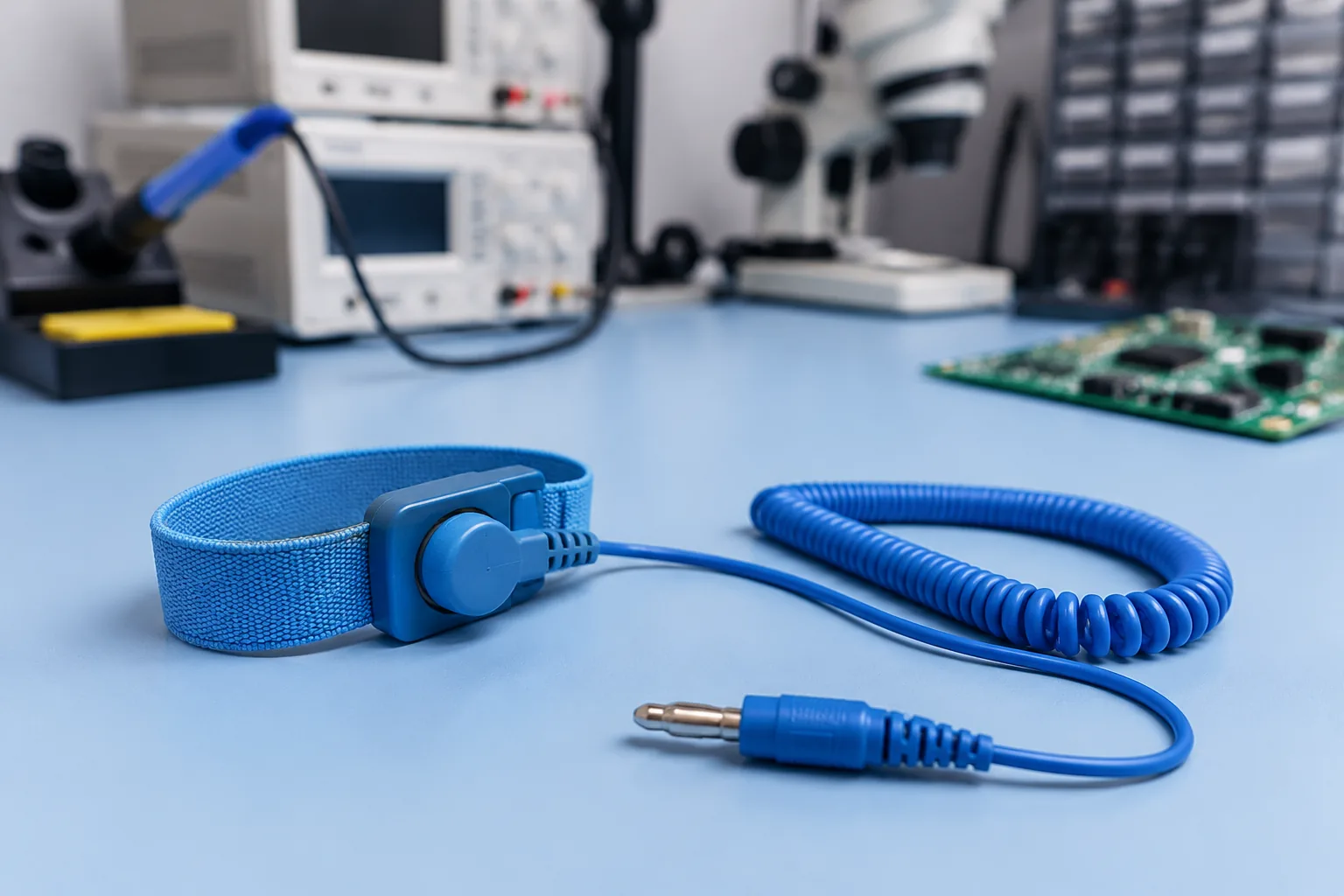
Why the Wrist Strap Is the EPA Device Most Likely to Fail
Of every item in an ESD control program, the wrist strap is the one most likely to be out of spec when tested — not because the design is poor, but because it is a wearable with a flexing cord, a skin interface, and a current-limiting resistor, any of which can degrade silently. The documented failure mechanisms are:
- Broken coil-cord wire — the cord flexes constantly; the internal conductor fractures while the insulation looks intact, so the failure is invisible until tested. A broken coil cord is the single most common "high fail" cause.
- Dirty or poorly fitted wristband — the conductive inner surface of the band soils with skin oils, lotions and dust; a loose band makes intermittent skin contact. Both raise the path-to-ground resistance into the high-fail zone.
- High skin resistance — dry skin (low humidity), lotions, or hair under the band all increase contact resistance. The fix is firm, even contact of the band against bare skin, sometimes aided by an electronics-approved ESD lotion.
- Worn or shorted 1 MΩ current-limiting resistor — the resistor inside the cord limits current to a safe level; if it shorts, the strap fails low (a safety hazard), if it drifts high the strap fails high.
- Improper wear — strap placed over clothing sleeve, too loose, or clipped to a dissipative mat edge instead of the groundable point.
Because these failures are silent — the operator feels nothing and the strap looks fine — the only way to detect them is to test the system while it is worn, so the test captures all three components: band, cord (including resistor), and skin interface.
What Resistance Range Must a Wrist Strap Meet?
A wrist strap is tested as a system — operator + band + cord + ground — and the resistance must fall in a defined band bounded by a low limit and a high limit. The band reflects two competing requirements: the strap must be conductive enough to bleed charge, but resistive enough to limit current through the human body to a safe level.
| Limit | Typical value | Engineering meaning |
|---|---|---|
| Low limit (low fail) | < 750 kΩ (often ~800 kΩ) | Below this the current-limiting function is lost — the 1 MΩ resistor is missing or shorted, a personnel-safety hazard. The tester fails low to catch a strap without its protective resistor. |
| High limit (high fail) | > 35 MΩ | Above this the strap cannot bleed charge fast enough — body voltage builds up and an ESD event becomes likely. ANSI/ESD S20.20 sets the wrist-strap system resistance upper limit at < 3.5 × 10⁷ Ω (35 MΩ). |
| Pass band | ~750 kΩ to 35 MΩ | The strap bleeds charge effectively and limits current to a safe level. The nominal 1 MΩ coil-cord resistor sits inside this band, plus the variable skin-contact and band resistance. |
The 1 MΩ resistor is the heart of the safety design. By Ohm's law it limits the current through the operator to 250 µA at 250 V RMS AC — below the human perception threshold — so that if the operator accidentally touches a live conductor while grounded through the strap, the current is non-perceptible and non-harmful. This is why a "low fail" is treated as seriously as a "high fail": a strap that has lost its resistor is an electrical-safety hazard, not merely an ESD-control one.
How Is the Wrist Strap Tested — Tester, Station, or Continuous Monitor?
Three levels of verification are used, each trading off speed, coverage and cost:
- Portable wrist-strap tester — a handheld unit; the operator wears the strap, plugs the cord into the tester, presses the button, and reads a pass/high-fail/low-fail LED. Fast, cheap, ideal for spot checks and small labs. Verifies the system at one instant.
- Combination test station (wall-mounted, often at the EPA entrance) — same resistance test, but adds a footplate so the operator tests wrist strap and ESD footwear in one step. Forces compliance at the point of entry to the EPA. Dual footplates test both feet independently and simultaneously.
- Continuous (constant) monitor — verifies the wrist strap throughout the shift, not just at entry. If the cord disconnects, the band lifts off the skin, or the ground path breaks at any moment, lights and a buzzer alert the operator immediately. Continuous monitoring is the only method that catches mid-shift failures, and where it is used the daily entry test for the wrist strap can be omitted per ANSI/ESD S20.20.
The best test is the one done while the strap is worn, because it captures the skin interface — a bench test of band-plus-cord alone will pass a band that does not actually make skin contact on the operator.
Why a Multimeter "Continuity Check" Is Not a Valid Verification
A recurring field question — often triggered by a consumer review finding "no continuity" in a cheap strap — is whether a multimeter can verify a wrist strap. The answer is that a multimeter continuity check is actively misleading for two reasons. First, a correctly functioning wrist strap does not show zero-ohm continuity: it contains a 1 MΩ current-limiting resistor by design, so a multimeter set to continuity/beep mode will report "no continuity" on a perfectly good strap, because 1 MΩ is above the typical beep threshold (~50–200 Ω). The reviewer who reported "NO CONTINUITY — NO STATIC PROTECTION" was almost certainly measuring a strap whose 1 MΩ resistor was doing exactly its job. Second, a multimeter cannot reproduce the defined test conditions — contact pressure, electrode geometry, applied test voltage — and its high-resistance ranges are noisy above 10⁶ Ω. For any formal ESD program, audit, or compliance record, only a calibrated ESD wrist-strap tester to ANSI/ESD STM1.1 is accepted; a multimeter can show rough cord integrity but cannot validate a wrist-strap system.
What Are the In-Service Test Frequency and Failure Handling?
Under ANSI/ESD S20.20 and IEC 61340-5-1, the test frequency is risk-driven:
- Daily / per-shift / on EPA re-entry is the default for wrist straps used daily, when no continuous monitor is fitted. The test is done before the operator handles any ESDS item.
- Continuous monitoring replaces the daily entry test and is required where product value or sensitivity justifies knowing the ground is intact at every moment.
- Periodic ground-system verification (the AC outlet ground, common point ground, ground bus) at e.g. 6-month intervals, separately from the per-use wrist-strap test.
Failure handling is prescribed: stop work, do not handle ESDS items, set the faulty strap aside, and diagnose by testing the band and cord separately — if the cord fails low, replace the cord (the resistor is shorted); if the band fails high, clean or replace the band. Record the failure (serial, date, cause) in the ESD log for audit traceability. A failed strap is not returned to service until it passes a re-test.
For the complete EPA personnel-grounding cluster, see our ESD Floor Mat Testing (the floor-footwear system for standing/mobile personnel) and Anti-static clothing testing; for the device-level discharge test, which is a different subject, see electrostatic discharge immunity testing.
FAQ
What resistance should an ESD wrist strap read?
The worn system (operator + band + cord + ground) should measure in the ~750 kΩ to 35 MΩ pass band — above the low limit (which confirms the 1 MΩ current-limiting resistor is present) and below the 35 MΩ high limit set by ANSI/ESD S20.20 (which confirms it can bleed charge fast enough).
Why does my multimeter show "no continuity" on a good wrist strap?
Because the strap contains a 1 MΩ current-limiting resistor by design, and a multimeter's continuity/beep mode typically thresholds at ~50–200 Ω — so 1 MΩ reads as "no continuity" on a perfectly functioning strap. A multimeter cannot validate a wrist strap; use a calibrated ESD wrist-strap tester.
What is the difference between high fail and low fail?
A high fail (> 35 MΩ) means the strap cannot bleed charge — usually a broken cord, dirty/loose band, or high skin resistance; body voltage builds up. A low fail (< 750 kΩ) means the current-limiting resistor is missing or shorted — a personnel-safety hazard, because the strap can no longer limit current through the body. Both remove the strap from service.
How often should a wrist strap be tested?
Daily, per-shift, or on each EPA re-entry when no continuous monitor is used; continuous monitoring replaces the daily test where fitted. The AC equipment ground and common point ground are verified separately on a longer (e.g. 6-month) cycle.
Why is the 1 MΩ resistor in the cord?
For personnel safety. By Ohm's law it limits the current through the operator to ~250 µA at 250 V RMS AC — below the human perception threshold — so an accidental contact with a live conductor while grounded through the strap is non-perceptible and non-harmful. The resistor is why the low-fail test exists: to confirm it is present and working.
Our Testing Capabilities
As an ISO/IEC 17025-accredited third-party laboratory, Beijing ZKGX Research provides anti-static wrist strap and personnel-grounding testing aligned to ANSI/ESD S20.20, ANSI/ESD STM1.1, IEC 61340-5-1, SJ/T 10694-2022 and GB/T 32304:
- Worn-system resistance test — operator + band + cord + ground, against the 750 kΩ low limit and 35 MΩ high limit, with high-fail / low-fail diagnostics.
- Component isolation testing — band, coil cord (including 1 MΩ resistor) and skin interface tested separately to localise high-fail (broken cord, dirty band) and low-fail (shorted resistor) faults.
- Compliance-verification program support — daily/shift/re-entry test protocols, continuous-monitor validation, and 6-month ground-system (AC outlet, common point ground, ground bus) verification per ANSI/ESD S6.1.
- EPA personnel-grounding cluster — wrist strap + ESD footwear + floor-footwear system (STM97.1) + anti-static garment, as an integrated personnel-grounding verification.
- Calibrated instrumentation — ESD wrist-strap testers and combination test stations with traceable calibration, suitable for audit-grade record-keeping.
Sample types include elastic and metal-expansion wristbands, coil cords with 1 MΩ (and 2 MΩ / 4 MΩ dual-conductor) resistors, banana-plug and snap terminations, and continuous-monitor systems. If you have a specific program (ANSI/ESD S20.20, IEC 61340-5-1, GB/T 32304), strap type, or customer-specified acceptance band, contact the laboratory to confirm the exact test set and reporting format.