What Does "ESD Floor Mat Testing" Actually Mean?
An ESD floor mat is the static-dissipative surface — bench mat, floor mat or whole anti-static floor — inside an electrostatic protected area (EPA) that keeps personnel, work surfaces and ESD-sensitive (ESDS) items at the same electrostatic potential and provides a controlled path for charge to bleed to ground. ESD floor mat testing is the periodic verification of that surface's electrical resistance and its ground path, not a mechanical test of the rubber. It is governed by the ANSI/ESD S20.20 program framework (with IEC 61340-5-1 as its international counterpart) and the test methods ANSI/ESD STM4.1 (worksurfaces — resistance measurement), ANSI/ESD STM7.1 (floor materials — resistive characterisation) and ANSI/ESD STM97.1 / 97.2 (floor-footwear system resistance and walking voltage). In China, the corresponding test methods are SJ/T 10694-2022 (电子产品制造与应用系统防静电测试方法) and the floor-construction code GB 50944 (防静电地面工程技术规程), under the program requirement of GB/T 32304 (电子产品防静电控制要求). It is distinct from ordinary anti-fatigue matting, which is rated for slip resistance, flammability and hardness — properties that say nothing about static control.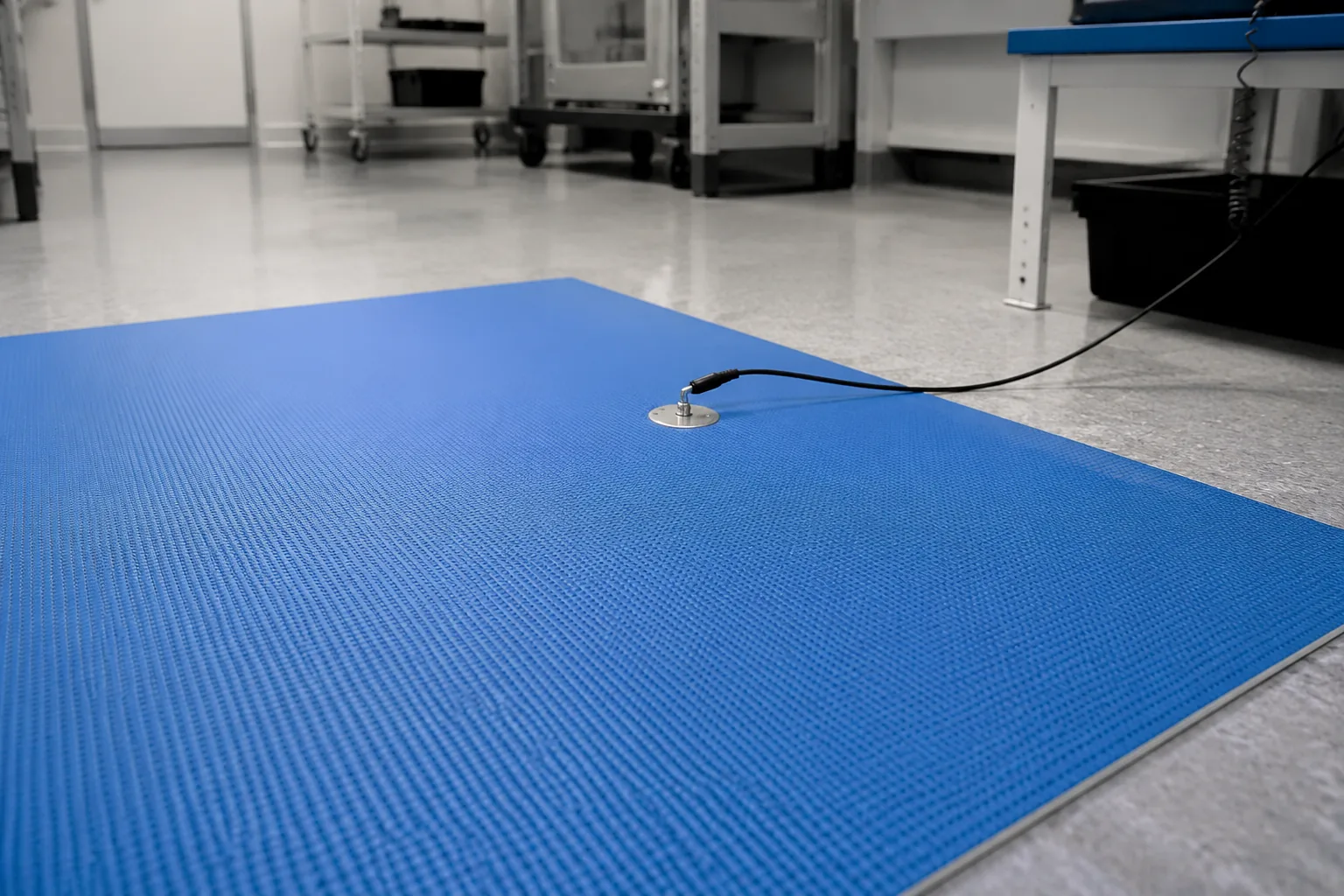
Why an ESD Mat Is a "System", Not Just a Sheet
The single most important idea in mat testing is that a mat only does its job as part of a grounded system. The surface must be dissipative, the surface must be bonded to a groundable point (snap), the snap must connect through a cord to the common point ground, and the common point ground must connect to the equipment grounding conductor (AC ground). Break any link and the mat becomes a floating charged object rather than a protective surface — and worse, a charged dissipative surface can transfer charge to an ESDS item rather than drain it. This is why the standard program requires both the surface material test (point-to-point resistance across the mat) and the system test (resistance to ground, which includes the snap, cord, common point ground and equipment ground). A mat that passes point-to-point can still fail resistance-to-ground through a broken cord or loose snap, so the two tests are complementary, not interchangeable.
What Resistance Range Must an ESD Mat Meet?
ESD materials are classified by resistance into three bands, and the band determines both function and safety:
| Classification | Resistance range | Engineering meaning |
|---|---|---|
| Conductive | < 1 × 10⁵ Ω (surface resistance per STM11.11) | Charge moves very fast — fast dissipation, but risk of rapid discharge and mains shock if energised circuits are present |
| Dissipative | 1 × 10⁶ to 1 × 10⁹–10¹⁰ Ω | Charge moves in a controlled way — the target band for most EPA worksurfaces and floors |
| Insulative | > 1 × 10¹¹ Ω | Charge does not move — cannot be grounded, must be neutralised or removed |
For worksurfaces and floor materials under ANSI/ESD S20.20, the minimum technical requirement is resistance to ground < 1 × 10⁹ Ω, with the typical dissipative target band of 1 × 10⁶ to 1 × 10⁹ Ω. China's GB 50944 floor-construction code specifies a comparable 10⁴ to 10⁹ Ω band for anti-static floor surfaces. The key engineering point competitors gloss over: lower is not always better. A surface in the conductive band dissipates charge so quickly that it can deliver a rapid discharge that damages sensitive parts, and it presents an electrical-safety hazard if the operator touches an energised conductor through it. The dissipative band is the deliberate compromise — fast enough to bleed charge within the EPA's charge-decay requirement, slow enough to be safe.
How Are Point-to-Point, RTGP and RTG Measured?
Three measurements define a complete mat verification, and each isolates a different part of the ground system. The test instrument is an ESD resistance meter with 5 lb (2.27 kg) electrodes, not a multimeter — the defined electrode pressure, electrode area and test voltage are what make the reading traceable.
Resistance to Ground (RTG) — the primary audit measurement. One 5 lb electrode is placed on the mat's most-used area; the other lead connects to the common point ground (or AC equipment ground via a grounding plug). Test at 10 V; if the reading exceeds 1 × 10⁶ Ω, switch to 100 V. RTG verifies the whole ground path: mat surface → snap → cord → common point ground → AC ground. If RTG passes, the system is good and you move on.
Resistance to Groundable Point (RTGP) — a diagnostic, run only if RTG fails. The lead connects to the mat's grounding snap instead of the building ground. If RTGP passes where RTG failed, the fault is between the snap and AC ground — a broken cord, loose snap or wrong ground point, not the mat.
Point-to-Point Resistance (RTT / RTTP) — two 5 lb electrodes placed 10 inches (25.4 cm) apart on the mat surface, at least 2 inches from any edge and 3 inches from any groundable point, at 100 V for resistances above 1 × 10⁶ Ω. RTT verifies the mat material itself is still uniformly dissipative; a worn, contaminated or aged area reads high. If RTT fails but RTG passed, the mat surface is locally degraded.
This three-step logic — RTG first, RTGP if RTG fails, RTT if RTGP passes but the system still misbehaves — is the efficient diagnostic sequence that isolates the fault to material, snap or ground path.
How Do Worksurface, Floor and Floor-footwear testing Differ?
A frequent confusion is treating all ESD "mat" testing as one method. Three distinct tests apply to three distinct surfaces, and a complete EPA program runs all three:
- Worksurface / bench mat — ANSI/ESD STM4.1 (Worksurfaces — Resistance Measurements). Two 5 lb electrodes, point-to-point and RTG as above; the bench mat is where ESDS items are handled and the tightest dissipative control applies.
- Floor material — ANSI/ESD STM7.1 (Resistive Characterization of Materials — Floor Materials). Measures the floor's own resistance (point-to-point and to ground), typically across the larger floor area; GB/T 36340-2018 specifies the conditioning environment of 23 ± 2 °C / 50 ± 5 % RH for raised-access anti-static floor panels.
- Floor-footwear system — ANSI/ESD STM97.1 (Resistance in Combination with a Person) and STM97.2 (Voltage Measurement in Combination with a Person). This is the system test: the resistance through the person, the ESD footwear and the floor to ground must be < 1 × 10⁹ Ω, and the body voltage generated in a standard walking test must be < 100 V. Both limits must be met. A floor that passes STM7.1 can still fail STM97.1 if the footwear is wrong.
The distinction matters because the mat's job is different in each: the bench mat drains charge from items placed on it; the floor drains charge from personnel and mobile equipment; the floor-footwear system is what actually keeps a standing operator at ground potential.
Why Humidity, Cleaning and Test Voltage Matter
Three environmental and procedural factors drive reading reliability, and any of them can turn a pass into a false fail or a false pass:
- Humidity — static electricity is strongly humidity-dependent. ANSI/ESD S7.1 specifies resistance measurements at both ~50 % RH and ~12 % RH because a mat that passes at 50 % can drift out of band at 12 % (the low-humidity worst case). A single reading at uncontrolled humidity is not a valid qualification.
- Test voltage — the 10 V / 100 V switch is not arbitrary. Below 1 × 10⁶ Ω, 10 V is used to avoid driving excess current through a conductive material; above 1 × 10⁶ Ω, 100 V is required to get a stable reading on a dissipative material. Using the wrong voltage gives a non-comparable number.
- Surface contamination — dirt, flux, oil, skin residue and silicone-based cleaner are the single biggest cause of high-resistance false fails. Clean with the approved ESD mat cleaner, dry fully, then test. Equally, conductive contamination can cause a low-resistance false pass. Many "failed" mats are simply dirty.
Why a Multimeter Is Not a Valid Test Instrument
This is a recurring field question, and the answer is that a handheld multimeter cannot reproduce the conditions that make an ESD measurement traceable. ESD resistance testing requires a defined test voltage (10 V or 100 V), a defined electrode (5 lb, ~6.5 cm diameter, conductive rubber), a defined contact pressure and a repeatable measurement geometry. A multimeter applies an undefined low voltage through sharp probe tips, has no controlled electrode area or pressure, and its high-resistance ranges are typically noisy above 10⁷ Ω. A multimeter can show rough continuity, but for any formal ESD control program, audit or customer-required verification, only an ESD resistance meter to STM4.1 / STM7.1 is accepted.
For the related ESD control items in a complete EPA, see our Anti-static clothing testing; for the device-level ESD immunity test (IEC 61000-4-2), which is a different subject from EPA worksurface verification, see electrostatic discharge immunity testing.
FAQ
What resistance should an ESD floor mat read?
Under ANSI/ESD S20.20 the minimum requirement is resistance to ground < 1 × 10⁹ Ω, with the typical dissipative target band of 1 × 10⁶ to 1 × 10⁹ Ω. China's GB 50944 specifies a comparable 10⁴ to 10⁹ Ω band for anti-static floors. The exact acceptance limit comes from your ESD control program or customer spec.
What is the difference between point-to-point and resistance-to-ground testing?
Point-to-point (RTT) checks the mat material is uniformly dissipative across the surface; resistance-to-ground (RTG) checks the mat has a controlled path to ground through the snap, cord and common point ground. A mat can pass RTT and fail RTG (broken cord), or pass RTG and fail RTT in a worn area. Both are needed.
Can I test an ESD mat with a normal multimeter?
No, not for formal verification. ESD testing needs a defined test voltage (10/100 V), a 5 lb electrode of defined area and pressure, and a repeatable geometry — none of which a multimeter provides. A multimeter may show rough continuity but cannot produce a traceable resistance reading to STM4.1 / STM7.1.
Why is resistance measured at both 50 % and 12 % humidity?
Static behaviour is humidity-dependent: a mat that is dissipative at 50 % RH can drift into the insulative band at 12 % RH (the low-humidity worst case). ANSI/ESD S7.1 requires both conditions precisely so the qualification covers the dry-season condition, not just the comfortable-lab condition.
How often should ESD mats be tested?
The frequency is set by the ESD control program. ANSI/ESD S20.20 is program-based and requires compliance verification; common practice is at installation and at least four times per year, increasing for high-use, soldering-heavy or repair benches. Continuous wrist-strap monitors do not verify the mat, so mat RTG testing continues even where continuous monitoring is in place.
Our Testing Capabilities
As an ISO/IEC 17025-accredited third-party laboratory, Beijing ZKGX Research provides ESD floor mat, worksurface and floor-footwear testing aligned to ANSI/ESD S20.20, STM4.1, STM7.1, STM97.1/97.2, IEC 61340-5-1, SJ/T 10694-2022, GB 50944, GB/T 32304 and GB/T 36340:
- Worksurface resistance to ANSI/ESD STM4.1 — point-to-point (RTT), resistance to groundable point (RTGP) and resistance to ground (RTG) with 5 lb electrodes at 10 V / 100 V, in the dissipative band 1 × 10⁶ to < 1 × 10⁹ Ω.
- Floor material resistance to ANSI/ESD STM7.1 and GB/T 36340 (23 ± 2 °C / 50 ± 5 % RH conditioning), point-to-point and to-ground across the floor area.
- Floor-footwear system test to ANSI/ESD STM97.1 (system resistance < 1 × 10⁹ Ω) and STM97.2 (walking body voltage < 100 V).
- Dual-humidity qualification per ANSI/ESD S7.1 (~50 % and ~12 % RH) and SJ/T 10694 / GB 50944 floor-band verification (10⁴–10⁹ Ω).
- Failure diagnosis — isolating material vs snap vs cord vs ground-path faults through the RTG→RTGP→RTT sequence, with a documented audit-trail record.
Sample types include bench worksurface mats, floor mats, full anti-static floor finishes, raised-access anti-static floor panels, and the floor-footwear-person system. If you have a specific program (ANSI/ESD S20.20, IEC 61340-5-1, GB/T 32304), surface type, or customer-specified acceptance limit, contact the laboratory to confirm the exact test set and reporting format.