What Is Bulletproof Vest Testing and Why It Matters
Bulletproof vest testing is the systematic process of evaluating whether body armor can stop specific projectile threats under controlled, standardized conditions. The testing determines two critical outcomes: whether the projectile penetrates the armor (complete penetration vs partial penetration), and how much blunt force trauma the wearer would experience even when the bullet is stopped (backface signature).
The stakes are absolute. When a bullet strikes body armor, the layered fibers decelerate the projectile and spread its force across a wider area. The bullet deforms upon impact, reducing its penetrating power. However, the deformation of the armor into the wearer's body — measured in millimeters of depth in a clay backing — must remain within strict limits. A vest that stops a bullet but allows 60 mm of backface deformation may still cause fatal internal injuries from blunt force trauma.
Under current NIJ standards, armor must withstand 12 shots (six front, six back) with clay deformation no deeper than 44 mm (1.73 inches). This standard, co-developed by the National Institute of Standards and Technology (NIST) and the National Institute of Justice (NIJ), represents decades of research into real-world ballistic threats and human injury tolerance.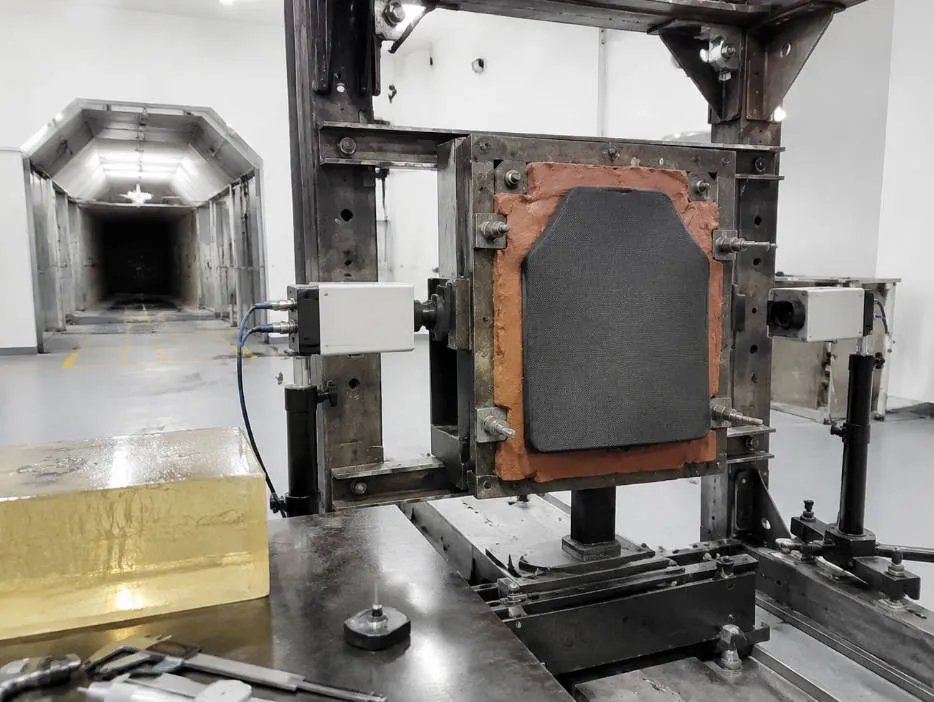
Key Standards for Bulletproof Vest Testing
|
Standard |
Organization |
Scope |
Latest Version |
|---|---|---|---|
|
NIJ 0101.06 |
National Institute of Justice (US) |
Ballistic resistance of body armor |
2008 (still active) |
|
NIJ 0101.07 |
NIJ |
Updated ballistic resistance standard |
Draft/publication in progress |
|
NIJ 0115.00 |
NIJ |
Stab resistance of body armor |
2000 |
|
MIL-STD-662F |
US Department of Defense |
V-50 ballistic test for armor |
1997 |
|
STANAG 4569 |
NATO |
Protection levels for occupation vehicles (used for plate testing reference) |
Edition 2 |
|
HOSDB 39/07 |
UK Home Office |
Body armor standards (UK) |
2007 |
|
VPAM |
VPAM Association (Germany) |
General and ballistic protection testing |
Various |
|
ISO 17025 |
ISO |
General requirements for testing laboratory competence |
2017 |
|
ASTM F3215-17 |
ASTM |
Standard practice for determination of V-50 |
2017 |
NIJ Threat Levels Explained
The NIJ 0101.06 standard defines five threat levels for body armor, each specifying the ammunition types, velocities, and number of shots the armor must stop.
|
NIJ Level |
Armor Type |
Threat Ammunition |
Bullet Velocity |
Shots Required |
Typical Use |
|---|---|---|---|---|---|
|
Level IIA |
Soft |
9mm FMJ RN, .40 S&W FMJ |
1,165-1,255 ft/s |
6 per panel |
Undercover, warm climate |
|
Level II |
Soft |
9mm FMJ RN, .357 Magnum JSP |
1,175-1,305 ft/s |
6 per panel |
Patrol officers, general duty |
|
Level IIIA |
Soft |
.357 SIG FMJ FN, .44 Magnum SJHP |
1,400-1,530 ft/s |
6 per panel |
Tactical units, most common police vest |
|
Level III |
Hard plate |
7.62mm NATO FMJ (M80) |
2,780 ft/s |
6 per plate |
Military, active shooter response |
|
Level IV |
Hard plate |
.30 Cal AP (M2 AP) |
2,880 ft/s |
1 per plate |
Military high-threat environments |
Key rules:
-
Soft armor (IIA through IIIA) is tested with 6 shots per panel, front and back
-
Level III plates must stop 6 shots from a 7.62mm NATO round
-
Level IV plates must stop at least 1 armor-piercing round
-
All testing includes environmental conditioning before live fire
Core Ballistic Testing Methods
Penetration Testing (Pass/Fail)
The fundamental ballistic test is binary: the bullet either completely penetrates the armor or it does not. A "complete penetration" is defined as the projectile or any fragment of the armor passing entirely through the test specimen and being detected in the witness panel (typically a thin aluminum sheet placed behind the clay backing).
Partial penetration occurs when the bullet is stopped but causes deformation in the clay. The depth of this deformation — the backface signature (BFS) — is the second critical pass/fail criterion.
Fair Impact Zones
Shots must land within specific zones on the armor panel:
-
Shot-to-shot distance: Minimum 51 mm (2 inches) between impact points
-
Edge distance: Minimum 51 mm from any edge
-
Corner distance: Minimum 76 mm (3 inches) from corners
-
Shots outside these zones are considered "unfair impacts" and must be re-shot
Oblique Angle Testing
Some test protocols require shots at angles up to 30 degrees from normal (perpendicular) incidence. Angled impacts present different stress patterns on the armor fibers and may be more or less likely to penetrate depending on the armor design.
The V-50 Ballistic Limit Test
V-50 testing is a statistical method that goes beyond the pass/fail approach. It determines the exact velocity at which a projectile has a 50% probability of penetrating the armor.
How V-50 Testing Works
-
Mount the armor on a calibrated fixture with clay backing
-
Fire projectiles at progressively increasing velocities
-
Record each shot: velocity at impact, penetration result (complete or partial), BFS measurement
-
Establish the V-50 value: the velocity where 50% of shots penetrate and 50% are stopped
Why V-50 Matters
|
Factor |
Pass/Fail Testing |
V-50 Testing |
|---|---|---|
|
Result type |
Binary (pass or fail) |
Statistical velocity threshold |
|
Margin visibility |
Cannot determine how close to failure |
Shows exact performance margin |
|
Comparison value |
Limited (same level = same rating) |
Enables quantitative comparison between products |
|
Design feedback |
Minimal |
Detailed data for material optimization |
|
Test standard |
NIJ 0101.06 compliance |
MIL-STD-662F, ASTM F3215 |
For example, two Level IIIA vests both pass the NIJ test, but one may have a V-50 of 1,700 ft/s while the other has 1,550 ft/s — a significant difference in real-world protection margin.
Fragment Protection Testing
V-50 testing is particularly important for fragment protection. In military scenarios, explosive devices produce high-velocity fragments (shrapnel) that are often more lethal than bullets. V-50 testing with standardized fragment simulating projectiles (FSPs) measures the armor's ability to defeat these irregular, often tumbling threats.
Backface Signature and Clay Calibration
The backface signature (BFS) is the depth of the indentation left in the clay backing material after a bullet is stopped by the armor. NIJ 0101.06 limits this to 44 mm (1.73 inches) maximum.
Clay Calibration Requirements
The clay used for backing is not generic modeling clay. It must meet strict calibration standards:
|
Parameter |
Requirement |
|---|---|
|
Clay type |
Roma Plastilina #1 (oil-based, non-hardening) |
|
Calibration drop |
A 63.5 mm (2.5 inch) diameter steel sphere dropped from 2 m (6.56 ft) must produce a specific indentation depth |
|
Temperature |
Maintained within a specified range (typically 20-25 °C) |
|
Conditioning |
Clay blocks are conditioned for a minimum period befOre testing |
|
Verification |
Drop test repeated at specified intervals during testing |
The clay must be verified before, during, and after a test series. If the calibration drop produces an indentation outside the acceptable range, the clay block must be reconditioned or replaced, and any shots on that block may need to be re-tested.
Why 44 mm?
The 44 mm limit was established through research into human injury tolerance. Blunt force trauma at depths exceeding 44 mm to the chest or back has a statistically significant probability of causing:
-
Rib fractures
-
Lung contusions
-
Cardiac contusions
-
Lacerated organs
Environmental Conditioning Tests
Body armor does not serve its purpose in a laboratory. It is worn in rain, heat, humidity, and through years of daily use. Environmental conditioning tests simulate these real-world degradation factors before ballistic testing.
Tumble Conditioning (NIJ 0101.06)
|
Parameter |
Specification |
|---|---|
|
Equipment |
Rotary tumbler (similar to a commercial dryer) |
|
Sample size |
16 vest panels per batch |
|
Temperature |
65 °C (149 °F) |
|
Humidity |
80% relative humidity (RH) |
|
Duration |
10 days (one full cycle) |
|
Post-conditioning |
Panels tested at reduced velocity to verify retained protection |
The tumble test simulates years of wear in 10 days. The combination of heat, humidity, and mechanical flexing weakens fiber materials — particularly some types of aramid fibers that are susceptible to moisture degradation. NIST research found that sweat moisture, combined with the fiber folding from daily wear, can cause certain fibers to weaken and fail over time.
Water Immersion Testing
Some armor types must also withstand water immersion to verify that the ballistic material does not degrade when wet. This is particularly relevant for soft armor worn under clothing where perspiration is constant.
Temperature Cycling
Armor may be subjected to temperature cycles (e.g., -20 °C to +60 °C) to simulate storage in vehicle trunks, exposure to extreme climates, and thermal shock conditions.
Comfort and Mobility Testing
ballistic protection is meaningless if the armor is so uncomfortable or restrictive that officers and soldiers refuse to wear it. Three new DuPont-developed test methods quantify comfort and mobility:
Lower Costal Bending (LCB) Test
|
Parameter |
Detail |
|---|---|
|
Method reference |
HO-DPT 67474-2 |
|
What it measures |
Energy lost due to armor stiffness during torso bending |
|
Real-world relevance |
Bending movements during duty lead to energy loss and accelerated exhaustion |
|
Output |
Quantified energy loss in joules |
Double Curvature Compression (DCC) Test
|
Parameter |
Detail |
|---|---|
|
Method reference |
HO-DPT 67474-3 |
|
What it measures |
Energy needed for armor to conform to a double-curved torso shape |
|
Real-world relevance |
Body armor must adopt multi-curved shapes during real movement |
|
Output |
Adaptability score — higher conformance = better mobility |
Edge Pressure (EP) Test
|
Parameter |
Detail |
|---|---|
|
Method reference |
HO-DPT 67474-1 |
|
What it measures |
Discomfort at pressure points (lower abdomen, neck, arm) |
|
Real-world relevance |
Vest edges dig into the body during extended wear |
|
Output |
Quantified discomfort pressure at localized points |
These three tests, inspired by real-world end-use situations and body movements, enable identification of discomfort levels and mobility constraints wearers experience during operational activities.
Soft Armor vs Hard Armor Testing
|
Test Parameter |
Soft Armor (IIA-IIIA) |
Hard Armor (III-IV) |
|---|---|---|
|
Form factor |
Flexible panels, vest-style |
Rigid plates, plate carrier |
|
Primary material |
Aramid (Kevlar) or UHMWPE layers |
Ceramic + polyethylene composite |
|
Test shots |
6 per panel (front + back) |
6 (Level III) or 1 (Level IV) |
|
Clay backing |
Required, BFS measured |
Required, BFS measured |
|
Tumble conditioning |
Required (10 days) |
Not typically required |
|
Water immersion |
May be required |
Not typically required |
|
Weight range |
3-6 lbs per panel |
4-10 lbs per plate |
|
Multi-hit capability |
Tested (6 shots) |
Level III tested (6 shots), Level IV single shot |
|
Typical threat |
Handgun rounds |
Rifle rounds, armor-piercing |
|
V-50 applicability |
Common for development |
Common for plate qualification |
Materials Used in Modern Body Armor
|
Material |
Type |
Key Properties |
Used In |
|---|---|---|---|
|
Kevlar (aramid) |
Woven fiber |
High tensile strength, heat resistant, susceptible to UV and moisture |
Soft armor panels |
|
Twaron (aramid) |
Woven fiber |
Similar to Kevlar, slightly different mechanical properties |
Soft armor panels |
|
UHMWPE (Dyneema/Spectra) |
Unidirectional or woven |
Lighter than aramid, excellent energy absorption, moisture resistant |
Soft and hard armor |
|
Alumina (Al2O3) ceramic |
Hard plate component |
Extremely hard, shatters incoming projectile, brittle |
Level III/IV plates |
|
Silicon carbide (SiC) ceramic |
Hard plate component |
Lighter than alumina, excellent hardness |
Level III/IV plates |
|
Boron carbide (B4C) ceramic |
Hard plate component |
Lightest ceramic option, highest hardness |
Military Level IV plates |
|
Polyethylene (PE) backing |
Composite backing |
Catches projectile fragments after ceramic shattering |
Hard armor plate backs |
The Testing Laboratory Process
Step-by-Step: A Complete NIJ 0101.06 Test
-
Sample receipt and documentation: Armor samples logged, photographed, measured for thickness and weight
-
Clay block preparation: Roma Plastilina #1 conditioned to specification, calibrated with steel sphere drop test
-
Environmental conditioning: 16 panels placed in rotary tumbler at 65 °C / 80% RH for 10 days (if required)
-
Pre-test calibration: Verify chronograph, verify clay, verify witness panel placement
-
Mount armor on clay: Panel fixed in fully automated test rig with clay backing
-
Live fire testing: Fire specified ammunition at specified velocities, measuring each shot's impact velocity
-
BFS measurement: After each shot (or series), measure clay indentation depth
-
Witness panel inspection: Check for complete penetrations (projectile or fragments through the armor)
-
Post-test clay calibration: Re-verify clay to ensure it maintained properties throughout testing
-
Report generation: Document all shot data, velocities, BFS measurements, pass/fail results
Accreditation Requirements
NIJ-approved testing must be conducted at an ISO 17025 accredited laboratory. This accreditation ensures:
-
Competent personnel performing tests
-
Calibrated and maintained equipment
-
Documented procedures followed exactly
-
Traceable measurement standards
-
Quality management system in place
TNO's Laboratory for Ballistics Research is an example of an ISO 17025 accredited facility that conducts NIJ 0101.06 testing. Their flexible protocol allows Level IIIA testing to be completed within 4 days.
Common Test Failures and What They Mean
|
Failure Mode |
Cause |
Detection |
Consequence |
|---|---|---|---|
|
Complete penetration |
Armor material insufficient for threat level |
Projectile or fragments found in witness panel |
Fail — armor does not meet rated level |
|
BFS exceeds 44 mm |
Material too thin or too stiff for energy absorption |
Clay indentation deeper than 44 mm |
Fail — blunt trauma risk too high |
|
Edge failure |
Insufficient edge coverage or construction |
Penetration at or near panel edge |
Fail — edge protection inadequate |
|
Post-conditioning failure |
Material degraded by humidity/heat/flexing |
Passes pre-conditioning but fails after tumbling |
Fail — long-term durability concern |
|
Shot clustering |
Shots too close together weakening adjacent area |
Multiple shots within 51 mm radius |
Invalid test — must be re-shot properly |
|
Clay out of calibration |
Clay too soft or too hard |
Calibration sphere produces wrong indentation depth |
Invalid test — all shots on that block voided |
|
Velocity out of range |
Chronograph error or ammunition inconsistency |
Impact velocity outside specified range |
Invalid shot — must be re-fired |
Historical Evolution of Body Armor Testing
|
Era |
Development |
Significance |
|---|---|---|
|
1923 |
Protective Garment Corp live demonstration |
WH Murphy took two .38 rounds to the chest at 10 feet to prove vest effectiveness |
|
1920s-30s |
Cotton padding and cloth vests |
Early vests could stop handgun rounds up to 300 m/s; criminals and police both adopted them |
|
1930s |
.357 Magnum and .38 Super development |
Law enforcement developed more powerful rounds to defeat criminal body armor |
|
1970s |
NIST + US Army + DOJ develop first standardized tests |
Scientific approach replaced anecdotal evidence; first NIJ standard created |
|
1970s-80s |
Kevlar commercialization |
DuPont's aramid fiber revolutionized soft armor weight and protection |
|
2000s |
NIJ 0101.06 developed |
Comprehensive standard including environmental conditioning and BFS limits |
|
2010s |
V-50 statistical testing adopted widely |
Military and advanced manufacturers adopted probabilistic assessment |
|
2020s |
Comfort and mobility testing formalized |
DuPont LCB/DCC/EP methods quantify wearer experience |
|
Present |
NIJ 0101.07 in development |
Updated standards addressing new threats and materials |
The transition from Murphy's 11 lb (5 kg) vest in 1923 to modern Level IIIA vests weighing under 5 lbs (2.3 kg) per panel represents nearly a century of material science and testing evolution. Each generation of testing standards has driven improvements in both protection and wearability.
Summary
Bulletproof vest testing comes down to three numbers: 44 mm — the maximum allowed backface signature depth that separates a stopped bullet from a fatal blunt trauma injury; V-50 — the velocity threshold where armor performance transitions from reliable to uncertain, revealing margins that pass/fail tests cannot; and 65 °C / 80% RH for 10 days — the environmental conditioning that simulates years of real-world wear in accelerated time. The difference between a vest that passes in the lab and one that protects on the street is the gap between unconditioned samples and tumble-conditioned panels, between a single shot and 12 consecutive stops, between knowing it passed and knowing by how much.