What Does "Candida albicans Testing" Mean in a Laboratory?
Candida albicans is a polymorphic yeast (fungus) — a normal commensal of the human skin, mouth, throat, gut and vagina that, given the right conditions (antibiotic use, immunosuppression, diabetes, central venous catheters), overgrows and causes candidiasis: oral/vaginal thrush, oesophageal candidiasis, and the life-threatening invasive candidiasis / candidemia. Because C. albicans is both a human commensal and an opportunistic pathogen, and because it also appears as a contaminant in cosmetic and food products, "Candida albicans testing" in a laboratory is not one test but three distinct services answering different questions on different matrices: product-release testing (cosmetics, food, pharmaceuticals — is the product free of C. albicans?), clinical microbiology (is this the pathogen in the patient — culture, biomarker, molecular), and antifungal susceptibility testing (AFST) (what will kill it — CLSI/EUCAST MIC). The competitor content that dominates the SERP is almost entirely clinical/patient-education (WebMD, Healthline, CDC, Public Health Ontario AFST, RT-PCR clinic) — there is no consolidated view across the product-release and Chinese-regulatory angles. This article covers the three service families and the methods/standards behind each, because that is what a testing laboratory is actually asked to perform.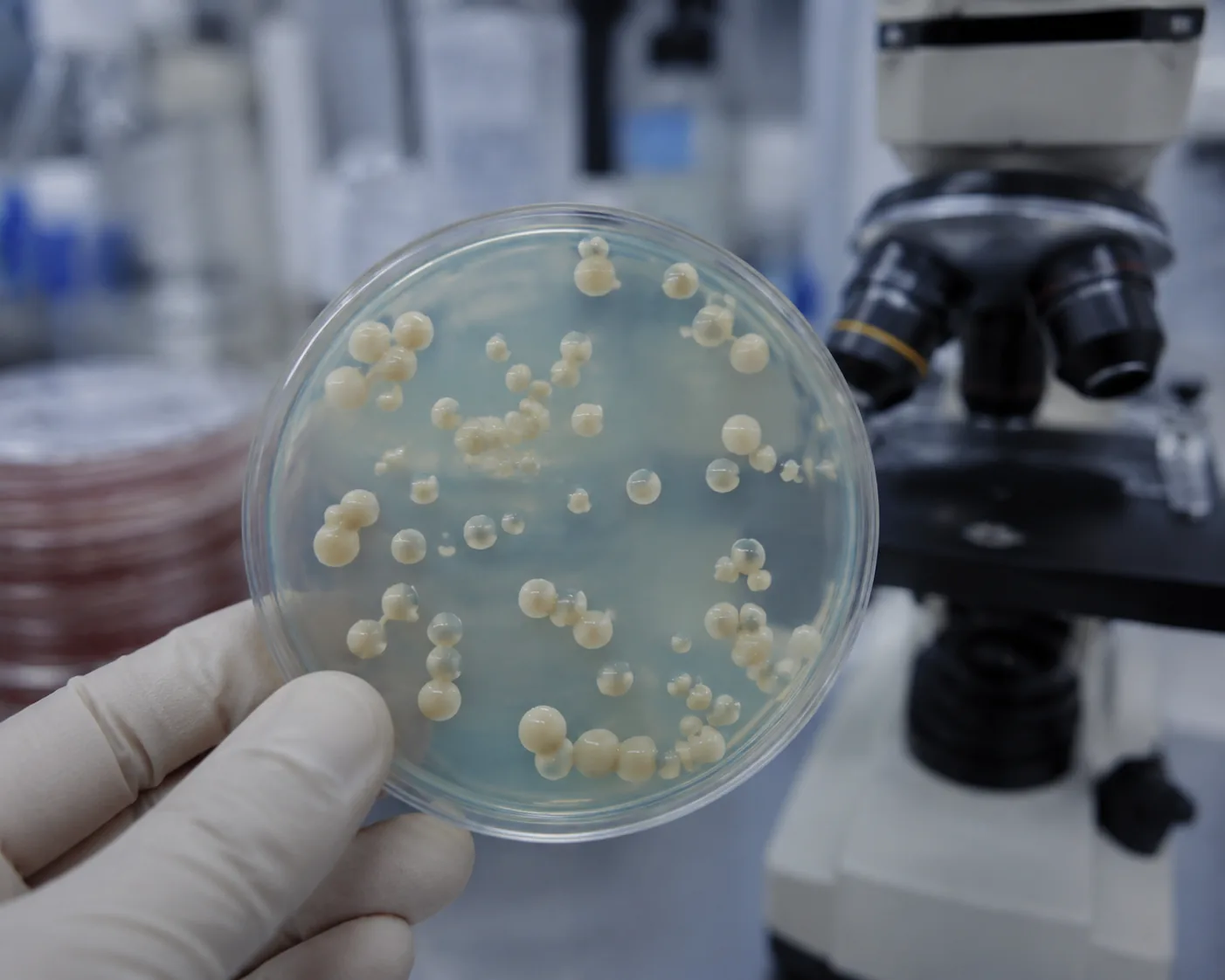
Why a Polymorphic Commensal Drives Three Different Test Services
The single feature that makes C. albicans worth testing across cosmetics, food and clinical specimens alike is its dual life — it grows as a commensal on mucosa, as a yeast-forming creamy colony on agar, and as invasive hyphae in tissue. This means the same organism is interpreted completely differently by matrix:
- In a cosmetic product, any C. albicans recovered is a product-quality failure — the limit is zero, and the question is "is it absent?".
- In a clinical specimen from a sterile site, C. albicans is a pathogen — the question is "is this what is causing the disease, and is it sensitive to the antifungal?".
- In a non-sterile clinical specimen (mouth, vagina, gut), C. albicans may be a commensal — a positive culture does not by itself diagnose disease, which is why the clinical report carries the caveat "clinical correlation essential".
What Are the Three Service Families?
| Service | Question | Matrix | Standard family |
|---|---|---|---|
| Product release testing | Is the product free of C. albicans? | Cosmetics, food, pharmaceuticals | Cosmetics: ISO 18416:2015 (Cosmetics — Microbiology — Detection of Candida albicans), SN/T 2206.8-2013 (export cosmetics). Food: GB 4789.15-2016 (mould and yeast count; export food only for species-level). Pharma: Chinese Pharmacopoeia (ChP) microbiology chapters |
| Clinical microbiology | Is this the pathogen in the patient? | Blood, oropharyngeal/vaginal swab, stool, tissue | Culture (blood culture, Sabouraud), microscopy, biomarkers (β-D-glucan, mannan), molecular (T2Candida, PCR) |
| Antifungal susceptibility (AFST) | What antifungal will kill it? | Pure clinical yeast isolate | CLSI M27M44S (yeasts), M38M51S (filamentous fungi); EUCAST; microbroth dilution |
The methods look superficially related (all end in culture on Sabouraud-type agar and confirmation by biochemistry), but the sample preparation, the detection limit and the acceptance criterion differ — a cosmetic enrichment test (zero tolerance) is not the same as a clinical blood culture (pathogen detection in a sterile site).
How Is Product-Release Testing Performed?
For cosmetic and food products the question is "not detected in the declared quantity", and the method is enrichment culture because the product may carry a low bioburden masked by formulation:
- Cosmetics — ISO 18416:2015 (Detection of Candida albicans): enrichment in a non-selective liquid medium, isolation on a selective agar (typically Sabouraud chloramphenicol / chromogenic Candida agar), identification by germ-tube test, chlamydospore formation on cornmeal-Tween agar, and assimilation/fermentation panels. China uses SN/T 2206.8-2013 for export cosmetics, and a national standard equivalent to ISO 18416:2015+Amd 1:2022 is in preparation. Acceptance = not detected.
- Food — GB 4789.15-2016 (霉菌和酵母计数): counts total mould and yeast, not C. albicans specifically; species-level C. albicans in food is restricted to export food under industry standards. Two methods: standard plate count on dichloran rose-bengal chloramphenicol (DRBC) agar for general foods; and a tomato-specific method.
- Pharmaceuticals — Chinese Pharmacopoeia (ChP) microbiology chapters: control of specified microorganisms, including C. albicans, in non-sterile and sterile products.
Because the limit is zero, the detection capability (enrichment volume, medium selectivity, incubation) is what defines whether a "not detected" is meaningful — a 1 g direct plate "not detected" does not equal a 100 mL enrichment "not detected".
How Is Clinical Detection Performed?
For a patient, C. albicans is detected by a tiered set of methods, each with a different turnaround and clinical role:
- Blood culture — the gold standard for invasive candidiasis / candidemia; a blood sample is inoculated into a blood-culture bottle and incubated; a positive result takes 1–5 days. Limitation: low sensitivity in early candidemia and a long turnaround.
- Microscopy — Gram stain (Gram-positive yeast, budding), wet mount with KOH, or calcofluor white; fast, cheap, presumptive.
- (1,3)-β-D-glucan (BDG) — a pan-fungal biomarker that detects invasive fungal infection but cannot distinguish Candida from Aspergillus or other fungi; a negative result helps rule out invasive fungal infection.
- Mannan antigen + anti-mannan antibody — a Candida-specific biomarker combination; lower sensitivity alone, used as an adjunct.
- T2Candida panel — an FDA-cleared automated magnetic-resonance molecular assay that detects Candida directly in whole blood within hours and identifies the five common species (C. albicans, C. glabrata, C. parapsilosis, C. tropicalis, C. krusei).
- PCR — no FDA-cleared PCR for Candida exists, but commercial panels detect the five common species; results can be difficult to interpret.
- Candida antibodies (IgG/IgA/IgM) — a blood test measuring the immune response; positive antibodies do not necessarily mean active disease, and many healthy carriers have detectable IgG. Clinical correlation is essential.
Because no single test is perfect, clinicians commonly combine a blood culture with a biomarker (BDG) and/or a molecular assay (T2Candida) to diagnose invasive candidiasis.
How Is Antifungal Susceptibility Testing (AFST) Performed?
AFST determines which antifungal will treat the infection, and it is performed on a pure clinical yeast isolate by microbroth dilution, fully compliant with the Clinical and Laboratory Standards Institute (CLSI) method:
- Standards — CLSI M27M44S (yeasts, 4th Ed. 2026), CLSI M38M51S (filamentous fungi, 4th Ed. 2026); EUCAST is the European counterpart.
- Drugs tested — amphotericin B, echinocandins (anidulafungin, micafungin, caspofungin), azoles (fluconazole, itraconazole, posaconazole, voriconazole), 5-flucytosine.
- Result — minimum inhibitory concentration (MIC) for yeasts / minimum effective concentration (MEC) for echinocandins against filamentous fungi, with clinical breakpoint interpretation where CLSI has established one; reported as "No Interpretation" where no breakpoint exists.
- Indication gating — C. albicans AFST is typically restricted to isolates from sterile sites, or from non-sterile sites in immunocompromised/ICU/post-transplant patients or treatment failure, reflecting that C. albicans is usually susceptible and AFST is reserved for the harder clinical questions. Repeat AFST on the same patient is limited to once per week.
The clinical breakpoint caveat matters: many drugs/species combinations have no CLSI breakpoint, so the report carries "No Interpretation" — a MIC number without a susceptible/intermediate/resistant call is not a complete answer.
What Belongs on the Report?
A compliant C. albicans test report states the service, the matrix, the standard/method, the detection limit and the result against the applicable limit — "not detected in x g / x mL" for product release; species identification + MIC/MEC + interpretation for clinical AFST; culture/biomarker/molecular result for clinical detection. The cardinal error is conflating the services — e.g. reporting a cosmetic enrichment result against a clinical MIC breakpoint, or interpreting a vaginal-swab positive as "disease" without clinical correlation.
For related microbiological services, see our Cosmetics testing, Health Food Testing for China SAMR, and Clean bench testing.
FAQ
What does "Candida albicans not detected" mean, and in what quantity?
It means the organism was not recovered using the method's detection capability — but that capability depends on the quantity tested and the enrichment. "Not detected in 1 g of cosmetic (enrichment)" is a meaningful zero-tolerance result; "not detected on a single direct plate" is not. The report must state the quantity and the method.
Why is a positive Candida culture not always a diagnosis of candidiasis?
Because C. albicans is a normal commensal of the mouth, throat, gut and vagina — it can be recovered from healthy people without causing disease. A positive culture from a non-sterile site (mouth swab, vaginal swab, stool) requires clinical correlation with symptoms. Only a positive culture or biomarker from a normally sterile site (blood, sterile tissue) supports invasive candidiasis.
What is the difference between a blood culture and the T2Candida panel?
A blood culture grows the organism in a bottle over 1–5 days and is the gold standard but slow and less sensitive early. The T2Candida panel is an FDA-cleared automated magnetic-resonance molecular assay that detects Candida DNA directly in whole blood within hours and identifies the five common species — faster, but does not provide a live isolate for AFST.
What is the zero-tolerance criterion for Candida albicans in cosmetics?
Under ISO 18416:2015 and SN/T 2206.8-2013, cosmetics must be free of C. albicans — the limit is "not detected" in the declared quantity, using enrichment culture followed by isolation on selective agar and confirmation (germ tube, chlamydospores, assimilation). A cosmetic carrying C. albicans is a product-quality failure.
How is antifungal susceptibility testing reported when there is no CLSI breakpoint?
The MIC (or MEC for echinocandins against filamentous fungi) is reported as a number, but where CLSI has not established a clinical breakpoint for that drug/species combination, the interpretation field reads "No Interpretation" — the MIC is uninterpretable as susceptible/intermediate/resistant, and treatment decisions rely on epidemiological cutoff values and clinical judgement.
Our Testing Capabilities
As an ISO/IEC 17025-accredited third-party laboratory, Beijing ZKGX Research provides Candida albicans testing across the three service families:
- Product release testing — cosmetics to ISO 18416:2015 and SN/T 2206.8-2013 (enrichment + selective agar + germ tube / chlamydospore / assimilation confirmation, zero-tolerance "not detected"); food mould & yeast count to GB 4789.15-2016 with species-level C. albicans for export food; pharmaceutical control of specified microorganisms to ChP.
- Clinical microbiology — blood culture, microscopy (Gram/KOH/calcofluor), pan-fungal (1,3)-β-D-glucan and Candida mannan/anti-mannan biomarkers, T2Candida panel and PCR for the five common species, and antibody (IgG/IgA/IgM) serology.
- Antifungal susceptibility testing (AFST) — CLSI M27M44S (yeast) and M38M51S (filamentous) microbroth dilution for amphotericin B, echinocandins, azoles and 5-flucytosine, with clinical-breakpoint interpretation where CLSI has established one.
Sample types include cosmetic products, foods, pharmaceuticals, clinical blood/sterile-site specimens, oropharyngeal/vaginal swabs, stool, and pure yeast isolates for AFST. If you have a specific matrix, regulatory target (ISO / SN/T / GB / ChP / CLSI / EUCAST), or acceptance criterion (zero-tolerance / MIC breakpoint / clinical correlation), contact the laboratory to confirm the correct standard, method, and reporting format befOre testing.