Isotope testing is the analytical process of measuring the relative abundances and ratios of isotopes — atoms of the same element with different numbers of neutrons — within organic, inorganic, and environmental samples. Every element on the periodic table exists in multiple isotopic forms, and the subtle variations in their ratios serve as powerful natural tracers that reveal information about origin, age, diet, climate, geological history, and biochemical processes that no other analytical method can provide.
Isotope testing spans an extraordinary range of applications: reconstructing ancient human diets from bone chemistry, tracing the geographic origin of food products, monitoring environmental pollution, dating geological formations billions of years old, verifying nuclear safeguards, diagnosing metabolic disorders in medicine, and solving forensic cases through hair strand analysis. The breadth of information encoded in isotopic signatures makes this field one of the most interdisciplinary tools in modern science.
How Does Isotope Testing Work?
Isotope testing works by exploiting the fact that physical, chemical, and biological processes fractionate isotopes — they preferentially use lighter or heavier isotopes, leaving measurable signatures in the resulting materials. These fractionation patterns are predictable and well-characterized, allowing scientists to work backward from measured isotope ratios to infer the processes that produced them.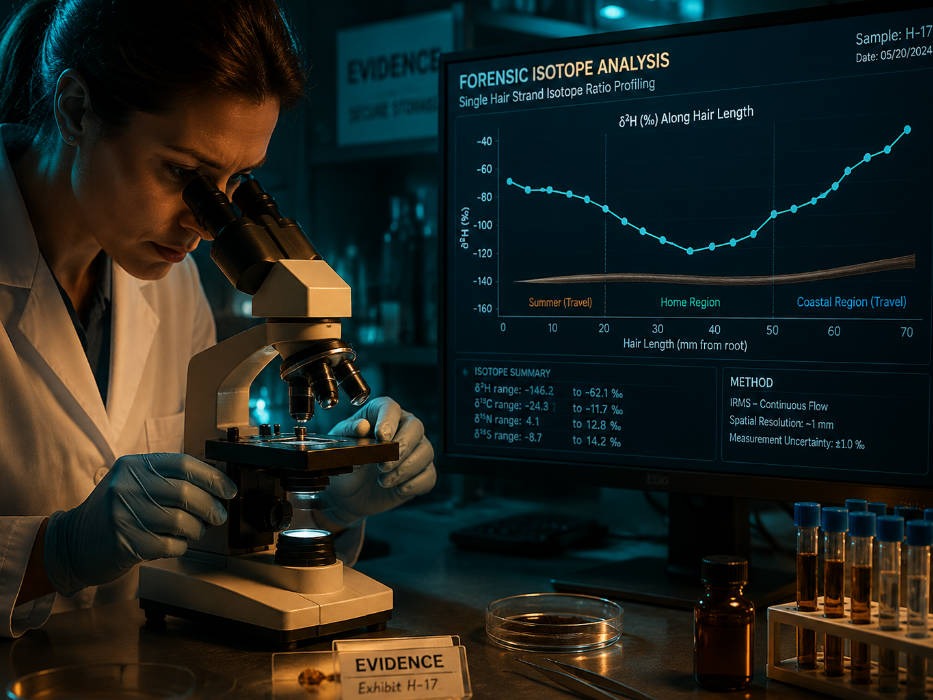
The core measurement is expressed as a delta value (δ) in parts per thousand (permil, ‰), representing the deviation of a sample's isotope ratio from an internationally recognized standard:
δX = [(R_sample / R_standard) – 1] × 10³
Where X is the isotope of interest and R is the ratio of the heavy to light isotope. For example, δ¹³C values around –27‰ indicate C₃ plant-based carbon sources, while values around –13‰ indicate C₄ plant origins.
Samples are prepared by isolating the element or compound of interest, then introduced into a mass spectrometer that separates isotopes by their mass-to-charge ratio. Modern instruments can measure isotope ratios with precision better than 0.1‰, enabling detection of extremely subtle natural variations.
What Are Stable Isotopes and Why Do They Matter?
Stable isotopes are non-radioactive forms of elements that do not decay over time. The most commonly analyzed stable isotope systems include:
|
Element |
Light Isotope |
Heavy Isotope |
Key Application |
|---|---|---|---|
|
Hydrogen |
¹H |
²H (deuterium) |
Hydrology, migration studies, plant physiology |
|
Carbon |
¹²C |
¹³C |
Diet reconstruction, food webs, C₃/C₄ plant identification |
|
Nitrogen |
¹⁴N |
¹⁵N |
Trophic level, nutrient sourcing, agricultural practices |
|
Oxygen |
¹⁶O |
¹⁸O |
Paleoclimate, hydrology, geographic provenance |
|
Sulfur |
³²S |
³⁴S |
Marine vs. terrestrial sources, benthic vs. pelagic producers |
|
Strontium |
⁸⁶Sr |
⁸⁷Sr |
Geographic origin, geological provenance, migration |
|
Lead |
²⁰⁴Pb |
²⁰⁶Pb, ²⁰⁷Pb, ²⁰⁸Pb |
Ore sourcing, artifact provenance, pollution tracing |
Stable isotopes matter because their ratios are set by natural processes and remain locked in biological and geological materials. Bone, teeth, hair, shells, sediments, ice cores, and water all preserve isotopic records that scientists can decode to reconstruct past conditions or trace present-day processes.
What Is Stable Isotope Analysis Used For?
How Is Isotope Testing Used in Archaeology and Paleodiet Reconstruction?
Isotope analysis in archaeology has revolutionized our understanding of ancient human diets, migration, and cultural practices. By analyzing carbon (¹³C/¹²C), nitrogen (¹⁵N/¹⁴N), and zinc isotopes in bone collagen, bone mineral (hydroxylapatite), and tooth enamel, researchers can determine what people ate, where they lived, and how they moved across landscapes.
Carbon isotopes distinguish between C₃ and C₄ plant-based diets. C₃ foods include wheat, rice, tubers, fruits, and most vegetables (δ¹³C ≈ –26‰), while C₄ foods include millet, maize, and sugarcane (δ¹³C ≈ –12‰). Carbon isotope ratios can also separate marine, freshwater, and terrestrial food sources, since marine organisms have distinctly different δ¹³C signatures.
The carbon in bone collagen predominantly reflects dietary protein, while bone mineral reflects all consumed carbon — carbohydrates, lipids, and protein combined. Analyzing both fractions provides a more complete dietary picture.
Nitrogen isotopes (δ¹⁵N) indicate trophic level: organisms higher in the food chain accumulate ¹⁵N, with an average enrichment of approximately 3.2‰ per trophic level. High δ¹⁵N values suggest heavy consumption of animal protein or fish. Nitrogen isotopes also reveal agricultural practices — enriched δ¹⁵N in archaeological soils can indicate historical manure application, distinguishing crop cultivation from grazing land.
How Does Isotope Analysis Help Trace Human and Animal Migration?
Oxygen isotope ratios (¹⁸O/¹⁶O) in body tissues serve as geographic tracers because drinking water isotopic composition varies predictably with latitude, altitude, temperature, and distance from coastlines. This creates isotopic maps (isoscapes) that link tissue values to specific geographic regions.
Teeth are particularly valuable for migration studies because they form during childhood and never remodel — their isotopic composition remains locked from the time of formation, recording the region where an individual was born and raised. Bone, by contrast, remodels throughout life with a turnover rate of approximately 10 years, reflecting the region of residence during the last decade of life.
By comparing tooth and bone isotope ratios from the same individual, archaeologists can determine whether a person migrated during their lifetime and approximately when. Where deciduous teeth are present, researchers can even determine the age at which a child was weaned, because breast milk has elevated ¹⁸O levels.
Strontium isotopes (⁸⁷Sr/⁸⁶Sr) provide complementary geographic information because strontium ratios in bedrock vary geologically and are incorporated into bone and teeth through the food chain. Combining strontium and oxygen isotope data creates a powerful dual-tracer system for reconstructing individual mobility patterns.
What Role Does Isotope Testing Play in Ecology and Food Web Studies?
Stable isotope analysis has become a foundational method in ecology for understanding food web structure, energy flow, and trophic dynamics. The approach offers a critical advantage over traditional stomach content analysis: isotope ratios in animal tissues reflect assimilated nutrients over weeks to months, regardless of whether the stomach is empty at the time of capture.
In aquatic ecosystems, the three primary isotope systems used together are:
-
δ¹³C — identifies primary production sources (different phytoplankton species, marsh grasses, benthic algae). Large differences between organisms indicate different food sources or food webs based on different primary producers. δ¹³C also tracks seasonal dietary shifts reflecting phytoplankton abundance changes.
-
δ¹⁵N — indicates trophic level position. The consistent ~3.2‰ enrichment per trophic level allows scientists to map entire food webs, from phytoplankton through zooplankton to top predators.
-
δ³⁴S — distinguishes benthic vs. pelagic producers and marsh vs. phytoplankton sources. The large difference between seawater sulfates (~+21‰) and sulfides (~–10‰) provides clear discrimination between aerobic and anaerobic food web components.
Hydrogen isotopes (δ²H) reflect local water values and have been used to study bird migration and aquatic food web connectivity across watersheds.
How Is Isotope Testing Applied in Forensic Science?
Isotope analysis of human hair has emerged as a powerful forensic tool. Hair grows at a recognizable rate of 9–11 mm per month, and its isotopic composition reflects dietary intake, particularly drinking water. Because drinking water isotopic ratios vary geographically — shaped by local geology, altitude, and climate — hair strands serve as a timeline of geographic movement.
Forensic applications include:
-
Determining whether a suspect recently visited a specific location by analyzing isotopic variation along the length of a hair strand
-
Identifying human remains by matching bone and tooth isotope profiles to geographic regions
-
Verifying alibis by comparing stated travel history with isotopic evidence locked in hair and nails
-
Tracing the origin of seized drugs using carbon, nitrogen, and hydrogen isotope fingerprints of the plant source material
This non-invasive method is increasingly used when DNA or traditional forensic evidence yields no answers. Strontium isotopes (⁸⁷Sr, ⁸⁸Sr) combined with oxygen isotope variations provide a global discrimination framework.
How Does Isotope Testing Verify Food Authenticity and Origin?
Food authenticity testing using stable isotopes is a major commercial application that protects consumers and supply chains from fraud. Isotope ratios in food products reflect the soil, water, climate, and agricultural practices of their origin, creating a geographic fingerprint that cannot be easily replicated.
Key applications include:
-
Honey adulteration detection — δ¹³C analysis distinguishes C₄ plant-derived sugar syrups (cane or corn) from authentic C₃ flower nectar honey
-
Wine provenance verification — δ¹⁸O in wine water reflects the isotopic composition of grape-growing region precipitation, establishing geographic origin
-
Olive oil authentication — carbon and hydrogen isotope profiles verify geographic origin and detect blending with cheaper oils
-
Meat and dairy origin tracing — strontium and hydrogen isotopes link animal products to specific grazing regions
-
Organic vs. conventional farming verification — δ¹⁵N values are typically higher in organically fertilized crops due to manure-derived nitrogen
International food safety databases like the EU Wine Isotope Database and global isotope maps support large-scale verification programs.
What Is the Role of Isotope Testing in Environmental Monitoring?
Isotope analysis provides unique capabilities for tracking pollution sources, understanding nutrient cycles, and monitoring ecosystem health:
-
Nitrogen pollution tracing — δ¹⁵N values distinguish between natural soil nitrogen (2–8‰) and human-derived sewage nitrogen (10–20‰). As wastewater-rich groundwater enters estuaries, elevated δ¹⁵N is incorporated into local organisms (macrophytes, clams, fish), providing a biological monitor of anthropogenic nutrient input. This method is increasingly used to monitor eutrophication and hypoxic events in coastal ecosystems.
-
Greenhouse gas source attribution — carbon isotopes differentiate between fossil fuel-derived, biogenic, and geological CO₂ and methane sources, supporting climate change research and emissions verification.
-
Hydrological tracing — δ¹⁸O and δ²H in water trace evaporation, precipitation patterns, groundwater recharge, and surface water–groundwater interactions.
-
Contaminant source tracking — lead isotopes identify the origin of environmental lead contamination, distinguishing between natural geologic sources and industrial emissions from specific ore bodies or regions.
How Is Isotope Testing Used in Geology and Paleoclimatology?
Geological isotope analysis provides information spanning billions of years of Earth history:
-
Oxygen isotopes in marine sediments and ice cores — δ¹⁸O in foraminifera shells and ice core layers serves as a paleothermometer, recording global temperature changes over millions of years. Heavier ¹⁸O is preferentially locked in ice sheets during glacial periods, leaving ocean water enriched in ¹⁶O.
-
Radiometric dating — Radioactive isotopes (¹⁴C, ⁴⁰K/⁴⁰Ar, ²³⁸U/²⁰⁶Pb, ⁸⁷Rb/⁸⁷Sr) provide absolute age determinations for rocks, fossils, and archaeological materials across timescales from decades to billions of years.
-
Sedimentary provenance — neodymium (Nd) and strontium isotope ratios in sedimentary rocks identify the source terrain of eroded material, reconstructing ancient mountain belts and continental configurations.
-
Volcanic and magmatic processes — isotope geochemistry traces mantle vs. crustal contributions to igneous rocks, revealing deep Earth processes.
Analysis of ¹⁸O/¹⁶O ratios in Colorado Delta clam shells was used to reconstruct the historical extent of the estuary prior to upstream dam construction, demonstrating how isotope testing can inform modern water management decisions.
What Role Does Isotope Analysis Play in Medicine and Biomedical Research?
Medical isotope testing encompasses both stable and radioisotope applications:
-
Stable isotope tracer studies — ¹³C-labeled compounds are used to measure metabolic rates, nutrient absorption, protein turnover, and glucose metabolism without radiation exposure. ¹³C-urea breath testing is a standard non-invasive diagnostic for Helicobacter pylori infection.
-
Isotope Ratio Mass Spectrometry (IRMS) in clinical research — measures natural isotopic variation in body tissues to study nutritional status, metabolic disorders, and physiological stress.
-
Radioisotope imaging and therapy — Technetium-⁹⁹ᵐ (^99mTc) is the most widely used diagnostic radioisotope, employed in over 80% of nuclear medicine imaging procedures worldwide. Iodine-131 treats thyroid disorders. Fluorine-18 (^18F) enables PET scanning for cancer detection and neurological research.
-
Doubly labeled water technique — using ²H and ¹⁸O to measure energy expenditure in free-living humans and animals without restricting activity.
How Is Isotope Testing Used in Nuclear Safeguards and Radioisotope Dating?
Nuclear safeguards rely heavily on isotope analysis to verify compliance with treaties and monitor nuclear materials:
-
Uranium enrichment verification — ²³⁵U/²³⁸U ratios confirm whether uranium is at natural (0.72%), low-enriched (3–5%), or weapons-grade (>90%) levels
-
Plutonium isotopic characterization — ²³⁹Pu/²⁴⁰Pu ratios reveal reactor type and burnup history
-
Environmental swipe sampling — mass spectrometry detects trace isotopic signatures on surfaces at nuclear facilities
Radioisotope dating methods provide absolute chronologies:
|
Method |
Isotope System |
Effective Age Range |
|---|---|---|
|
Radiocarbon |
¹⁴C → ¹⁴N |
Up to ~50,000 years |
|
Potassium-Argon |
⁴⁰K → ⁴⁰Ar |
>100,000 years |
|
Uranium-Lead |
²³⁸U → ²⁰⁶Pb |
Millions to billions of years |
|
Rubidium-Strontium |
⁸⁷Rb → ⁸⁷Sr |
Millions to billions of years |
|
Argon-Argon |
⁴⁰Ar/³⁹Ar |
Thousands to billions of years |
Accelerator Mass Spectrometry (AMS) has revolutionized radiocarbon dating by requiring only milligram samples — enabling dating of individual amino acids, single seeds, or precious artifacts that were previously impossible to analyze.
Which Isotopes Are Most Commonly Analyzed?
The workhorses of isotope testing include:
-
Carbon (¹³C/¹²C) — Diet, food webs, C₃/C₄ photosynthesis, marine vs. terrestrial, food authenticity, pollution source
-
Nitrogen (¹⁵N/¹⁴N) — Trophic level, agricultural practices, sewage contamination, paleodiet
-
Oxygen (¹⁸O/¹⁶O) — Paleoclimate, hydrology, geographic provenance, bone and tooth sourcing
-
Hydrogen (²H/¹H) — Migration, hydrology, plant physiology, food authentication
-
Sulfur (³⁴S/³²S) — Marine vs. terrestrial, benthic vs. pelagic, pollution tracing
-
Strontium (⁸⁷Sr/⁸⁶Sr) — Geographic origin, migration, artifact provenance, geological sourcing
-
Lead (²⁰⁶Pb, ²⁰⁷Pb, ²⁰⁸Pb) — Ore provenance, pollution source, archaeological artifact sourcing
Multi-isotope approaches — analyzing three or more isotope systems simultaneously — provide overlapping constraints that dramatically improve the specificity and reliability of interpretations.
What Analytical Techniques Are Used in Isotope Testing?
isotope ratio mass spectrometry (IRMS) is the gold standard for stable isotope analysis. Key configurations include:
-
Gas Source IRMS (GS-IRMS) — The most common configuration for light element isotopes (C, N, O, H, S). Samples are converted to simple gases (CO₂, N₂, CO, SO₂, H₂) and isotopes are separated by mass-to-charge ratio. Achieves precision of <0.1‰ for most elements.
-
Thermal Ionization Mass Spectrometry (TIMS) — Used for heavy elements (Sr, Pb, Nd, U). Samples are loaded onto filaments and ionized by heating. Provides the highest precision for radiogenic isotope systems, with uncertainties below 0.001%.
-
Multi-Collector inductively coupled plasma mass spectrometry (MC-ICP-MS) — Combines the ionization efficiency of plasma with multi-collector detection for high-precision analysis of a wide range of elements. Faster sample throughput than TIMS with comparable precision.
-
Accelerator Mass Spectrometry (AMS) — Counts individual rare isotopes (especially ¹⁴C) against abundant stable isotopes. Enables radiocarbon dating from milligram samples and isotope dilution measurements at ultra-trace levels.
-
Secondary Ion Mass Spectrometry (SIMS) — Provides in-situ isotopic analysis at micrometer spatial resolution, enabling analysis of individual mineral grains, growth zones in teeth, or layered structures in geological samples.
Sample preparation typically involves isolation and purification of the target element or compound, often using elemental analyzers (for bulk C and N), gas benches (for carbonate C and O), or chemical separation columns (for Sr, Pb, Nd).
What Are the Challenges and Limitations of Isotope Testing?
Despite its power, isotope testing faces several important limitations:
-
Diagenesis and preservation — Post-depositional chemical alteration can overprint original isotopic signals in archaeological and geological materials. Researchers must target diagenesis-resistant components (e.g., phosphate groups in bone rather than carbonate) and conduct preservation screening.
-
Isotopic equifinality — Different processes can produce similar isotopic signatures, creating interpretive ambiguity. Multi-isotope approaches and independent lines of evidence are needed to resolve competing explanations.
-
Incomplete reference databases — Interpretation depends on comparing sample values to known baselines (isoscapes, food web endpoints, geological maps). Gaps in reference data limit geographic and temporal resolution.
-
Mixing and re-use — In archaeological contexts, metals from multiple ore sources were melted and re-cast, creating mixed isotopic signatures that complicate provenance determination.
-
Individual and temporal variation — Within-individual isotope variation, seasonal dietary changes, and age-related physiological effects introduce noise that requires statistical treatment.
-
Sample destruction — Many techniques require sample consumption, which can be problematic for precious archaeological specimens, museum objects, or forensic evidence.
-
Cost and accessibility — Mass spectrometry instruments cost hundreds of thousands of dollars, and individual sample analyses range from $30 to $100+ for routine stable isotope work, and considerably more for AMS or TIMS analyses.
How Is Isotope Testing Evolving With New Technology?
The field continues to advance rapidly on several fronts:
-
Compound-specific isotope analysis (CSIA) — Instead of measuring bulk isotope ratios, GC-IRMS and LC-IRMS systems analyze isotopes in individual compounds (specific amino acids, fatty acids, sugars). This dramatically increases dietary and environmental resolution, because different compounds carry different isotopic information.
-
Clumped isotope thermometry — Measures the frequency of rare isotope pairs (e.g., ¹³C-¹⁸O bonds in carbonate) to determine formation temperature independently of water composition, overcoming a major limitation of traditional δ¹⁸O paleothermometry.
-
Position-specific isotope analysis — Measures isotope ratios at specific positions within molecules, providing information about biosynthetic pathways and environmental conditions at unprecedented resolution.
-
Laser-based isotope instruments — Cavity ring-down spectroscopy (CRDS) and off-axis integrated cavity output spectroscopy (OA-ICOS) enable field-deployable, real-time isotope measurements of water, CO₂, and methane without requiring mass spectrometry — lowering cost, increasing throughput, and enabling continuous monitoring.
-
Isoscape development — Global and regional isotopic landscape maps are becoming increasingly detailed and accessible, combining remote sensing, hydrological modeling, and empirical datasets to improve geographic provenance determination.
-
Machine learning integration — AI and statistical models are being applied to multi-isotope datasets to improve classification accuracy for food authenticity, forensic provenance, and paleoenvironmental reconstruction.
-
Microanalytical techniques — SIMS, laser ablation IRMS, and nanoSIMS enable isotopic analysis at sub-micrometer resolution, opening new applications in materials science, cell biology, and planetary science.
Isotope testing stands at the intersection of physics, chemistry, biology, geology, and engineering — a discipline where atomic-level measurements unlock Earth-scale stories. From a single hair strand that reveals a person's travel history to an ice core that records a million years of climate, the isotopes embedded in every material on Earth carry signatures that modern science is learning to read with ever-greater precision and insight.