Phenolic Resin testing is the set of laboratory methods that characterize a phenol-formaldehyde (PF) resin's identity, physical form, reactivity, cure behavior, residual monomers, and fitness for its end-use (molding compounds, foundry binders, friction materials, laminates, wood adhesives, foams). It is governed by EN ISO 10082 (Plastics — Phenolic resins — Classification and test methods), which both classifies phenolic resins and catalogues the ISO test methods; the individual property tests are then run to the referenced ISO standards — ISO 9396 / 8987 (gel time and reactivity), ISO 9397 / 8974 (free formaldehyde and residual phenol), ISO 8988 (hexamethylenetetramine), ISO 2555 / 3219 / 12058 (viscosity), ISO 8619 (flow distance), ISO 11409 (DSC cure), ISO 9771 (pseudo-adiabatic cure).
What Makes Phenolic Resin a Distinct Test Subject?
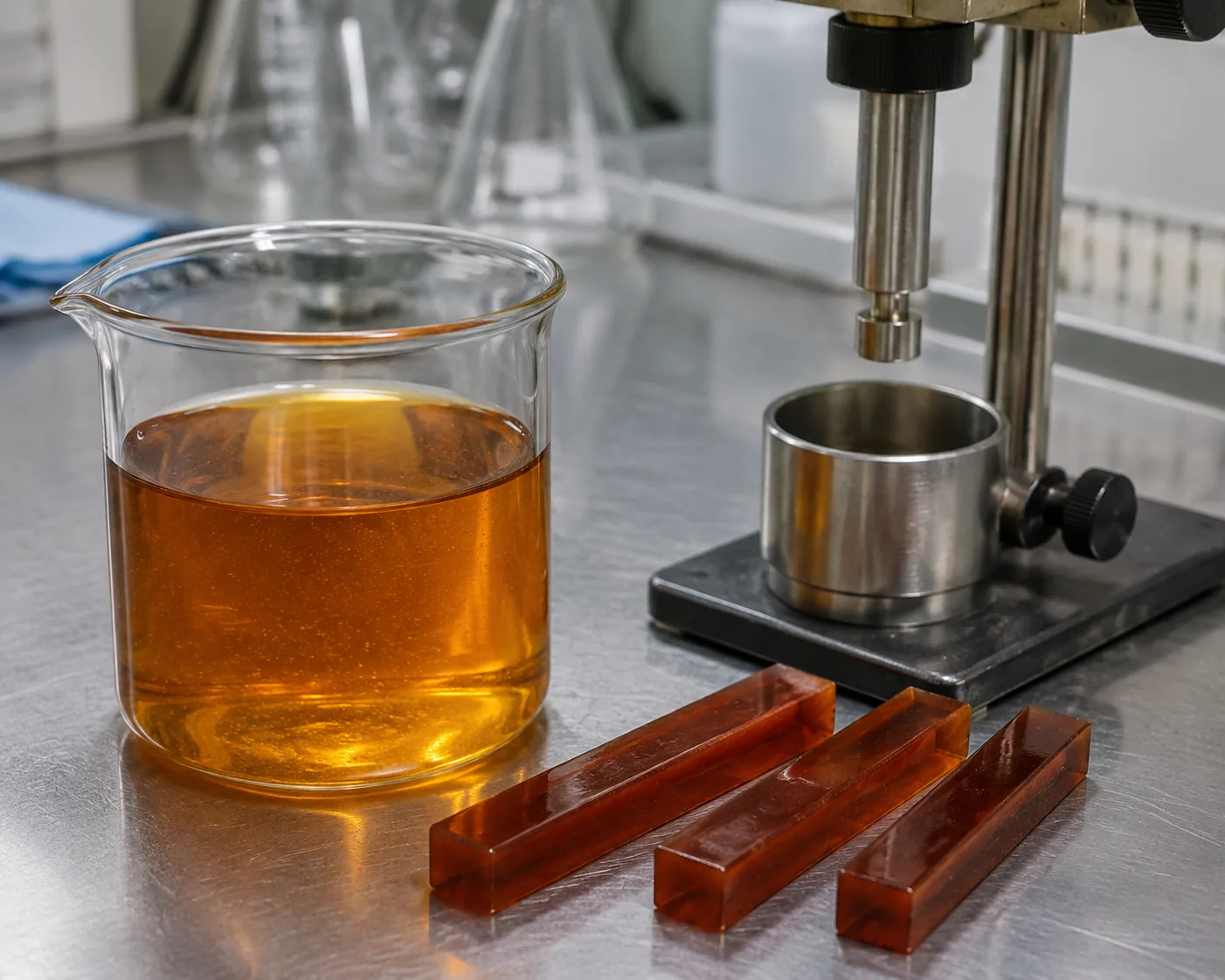
Phenolic resins are thermosets cured by polycondensation, which sets them apart from the addition-cured thermosets (epoxy, unsaturated polyester) most labs handle more often. Polycondensation releases by-products — water, ammonia, or similar — during cure, so the test method must respect the industrial conditions under which the resin is actually processed: press pressure to contain the volatiles, a flash-off step to let them escape, and a B-stage intermediate that controls how far the condensation has already proceeded. A resin tested without regard for these conditions gives numbers that do not match production.
The second defining trait is the two resin families — novolacs and resols — which differ chemically, in cure chemistry, and therefore in what they must be tested for (background on the phenol–formaldehyde chemistry):
- Novolacs are made with a deficit of formaldehyde under acid catalysis. They are two-step, non-self-curing; an external hardener — almost always hexamethylenetetramine (hexamine) — must be added to cross-link them. The hexamine content (ISO 8988) and the flow distance of the B-stage molding powder (ISO 8619) are the tests that decide whether a novolac will cure properly in the mold.
- Resols are made with an excess of formaldehyde under base catalysis. They are one-step, self-curing; heat alone drives the further condensation, so the resin's own gel time (ISO 9396) and cure exotherm (ISO 11409) are the tests that decide processing behavior. Resols also carry free formaldehyde that continues to react during storage — its level (ISO 9397) governs both reactivity and the workplace/food-contact exposure question.
The degree of condensation reached at any moment is described by the A-, B-, and C-stage convention: A-stage (resol) is still soluble and fusible; B-stage (resitol) is partially condensed — still fusible but barely soluble, the state of a novolac molding powder or an impregnated prepreg; C-stage (resit) is fully cross-linked, infusible and insoluble, the final cured state. Most property tests target a specific stage, so a test report must state which stage the specimen was in.
What Standards Govern Phenolic Resin Testing?
EN ISO 10082 (Plastics — Phenolic resins — Classification and test methods, ISO/TC 61) is the umbrella. It classifies phenolic resins by chemical structure (novolac vs resol vs modified vs addition), by raw materials (phenols, aldehydes), by physical form (liquid, powder, pellet, dispersion), by catalyst/hardener, and by degree of condensation (A/B/C), and it catalogues the ISO test methods applicable to each. The tests are then run to the individual ISO standards referenced in Clause 4:
| Property | ISO method |
|---|---|
| Viscosity (rotational, Brookfield) | ISO 2555 |
| Viscosity (rotational, cone-plate / shear-rate) | ISO 3219 |
| Viscosity (capillary, flow cup) | ISO 12058 |
| Density | ISO 2811 (and apparent density of powder per ISO 60) |
| Gel time (B-stage) | ISO 9396 |
| Reactivity — gel time and B-time | ISO 8987 |
| Free formaldehyde | ISO 9397 (titrimetric) / ISO 11402 (potentiometric) |
| Free phenol and other residuals (GC) | ISO 8974 (gas chromatography) |
| Hexamethylenetetramine (hexamine) content | ISO 8988 (three sub-methods: Kjeldahl, perchloric acid, salicylate) |
| Flow distance (molding powder) | ISO 8619 |
| Melting behaviour (capillary) | ISO 3146 |
| Cure behaviour (DSC) | ISO 11409 |
| Pseudo-adiabatic cure | ISO 9771 |
| Water content | ISO 760 (Karl Fischer) |
| Ash | ISO 3451 |
| Electrical conductivity (liquid resin) | ISO 9399 |
The North American counterparts are the ASTM D-series for phenolics — ASTM D1312 (free phenol), ASTM D4426 (hexamine in novolacs by TG), ASTM D4640 (gel time by hot-plate), ASTM D1574 (flow distance) — which differ in apparatus but answer the same engineering questions. Because phenolics are one branch of resin testing and overlap with Adhesive testing where PF resins serve as wood-bonding adhesives, the umbrella method set below applies the same ISO conventions used across our polymer and adhesive work.
The fact the SERP obscures: a phenolic resin "specification" is not one number but a profile across reactivity (gel time), residuals (free formaldehyde, free phenol, hexamine), viscosity, and cure (DSC peak). A datasheet that quotes "viscosity 500 mPa·s" without naming the resin's stage, the shear rate (ISO 3219 is shear-rate-defined; ISO 2555 is single-spindle), and the temperature is unverifiable, because phenolic resin viscosity rises sharply as condensation proceeds. The same stage-and-shear-rate discipline governs the broader plastic testing workflow, and it is why a PF resin used as a binder in a protective coating must be reported with its cure state, not just a single viscosity figure.
How Are Free Formaldehyde and Residual Phenol Measured?
The residual-monomer tests are the ones that decide both the resin's reactivity and its regulatory exposure profile, and they are the tests most often misreported in the SERP. Two methods, two analytes:
- Free formaldehyde (ISO 9397) — the hydroxylamine hydrochloride titrimetric method, as published by ISO. The resin sample is dissolved/dispersed, reacted with hydroxylamine hydrochloride which converts free formaldehyde to the oxime, releasing an equivalent of acid; the released acid is titrated with sodium hydroxide. The result is reported as % free formaldehyde. ISO 11402 is the potentiometric variant. Free formaldehyde governs two things at once: it continues to react during storage (advancing the resin), and it is the regulated substance in workplace (OSHA, REACH) and food-contact (FDA 21 CFR §175.380, BfR) applications. A high free-formaldehyde novolac is more reactive but more restricted.
- Free phenols and other residuals (ISO 8974) — gas chromatography. The resin is dissolved in a solvent, an internal standard is added, and the free phenol (and cresols, xylenols) are quantified by GC. GC catches the substituted phenols that a wet-chemistry "total phenol" method cannot distinguish, and it reports each individually. Free phenol is the residual monomer of greatest toxicological concern (phenol is corrosive and a priority pollutant), and the food-contact regulations cap it tightly.
A complete residual-monomer report cites both ISO 9397 (free formaldehyde, %) and ISO 8974 (free phenol and substituted phenols, %, by GC). A single "free monomer" number is meaningless — formaldehyde and phenol are different substances with different limits, different chemistries, and different analytical methods.
What Is Gel Time and How Is It Tested?
Gel time is the headline reactivity test — the time it takes for the resin, at a defined temperature, to cross-link from a flowable liquid to an infusible gel. Two methods cover two conditions:
- ISO 9396 (gel time of B-stage resins) — for resins already advanced to the B-stage (novolac-hexamine molding powders, prepregs). A defined specimen is held at a defined test temperature (commonly 150 °C, 160 °C, or 170 °C) on a gel-time apparatus with a reciprocating plunger; the time from melt to the torque/viscosity inflection that marks gelation is the gel time, in seconds.
- ISO 8987 (reactivity — gel time and B-time on a defined test plate) — measures both the gel time and the B-time (the time to reach the B-stage, the still-fusible intermediate) on a heated test plate, giving a two-point reactivity profile rather than a single gel time. This distinguishes a resin that gels fast from one that advances slowly through the B-stage — a difference that decides whether a molding cycle can be shortened.
The North American ASTM D4640 (hot-plate gel time) and the older ISO 9396 apparatus differ in geometry but answer the same question. The gel time is the test that sets the molding cycle: a novolac with a 30 s gel time at 160 °C can be molded on a fast cycle; one with a 90 s gel time cannot. Because gel time depends on temperature, hexamine content (for novolacs), and storage age (resols advance during storage), a defensible gel-time report cites the standard, the test temperature, and the specimen's age and stage.
How Is Hexamine Content Measured in Novolacs?
For novolacs, hexamethylenetetramine content (ISO 8988) is the test that decides whether the resin will cure at all, because hexamine is the cross-linker that turns a non-self-curing novolac into a curable molding powder. ISO 8988 offers three sub-methods because hexamine is measured in different matrices:
- Method A — Kjeldahl (high-accuracy, wet-chemistry): hexamine nitrogen is digested to ammonium sulfate, distilled as ammonia, and titrated.
- Method B — perchloric acid titration: hexamine is titrated directly with perchloric acid in acetic anhydride/acetic acid medium.
- Method C — salicylate / photometric: hexamine is hydrolyzed to formaldehyde and ammonia, and quantified photometrically.
The ASTM D4426 (hexamine in novolacs by thermogravimetry) is the North American fast method — the hexamine decomposes in a defined temperature window and its mass loss is measured by TGA, giving a percent hexamine in minutes. Whichever method, the result is reported as % hexamine, and the molding-powder formulation is reconciled against it. A novolac batch with low hexamine will under-cure; a batch with high hexamine will gas and blister (the hexamine releases ammonia as it cures).
How Is Cure Behavior Characterized — DSC and Flow Distance?
Cure behavior is characterized by two complementary methods that describe different aspects of how the resin transitions from liquid to fully cross-linked solid:
- ISO 11409 (DSC cure behavior) — differential scanning calorimetry. A few milligrams of resin are heated (isothermally or at a defined ramp) in a DSC, and the exothermic heat of cure is recorded as a function of temperature and time. The result reports the onset temperature of cure, the peak temperature, the heat of cure (J/g), and (under isothermal conditions) the time to peak. The DSC curve is the resin's cure fingerprint: a novolac-hexamine shows a sharp, high-temperature exotherm; a resol shows a broader, lower-temperature exotherm; modified resins show shoulders and shifts that reveal the modifier. The pseudo-adiabatic cure behaviour (ISO 9771) simulates the large-mass, self-heating cure of a thick section (a foundry mold, a foamed insulation), where the resin's own exotherm raises its temperature well above the oven setting.
- ISO 8619 (flow distance) — for molding powders. A defined mass of the B-stage powder is compressed into a pellet and placed on an inclined heated plate at a defined temperature; the distance the molten resin flows before it gels is the flow distance, in millimeters. Flow distance integrates two properties — melt viscosity and gel time — into a single number that directly predicts mold-filling. A powder with a long flow distance fills a complex mold; a powder with a short flow distance gels before filling and produces short-shots.
The two methods are complementary: DSC tells you when the resin cures; flow distance tells you how long it stays flowable before it does. A complete processing window for a molding compound reports both, plus the gel time, plus the hexamine content.
What Structural and Thermal Tests Complete the Profile?
Beyond the reactivity and residuals tests, a full phenolic resin characterization includes the structural and thermal fingerprint:
- FTIR (Fourier-transform infrared) — the resin's functional-group fingerprint. Phenolic resins show characteristic O–H, aromatic C–H, and C–O–C absorptions; modified resins show additional peaks. FTIR is the identity test that distinguishes a novolac from a resol and verifies that a resin is what the label claims.
- TGA (thermogravimetric analysis) — mass loss versus temperature. The cure-mass-loss (water, ammonia) appears at the cure temperature; the thermal decomposition appears above ~300 °C with the phenol-derivative and permanent-gas evolutions that the pyrolysis literature documents. TGA gives the thermal stability ceiling of the cured resin.
- DSC for Tg — the glass transition of the cured resin; phenolic networks are rigid and have high Tg, often above 150 °C, which is why they serve as high-temperature structural and electrical insulation.
- Chromatographic separations (GPC, HPLC) — molecular-weight distribution of the soluble A/B-stage resin; detects reprocessing or contamination.
Frequently Asked Questions
What standard governs phenolic resin testing?
EN ISO 10082 (Plastics — Phenolic resins — Classification and test methods) is the umbrella — it classifies phenolic resins (novolac vs resol vs modified, by physical form, by catalyst/hardener, by A/B/C stage) and catalogues the ISO test methods. The individual property tests are run to the referenced ISO standards: ISO 9396 / 8987 (gel time and reactivity), ISO 9397 / 8974 (free formaldehyde and residual phenols), ISO 8988 (hexamine), ISO 2555 / 3219 / 12058 (viscosity), ISO 8619 (flow distance), ISO 11409 (DSC cure), ISO 9771 (pseudo-adiabatic cure).
What is the difference between a novolac and a resol — and how does testing differ?
Novolacs are acid-catalyzed with a formaldehyde deficit; they are non-self-curing and need an external hardener (hexamine). Their critical tests are hexamine content (ISO 8988) and flow distance (ISO 8619). Resols are base-catalyzed with a formaldehyde excess; they are self-curing under heat. Their critical tests are gel time (ISO 9396) and free formaldehyde (ISO 9397), which also governs storage stability and regulatory exposure.
How is free formaldehyde tested and why does it matter?
Free formaldehyde is measured by ISO 9397 (hydroxylamine titration, %) or ISO 11402 (potentiometric). It matters for two reasons: it continues to react during storage (advancing the resin), and it is the regulated substance in workplace and food-contact applications (FDA 21 CFR §175.380, BfR, REACH). A high free-formaldehyde resol is more reactive but more restricted.
How is gel time tested and why is the temperature critical?
Gel time (ISO 9396 for B-stage resins, ISO 8987 for the gel-time/B-time profile) is the time for the resin to cross-link at a defined test temperature (commonly 150–170 °C). Gel time depends steeply on temperature, on hexamine content (for novolacs), and on storage age (resols advance during storage), so a defensible report cites the standard, the test temperature, and the specimen's age and stage.
What is hexamine content and which resins need it tested?
Hexamethylenetetramine (hexamine) is the cross-linker added to novolacs to make them curable; ISO 8988 measures it by Kjeldahl, perchloric acid, or salicylate methods (ASTM D4426 uses TGA). Only novolacs need it tested — resols self-cure and contain no hexamine. A novolac with low hexamine under-cures; one with high hexamine gases and blisters because hexamine releases ammonia as it cures.
What does DSC cure testing (ISO 11409) tell you?
DSC records the exothermic heat of cure as a function of temperature and time, giving the onset temperature, peak temperature, heat of cure (J/g), and time to peak. It is the resin's cure fingerprint — distinguishing a sharp novolac-hexamine exotherm from a broad resol exotherm — and it sets the press-curing thermal cycle. ISO 9771 simulates the self-heating cure of thick sections.
Our Testing Capabilities
Beijing ZKGX Research (ISO/IEC 17025 testing laboratory) provides phenolic resin testing across identity, reactivity, cure, residuals, and processing behavior:
- Classification and identity to EN ISO 10082 — novolac vs resol, A/B/C stage, FTIR fingerprint, GPC molecular-weight distribution.
- Reactivity — gel time to ISO 9396 and ISO 8987 (gel time and B-time), DSC cure behavior to ISO 11409, pseudo-adiabatic cure to ISO 9771.
- Residuals and regulatory — free formaldehyde (ISO 9397 / ISO 11402), free and substituted phenols by GC (ISO 8974), hexamethylenetetramine in novolacs (ISO 8988, all three sub-methods).
- Processing behavior — flow distance of molding powder (ISO 8619), viscosity (ISO 2555 / 3219 / 12058), density and apparent density, water content (ISO 760), ash (ISO 3451).
- Thermal — TGA decomposition, DSC Tg of the cured network, melting behaviour (ISO 3146).
- End-use qualification — food-contact (FDA 21 CFR §175.380, BfR), foundry binder emissions, friction-material and laminate fitness-for-use.
If you have a phenolic resin batch to qualify, a molding powder to specify, or a residual-monomer / food-contact claim to verify, contact our testing team to scope the applicable ISO / EN / ASTM methods, the specimen stage, and the acceptance criteria.