Table of Contents
- What is viral clearance testing?
- The standard stack: ICH Q5A(R2), FDA, EMA, EP, WHO, NMPA, Chinese Pharmacopoeia
- ICH Q5A(R2) vs R1: the eight key updates
- The three-pillar viral safety strategy
- Model viruses: the five-virus panel for clearance studies
- Log reduction factor: definition, calculation, and the statistical limit
- The inactivation / removal unit operations and their typical log reduction factors
- Study design: scale-down, cytotoxicity, recovery, and the orthogonal steps
- Viral clearance for the new product types: AAV, VLP, viral vectors
- Next-Generation Sequencing as a replacement for in vivo testing
- NMPA and Chinese Pharmacopoeia requirements
- FAQ
- Our viral clearance testing capabilities
What is viral clearance testing?
Viral clearance testing (viral inactivation / viral removal validation) is the laboratory demonstration that the downstream purification process of a biological product derived from a cell line of human or animal origin — a monoclonal antibody (mAb), a recombinant protein, an Fc-fusion, an AAV viral-vector gene therapy, a virus-like particle (VLP) vaccine, or a recombinant-protein vaccine — can remove or inactivate any potentially contaminating virus to a level that poses no risk to the patient. The output of a viral clearance study is a dossier of log₁₀ reduction factors (RF) for each unit operation of the purification process, against a panel of model viruses that represent the range of viral contaminants plausible for the cell substrate and the raw materials. The cumulative log reduction across the orthogonal steps, combined with the starting viral burden and the patient dose, supports the viral safety claim of the product in the marketing application.
Biological products are manufactured in living cells (CHO, NS0, SP2/0, HEK293, Sf9, Vero, MDCK) and they use biological raw materials (serum, transferrin, insulin, growth factors). Both the cell substrate and the raw materials can carry viruses — endogenous retroviruses (the CHO cell constitutively expresses C-type retrovirus-like particles, ~10⁷ particles/mL of harvest), or adventitious contaminants introduced by the raw materials or the operator. A patient receiving a biological product is exposed to these contaminants at every dose, often for years. Viral clearance testing is the regulatory answer to this risk: the purification process is designed with orthogonal viral clearance steps (an inactivation step plus a removal step, working by different mechanisms so that a virus resistant to one is caught by the other), and each step is validated in a scaled-down laboratory model with a high titre of a relevant model virus, with the log reduction factor measured and reported.
The standards governing viral clearance testing span the ICH Q5A(R2) Viral Safety Evaluation of Biotechnology Products Derived from Cell Lines of Human or Animal Origin (the international harmonised guideline, R1 adopted 1999, R2 reached Step 4 in November 2023), the FDA Guidance for Industry Chemistry, Manufacturing, and Control (CMC) Information for Human Gene Therapy INDs and the Points to Consider in the Manufacture and Testing of Monoclonal Antibody Products for Human Use, the EMA EMEA/CHMP/BWP/268/95 Note for Guidance on Virus Validation Studies: The Design, Contribution and Interpretation of Studies Validating the Inactivation and Removal of Viruses, the European Pharmacopoeia 5.1.6 Alternative Methods for Control of Microbiological Quality and 2.6.16 Nucleic Acid Amplification Techniques, the WHO Technical Report Series 978 Annex 2 Recommendations for the Evaluation of Animal Cell Cultures as Substrates for the Manufacture of Biological Medicinal Products, and in China the NMPA Technical Guideline for Validation of Virus Removal/Inactivation of Biological Products and the Chinese Pharmacopoeia General Monograph 3304 Viral Safety of Biological Products. A biological product cannot be placed on the US, EU, Japanese, or Chinese market without a complete viral clearance dossier satisfying these standards.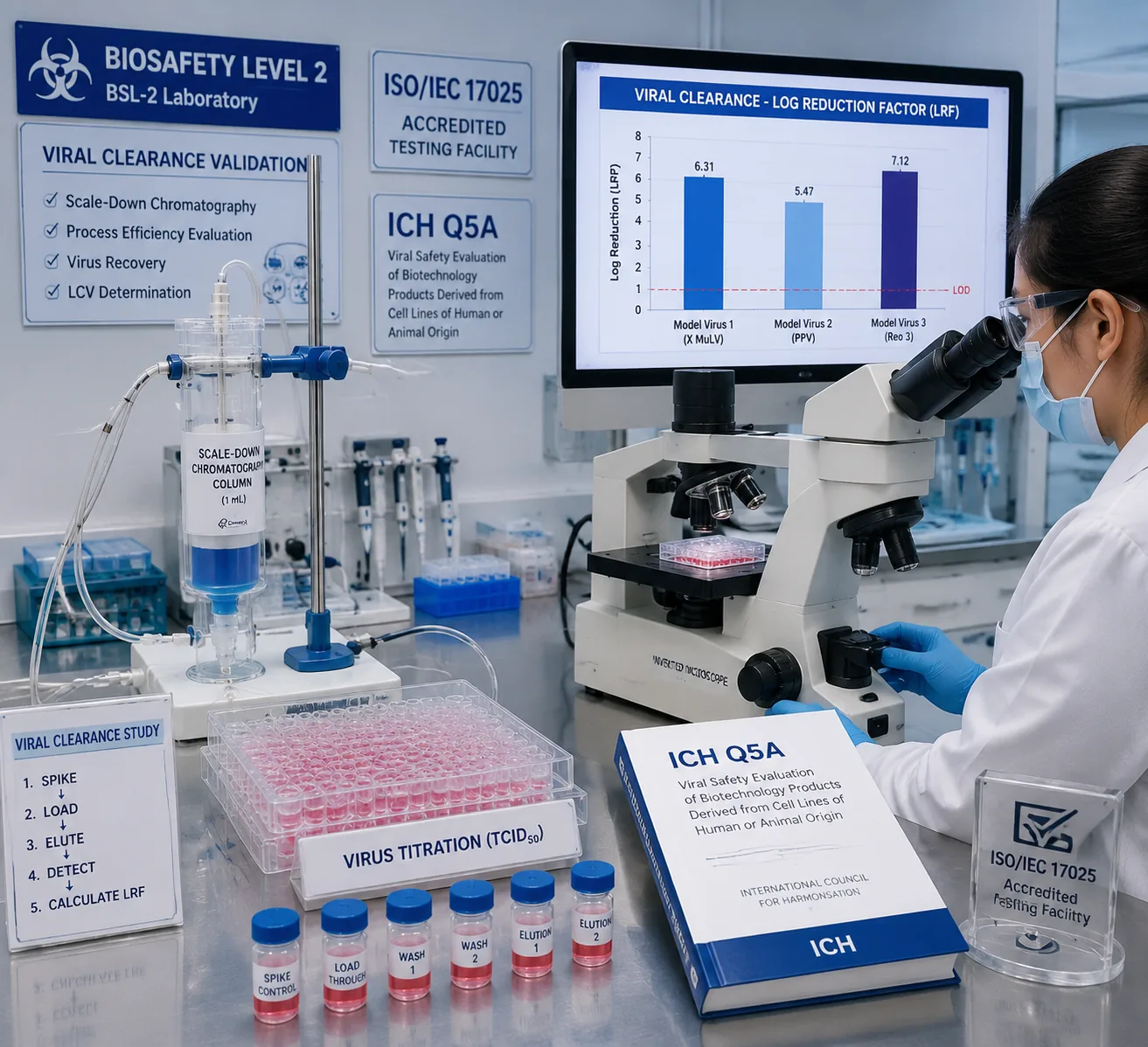
The standard stack: ICH Q5A(R2), FDA, EMA, EP, WHO, NMPA, Chinese Pharmacopoeia
A complete viral clearance testing project draws on a stack of international, US, EU, WHO, and Chinese standards and guidelines.
| Family | Standard | Scope |
|---|---|---|
| ICH Q5A(R2) (Step 4, November 2023) | Viral Safety Evaluation of Biotechnology Products Derived from Cell Lines of Human or Animal Origin | The international harmonised guideline; the R2 revision expands the scope to viral vectors and VLPs, introduces NGS as a replacement for in vivo testing, addresses continuous manufacturing, and codifies the platform-validation approach |
| ICH Q5D | Derivation and Characterisation of Cell Substrates Used for Production of Biotechnological/Biological Products | The cell-substrate characterisation that feeds into the viral risk assessment |
| ICH Q2(R2) | Validation of Analytical Procedures | Applies to the NGS / qPCR / TCID₅₀ methods used to quantify virus |
| ICH Q13 | Continuous Manufacturing of Drug Substances and Drug Products | Continuous-manufacturing viral clearance considerations |
| FDA Guidance | Points to Consider in the Manufacture and Testing of Monoclonal Antibody Products for Human Use (1997) and Chemistry, Manufacturing, and Control (CMC) Information for Human Gene Therapy INDs (2020) | US FDA expectations for viral clearance of mAbs and viral-vector gene therapies |
| EMA EMEA/CHMP/BWP/268/95 | Note for Guidance on Virus Validation Studies: The Design, Contribution and Interpretation of Studies Validating the Inactivation and Removal of Viruses | EU guidance on the design of viral clearance studies (the technical companion to ICH Q5A) |
| EP 5.1.6 | Alternative Methods for Control of Microbiological Quality | European pharmacopeial context for NGS and NAT as alternative virus-detection methods |
| EP 2.6.16 | Nucleic Acid Amplification Techniques | European pharmacopeial method for NAT-based virus detection |
| WHO TRS 978 Annex 2 | Recommendations for the Evaluation of Animal Cell Cultures as Substrates for the Manufacture of Biological Medicinal Products | WHO guidance; the international basis for many national guidelines |
| NMPA Technical Guideline for Validation of Virus Removal/Inactivation of Biological Products | Chinese guideline for viral clearance of biological products | The Chinese equivalent of ICH Q5A; applies to mAbs, recombinant proteins, blood products, vaccines, and cell/gene therapies |
| Chinese Pharmacopoeia General Monograph 3304 | Viral Safety of Biological Products | The Chinese pharmacopeial general chapter for viral safety |
| NMPA Technical Guideline for Viral Safety of Blood Products | Specific Chinese guidance for the blood-products category (albumin, IVIG, Factor VIII) | Builds on the 3304 framework with blood-products-specific requirements |
The single most consequential fact for a Chinese manufacturer is that NMPA's viral clearance guideline and the Chinese Pharmacopoeia 3304 are the NMPA-mandated framework, and they adopt the ICH Q5A principles with the Chinese documentation and review conventions. A biological product placed on the Chinese market must satisfy the NMPA viral-clearance dossier, which is reviewed by the CDE (Center for Drug Evaluation) at NMPA. China's adoption of ICH Q5A(R2) is in progress; the R1 framework is the current operating reference.
ICH Q5A(R2) vs R1: the eight key updates
The November 2023 R2 revision of ICH Q5A is the most consequential update to the international viral safety framework in 24 years. Eight key updates distinguish R2 from R1:
| # | Update | Impact on viral clearance testing |
|---|---|---|
| 1 | New product types in scope — AAV and lentiviral vectors, VLPs, baculovirus-expressed vectors, viral-vector-derived products | Viral clearance must now be demonstrated for products where the product itself is a virus; the orthogonal-step design must preserve the product virus while clearing the enveloped / non-enveloped contaminants |
| 2 | Next-Generation Sequencing (NGS) introduced as a replacement for in vivo virus detection and for the antibody-production assays | NGS is treated as a limit test, replacing the in vivo animal tests and the mouse / rat antibody-production assays (MAP / RAP) that have been the standard for decades |
| 3 | Continuous manufacturing (CM) addressed in a new section, in parallel with ICH Q13 | Viral clearance for CM unit operations (continuous chromatography, continuous low-pH inactivation, continuous viral filtration) with diversion / segregation logic |
| 4 | Platform validation approach codified — a well-characterised platform process (e.g. a CHO mAb platform) can use prior knowledge in place of product-specific viral clearance studies, subject to the principles of new Section 6.6 | Reduces the number of product-specific clearance studies for products using a validated platform |
| 5 | Resin reuse — for Protein A affinity capture, virus removal is not impacted or slightly increases for used resin, so product-specific resin-reuse studies are not expected | For other resin types (AEX, CEX), equivalent prior knowledge can be provided in place of product-specific studies |
| 6 | Prior knowledge formalised in new Annex 5, with the four required principles: well-characterised platform process, equivalent composition of process intermediates, equivalence of upstream step, robustness of critical parameters | Provides a documented pathway to substitute prior knowledge for product-specific clearance studies |
| 7 | Flexible approach for well-characterised cell substrates — for extensively-used cell lines (CHO, NS0, SP2/0) in vivo testing may be excluded; CHO-derived endogenous virus particles can be detected by a qualified molecular method | Eliminates the in vivo animal tests that have been required for decades, in line with the 3Rs (replacement, reduction, refinement) |
| 8 | New glossary and definitions — NGS, helper virus, viral vector for protein expression, viral vector-derived products, master / working virus seed, production virus, platform validation, process robustness, prior knowledge, EOPC, ECB, LIVCA | Aligns the terminology with the expanded scope |
The R2 revision's overall direction is to broaden the scope (viral vectors, VLPs, continuous manufacturing), reduce animal testing (NGS replacing in vivo, flexible approach for CHO), and reduce the burden (platform validation, prior knowledge, resin reuse) — while maintaining the scientific rigour of the three-pillar viral safety strategy.
The three-pillar viral safety strategy
ICH Q5A(R2) is built on three complementary, orthogonal approaches to viral safety. The viral clearance study is one of the three; it is necessary but not sufficient, and must be combined with the other two for a complete viral safety claim.
| Pillar | What it addresses | Test methods |
|---|---|---|
| 1. Safe sourcing and testing of cell lines and raw materials | The risk that the cell substrate carries endogenous virus (CHO retrovirus-like particles) or that the raw materials carry adventitious virus | Cell-line qualification per ICH Q5D (master cell bank, working cell bank, end-of-production cells); in vitro and in vivo adventitious-agent testing; NGS for broad-range virus detection; raw-material viral-risk assessment |
| 2. Viral clearance validation of the purification process | The risk that, despite sourcing controls, a contaminating virus is present in the bulk harvest | The viral clearance study — scale-down of each orthogonal purification step with relevant model viruses, measurement of the log reduction factor |
| 3. Testing for virus at appropriate steps of the production process | The risk that a virus was introduced during production despite the controls above | Bulk-harvest virus testing (in vitro, NGS); end-of-production cell testing; the limit of in vitro cell age (LIVCA) |
A viral clearance study by itself, no matter how good its log reduction factors, cannot substitute for cell-line qualification or for bulk-harvest testing. The three pillars are independent defences — if one fails (an adventitious virus is introduced by a raw material despite sourcing controls), the other two (clearance, post-harvest testing) catch it.
Model viruses: the five-virus panel for clearance studies
The viral clearance study uses a panel of model viruses that represent the range of viral contaminants plausible for the cell substrate and the raw materials. The model viruses are chosen to span the envelope status (enveloped vs non-enveloped), the genome (DNA vs RNA), the size (small vs large), and the physico-chemical resistance (acid-resistant vs acid-labile; heat-resistant vs heat-labile). The ICH Q5A(R2) Annex 1 Table A-1 lists the viruses most commonly used.
| Model virus | Family / genus | Envelope | Genome | Size (nm) | Cell substrate relevance | Typical role |
|---|---|---|---|---|---|---|
| Murine Leukaemia Virus (XMuLV / MuLV) | Retroviridae, Gammaretrovirus | Yes (enveloped) | RNA | 80-110 | Endogenous CHO retrovirus-like particles — the relevant model for the CHO-derived C-type particles | Model for the endogenous retrovirus in CHO; the principal model for low-pH inactivation and for viral filtration |
| Pseudorabies Virus (PRV / Suid herpesvirus 1) | Herpesviridae | Yes (enveloped) | DNA | 120-200 | A model for large enveloped herpes-type viruses — relevant for cell substrates that may carry herpes-like viruses | Model for large enveloped DNA virus; inactivation and removal |
| Bovine Viral Diarrhea Virus (BVDV) | Flaviviridae, Pestivirus | Yes (enveloped) | RNA | 40-60 | A model for enveloped RNA viruses introduced by bovine raw materials (serum, transferrin) | Model for enveloped RNA virus (especially the serum-borne pestiviruses) |
| Reovirus type 3 (Reo-3) | Reoviridae | No (non-enveloped) | RNA (dsRNA) | 70-85 | A model for non-enveloped dsRNA viruses | Model for non-enveloped virus (acid- and heat-resistant) |
| Minute Virus of Mice (MMV) / Porcine Parvovirus (PPV) | Parvoviridae | No (non-enveloped) | DNA (ssDNA) | 18-26 | The smallest relevant virus; highly resistant to heat and to inactivation | Model for small non-enveloped DNA virus (the most challenging for viral filtration and for inactivation) |
| Hepatitis A Virus (HAV) | Picornaviridae | No (non-enveloped) | RNA | 25-30 | Relevant for human-plasma-derived products (blood products) | Model for non-enveloped enteric virus in blood-products-specific clearance studies |
| Encephalomyocarditis Virus (EMCV) | Picornaviridae | No (non-enveloped) | RNA | 25-30 | Model for non-enveloped enteric RNA viruses | Model for small non-enveloped RNA virus in AAV / VLP clearance |
A typical mAb viral clearance study uses XMuLV + PRV + BVDV + MMV (four viruses spanning the four classes: large enveloped DNA, large enveloped RNA, small non-enveloped DNA, non-enveloped RNA / Reo-like); the panel is tailored to the specific risk profile of the product. A blood-products clearance study adds HAV (and often HIV, B19 / PPV, HCV surrogate) for the blood-borne-virus concern.
Log reduction factor: definition, calculation, and the statistical limit
The log₁₀ reduction factor (RF) is the single output of a viral clearance step. It is calculated from the virus titre in the starting material and the virus titre in the post-step material:
RF = log₁₀(V_start) − log₁₀(V_post)
where V_start is the total virus in the load (titre × volume) and V_post is the total virus in the post-step fraction (titre × volume, summed across all post-step fractions).
Virus titre is measured by TCID₅₀ (50 % tissue culture infectious dose, the Reed-Muench method) for viruses that produce cytopathic effect in cell culture (XMuLV, PRV, BVDV, Reo-3, MMV on suitable indicator cells), by plaque assay for viruses that form countable plaques (PRV, MMV), or by qPCR for viruses that cannot be grown in culture (the MVM qPCR is a molecular surrogate of infectivity; for non-infectious particles like the CHO retrovirus-like particles, qPCR or TEM is used).
Statistical considerations (ICH Q5A Annex 2) — the limit of detection (LOD) of the TCID₅₀ assay is set by the volume of each dilution tested and the number of replicates per dilution; the 95 % confidence interval of the titre must be reported. For a clearance step that reduces the virus below the LOD, the RF is reported as "≥ X log" where X is the RF calculated from the LOD (not from a measured value above the LOD). This means that a "≥ 5 log" RF is a lower bound, not a measured value; the true RF may be higher, but the assay cannot see below the LOD.
The cumulative log reduction across the orthogonal steps is the sum of the individual step RFs. A typical mAb process with low-pH inactivation + Protein A chromatography + anion-exchange chromatography + viral filtration achieves a cumulative RF of ≥ 15-20 log for the enveloped viruses and 6-12 log for the small non-enveloped viruses.
The inactivation / removal unit operations and their typical log reduction factors
The orthogonal unit operations of the purification process work by two distinct mechanisms — inactivation (the virus is destroyed, no longer infectious) and removal (the virus is separated from the product, but remains infectious in the waste stream). A process must have at least one of each, working by orthogonal mechanisms, so that a virus resistant to one is caught by the other.
| Unit operation | Mechanism | Typical log₁₀ RF (enveloped) | Typical log₁₀ RF (non-enveloped) | Notes |
|---|---|---|---|---|
| Low-pH inactivation (pH 3.5 hold) | Inactivation — the low pH denatures the viral envelope glycoprotein | ≥ 4-5 log (XMuLV, PRV, BVDV) | < 1 log (MMV, Reo-3 — non-enveloped viruses are resistant) | The workhorse of mAb processes; typically a 60-min hold at pH 3.5; kinetics characterised pre-study |
| Solvent / Detergent (S/D) treatment | Inactivation — the detergent (Tween 80 / Triton X-100) and the solvent (tri-n-butyl phosphate) disrupt the viral envelope | ≥ 4-6 log | < 1 log | Used in blood-products (plasma-derived) processes; the standard for IVIG, Factor VIII |
| Heat treatment (pasteurisation, 60 °C, 10 h) | Inactivation — heat denatures viral proteins | 4-6 log (enveloped); 2-5 log (some non-enveloped, including B19 / PPV) | Variable | Used in plasma-derived albumin (60 °C, 10 h) |
| Dry heat (80 °C, 72 h) | Inactivation | 4-6 log | 2-4 log | Used for the final container of plasma-derived products (coagulation factors) |
| Nanofiltration (parvovirus-grade, 15-20 nm pore) | Removal — the virus is size-excluded by the parvovirus-rated membrane | ≥ 4-6 log | ≥ 4-6 log | The workhorse for the small non-enveloped viruses; the only step that removes MMV effectively; also removes the enveloped viruses |
| Protein A affinity chromatography | Removal (mostly) | 2-5 log (XMuLV) | 1-4 log (MMV) | The capture step of mAb processes; robust, reproducible, the resin-reuse step (R2 clarifies prior-knowledge approach) |
| Anion-exchange chromatography (AEX) | Removal — the negatively charged virus binds the positively charged resin while the product flows through | 4-6 log (XMuLV, PRV) | 2-5 log (MMV) | Flow-through mode for the basic mAb; bind-elute for acidic proteins |
| Cation-exchange chromatography (CEX) | Removal | 1-3 log | 1-3 log | Lower clearance than AEX for most viruses |
| Low-pH hold for viral inactivation (the eluate hold) | Inactivation — same mechanism as the low-pH inactivation | ≥ 4-5 log | < 1 log | Sometimes combined with the Protein A eluate |
The orthogonal combination is the key to the viral safety claim: the enveloped viruses are cleared by the low-pH inactivation (≥ 4-5 log) and by the viral filtration (≥ 4-6 log); the non-enveloped viruses are cleared by the viral filtration (≥ 4-6 log) and by the AEX chromatography (2-5 log). No single step clears both classes with high log reduction; the cumulative log reduction across the orthogonal steps is what gives the viral safety margin.
Study design: scale-down, cytotoxicity, recovery, and the orthogonal steps
The viral clearance study is performed on a scale-down model of each unit operation, in a BSL-2 laboratory (or BSL-3 for the BSL-3 model viruses like HIV). The scale-down model must be representative of the manufacturing-scale step, with the critical process parameters (pH, temperature, residence time, load density, resin / membrane type) controlled to the manufacturing values. The study design must address:
- Scale-down qualification — demonstrate that the scale-down model produces a product of equivalent quality to the manufacturing step (same impurity clearance, same product recovery); this is documented in a scale-down qualification report.
- Cytotoxicity and interference — the process intermediate may be cytotoxic to the indicator cells used for the TCID₅₀ assay; the cytotoxicity is characterised and the assay is run at non-cytotoxic dilutions, with interference controls.
- Virus recovery — the virus spiked into the process intermediate must be recoverable from the post-step fraction; if the recovery is poor (virus lost by binding to the resin or to the membrane), the RF is under-reported. A recovery control (virus spiked into buffer, processed through a mock step) is run in parallel.
| Orthogonality — at least two orthogonal steps must be tested for each virus, working by different mechanisms (an inactivation + a removal), so that a virus resistant to one is cleared by the other. - Blank / negative control — a buffer-only run (no virus) to confirm no cross-contamination of the assay.
- Statistical power — the titre and the 95 % CI per fraction, the cumulative RF, and the "≥ X log" reporting for the below-LOD fractions.
The viral clearance study report is a 50-100 page dossier per product per cell-substrate, with the scale-down qualification, the cytotoxicity / interference data, the raw titre data, the cumulative RF table, the statistical analysis, and the conclusion against the ICH Q5A expectations.
Viral clearance for the new product types: AAV, VLP, viral vectors
The R2 scope expansion to AAV, lentiviral vectors, VLPs, and baculovirus-expressed vectors introduces a novel design constraint: the product itself is a virus (or a virus-like particle), so the inactivation and removal steps must preserve the product while clearing the contaminants. The design principles per R2 are:
| Product type | Envelope status of product | Inactivation options | Removal options |
|---|---|---|---|
| Adeno-Associated Virus (AAV) — gene therapy | Non-enveloped | Inactivation steps for enveloped contaminants (low-pH hold, S/D on the supernatant) are viable because the non-enveloped AAV is resistant | Large-pore virus filtration separates the small AAV (~25 nm) from the larger enveloped contaminants (baculovirus, herpes-like); chromatography |
| Lentiviral vector — gene therapy | Enveloped | Inactivation steps will denature the product vector — not viable; rely on prevention and detection | Viral filtration not viable (the vector is too large) — rely on chromatography and on raw-material / culture-medium treatment |
| Virus-Like Particle (VLP) vaccine | Depends on the VLP (e.g. HBV VLP is non-enveloped; HIV VLP is enveloped) | Inactivation options depend on the VLP's stability | Removal by chromatography and by size-selective filtration |
| Baculovirus-expressed recombinant protein / VLP (Sf9 insect cells) | The baculovirus is enveloped; the recombinant product is non-enveloped (typically) | Inactivation of the enveloped baculovirus by low-pH or solvent; the non-enveloped product survives | Large-pore filtration removes the baculovirus; chromatography separates the product |
The published Kathryn Remington data (file ref) illustrates the typical log reduction achieved for a baculovirus-expressed small non-enveloped product: inactivation ≥ 5.15 log for BACV and ≥ 4.41 log for VSV (the enveloped model); chromatography 1.82 log BACV, 3.84 log VSV; large-pore virus reduction filtration ≥ 4.91 log BACV, ≥ 4.83 log VSV; overall ≥ 11.88 log BACV, ≥ 13.08 log VSV. These numbers are the design target for a typical baculovirus process.
Next-Generation Sequencing as a replacement for in vivo testing
The R2 introduction of Next-Generation Sequencing (NGS) as a replacement for in vivo animal virus-detection assays (the mouse / rat antibody-production assays, the in vivo chick-embryo / suckling-mouse / guinea-pig tests) is the most visible regulatory advance of the revision. NGS:
- Is a sequence-agnostic, broad-range virus detection method — it sequences all the nucleic acid in the sample and identifies any virus by alignment to reference databases, including viruses that the targeted assays (qPCR for specific viruses) would miss
- Is a limit test — the result is "virus sequence detected" or "no virus sequence detected" at the sensitivity threshold of the assay
- Replaces the in vivo tests that have been a regulatory expectation for decades — aligning with the 3Rs (replacement, reduction, refinement of animal testing) and with the ICH Q5A(R2) flexible approach for well-characterised cell substrates (CHO, NS0, SP2/0 — in vivo not necessary)
The validation of NGS as a replacement for in vivo testing per ICH Q5A(R2) and EP 2.6.16 requires demonstration of:
- Specificity — NGS detects all viruses in the reference panel
- Sensitivity — NGS LOD at or below the in vivo assay LOD (typically 10⁻⁶ to 10⁻⁸ genome copies per cell)
- Robustness — NGS performance across operators, instruments, reagent lots
- Bioinformatics pipeline qualification — the database, the alignment algorithm, the reporting threshold
The NGS dossier is the new viral safety testing output for the 2024+ biological-product development pipeline; the laboratory that holds capability in NGS-based virus detection (in addition to the classic TCID₅₀ / qPCR / TEM) is positioned for the R2 transition.
NMPA and Chinese Pharmacopoeia requirements
In China, the viral safety of biological products is regulated by the NMPA Technical Guideline for Validation of Virus Removal/Inactivation of Biological Products and the Chinese Pharmacopoeia General Monograph 3304 Viral Safety of Biological Products. These adopt the ICH Q5A principles with the Chinese documentation conventions:
- Cell-substrate qualification per ICH Q5D and the Chinese Pharmacopoeia cell-bank requirements
- Viral clearance study with the same five-virus panel (XMuLV, PRV, BVDV, Reo-3, MMV / PPV) and the same log-reduction-factor calculation, in a CMA/CNAS-accredited laboratory
- Bulk-harvest testing by in vitro cell-culture methods, NGS, and the relevant specific assays
- Product-specific requirements for the blood-products category (albumin, IVIG, Factor VIII) per the NMPA blood-products viral-safety guideline — including the S/D treatment, the heat treatment, and the nanofiltration steps validated against HIV, HAV, B19, and HCV surrogates
The NMPA adoption of ICH Q5A(R2) is in progress (as of 2024, the R1 framework is the operating reference); a Chinese manufacturer targeting global markets should plan the R2 dossier (NGS, platform validation, viral-vector scope) in parallel with the R1-based NMPA dossier.
FAQ
What is the difference between ICH Q5A(R1) and ICH Q5A(R2)?
R2 (Step 4, November 2023) introduces eight key updates: (1) new product types in scope (AAV, lentiviral vectors, VLPs, baculovirus vectors); (2) NGS as a replacement for in vivo virus detection; (3) continuous manufacturing; (4) platform validation and prior knowledge; (5) resin reuse; (6) new Annex 5 on prior knowledge; (7) flexible approach for well-characterised cell substrates (in vivo testing not necessary for CHO); (8) new glossary.
What are the model viruses used in a viral clearance study?
The standard five-virus panel is XMuLV (enveloped RNA, the CHO retrovirus model), PRV (enveloped DNA, herpes-type), BVDV (enveloped RNA, pestivirus from serum), Reo-3 (non-enveloped dsRNA), and MMV or PPV (small non-enveloped DNA, the most challenging for filtration and inactivation). The panel is tailored to the cell substrate and the raw materials.
What is a log reduction factor and what is the typical target?
The log₁₀ reduction factor (RF) is the log of the ratio of virus in the load to virus in the post-step fraction. A typical mAb process achieves a cumulative RF of ≥ 15-20 log for the enveloped viruses and 6-12 log for the small non-enveloped viruses across the orthogonal inactivation + removal steps. A "≥ 5 log" RF is a lower bound set by the assay limit of detection, not a measured value.
Why are orthogonal inactivation and removal steps required?
Because the enveloped viruses are cleared by inactivation (low pH ≥ 4-5 log) but are resistant to small-pore filtration (no impact), while the non-enveloped viruses are resistant to inactivation (< 1 log) but are removed by the viral filtration (≥ 4-6 log). No single step clears both classes; the orthogonal combination is the only way to achieve a robust cumulative reduction.
Does an AAV viral-vector product require a viral clearance study?
Yes, under ICH Q5A(R2). The study design is product-specific: the inactivation steps (low-pH hold, S/D on the supernatant) target the enveloped contaminants (baculovirus, herpes-like) while preserving the non-enveloped AAV; the large-pore virus filtration separates the small AAV (~25 nm) from the larger enveloped contaminants; the chromatography separates the product. The published log reduction for a baculovirus-expressed AAV process is ≥ 11-13 log overall.
Our viral clearance testing capabilities
Beijing ZKGX Research (ISO/IEC 17025 accredited, CMA- and CNAS-accredited testing laboratory) provides complete viral clearance testing across the ICH Q5A(R2), FDA, EMA, EP, WHO, NMPA, and Chinese Pharmacopoeia standard stack:
- ICH Q5A(R2) viral clearance study — full scale-down validation of each orthogonal purification step, with the five-virus panel (XMuLV, PRV, BVDV, Reo-3, MMV / PPV) and the cumulative log₁₀ reduction factor calculation.
- FDA Guidance support for mAbs and viral-vector gene therapies — the type-test dossier for the IND / BLA submission.
- EMA EMEA/CHMP/BWP/268/95 viral clearance study design — the technical companion to ICH Q5A for the EU submission.
- Low-pH inactivation — kinetics characterisation (pre-study), 60-min pH 3.5 hold, sampling at 0, 5, 15, 30, 60 min, ≥ 4-5 log enveloped-virus RF.
- Solvent / Detergent (S/D) treatment — for plasma-derived products, ≥ 4-6 log enveloped-virus RF.
- Heat treatment / pasteurisation — 60 °C 10 h for plasma-derived albumin; log RF by virus class.
- Nanofiltration — parvovirus-grade 15-20 nm pore, ≥ 4-6 log for both enveloped and non-enveloped viruses.
- Chromatography — Protein A capture, AEX flow-through, CEX bind-elute; scale-down qualification, aged-resin studies, prior-knowledge dossier per ICH Q5A(R2) Section 6.6 and Annex 5.
- Next-Generation Sequencing (NGS) — as a replacement for in vivo virus detection per ICH Q5A(R2) and EP 2.6.16; sequence-agnostic broad-range detection; sensitivity ≥ 10⁻⁶ to 10⁻⁸ genome copies / cell; bioinformatics pipeline qualified.
- Cell-substrate qualification — Master Cell Bank, Working Cell Bank, End-of-Production Cells per ICH Q5D and Chinese Pharmacopoeia; in vitro adventitious-agent testing; TEM of the CHO retrovirus-like particles; the CHO flexible approach (in vivo not necessary, R2).
- AAV / VLP / viral vector clearance studies — product-specific design preserving the product while clearing the enveloped / non-enveloped contaminants; baculovirus process; human-cell-line process.
- NMPA Technical Guideline for Validation of Virus Removal/Inactivation of Biological Products — the Chinese dossier; Chinese Pharmacopoeia 3304 Viral Safety of Biological Products conformity; CMA/CNAS-accredited reports.
- Blood-products — NMPA Technical Guideline for Viral Safety of Blood Products; S/D, heat, nanofiltration validated against HIV, HAV, B19, HCV surrogate.
Suitable product categories include: monoclonal antibodies (mAbs); Fc-fusion proteins; recombinant proteins from CHO, NS0, SP2/0, HEK293; AAV gene therapies; lentiviral vector gene therapies; VLP vaccines; baculovirus-expressed recombinant proteins and VLPs; plasma-derived albumin, IVIG, Factor VIII, and coagulation factors. Each project is delivered with a full data report (study protocol, scale-down qualification, cytotoxicity and interference data, raw TCID₅₀ / qPCR / TEM data, statistical analysis, cumulative log reduction factor table, classification conclusion per ICH Q5A(R2) / NMPA / 3304) in English and/or Chinese, with CMA/CNAS stamping. Contact Beijing ZKGX Research to scope the viral clearance study applicable to your product and target market.