What Is an Anti-Static Rack, and What Does Testing It Mean?
An "anti-static rack" is any static-dissipative structure used inside an electrostatic protected area (EPA) to store, move or hold ESD-sensitive (ESDS) items — component racks (插件架), PCB racks, tote boxes (周转箱), kitting carts, trolleys, flow racks and shadow boards. Because these structures physically touch the ESDS items (or the trays holding them), their surfaces must remain within the dissipative resistance band and be bonded to the EPA ground; a rack that has gone insulative, or a trolley with insulative casters, can charge up triboelectrically and transfer that charge to the items it carries. Anti-static rack testing is the periodic verification of the rack's surface resistance and its path to ground, governed by the ANSI/ESD S20.20 program framework with the test methods ANSI/ESD STM4.1 (worksurfaces) and ANSI/ESD STM7.1 (floor materials, extended to mobile-equipment surfaces), and in China by SJ/T 10694-2022 (电子产品制造与应用系统防静电测试方法) under GB/T 32304 (电子产品防静电控制要求). It is distinct from the device-level ESD immunity test (IEC 61000-4-2, which tests products against discharge, not EPA furniture), and from ESD-packaging testing (ANSI/ESD S541, which tests shielding bags). Here the rack-as-EPA-furniture is the subject, and the question is whether it still belongs in the grounded dissipative system.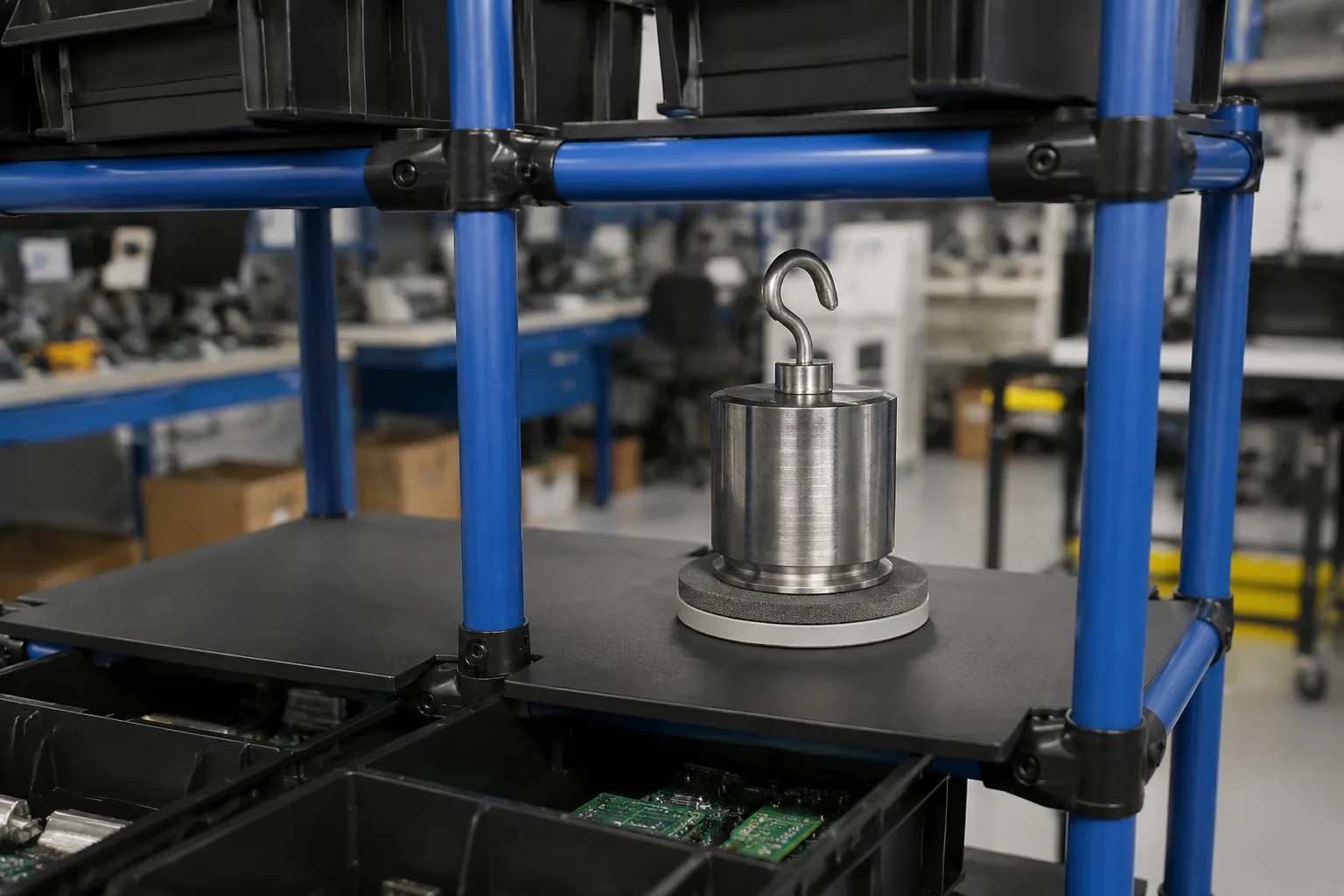
Why a Rack Is Part of the EPA Grounded System — Not Just "Metal"
The most common misconception is that a metal rack is automatically ESD-safe. It is not, for two reasons. First, many "metal" racks are coated, anodised or fitted with plastic shelves, bins and casters that are insulative; the bare-steel frame may be conductive but the surface that actually contacts the ESDS item is often not. Second, even a fully conductive rack is only safe if it is bonded to the EPA ground — a conductive but isolated rack is a charged floating object that will discharge into the first ESDS item it touches, which is worse than an insulative rack. This is the same principle that governs seating (ANSI/ESD STM12.1): an ESD chair is not just dissipative-upholstered, it is grounded through its casters to the dissipative floor, and the same system logic applies to a trolley or flow rack. A rack therefore passes ESD testing only when both its surface resistance is in band and its resistance-to-ground through casters/floor or through a ground cord is within limit — surface alone is not enough.
What Resistance Range Must an Anti-Static Rack Meet?
The dissipative band that defines an ESD-safe surface is the same one that governs worksurfaces and floors, and the same engineering trade-off applies — conductive enough to bleed charge, resistive enough to be safe:
| Classification | Surface resistance | Use on a rack |
|---|---|---|
| Conductive | < 1 × 10⁵ Ω | Rare on racks; risk of rapid discharge to ESDS item and mains-shock hazard if energised circuits are near |
| Dissipative (target) | 1 × 10⁶ to < 1 × 10⁹ Ω | The required band for rack surfaces, shelves and bins that contact ESDS items — the ANSI/ESD S20.20 worksurface/floor limit |
| Insulative (fail) | > 1 × 10¹¹ Ω | Cannot be grounded; charges accumulate — an insulative shelf or bin is an ESD hazard, not protection |
Under ANSI/ESD S20.20 the technical requirement for worksurfaces and floors — extended to rack/trolley surfaces that perform the same contact function — is resistance to ground < 1 × 10⁹ Ω, with the dissipative target band of 1 × 10⁶ to 1 × 10⁹ Ω. China's SJ/T 10694-2022 applies the same band. The point competitors state but do not explain: "lower is not better" on a rack. A conductive (< 10⁵ Ω) metal shelf can deliver a rapid discharge to a sensitive device placed on it, and if the rack is near 250 V+ circuitry it is a shock path. The dissipative band is the deliberate compromise, which is why racks are deliberately coated with dissipative finishes (e.g. ESD PE on steel tube, dissipative HDPE decking) rather than left as bare metal.
How Are Surface Resistance and Resistance-to-Ground Measured?
The rack is tested with the same instrumentation and logic as a worksurface — an ESD resistance meter with 5 lb (2.27 kg) electrodes, not a multimeter:
- Point-to-point resistance (RTT) — two 5 lb electrodes placed on the rack surface (shelf, bin, tube) at the standard geometry, at 100 V for readings above 1 × 10⁶ Ω. Verifies the surface material is uniformly dissipative across the rack — catches a worn, contaminated or aged coating.
- Resistance to ground (RTG) — one 5 lb electrode on the rack surface, the other lead to the EPA common point ground (or, for a mobile rack, to the floor it stands on via the casters). Verifies the system path: surface → frame → casters → floor → ground, or surface → ground cord → ground. This is the test that catches an isolated rack — a conductive-but-ungrounded rack fails RTG.
- Caster / wheel resistance — for mobile racks and trolleys, the casters are the ground path, so the caster-to-floor resistance is part of the RTG. Insulative casters (rubber, nylon) break the ground path even on a dissipative floor; ESD casters (conductive/dissipative rubber) are required, exactly as ESD chairs use ESD casters per STM12.1.
The diagnostic sequence is RTG first, then RTT if RTG fails: a high RTG with a good RTT points to the ground path (caster/cord/connection), not the surface.
What Are the In-Service Verification Frequency and Failure Causes?
A rack is a periodically re-tested EPA item, and the documented frequency and failure causes are:
- Test frequency — under typical EPA programs (and SJ/T 10694's recommendation) rack/trolley/tote-box surface resistance is verified at least every 6 months, more often in severe service. This is a longer interval than daily wrist-strap testing because racks do not flex or skin-contact, but shorter than annual because coatings wear and casters age.
- Failure causes:
- Coating wear / contamination — the dissipative coating on steel tube or the dissipative HDPE shelf wears through abrasion, or soils with dust, oil and flux; the surface drifts insulative.
- Insulative replacement parts — a maintainer fits standard (non-ESD) casters, bins or shelf liners, breaking the dissipative path.
- Broken ground path — the ground cord disconnects, or conductive caster bolts corrode; the rack becomes a floating conductor.
- Chemical / UV degradation — cleaning with the wrong chemical, or UV exposure, breaks down the dissipative additive in the polymer.
- Failure handling — clean the surface with the approved ESD cleaner and re-test; if still out of band, isolate the failed component (re-coat, replace casters, replace bins) and re-test before returning the rack to EPA service.
For the complete EPA cluster, see our ESD Floor Mat Testing (the floor that mobile racks stand on), Anti-Static Wrist Strap Testing (the personnel grounding at the rack), and Anti-static clothing testing; for the device-level discharge test, which is a different subject, see electrostatic discharge immunity testing.
FAQ
Is a metal rack automatically ESD-safe?
No. Many "metal" racks are coated or fitted with plastic shelves, bins and casters that are insulative; and even a fully conductive rack is only safe if it is bonded to the EPA ground. A conductive but ungrounded rack is a charged floating object that discharges into ESDS items. A rack passes ESD testing only when its surface resistance is in the dissipative band and its resistance-to-ground is within limit.
What resistance should an anti-static rack surface read?
The dissipative target band is 1 × 10⁶ to < 1 × 10⁹ Ω (surface resistance, ANSI/ESD S20.20 worksurface/floor limit, extended to rack surfaces); resistance to ground must also be < 1 × 10⁹ Ω. SJ/T 10694-2022 applies the same band.
How is a mobile rack/trolley grounded for testing?
Through its casters, to the dissipative floor it stands on — the same system as an ESD chair (STM12.1). The RTG measurement goes from the rack surface through the frame, through the casters, through the floor, to ground. Insulative casters break this path; ESD (conductive/dissipative) casters are required.
How often should anti-static racks be tested?
At least every 6 months under typical EPA programs (SJ/T 10694), more often in severe service. The interval is longer than daily wrist-strap testing (racks do not flex or skin-contact) but shorter than annual, because dissipative coatings wear and casters age.
Why is a conductive rack surface not necessarily better than a dissipative one?
Because a conductive (< 10⁵ Ω) surface can deliver a rapid discharge to an ESDS item placed on it, and near energised circuits it is a shock path. The dissipative band (10⁶–10⁹ Ω) bleeds charge fast enough for EPA purposes but slowly enough to be safe — which is why racks are deliberately coated with dissipative finishes rather than left as bare metal.
Our Testing Capabilities
As an ISO/IEC 17025-accredited third-party laboratory, Beijing ZKGX Research provides anti-static rack, trolley and EPA-furniture testing aligned to ANSI/ESD S20.20, STM4.1, STM7.1, STM12.1, IEC 61340-5-1, SJ/T 10694-2022 and GB/T 32304:
- Surface resistance (point-to-point, RTT) on rack shelves, bins, tubes and decking, with 5 lb electrodes at 10 V / 100 V, in the dissipative band 1 × 10⁶ to < 1 × 10⁹ Ω.
- Resistance to ground (RTG) — surface → frame → casters/cord → floor → ground, verifying the system path (< 1 × 10⁹ Ω).
- Caster / wheel resistance for mobile racks and trolleys, confirming the ground path through ESD casters to the dissipative floor (STM12.1 method).
- Periodic verification program support — 6-monthly RTT/RTG schedules per SJ/T 10694, with failure-cause diagnosis (coating wear, insulative replacement parts, broken ground path, chemical degradation).
- EPA furniture cluster — racks + trolleys + seating + worksurfaces + flooring as an integrated grounded-system verification.
Sample types include component racks (插件架), PCB racks, tote boxes (周转箱), kitting carts, trolleys, flow racks, and ESD workstations with dissipative-coated steel tube / HDPE decking construction. If you have a specific program (ANSI/ESD S20.20, IEC 61340-5-1, GB/T 32304, SJ/T 10694), rack construction, or customer-specified acceptance band, contact the laboratory to confirm the exact test set and reporting format.