Table of Contents
- What standards govern ceramic tooth testing?
- How is flexural strength tested?
- How is fracture toughness measured?
- How is wear behaviour evaluated?
- How is chemical solubility tested?
- How is metal-ceramic bond compatibility assessed?
- How do the Chinese YY / GB standards align?
- FAQ
- Our ceramic tooth testing service
What standards govern ceramic tooth testing?
Ceramic tooth (dental ceramic) testing is governed by ISO 6872, Dentistry — Ceramic materials, the international standard that defines the mechanical, physical and chemical requirements for dental ceramics used in fixed all-ceramic and metal-ceramic restorations. The standard classifies dental ceramics into classes by clinical indication, sets the minimum flexural strength and fracture toughness for each class, and specifies the test methods by which each property is measured. ISO 6872 is supplemented by ISO 9693 for the metal-ceramic bond compatibility, ISO/TS 11405 for the adhesion-to-tooth-structure testing, and the ISO 10993 biocompatibility framework for the biological evaluation.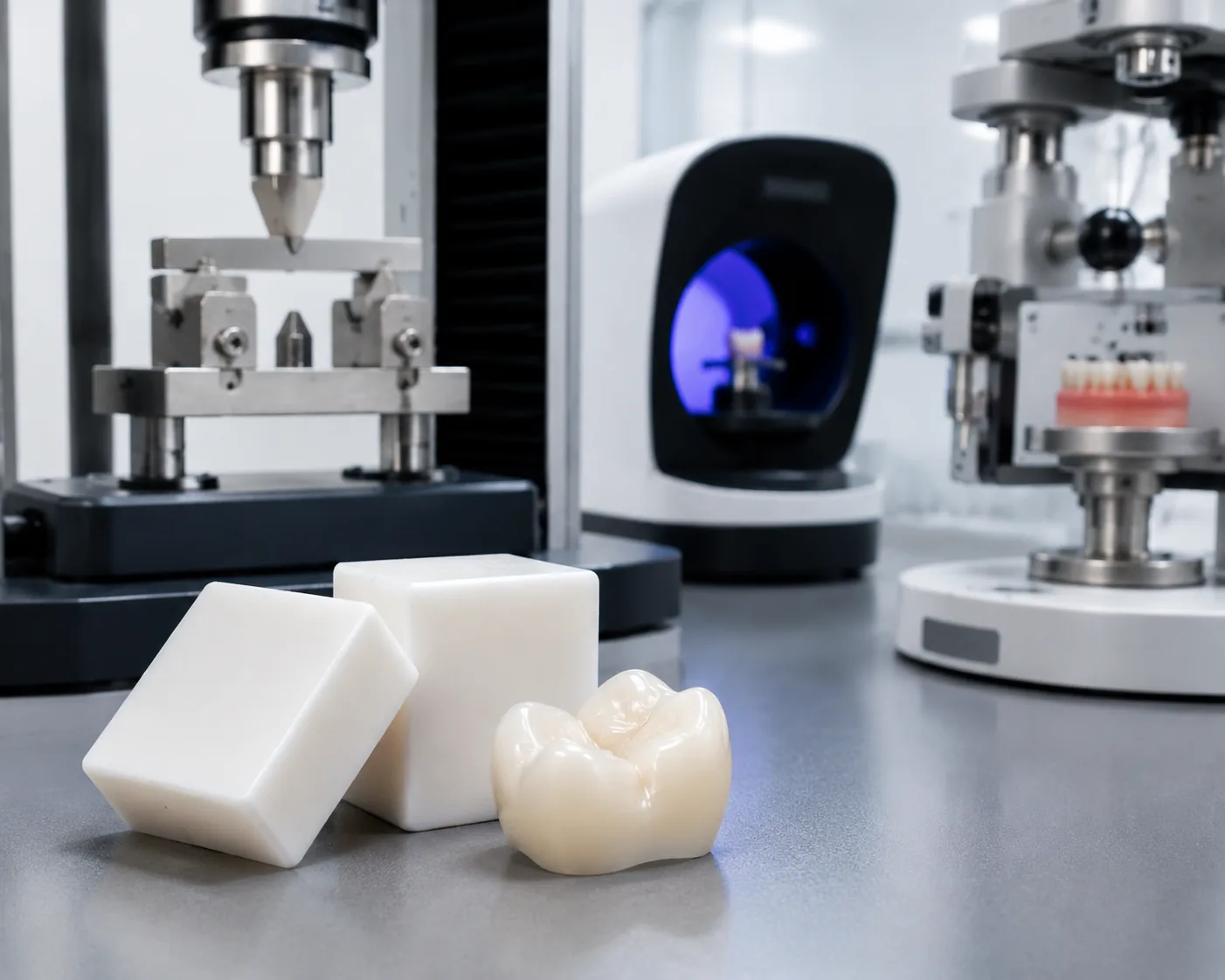
The principal reference standards our laboratory works to are:
-
ISO 6872:2024, Dentistry — Ceramic materials (ISO 6872:2024) — the master international standard for dental ceramics. ISO 6872 defines the classification system (Class 1 through Class 5 by clinical indication), the minimum flexural strength and fracture toughness for each class, the chemical solubility limit, the test methods (the biaxial flexural strength test, the SEVNB fracture-toughness test, the chemical-solubility test), and the specimen preparation requirements. The 2024 edition is the current version, replacing the widely-cited 2015 edition. ISO 6872 is aligned with ANSI/ADA Standard No. 69 in the United States and is recognised by the FDA in its Dental Ceramics Guidance for Industry (FDA Guidance).
-
ISO 9693:2019, Dentistry — Compatibility testing for metal-ceramic systems (ISO 9693:2019) — the standard for the thermomechanical-compatibility testing between a veneering porcelain ceramic and a metal (or ceramic) substructure, covering the three-point-bend bond-strength test and the thermal-expansion-coefficient matching. The bond-strength criterion is typically ≥ 25 MPa. ISO 9693 is aligned with ANSI/ADA Standard No. 38.
-
ISO/TS 11405:2015, Dentistry — Testing of adhesion to tooth structure — the standard for the bonding-adhesion testing between the ceramic restoration and the tooth structure, covering the specimen preparation, the shear-bond-strength test, the tensile-bond-strength test, and the thermocycling protocol.
-
ISO 10993 series, Biological evaluation of medical devices — the biological-evaluation framework for the dental ceramic in its finished form, covering cytotoxicity (Part 5), sensitisation and irritation (Part 10), and the specific dental-device endpoints under ISO 7405.
-
YY 0716-2009 / GB/T 30367-2013, Dental ceramics / Dental ceramic materials — the Chinese national and industry standards for dental ceramics, adopting ISO 6872 for the Chinese market.
-
YY 0621-2025, Dentistry — Compatibility testing for metal-ceramic and ceramic-ceramic systems — the Chinese standard for the metal-ceramic and ceramic-ceramic compatibility testing, adopting ISO 9693 for the Chinese market.
A point worth stating plainly: the dental ceramic market encompasses multiple material classes — the feldspathic glass ceramics, the lithium-disilicate glass ceramics, the zirconia-reinforced lithium-silicate (ZLS) ceramics, the polymer-infiltrated ceramic networks (PICN), the resin nano-ceramics, the polycrystalline zirconia (3Y-TZP, 4Y-TZP, 5Y-TZP) — and each class has its own composition, its own mechanical properties, and its own clinical indication range. The ISO 6872 classification system assigns the ceramic to the class by the clinical indication, and the minimum-strength thresholds differ by class. We confirm the ceramic class, the clinical application (the veneer, the inlay, the onlay, the anterior crown, the posterior crown, the bridge), and the target market before quoting, because the test scope and the acceptance criteria are driven by the classification.
How is flexural strength tested?
The flexural strength — the stress at which the ceramic specimen fractures under the bending load, measured in megapascals (MPa) — is the primary mechanical property by which dental ceramics are classified and compared. ISO 6872 specifies two methods for the flexural-strength measurement:
The biaxial flexural strength method (the piston-on-three-balls method) uses a circular ceramic disc, supported on three balls equally spaced around the circumference, with the load applied at the centre by the piston. The biaxial method is preferred for the glass ceramics, the lithium-disilicate, and the resin-matrix ceramics, because the disc geometry avoids the edge effects that can cause the premature failure in the bar specimens. The biaxial method typically produces the higher strength values than the three-point-bend method for the same material, because the maximum stress occurs at the centre of the disc, away from the edges.
The three-point bend method uses a rectangular ceramic bar, supported on two points, with the load applied at the mid-span. The three-point-bend method is the standard for the zirconia ceramics (the polycrystalline zirconia is tested as bars because the material's uniform microstructure produces the consistent edge quality). ISO 6872 provides guidance on the span length (commonly 12 mm, but the range 12 to 30 mm is allowed), and the shorter span length produces the higher flexural strength — a fact that complicates the comparison between the materials tested under the different span lengths.
The flexural-strength values of the common dental ceramics, drawn from the published literature:
| Ceramic type | Typical flexural strength (MPa) | Clinical indication |
|---|---|---|
| Feldspathic glass ceramic | 60–90 | Veneers, anterior inlays |
| Leucite-reinforced glass ceramic | 120–160 | Veneers, anterior/onlays |
| Lithium-disilicate glass ceramic | 360–440 | Anterior/posterior crowns, bridges |
| Zirconia-reinforced lithium silicate (ZLS) | 210–370 | Crowns, onlays |
| Polymer-infiltrated ceramic network (PICN) | 130–160 | Veneers, crowns |
| Resin nano-ceramic | 200–210 | Inlays, onlays, crowns |
| 3Y-TZP polycrystalline zirconia | 800–1200 | Posterior crowns, multi-unit bridges |
These values are the comparative figures the dentist and the dental technician use for the material selection, and the ISO 6872 class thresholds set the minimum values for each clinical-indication class.
How is fracture toughness measured?
The fracture toughness — the resistance of the ceramic to the crack propagation, measured in MPa·m^(1/2) — is the property that distinguishes the brittle materials (the low fracture toughness, the easy crack propagation) from the tough materials (the high fracture toughness, the crack resistance). For the dental ceramics, the fracture toughness governs the chipping resistance, the fatigue resistance, and the clinical longevity, and it is the second key mechanical property (alongside the flexural strength) that ISO 6872 classifies.
ISO 6872 specifies the SEVNB method (the Single-Edge V-Notched Beam) as the standard method for the fracture-toughness measurement. The procedure:
- A sharp V-shaped notch is machined into the rectangular ceramic bar specimen (the notch radius is critical, typically ≤ 10 µm), creating the defined pre-crack from which the fracture initiates.
- The notched specimen is loaded in the three-point or four-point bending configuration, and the force at which the crack propagates through the specimen is recorded.
- The fracture toughness (K_Ic) is calculated from the force, the specimen geometry, and the notch dimensions, using the standard fracture-mechanics equation.
The fracture-toughness values of the common dental ceramics: the feldspathic glass ceramic ~0.8–1.0 MPa·m^(1/2); the lithium-disilicate ~2.0–2.5; the ZLS ~1.5–2.0; the PICN ~1.0–1.5; the 3Y-TZP zirconia ~4.0–5.0. The zirconia's high fracture toughness — a consequence of the transformation toughening (the tetragonal-to-monoclinic phase transformation at the crack tip, which absorbs the energy and resists the crack propagation) — is the reason the zirconia is the material of choice for the high-load posterior applications.
How is wear behaviour evaluated?
The wear behaviour — the material loss from the ceramic surface and the opposing enamel surface under the masticatory loading — is the property that determines the clinical longevity of the ceramic restoration and the opposing-dentition health. The wear is evaluated by the in-vitro chewing simulation, which mimics the physiological mastication using the defined load, the defined motion, and the defined number of cycles.
The chewing-simulation test procedure, drawn from the published chewing-simulation research on the CAD-CAM dental ceramics:
- The specimen preparation. The ceramic materials are sectioned into flat-surface specimens (commonly 6 × 6 × 6 mm³) and polished to the defined surface finish. The opposing enamel cusps are prepared from the healthy human third molars (stored in the distilled water at 4 °C, disinfected with 1 % chloramine-T), divided into four independent cusps per tooth, per ISO/TS 11405.
- The chewing simulation. The enamel cusp is placed on the top support and the ceramic specimen on the bottom support (mimicking the cusp-fossa relationship), and the chewing simulator applies the defined load (commonly 49–50 N for the physiological simulation, or 120 N for the increased-force simulation), the defined frequency (1 Hz), the defined lateral motion (0.7 mm) and the defined vertical motion (2 mm), with the thermal cycling (5 to 55 °C every 2 min). The simulation runs for the defined number of cycles (commonly 1,200,000 cycles, corresponding to approximately 5 years of clinical chewing).
- The wear quantification. The 3D laser scanner measures the surface profiles before and after the simulation, and the Geomagic software superimposes the pre- and post-wear scans to calculate the wear volume loss (in mm³) for both the ceramic specimen and the enamel cusp.
- The wear-mechanism characterisation. The SEM examination of the worn surfaces reveals the wear mechanisms — the microcracking, the delamination, the abrasive-groove formation, the nanocrystal pull-out — and it is the qualitative complement to the quantitative volume-loss measurement.
The published chewing-simulation data on four CAD-CAM dental ceramics (the PICN Vita Enamic, the resin nano-ceramic GC Cerasmart, the ZLS Celtra Duo, and the 3Y-TZP IPS e.max ZirCAD), tested at 120 N for 1,200,000 cycles, provides the comparative wear data:
| Ceramic material | Material volume loss (mm³) | Enamel-cusp volume loss (mm³) | Wear mechanism (SEM) |
|---|---|---|---|
| 3Y-TZP zirconia (ZIR) | 0.02 ± 0.01 | 0.29 ± 0.13 | Smooth scratches; no fracture |
| ZLS (DUO) | 0.69 ± 0.29 | 0.82 ± 0.53 | Delamination; zirconia-crystal pull-out; abrasive to enamel |
| Resin nano-ceramic (CERA) | 0.82 ± 0.52 | 0.19 ± 0.12 | Large wear paths; lowest enamel wear |
| PICN (ENA) | 0.74 ± 0.28 | 0.60 ± 0.47 | Microcracks; polymer-piece breakout |
The clinical implication: the zirconia has the lowest material volume loss (the wear resistance), but it can cause the microstructural defects of the opposing enamel (the crack lines and the small chipping areas, even without the significant volume loss). The resin nano-ceramic has the highest material loss but causes the lowest enamel wear (the flexible nano-ceramic microstructure absorbs the force). The ZLS ceramic causes the highest opposing-enamel wear (the ejected zirconia crystals on the worn surface are abrasive). The wear-behaviour evaluation is therefore the multi-parameter assessment — the material loss, the enamel loss, and the wear mechanism — and the material selection must account for all three.
How is chemical solubility tested?
The chemical solubility — the mass loss per unit surface area of the ceramic when immersed in the defined solution, measured in µg/cm² — is the property that determines the ceramic's chemical durability in the oral environment. ISO 6872 specifies the chemical-solubility test method and the acceptance limit.
The chemical-solubility test procedure:
- The ceramic specimen of the defined geometry (the defined surface area) is immersed in the defined solution (commonly the 4 % acetic acid solution at 80 °C for 16 hours) — the accelerated dissolution conditions that simulate the long-term chemical exposure in the oral environment.
- The specimen is removed, dried, and weighed, and the mass loss is calculated as the difference between the initial and the final mass.
- The chemical solubility is reported as the mass loss per unit surface area (µg/cm²).
- The acceptance criterion: the chemical solubility must be below the ISO 6872 limit (commonly 100 µg/cm² for the Class 1 ceramics, with the stricter limits for the higher classes).
The chemical-solubility test is the one that catches the ceramic with the inadequate glassy-matrix durability — the ceramic that will degrade, stain, or weaken over the years of the oral exposure. A ceramic that passes the flexural-strength and the fracture-toughness tests can still fail the chemical-solubility test if the glassy phase is susceptible to the acid attack, and the chemical-solubility test is the one that qualifies the ceramic for the long-term chemical durability.
How is metal-ceramic bond compatibility assessed?
For the metal-ceramic restorations (the porcelain-fused-to-metal crowns and bridges), the bond between the veneering porcelain and the metal substructure is the critical interface that determines the restoration's integrity. The bond compatibility is assessed under ISO 9693 (or its Chinese adoption YY 0621).
The ISO 9693 test procedure:
- The veneering porcelain is fired onto the defined metal (or ceramic) strip substrate, creating the bilayer specimen with the porcelain on one side and the substrate on the other.
- The bilayer specimen is loaded in the three-point-bend configuration, and the force at which the porcelain debonds from the substrate is recorded.
- The bond strength (in MPa) is calculated from the debonding force and the specimen geometry.
- The acceptance criterion: the bond strength must be ≥ 25 MPa.
ISO 9693 also addresses the thermal-expansion-coefficient matching — the difference between the metal's and the ceramic's thermal-expansion coefficients must be within the defined tolerance (typically ≤ 0.5 × 10⁻⁶ /°C), because the mismatch produces the residual stress at the bond interface on cooling from the firing temperature, and the excessive residual stress causes the spontaneous debonding or the delayed cracking.
The 2019 edition of ISO 9693 extends the scope beyond the metal-ceramic to the ceramic-ceramic systems (the zirconia framework with the veneering porcelain), reflecting the modern clinical practice where the all-ceramic bilayer restorations have largely replaced the metal-ceramic. The ceramic-ceramic bond testing follows the same three-point-bend methodology, with the bond-strength criterion adjusted for the ceramic-ceramic interface.
How do the Chinese YY / GB standards align?
The Chinese framework for the ceramic tooth (dental ceramic) testing uses the industry and national standards that adopt the ISO standards for the Chinese market:
- YY 0716-2009, 牙科陶瓷 (Dental ceramics) (std.samr.gov.cn) — the Chinese industry standard for dental ceramics, adopting ISO 6872:2008 (the 2008 edition, with the newer editions under revision). Administered by the National Technical Committee for Dental Materials and Devices, YY 0716 defines the classification, the performance requirements, and the test methods for all dental ceramics used in fixed restorations. The NMPA lists YY 0716 in the dental-restoration-product registration standards.
- GB/T 30367-2013, 牙科学 陶瓷材料 (Dentistry — Ceramic materials) — the Chinese national standard for dental ceramic materials, also adopting ISO 6872. GB/T 30367 is referenced alongside YY 0716 in the dental-product registration, and the relationship between the two standards (the YY industry standard and the GB national standard) should be confirmed at the project scoping, as the NMPA's evolving standard updates may shift the primary reference.
- YY 0621-2025, 牙科学 金属-陶瓷和陶瓷-陶瓷体系匹配性试验 (Dentistry — Compatibility testing for metal-ceramic and ceramic-ceramic systems) — the Chinese standard for the metal-ceramic and ceramic-ceramic compatibility testing, adopting ISO 9693. Published in June 2025, this is the current edition for the Chinese-market compatibility testing.
- GB/T 16886 series / YY/T 0268 — the Chinese biological-evaluation framework for dental materials, adopting ISO 10993 and the dental-specific biological-evaluation standard.
A regulatory point for the Chinese-market project: the NMPA classifies the dental ceramic restorations as medical devices (the Class II for the prefabricated ceramic materials, the Class II/III for the custom-made restorations), and the registration requires the conformity to the YY 0716 / GB/T 30367 standard, the ISO 10993 / GB/T 16886 biocompatibility evaluation, and the clinical-evidence documentation. The specific registration pathway depends on the product type (the raw ceramic material, the CAD/CAM block, the prefabricated crown, the custom-made restoration), and we confirm the product type and the target market before quoting.
FAQ
Which standard should my dental ceramic be tested to?
ISO 6872:2024 (international) or YY 0716-2009 / GB/T 30367-2013 (China) for the ceramic material properties (flexural strength, fracture toughness, chemical solubility). ISO 9693:2019 or YY 0621-2025 for the metal-ceramic bond compatibility. ISO/TS 11405 for the adhesion-to-tooth testing. ISO 10993 / GB/T 16886 for the biocompatibility. We confirm the ceramic class, the clinical application, and the target market before quoting.
What is the difference between biaxial and three-point-bend flexural strength?
The biaxial method (piston-on-three-balls, circular disc) avoids the edge effects and is preferred for the glass ceramics and the resin-matrix ceramics. The three-point-bend method (rectangular bar) is standard for the zirconia ceramics. The biaxial method typically produces the higher values than the three-point-bend for the same material. The span length in the three-point-bend test also matters — shorter span = higher strength — and ISO 6872 allows the range 12 to 30 mm, which can produce completely different flexural strengths for the same material. Comparing materials tested under different methods or span lengths is the classic error.
How does the chewing simulation predict the clinical wear?
The chewing simulation applies the defined load, the defined motion, and the defined number of cycles (commonly 1,200,000 cycles at 120 N, 1 Hz, simulating approximately 5 years of clinical chewing), with the thermal cycling (5 to 55 °C), and the wear is quantified by the 3D-scanning volume loss and the SEM wear-mechanism characterisation. The simulation does not perfectly replicate the clinical environment (the in-vivo variables — the saliva, the food bolus, the bruxism, the individual chewing patterns — are simplified), but it provides the comparative ranking of the materials and the opposing-enamel-wear assessment that the material selection relies on.
Why does zirconia cause low enamel wear volume but enamel microstructural defects?
Because the zirconia's polycrystalline microstructure is extremely wear-resistant (the very low material volume loss), but its high hardness means that the contact stress is transferred to the opposing enamel, causing the microcrack formation and the small chipping areas in the enamel, even without the significant volume loss. The wear-behaviour assessment must therefore include both the quantitative volume-loss measurement and the qualitative SEM mechanism characterisation, because the volume loss alone does not capture the enamel-microstructural-defect mode.
Do I need biocompatibility testing for the dental ceramic?
Yes. The dental ceramic is a tissue-contact medical device, and the ISO 10993 / GB/T 16886 biocompatibility evaluation is required for the finished, sterilised ceramic restoration. The endpoints typically include the cytotoxicity (ISO 10993-5), the sensitisation and irritation (ISO 10993-10), and the specific dental-device endpoints under ISO 7405 / YY/T 0268. The biocompatibility testing is performed on the finished ceramic in the form it will be used clinically.
Our ceramic tooth testing service
Our laboratory provides ceramic tooth (dental ceramic) testing across the full ISO 6872 framework — the biaxial and the three-point-bend flexural strength, the SEVNB fracture toughness, the chemical solubility, the wear behaviour by the chewing simulation, and the metal-ceramic / ceramic-ceramic bond compatibility under ISO 9693 — supplemented by the ISO/TS 11405 adhesion testing, the ISO 10993 / GB/T 16886 biocompatibility, and the full suite of the characterisation methods (XRD, FTIR, SEM, Vickers hardness, surface roughness, colour measurement). For the Chinese market, we test under YY 0716-2009 / GB/T 30367-2013 and report in Chinese for the NMPA submission.
We measure the flexural strength by the biaxial piston-on-three-balls and the three-point-bend methods; the fracture toughness by the SEVNB method; the chemical solubility by the acetic-acid immersion; the wear by the chewing simulation (the defined load, the defined cycles, the 3D-scanning volume loss, the SEM wear mechanism); the bond compatibility by the ISO 9693 three-point-bend test; the adhesion by the ISO/TS 11405 shear-bond-strength test; and the biocompatibility by the ISO 10993 / GB/T 16886 test set. Reports are issued with the standard, the method, the measured values, the ISO 6872 class thresholds, and the conformity conclusion explicitly stated, with the force-displacement curves, the 3D wear scans, the SEM images, and the biocompatibility test reports included, in a format suitable for the FDA submission, the EU MDR technical documentation, the NMPA registration dossier, or the internal quality audit.
To start a project, send us the ceramic type (the glass ceramic, the lithium-disilicate, the ZLS, the PICN, the resin nano-ceramic, the zirconia), the product form (the CAD/CAM block, the powder, the prefabricated restoration), the clinical application (the veneer, the inlay, the crown, the bridge), the target market, the regulatory pathway, and whether the project is the ISO 6872 conformity, the wear evaluation, the bond-compatibility testing, or the full registration support. We will return a project scope, sample requirement, schedule and quotation, and begin testing on your confirmation.