Copper alloy testing is essential for ensuring material quality, compliance with industry standards, and optimal performance across diverse applications. Copper alloys rank among the most widely used metal systems in modern industry because they blend high electrical conductivity with robust corrosion resistance and excellent formability. However, even minor variations in elemental content can significantly impact product performance and longevity.
Testing copper alloys addresses several critical needs:
- Quality Control: Ensures products meet exacting specifications
- Regulatory Compliance: Meets stringent international standards
- Process Optimization: Enables real-time adjustments during production
- Cost Efficiency: Reduces waste and minimizes safety margins
- Performance Assurance: Verifies mechanical and electrical properties
Copper alloys encompass a vast range of applications, from pure grades like OFE (Oxygen-Free Electronic), OFC (Oxygen-Free Copper), and ETP (Electrolytic Tough Pitch) to high-alloy compositions such as brass and cupro-nickel. Each grade has distinct elemental requirements that demand accurate testing methods.
What Are the Key Properties of Copper Alloys?
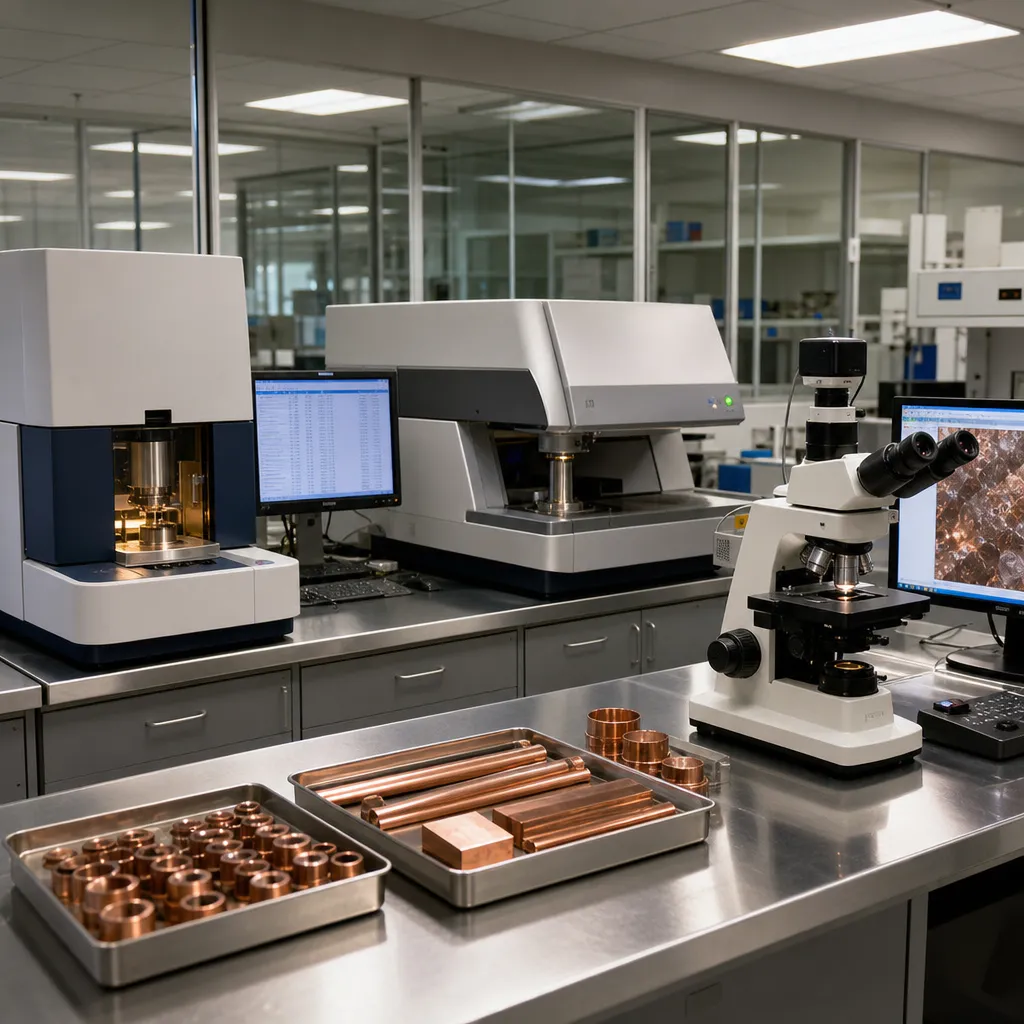
Copper alloys possess unique combinations of properties that make them indispensable across multiple industries. Understanding these properties is essential for selecting appropriate testing methods.
Electrical and Thermal Conductivity
Of all common metals, copper possesses the highest rating for both electrical and thermal conductivity, second only to silver. This property:
- Makes copper alloys ideal for electrical connectors and components
- Enables rapid heat dissipation in heat exchangers
- Requires special consideration during metallographic preparation
- Affects chemical and electrolytic polishing procedures
Mechanical Properties
Tensile Strength:
- Pure copper: relatively soft and malleable
- Alloying elements strengthen the material
- Precipitation hardening possible in certain alloys
- Cold working increases strength through work hardening
Formability:
- Face-centered cubic (FCC) crystal structure
- Excellent ductility and malleability
- Suitable for architectural applications
- Enables various forming processes
Corrosion Resistance
Copper alloys demonstrate outstanding resistance to corrosion in many environments:
- Natural formation of protective patina
- Excellent resistance to atmospheric corrosion
- Good performance in marine environments
- Specific alloys resist particular corrosive media
Antimicrobial Properties
Copper and copper alloys possess intrinsic antimicrobial properties:
- Kill greater than 99.9% of harmful bacteria within 2 hours
- EPA-registered as antimicrobial materials
- Effective against antibiotic-resistant bacteria
- More than 280 copper alloys have public health registration
Physical Properties Summary
| Property | Characteristic |
|---|---|
| Conductivity | Highest among common metals |
| Density | 8.93 g/cm³ (pure copper) |
| Melting Point | 1085°C (pure copper) |
| Crystal Structure | Face-centered cubic (FCC) |
| Magnetic Properties | Generally nonmagnetic |
| Color | Distinctive reddish-brown |
How Is Chemical Analysis Performed on Copper Alloys?
Chemical analysis of copper alloys determines elemental composition with high accuracy using various instrumental and classical methods. The choice of method depends on required precision, element concentration, and alloy type.
Optical Emission Spectrometry (OES)
OES is the cornerstone of analytical excellence for copper alloy testing, providing rapid and accurate elemental analysis.
Advantages:
- Real-time analysis of molten samples
- Detection limits down to single or sub-ppm levels
- Capability to measure over 30 elements
- Fast results for process optimization
Applications:
- Determining precise concentration of alloying elements
- Measuring trace impurities in pure copper
- Process control during melting and casting
- Quality assurance for finished products
X-ray Fluorescence (XRF) Spectrometry
XRF provides non-destructive elemental analysis suitable for various copper alloy applications.
Benefits:
- Non-destructive testing method
- Rapid multi-element analysis
- Minimal sample preparation
- Suitable for routine quality control
ARL OPTIM'X WDXRF Performance:
- Air-cooled Rh end-window tube (50W maximum power)
- SmartGonio™ and Multichromators™ options
- Performance equivalent to 200W conventional instruments
- Excellent long-term and short-term stability
Wet Chemical Methods
Classical analytical methods remain important for certain applications:
- Gravimetric analysis for specific elements
- Titrimetric procedures
- Colorimetric determination
- Reference method validation
ISO 15350 Standard
ISO 15350 provides a critical benchmark for copper alloy analysis by spectrometry, ensuring:
- Accuracy and reliability of composition measurements
- Compliance with regulatory requirements
- Consistency across different laboratories
- Traceability to international standards
What Metallographic Preparation Techniques Apply to Copper Alloys?
Metallographic preparation of copper alloys requires special techniques that respect the alloys' distinctive physical traits. The very ductility that makes these materials easy to shape also creates challenges during sectioning, grinding, and polishing.
Key Challenges in Metallographic Preparation
Work Hardening Behavior:
- Surface distortion from sectioning and grinding
- Mechanical polish can introduce spurious features
- Slip lines and deformation twins may appear
- Excessive pressure can mask grain boundaries
Thermal Conductivity Effects:
- Heat dissipates rapidly through the specimen
- Requires aggressive cooling during cutting
- Complicates chemical and electrolytic polishing
- Temperature variations affect etching rates
Oxidation Sensitivity:
- Brief air exposure creates oxide films
- Aluminum or beryllium alloys more sensitive
- Tarnishing can mask microstructural details
- Requires controlled atmosphere for delicate work
Sectioning Techniques
Low-Deformation Sectioning:
- Use abrasive cut-off wheels specifically designed for copper
- Rubber-bonded silicon-carbide wheels yield best results
- Maintain cutting speeds of 2,000-3,000 rpm
- Continuous abundant flow of cooling fluid
- Consistent moderate pressure to avoid smearing
Fine Wire and Foil analysis:
- Specialized technology for wires as thin as 0.1 mm diameter
- Foil analysis down to 20 microns thickness
- Requires custom sample preparation techniques
Mounting Methods
Hot Mounting:
- Temperature: 150-180°C
- Pressure: 200-300 bar
- Excellent edge retention
- Suitable for automated preparation
- Process time: 15-20 minutes
Cold Mounting:
- Epoxy or acrylic resins
- Curing time: 8-24 hours
- Protects delicate microstructures
- Preserves surface films and corrosion products
- Transparent for specimen orientation
Resin Selection:
- Phenolic resin with wood-flour filler for general use
- Diallyl-phthalate with glass-fiber for best edge retention
- Conductive epoxy for electrolytic etching
Grinding and Polishing Procedures
Grinding Sequence:
- Start with 320-grit (finer than for harder metals)
- Progress through 400, 600, 800, and 1200-grit
- Rotate specimen 90° between stages
- Use minimal pressure
- Rinse thoroughly between stages
Final Polishing Options:
Diamond Suspensions:
- Particle sizes from 6 µm to 1 µm
- Fast material removal
- Suitable for multiphase alloys
- Better edge retention
Alumina Suspensions:
- Particle sizes of 0.3 µm and 0.05 µm
- Superior for high-purity copper
- Minimizes deformation layer
- Reduces particle embedding
Lubricant Selection:
- Water alone insufficient for copper
- Glycol or alcohol-based lubricants preferred
- pH 7.5-8.5 to minimize oxidation
- Continuous flow during polishing
Etching Procedures
Common Etchants:
Ferric Chloride (FeCl₃):
- Most common etchant for copper alloys
- Typically 10% solution in water or alcohol
- Few drops of hydrochloric acid
- Concentration adjustable from 5% to 20%
Ammonium Persulfate ((NH₄)₂S₂O₈):
- 10% water-based solution
- Excellent for α-β brasses
- Shows boundaries in annealed specimens
- Avoids over-etching grain boundaries
Electrolytic Etching:
- Essential for high-purity copper
- 20% phosphoric acid electrolyte
- 1.5-2V for 10-15 seconds
- Precise voltage control
- Clear grain boundary delineation
Etching Time Control:
- Typical range: 5-30 seconds
- Short intervals with inspection preferred
- Stop reaction with alcohol rinse
- Freshly mixed etchants give better results
How Does Spectrometry Testing Analyze Copper Alloys?
Spectrometry testing provides rapid, accurate elemental analysis essential for copper alloy production and quality control. Both optical emission and X-ray fluorescence spectrometry serve critical roles.
Optical Emission Spectrometry (OES)
High-End Solutions for Ultra-Pure Copper:
Metavision-10008X:
- Ideal for OFE copper
- Sub-ppm detection for oxygen (1 ppm)
- Suitable for purity levels up to 99.998%+
- Detects critical elements: Bi, Se, Te
Metavision-1008i3:
- Best for OFC and ETP copper
- Oxygen detection limits of 10 ppm
- Comprehensive analysis for 99.992%+ purity
Economical Models for Alloy Makers:
- Metavision-8i for brass, bronze, and other alloys
- MOSS compact spectrometer for 21 elements
- Budget-conscious operations
Mobile Solutions:
- Metavision-MX+ and Metavision-MX
- PMI (Positive Material Identification)
- Scrap sorting and entry-gate inspections
- Arc, spark, UV, and combined probe options
XRF Spectrometry Applications
Sample Preparation:
- Milling prior to analysis
- Surface must be flat and clean
- Typical counting time: 36 seconds per element
Analytical Performance:
- Repeatability tests show excellent precision
- Copper concentration determined by difference to 100%
- Adjustable counting times for different elements
- Parallel analysis possible with fixed channels
Results Interpretation:
- Compare with certified reference materials
- Apply type standardization for best accuracy
- Consider matrix effects
- Report with measurement uncertainties
What Mechanical Tests Evaluate Copper Alloy Properties?
Mechanical testing evaluates strength, ductility, hardness, and other properties essential for design and quality control. Tests must account for copper's unique characteristics.
Tensile Testing
Tensile tests measure:
- Ultimate tensile strength
- Yield strength
- Elongation
- Reduction of area
Considerations for Copper Alloys:
- Work hardening during testing
- Strain rate sensitivity
- Temperature effects
- Annealing condition
Hardness Testing
Common Methods:
- Rockwell hardness (HRB, HRF scales)
- Vickers hardness (HV)
- Brinell hardness (HB)
Factors Affecting Results:
- Cold work condition
- Heat treatment
- Alloy composition
- Grain size
Bend Testing
Bend tests evaluate:
- Ductility
- Formability
- Presence of defects
- Weld quality
Impact Testing
Impact testing assesses:
- Toughness
- Ductile-to-brittle transition
- Temperature sensitivity
- Defect sensitivity
How Is Oxygen Content Measured in Copper?
Oxygen content measurement is critical for classifying copper grades and ensuring product reliability. Different grades have specific oxygen requirements.
Critical Oxygen Requirements
OFE (Oxygen-Free Electronic):
- Maximum oxygen: ≤10 ppm
- Some grades as low as 5 ppm
- Highest purity applications
- Critical for electronics
OFC (Oxygen-Free Copper):
- Maximum oxygen: ≤10 ppm
- Suitable for demanding applications
- Good electrical conductivity
ETP (Electrolytic Tough Pitch):
- Oxygen range: 200-400 ppm
- Some grades as low as 50 ppm
- Cost-effective option
- Standard electrical applications
Measurement Techniques
Optical Emission Spectrometry:
- Detection limits down to 1 ppm
- Rapid analysis
- Suitable for production control
- Requires proper calibration
Inert Gas Fusion:
- Highly accurate for oxygen determination
- Suitable for reference measurements
- Requires specialized equipment
- Sample must be clean and dry
Importance of Oxygen Control
Oxygen content affects:
- Electrical conductivity
- Hydrogen embrittlement susceptibility
- Weldability
- Mechanical properties
- Thermal conductivity
What Are the Testing Requirements for Different Copper Grades?
Different copper grades have specific testing requirements based on intended applications and performance criteria. Understanding these requirements ensures appropriate test methods.
Pure Copper Grades
ETP (Electrolytic Tough Pitch):
- Purity: 99.90%+ copper
- Oxygen: 200-400 ppm
- Primary application: Electrical conductors
- Key tests: Conductivity, oxygen content
OFC (Oxygen-Free Copper):
- Purity: 99.95%+ copper
- Oxygen: ≤10 ppm
- Primary application: Electronics, automotive
- Key tests: Ultra-trace impurity analysis
OFE (Oxygen-Free Electronic):
- Purity: 99.99%+ copper
- Oxygen: ≤10 ppm (often ≤5 ppm)
- Primary application: High-reliability electronics
- Key tests: Sub-ppm detection limits
Copper Alloys
Brasses (Cu-Zn):
- Alpha brasses: Less than 39% Zn
- Alpha-beta brasses: 39-46% Zn
- Applications: Cartridge cases, condenser tubes, marine hardware
- Key tests: Zn content, corrosion resistance
Bronzes (Cu-Sn):
- Phosphor bronzes: Cu-Sn-P
- Aluminum bronzes: Cu-Al
- Silicon bronzes: Cu-Sn-Ni
- Applications: Bearings, gears, valves
- Key tests: Sn content, wear resistance
Cupro-Nickel (Cu-Ni):
- Applications: Coins, tubes, marine
- Key tests: Ni content, corrosion resistance
Nickel Silver (Cu-Ni-Zn):
- Applications: Marine hardware, radiators
- Key tests: Multi-element analysis
Stringent Impurity Limits
Purity requirements often exceed what they appear:
- Individual impurity limits may be higher than combined limits
- Example: Bi (2 ppm), Se (2 ppm), Te (1 ppm), but combined ≤3 ppm
- Requires high-resolution analytical capability
- Must measure over 30 elements accurately
How Does XRF Spectrometry Analyze Copper Alloys?
XRF spectrometry provides non-destructive multi-element analysis suitable for various copper alloy applications. Modern instruments offer excellent precision and accuracy.
Instrument Capabilities
ARL OPTIM'X Features:
- Air-cooled Rh end-window tube
- Thin Be window (0.075 mm)
- 50W maximum power
- SmartGonio™ for flexible analysis
- Multichromators™ for fixed elements
Performance:
- Equivalent to 200W conventional WDXRF
- Excellent stability
- Total analysis time: approximately 10 minutes
- Counting time: 36 seconds per element
Sample Preparation
Requirements:
- Mill the sample surface
- Ensure flat, clean surface
- Remove any contamination
- Avoid oxidation during preparation
Analytical Results
Repeatability Testing:
Results demonstrate excellent precision across various copper alloy types:
Brass Sample:
- Sn: 0.498% (SD: 0.004)
- Zn: 32.88% (SD: 0.02)
- Pb: 0.253% (SD: 0.0033)
- Cu by difference: 65.83%
Phosphor Bronze:
- Sn: 4.756% (SD: 0.013)
- Zn: 0.372% (SD: 0.002)
- Pb: 0.741% (SD: 0.005)
- Cu by difference: 93.51%
Optimization Options
For Different Elements:
- Reduce counting time for major elements (Zn, Fe, Ni)
- Increase counting time for trace elements (As, Al)
- Use fixed channel for parallel analysis
- Optimize for specific alloy types
What Standards Govern Copper Alloy Testing?
International standards ensure consistent and reliable testing methods for copper alloys worldwide. Adherence to standards enables global trade and quality assurance.
Chemical Analysis Standards
ISO Standards:
- ISO 15350: Analysis by optical emission spectrometry
- ISO 1553: Determination of copper content
- ISO 4741: Determination of zinc content
- ISO 4742: Determination of tin content
ASTM Standards:
- ASTM E53: Chemical analysis of copper
- ASTM E62: Photometric procedures
- ASTM E75: Chemical analysis of copper-nickel alloys
- ASTM E478: Chemical analysis of copper alloys
Metallographic Standards
Sample Preparation:
- ASTM E3: Standard guide for preparation
- ASTM E340: Macroetching metals and alloys
- ASTM E407: Microetching metals and alloys
Mechanical Testing Standards
Tensile Testing:
- ASTM E8: Tension testing of metallic materials
- ISO 6892: Metallic materials - Tensile testing
Hardness Testing:
- ASTM E10: Brinell hardness
- ASTM E18: Rockwell hardness
- ASTM E92: Vickers hardness
Product Standards
Copper Products:
- ASTM B1: Hard-drawn copper wire
- ASTM B2: Medium-hard-drawn copper wire
- ASTM B3: Soft or annealed copper wire
- ASTM B49: Copper rod for electrical purposes
Copper Alloy Products:
- ASTM B16: Free-cutting brass rod
- ASTM B21: Naval brass rod
- ASTM B30: Copper-base alloys in ingot form
Choosing the Right testing equipment and Laboratory
Selecting appropriate testing equipment and qualified laboratories ensures accurate, reliable results for copper alloy analysis. Consider capability, accreditation, and experience.
Equipment Selection Criteria
For OES:
- Detection limits appropriate for application
- Elements covered match requirements
- Sample size capability
- Throughput requirements
- Mobile or laboratory-based
For XRF:
- Wavelength dispersive for best precision
- Element range and detection limits
- Sample handling capability
- Software and data management
- Maintenance requirements
Laboratory Selection
Accreditation:
- ISO/IEC 17025 laboratory accreditation
- Relevant industry certifications
- Quality management system
Technical Capability:
- Modern, calibrated equipment
- Qualified technical staff
- Standardized test methods
- Method validation procedures
Experience:
- Copper and copper alloy expertise
- Industry-specific knowledge
- Track record of reliable results
- Technical support capability
Service Offerings
Analysis Types:
- Elemental composition analysis
- Oxygen determination
- Trace impurity analysis
- Master alloy testing
Sample Types:
- Solid samples
- Wires and foils
- Molten metal
- Finished products
Additional Services:
- Consultation on test methods
- failure analysis
- Material certification
- Technical support
Conclusion
Comprehensive copper alloy testing ensures material quality, compliance with standards, and optimal performance across all applications. From chemical analysis verifying composition to mechanical testing confirming properties, each test provides critical information for material selection and quality control.
The combination of advanced analytical techniques, standardized methods, and experienced laboratories enables manufacturers to produce copper alloy products that meet the highest quality standards. Understanding test methods, their applications, and proper interpretation of results is essential for effective quality assurance.
As applications for copper alloys continue to expand—driven by their unique combination of conductivity, strength, corrosion resistance, and antimicrobial properties—the importance of thorough testing will only increase. Investment in proper testing capabilities and qualified laboratory partnerships ensures copper alloy products perform reliably in their critical applications across aerospace, automotive, electronics, and construction industries.