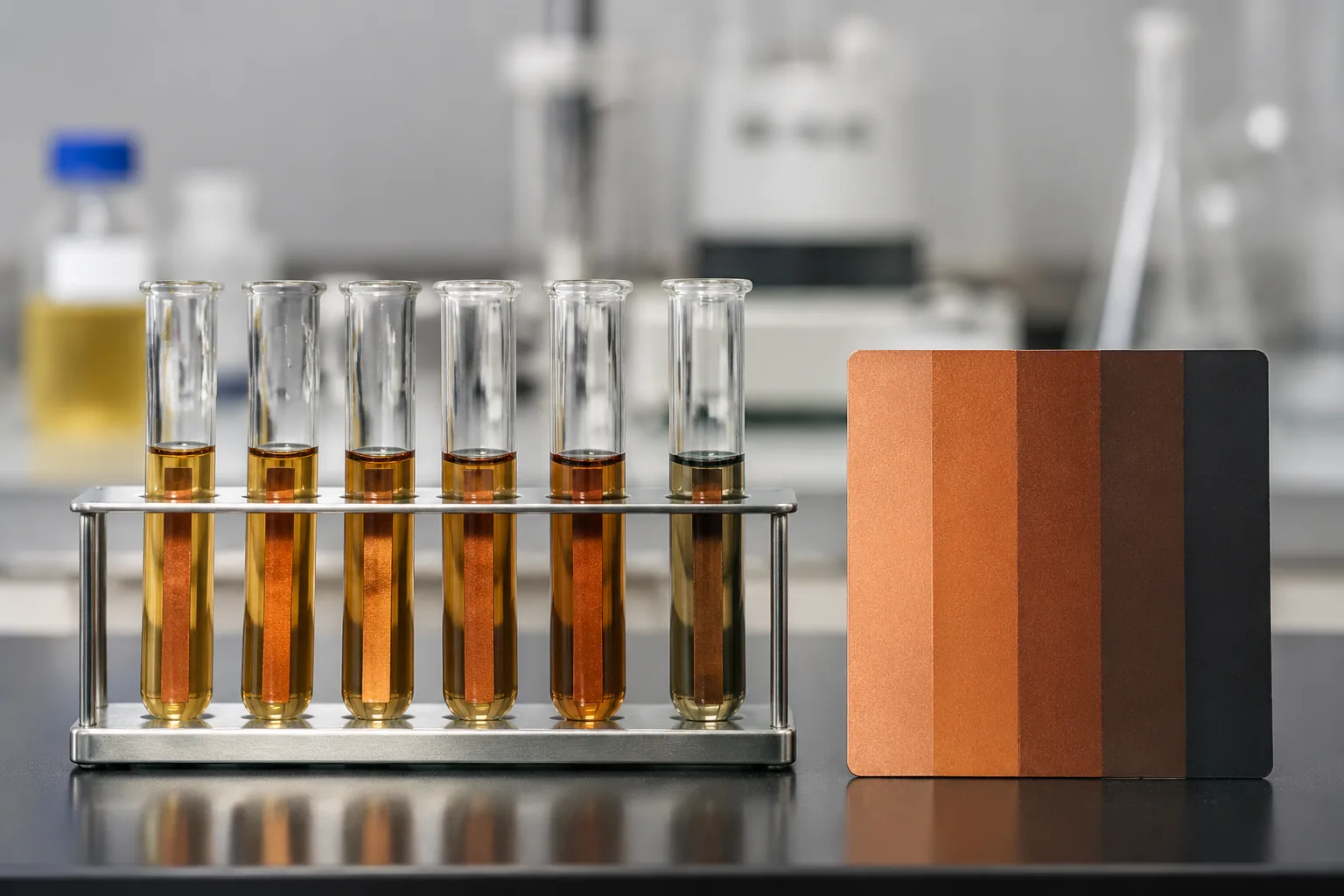
Copper strip testing — formally the copper strip corrosion test (铜片腐蚀试验) — is the petroleum-products laboratory method that determines whether a fuel, lubricant, or solvent contains corrosive active sulfur compounds (elemental sulfur, mercaptans, hydrogen sulfide, and other reactive sulfur species) that would attack copper and copper-alloy components in fuel systems, engines, and pipelines. The test is governed by GB/T 5096 (Petroleum Products — Determination of Corrosiveness to Copper, equivalent to ASTM D130 and ISO 2160), and it is a qualitative colour-matching test: a polished copper strip is immersed in the oil sample at a defined temperature for a defined time, then compared against a standard colour board to assign a corrosion rating from 1a (slight tarnish) to 4b (black corrosion). The defining trait of the test is that it measures corrosiveness to a specific metal (copper) — not total sulfur content — because only active (reactive) sulfur causes corrosion, while inactive organosulfur compounds may be present without harming copper.
The Active-Sulfur Principle — Why Total Sulfur ≠ Corrosiveness
The most important concept, and one absent from the search results, is that the copper strip test detects only active sulfur — not total sulfur. Petroleum products contain sulfur in many chemical forms:
- Elemental sulfur (S₈) — highly corrosive to copper; the most common cause of copper strip failure.
- Mercaptans / thiols (R-SH) — corrosive at elevated temperatures; cause tarnish and corrosion.
- Hydrogen sulfide (H₂S) — highly corrosive; usually dissolved trace amounts.
- Sulfides (R-S-R'), disulfides (R-S-S-R') — may or may not be corrosive depending on thermal decomposition.
- Thiophenes, benzothiophenes — inactive (non-corrosive); structurally stable aromatic sulfur that does not react with copper.
A fuel can have a high total sulfur content yet pass the copper strip test (because the sulfur is in inactive thiophenic form), or a low total sulfur content yet fail (because a small amount of active elemental sulfur is present). The copper strip test therefore answers a question that total-sulfur analysis (XRF, UV fluorescence) cannot: will this product actually corrode copper?
The Test Method: GB/T 5096 / ASTM D130
GB/T 5096 (石油产品铜片腐蚀试验法, TC280 petroleum products and lubricants) is the Chinese national standard, equivalent to ASTM D130 (Standard Test Method for Corrosiveness to Copper from Petroleum Products by the Copper Strip Tarnish Test) and ISO 2160. The procedure:
- Copper strip preparation — a standard pure copper strip (approx. 75 mm × 12.5 mm × 1.5–3.0 mm, electrolytic tough-pitch copper, ≥99.9 % Cu) is polished to a bright, mirror-like finish using progressively finer silicon-carbide paper (240, then 400 grit), then final-polished with 150-mesh silicon-carbide on a flat surface until all surface defects and blemishes are removed. The surface preparation is critical — any pre-existing tarnish would confound the result.
- Immersion — the polished copper strip is immediately immersed in a test tube containing 30 mL of the oil sample, ensuring the strip is fully submerged and not in contact with air.
- Temperature–time exposure — the test tube is placed in a bath at the specified temperature and held for the specified time. Common conditions:
- 100 °C / 3 h — the standard condition for most fuels (gasoline, kerosene, diesel) and many lubricants.
- 50 °C / 3 h — for lighter, more volatile products (aviation gasoline, natural gasoline).
- 120 °C / 3 h or higher — for heavier lubricants and turbine oils.
- Removal and washing — after the exposure, the copper strip is removed, washed with solvent (acetone or diethyl ether), and dried.
- Colour matching — the tested strip is compared against the ASTM copper strip corrosion standard (a set of 13 reproductions of tarnished/corroded copper strips, permanently mounted on a board). The closest match is recorded as the result.
The Corrosion Rating Scale (1a–4b)
The result is reported as a corrosion rating from the 13-standard colour board:
| Rating | Description | Appearance |
|---|---|---|
| 1a | Slight tarnish | Light orange (same as freshly polished) |
| 1b | Slight tarnish | Dark orange |
| 2a | Moderate tarnish | Claret red |
| 2b | Moderate tarnish | Lavender |
| 2c | Moderate tarnish | Multi-coloured with lavender blue and/or silver overlaid on claret red |
| 3a | Dark tarnish | Brassy or gold |
| 3b | Dark tarnish | Magenta overcast on brassy strip |
| 4a | Corrosion | Transparent black, dark grey, deep brown |
| 4b | Corrosion | Graphite black, glossy or jet black |
The pass/fail threshold is set by the product specification:
- aviation fuels (jet fuel, aviation gasoline) — typically ≤ 1b (the strictest).
- Automotive fuels (gasoline, diesel) — typically ≤ 1 (i.e., ≤ 1b).
- Lubricants — typically ≤ 1a or 1b.
- Industrial solvents — by agreement.
A rating of 2a or higher means the product contains active corrosive sulfur and fails for most fuel specifications.
What Failures the Test Reveals
A failing copper strip result indicates that the petroleum product contains active sulfur — most commonly:
- Elemental sulfur carried over from crude oil through insufficient refining (the desulfurization/hydrotreating process did not remove all reactive sulfur). This is the dominant cause of failures.
- Mercaptans remaining after insufficient caustic washing or Merox treatment of light distillates.
- Decomposition products from unstable sulfur compounds during storage (sulfides decomposing to release active species).
- Contamination during transport or storage (contact with sulfur-containing materials).
The test is therefore a refining-quality and product-stability indicator: a pass confirms the refining process removed active sulfur; a fail signals a process or contamination problem.
Why the Test Matters — Copper Components in Fuel Systems
Fuel systems, engines, and pipelines contain numerous copper and copper-alloy components (brass fittings, bronze bearings, copper fuel-line connectors, copper gaskets) that would corrode if exposed to active sulfur. Corrosion of these components causes:
- Fuel-system leaks (corroded brass fittings).
- Engine damage (corroded bronze bearings, abrasive copper sulfide particles in the lubricant).
- Fuel-injector and pump failure (corrosion deposits blocking precision components).
This is why every major fuel specification worldwide (gasoline, diesel, jet fuel, kerosene, lubricant) includes the copper strip test as a mandatory quality parameter.
Our Testing Capabilities
Beijing ZKGX Research conducts copper strip corrosion testing to GB/T 5096 / ASTM D130 / ISO 2160:
- Standard: GB/T 5096 (equivalent to ASTM D130 and ISO 2160), for petroleum products, fuels, lubricants, and solvents.
- Conditions: 50 °C / 100 °C / 120 °C (or as specified) × 3 hours, per the product specification.
- Rating: 1a–4b against the ASTM copper strip corrosion standard colour board.
- Products tested: automotive gasoline, diesel, jet fuel (Jet A-1), aviation gasoline, kerosene, solvents, lubricating oils, turbine oils, and other petroleum products.
- Deliverable: a test report stating the product, the standard (GB/T 5096 / ASTM D130), the test temperature and time, the corrosion rating (1a–4b), and pass/fail against the product specification limit.
If you have a fuel, lubricant, or solvent requiring copper strip corrosion verification, contact our testing team to scope the product type, the applicable test temperature, and the pass criterion.
Frequently Asked Questions
What standard governns copper strip testing?
GB/T 5096 (石油产品铜片腐蚀试验法, TC280) is the Chinese standard, equivalent to ASTM D130 and ISO 2160. A polished copper strip is immersed in the oil sample at a defined temperature (typically 100 °C) for 3 hours, then compared against a 13-standard colour board to assign a rating from 1a to 4b.
Is copper strip testing the same as total sulfur analysis?
No. Copper strip testing detects only active sulfur (elemental sulfur, mercaptans, H₂S) that would actually corrode copper. Total sulfur analysis (XRF, UV fluorescence) measures all sulfur including inactive thiophenic compounds that do not corrode. A fuel can have high total sulfur yet pass the copper strip test, or low total sulfur yet fail.
What is the pass criterion for copper strip corrosion?
For most fuels (gasoline, diesel, jet fuel), the criterion is ≤ 1 (i.e., ≤ 1b) — the copper strip may show only slight tarnish. Aviation fuels are often ≤ 1b. A rating of 2a or higher means active corrosive sulfur is present and the product fails.
What does a failing copper strip result indicate?
A failing result (rating 2a or higher) indicates that the petroleum product contains active sulfur — most commonly elemental sulfur carried through insufficient refining, or mercaptans from inadequate caustic washing. It signals a refining-quality or contamination problem that would cause corrosion of copper and brass components in fuel systems and engines.
What is the difference between GB/T 5096 and ASTM D130?
They are equivalent standards. GB/T 5096 (TC280, Chinese national standard) is technically equivalent to ASTM D130 (ASTM international standard) and ISO 2160 (international standard). The procedure, the copper strip, the colour board, and the rating scale (1a–4b) are identical. A report cites the standard applicable to the market.