What Does "Fiber Rope Testing" Mean?
Fiber rope testing is the mechanical characterisation of ropes made from textile fibers — synthetic (nylon, polyester, polypropylene, UHMWPE/Dyneema, Vectran, aramids) or natural (manila hemp, sisal) — to determine the properties that govern their serviceability: breaking force, elongation, linear density, diameter, lay length, and residual strength after service. It is governed internationally by the Cordage Institute CI 1800 test method (which integrates ASTM and OCIMF rope-test methods), ASTM D4268, and the ISO 1140/1141/1181/1346/1969 product standards under ISO 9554 general requirements; in China by GB/T 8834-2016 (纤维绳索有关物理和机械性能的测定 — determination of physical and mechanical properties) and the product-specification standard GB/T 21328-2024 (纤维绳索通用要求, identical adoption of ISO 9554:2019, effective 2024-10-01). It is distinct from Steel wire rope testing (metallic rope, different failure modes and standards) and from safety rope testing (PPE rope for fall protection / live-working insulation, governed by EN 894/GB 24543-type standards). A fiber rope and a wire rope of the same diameter have completely different breaking forces, elongations and fatigue behaviour, so the test methods are not interchangeable.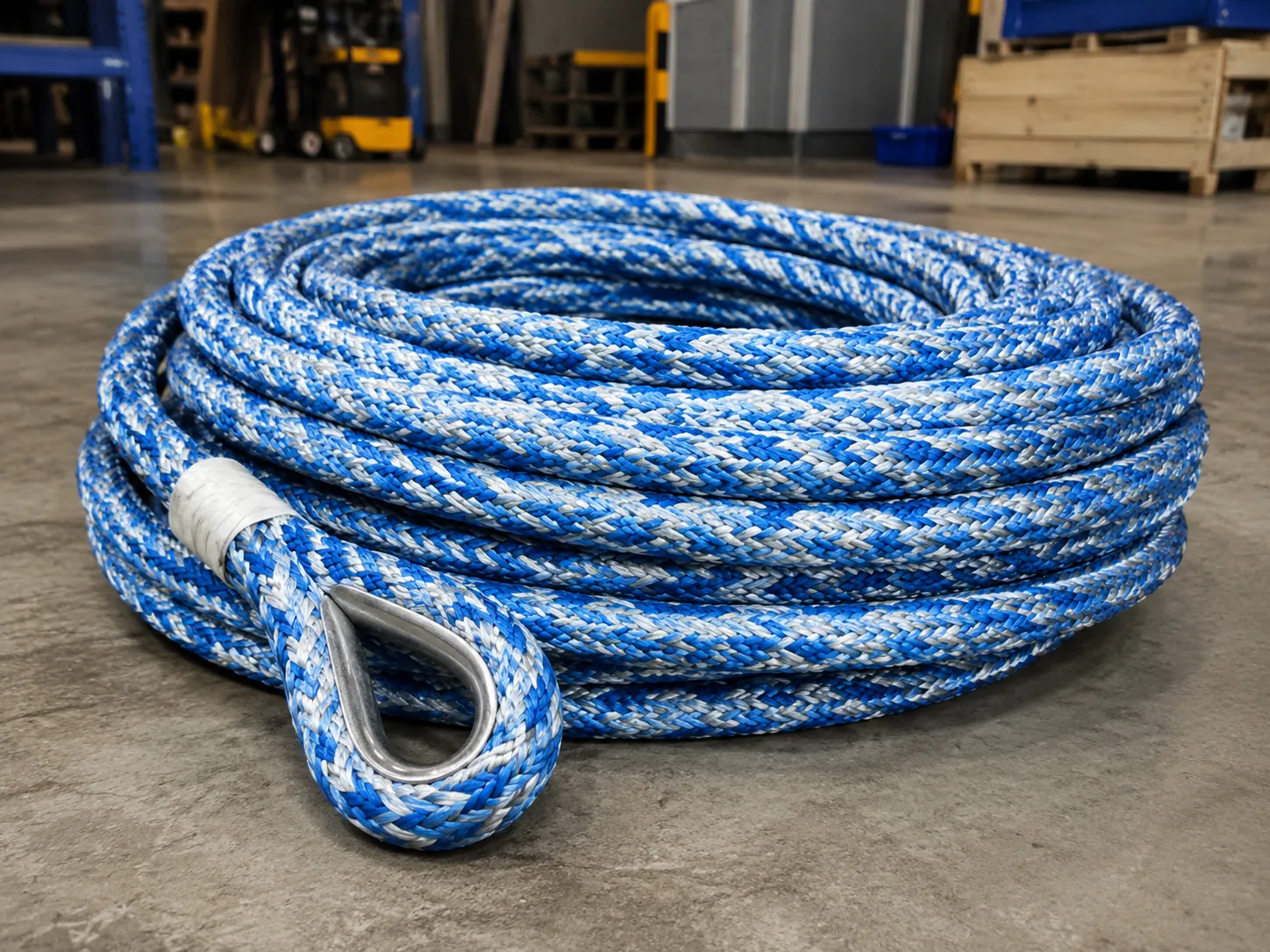
What Are the Core Mechanical Tests?
The properties a complete fiber-rope qualification verifies, per CI 1800 / ASTM D4268 / GB/T 8834:
- Breaking force (断裂强力, kN or lbf) — the maximum tensile load at which the rope fails, the single most important property. Measured by pulling a specimen to failure in a tensile machine at a controlled rate, with capstan or special rope grips to avoid slip and jaw-break. The reported value is the minimum breaking strength (MBS).
- Elongation (伸长, m or %) — the extension under load, measured simultaneously with breaking force. The load-elongation curve distinguishes a shock-absorbing rope (high elongation, like nylon sheets) from a low-stretch rope (like UHMWPE halyards).
- Linear density (线密度, ktex = kg/100 m or lb/100 ft) — mass per unit length at a specified reference tension. Two ropes of identical diameter can have different linear densities (different fiber packing), and linear density normalises strength comparisons between constructions.
- Lay length / pitch (捻距/编绞距) — the distance along the rope for one strand to make a complete revolution. Measured under reference tension; affects flexibility, strength efficiency, and rotation.
- Diameter (直径, mm or in) — nominal diameter at reference tension; governs fitting compatibility with sheaves, cleats and hardware.
GB/T 8834-2016 groups these into a single test method: line density, lay length and braid pitch are measured at a specified reference tension, then breaking force and elongation are measured in the same tensile test. The standard requires recording environmental temperature and humidity, and pre-conditioning specimens free of damage, rust or deformation.
Why Breaking Force Alone Is Not Enough — the 3σ MBS Method
A single breaking test tells you the strength of one specimen. Because fiber-rope manufacturing has natural variation (fiber denier, lay consistency, splice quality), a responsible qualification tests multiple specimens from different sections or lots and applies the 3σ minimum breaking strength (MBS) method: average breaking force minus three standard deviations. This yields a conservative MBS that accounts for manufacturing variation, so the rated strength is one the user can rely on rather than a best-case single result. This statistical approach underlies the manufacturer-stated MBS on every rope's data sheet, and it is why a competent test report quotes the number of specimens, the mean, the standard deviation and the resulting 3σ MBS — not a single break value.
How Do Working Load Limit (WLL) and Safety Factor Relate to MBS?
The working load limit (WLL) is the load a rope is rated to carry in service, and it is set as a fraction of the MBS — the inverse of the safety factor. The fraction reflects both the uncertainty of real-world loading and the consequence of failure:
- General industrial use: WLL = 15–25 % of MBS (a 4:1 to ~7:1 safety factor).
- Life-safety applications (rescue, climbing, fall protection): WLL set at ≤ 1/10 of MBS (10:1 or greater), because failure kills someone.
- Knots and splices reduce strength: tying common knots in a fiber rope typically reduces strength by 40–60 % versus an unknotted specimen, so a knotted rope's effective WLL must account for that reduction.
The practical point competitors gloss over: the MBS is a material property; the WLL is a use property. A rope's WLL depends on how it is terminated (splice, knot, hardware), the configuration (straight, over a sheave, bent), and the consequence of failure — so the same rope can carry different WLLs in different applications. This is also why field break testing of a rope in its actual configuration (with its splices and hardware) adds value that a factory material test cannot.
What Are the Three Distinct Abrasion/Bend Tests?
Abrasion and bending are the dominant in-service strength-loss mechanisms for fiber rope, and they are not the same test. J. F. Flory and I. M. L. Ridge's guidelines distinguish three tests that are routinely confused:
| Test | What it measures | Method |
|---|---|---|
| External abrasion test | Loss of strength from external rubbing only | Rope bears against an abrasive material on a revolving wheel for a specified number of revolutions, then a break test measures residual strength. Wheel diameter and wrap angle chosen so ≥1 lay length is abraded; wrap angle minimised to avoid friction-induced tension variation. |
| Cyclic bend over sheave (CBoS) | Loss from bending only, no abrasion | Rope cycled over a rotatable drum or sheave (which turns with the rope, so no sliding contact), then break-tested for residual strength. |
| Combined abrasion and bend service (CABS) | Real-world combined abrasion + bending | Duplicates actual service conditions. Must not be called an "abrasion test" — it is a service-simulation test, because the bending contribution cannot be separated from the abrasion. |
The discipline matters: a result reported as an "abrasion test" that was actually run over a fixed (non-rotating) sheave has measured combined abrasion-and-bend, not pure abrasion, and the reported residual strength is not comparable to a true abrasion-test result. A test report should name which of the three was performed.
Why Fiber Material Drives Temperature, UV and Creep Behaviour
The fiber type sets the rope's environmental limits, and the differences are dramatic — a fact the critical/melting-temperature table makes concrete:
| Fiber | Critical temp (°F) | Melting/decomp (°F) | Implication |
|---|---|---|---|
| Nylon | 325 | 425–490 | Good general-purpose; loses strength with heat |
| Polyester | 350 | 480 | Best UV resistance of the common synthetics |
| Polypropylene | 250 | 330 | Low-cost, floats; low temperature limit |
| UHMWPE (Dyneema) | 150 | 300 | Very high strength-to-weight, but low critical temp — heat from friction on a capstan can melt it |
| Vectran | 300 | 625 | High-modulus, low creep, good heat resistance |
| Technora (aramid) | 520 | 930 | High temperature tolerance |
| Manila (hemp) | 180 | 300 (chars) | Natural fiber, low temp, rots, absorbs water |
The counter-intuitive point: UHMWPE has the highest strength-to-weight but the lowest critical temperature (150 °F). Friction heat from surging on a capstan, winching on bitts, or running over a stuck sheave can locally exceed that temperature and cause melt-through failure that looks like a clean cut. Fiber selection is therefore a trade-off between strength, stretch, temperature resistance, UV resistance and creep — and the test program must verify the rope against the environmental condition of its service, not just its breaking force.
How Is In-Service Rope Inspected and Retired?
A fiber rope is a re-inspectable, eventually-retired item, and the retirement criteria are construction-specific because strength loss tracks broken-fiber fraction:
- Braided rope: retire when ≥ 25 % of fibers are broken or worn away.
- Double-braid cover: retire at 50 % cover wear (the core still carries load, but cover loss exposes the core).
- 3-strand rope: retire at ≥ 10 % wear (stranded construction is less redundant than braid).
- Cut strands: two adjacent cut strands in single braid → retire or cut out and re-splice.
- Heat damage (glossy/glazed): retire — melted areas have hidden adjacent damage and cannot be flexed out.
- Inconsistent diameter (flat spots, lumps): retire — indicates core/internal damage from overload or shock load.
- Chemical discoloration with brittleness/stiffness: retire.
When the discard point is not visually obvious, residual strength testing of a sample from the in-service rope is the definitive method — break-test a retired 3–6 ft section and compare its residual strength against the retirement criterion. Periodic residual-strength testing of in-service ropes is what calibrates the visual retirement rules to actual field conditions.
For the related rope-product clusters, see our steel wire rope testing (metallic rope), Safety rope testing (PPE fall-protection / live-working rope), and Fabric testing (textile material background of the fibers).
FAQ
What is the difference between fiber rope testing and wire rope testing?
Fiber rope (GB/T 8834 / CI 1800) is textile-based and fails by fiber abrasion, heat-melt, UV/chemical degradation and creep; its tests measure breaking force, elongation, linear density and residual strength. Wire rope (GB/T 20118 / ASTM A931) is metallic and fails by wire fatigue, corrosion and abrasion; its tests measure breaking force, and the inspection criteria are broken-wire counts. The methods, standards and failure modes are not interchangeable.
What is the 3σ minimum breaking strength (MBS) method?
A statistical method: test multiple specimens, calculate the average breaking force, subtract three standard deviations, and report the result as the MBS. This gives a conservative rated strength that accounts for natural manufacturing variation, so users can rely on the value rather than on a best-case single break.
Why is the WLL so much lower than the MBS?
Because the WLL is set as a fraction of MBS to provide a safety factor: 15–25 % of MBS (4:1–7:1) for general industrial use, ≤ 10 % (10:1+) for life-safety. The factor covers real-world variables — knots reduce strength 40–60 %, splices and hardware introduce stress concentrations, and dynamic/shock loads exceed static — that the factory breaking test does not reproduce.
What is the difference between an abrasion test and a CBoS test?
An abrasion test measures strength loss from external rubbing only, using an abrasive wheel; a cyclic-bend-over-sheave (CBoS) test measures strength loss from bending only, using a rotating sheave with no sliding contact. A test over a fixed (non-rotating) sheave measures both and must be reported as a combined abrasion-and-bend-service (CABS) test, not as an abrasion test.
When should an in-service fiber rope be retired?
When visual inspection finds ≥ 25 % fiber loss (braided), 50 % cover wear (double braid), ≥ 10 % wear (3-strand), two adjacent cut strands, glossy/glazed heat damage, inconsistent diameter from core damage, or chemical discoloration with brittleness. Where the discard point is unclear, residual-strength break testing of a sample from the rope is the definitive method.
Our Testing Capabilities
As an ISO/IEC 17025-accredited third-party laboratory, Beijing ZKGX Research provides fiber-rope testing aligned to GB/T 8834-2016, GB/T 21328-2024, CI 1800, ASTM D4268 and the ISO 9554 / 1140 / 1141 / 1181 / 1346 / 1969 framework:
- Breaking force (MBS) and elongation by tensile test with capstan/special rope grips, load-elongation curve, with the 3σ MBS statistical method across multiple specimens.
- Physical properties per GB/T 8834 — linear density (ktex), lay length / braid pitch, diameter at reference tension, with environmental conditioning recorded.
- Abrasion / bend tests — external abrasion (abrasive wheel, ≥1 lay abraded, then residual strength), cyclic bend over sheave (CBoS), and combined abrasion-and-bend service (CABS), each correctly named and reported.
- Residual strength testing of in-service rope samples, against construction-specific retirement criteria (25 % braid / 50 % double-braid cover / 10 % 3-strand).
- Fiber-material verification — confirming fiber type (nylon/polyester/PP/UHMWPE/Vectran/aramid/manila) against the declared critical/melting-temperature and UV/creep behaviour.
Sample types include braided, double-braid (core-dependent and integrated), 8-strand plaited and 3-strand twisted fiber ropes, in nylon, polyester, polypropylene, UHMWPE, Vectran, aramid and manila. If you have a specific rope construction, fiber type, application (marine mooring / lifting / life-safety / general industrial) or compliance target (GB / CI / ASTM / ISO / OCIMF), contact the laboratory to confirm the exact test set and reporting format.